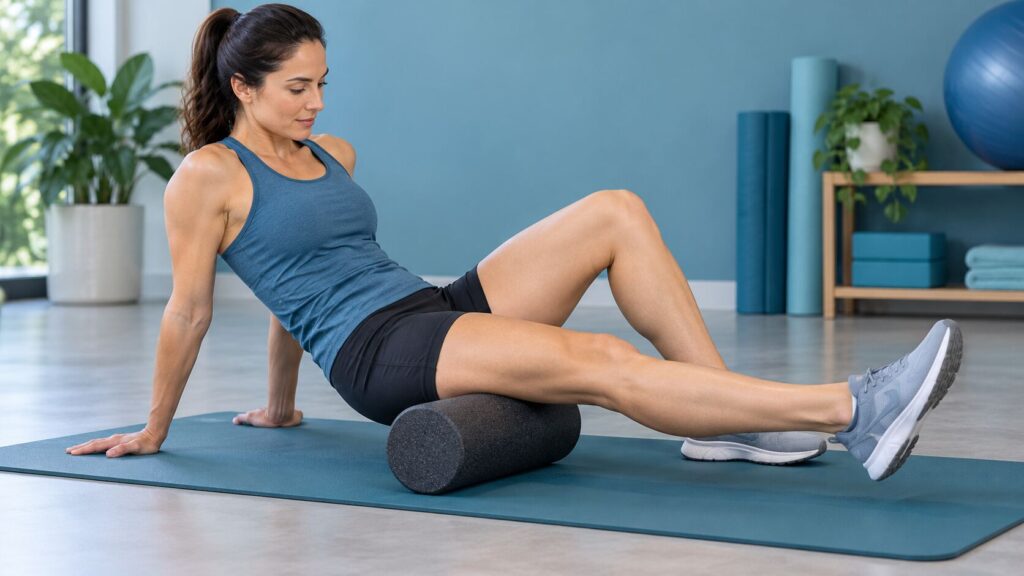
Yes—foam rolling can be a useful short-term addition to a leg mobility or recovery routine, especially when stiffness or post-exercise soreness makes movement feel restricted. It works best as a brief preparation or recovery tool alongside active mobility, strength and appropriate load management rather than as a treatment that permanently “releases” fascia.
What foam rolling can and cannot do
Foam rolling is a form of self-applied mechanical pressure in which body weight and a roller are used over a muscle region. Research generally supports temporary improvements in joint range of motion and perceived recovery, while the size and duration of the effect vary with the person, muscle group and method.
- It may make a nearby joint feel easier to move for a limited period.
- It may reduce perceived muscle soreness after demanding exercise.
- It can help a person identify areas that feel unusually sensitive.
- It does not permanently lengthen fascia or break up scar tissue.
- It does not replace progressive strengthening or rehabilitation.
A systematic review and meta-analysis of foam rolling found small short-term benefits for range of motion and recovery outcomes, with substantial variation among protocols.
Choose the right roller and pressure
A smooth medium-density roller is a sensible starting point because it spreads pressure over a larger area. A very firm, ridged or vibrating device is not automatically more effective and can make it harder to relax or control the movement.
- Softer roller: useful for beginners, sensitive muscles or larger contact areas.
- Medium-density roller: suitable for most general leg work.
- Firm roller: increases local pressure and requires better body control.
- Small ball: creates concentrated pressure and should be used cautiously.
- Roller stick: lets the hands control pressure without supporting body weight.
Set up before you start
Use a non-slip mat with enough clear floor space to change position safely. Place the roller under the target muscle, support part of your weight through the hands or opposite leg, and begin with less pressure than you think you need.
- Wear clothing that allows smooth movement over the roller.
- Keep wrists and shoulders in a comfortable supported position.
- Use the opposite foot to reduce load on the working leg.
- Keep breathing normally instead of bracing against discomfort.
- Reposition rather than twisting to reach a different muscle.
Use a simple pressure rule
Pressure should feel tolerable and should not produce guarding, breath-holding or a need to escape the position. Tenderness can be present, but sharp pain, burning, electrical sensations, numbness or tingling are signals to reduce pressure or stop.
- Start with more body weight supported by the arms and free leg.
- Move over the broad muscle belly rather than a joint or bony point.
- Shorten the rolling area when control becomes difficult.
- Pause only while the sensation remains comfortable and local.
- Finish if symptoms intensify after pressure is removed.
Foam roll the calves
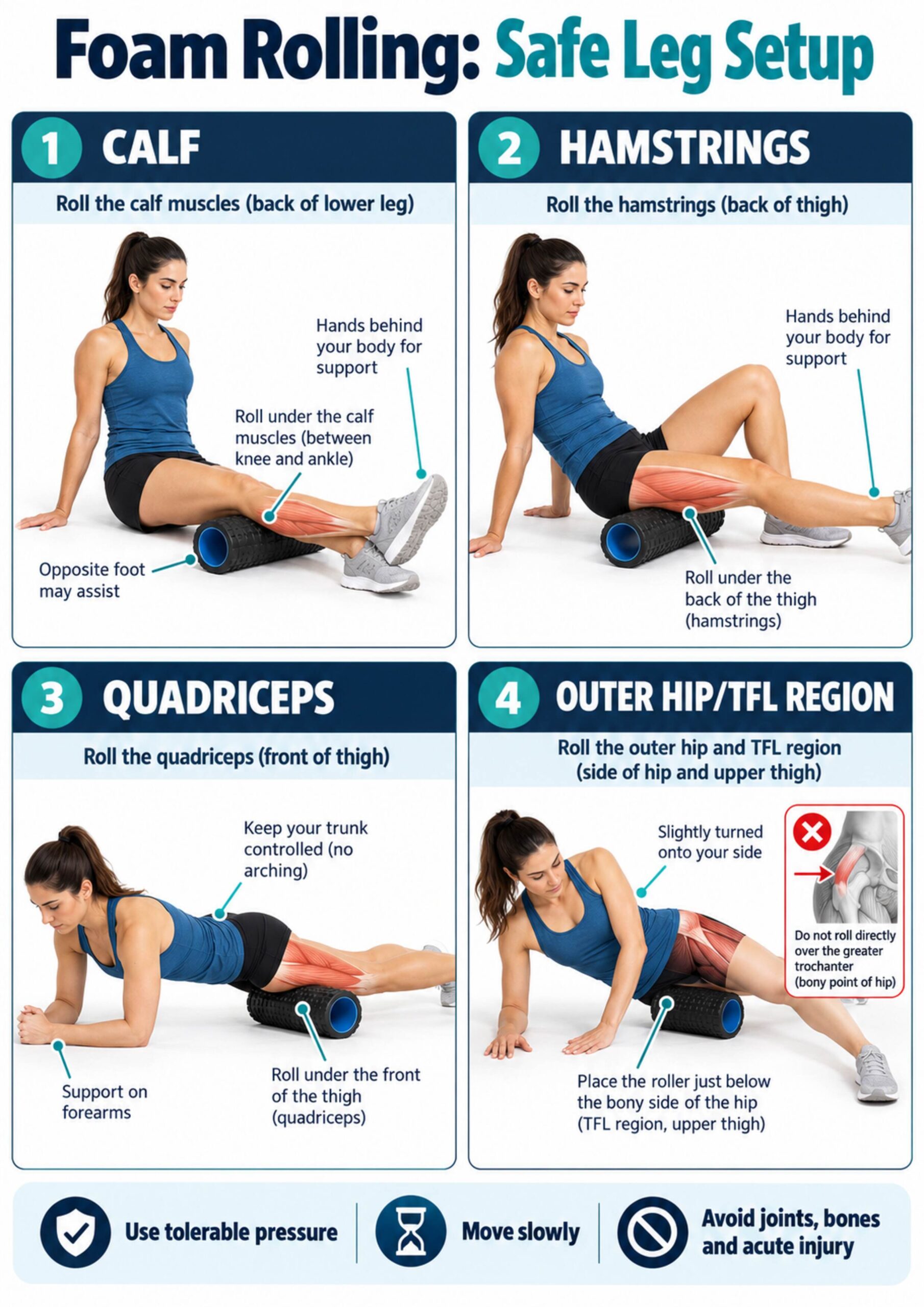
Sit with the roller under the calf and the hands behind the body. Keep the knee relaxed, use the other foot to share weight, and move between the upper calf and the lower muscular portion without rolling across the back of the knee or directly over the ankle.
- Turn the leg slightly inward to reach the outer calf.
- Turn it slightly outward to reach the inner calf.
- Avoid compressing a visible or painful varicose vein.
- Follow with ankle pumps or controlled calf raises.
Foam roll the hamstrings
Place the roller beneath the back of the thigh and support yourself with both hands. Move from below the sitting bone toward the back of the knee while staying on the muscular region and keeping the trunk controlled.
- Roll both thighs together for less pressure.
- Cross the free leg only if more pressure is comfortable.
- Shift the thigh slightly to sample the inner and outer hamstrings.
- Avoid direct pressure on the sitting bone or back of the knee.
Foam roll the quadriceps
Lie face down with the roller under the front of one or both thighs and support the upper body on the forearms. Keep the abdomen gently active so the low back does not sag, then move between the upper thigh and the area above the kneecap.
- Use both thighs together to reduce pressure.
- Shift slightly toward the inner or outer thigh without twisting the knee.
- Keep the kneecap off the roller.
- Follow with a controlled squat or knee bend if appropriate.
Approach the outer hip and thigh carefully
Rolling directly along the iliotibial band can be uncomfortable and is not required to improve hip or knee function. A more useful approach is often to work around the lateral quadriceps, tensor fasciae latae region and gluteal muscles while avoiding direct pressure on the greater trochanter, the bony point at the side of the hip.
- Angle the body slightly rather than lying fully on the side.
- Keep the top foot on the floor to control pressure.
- Use a short range over muscular tissue.
- Stop if symptoms radiate down the leg.
Build a practical leg routine
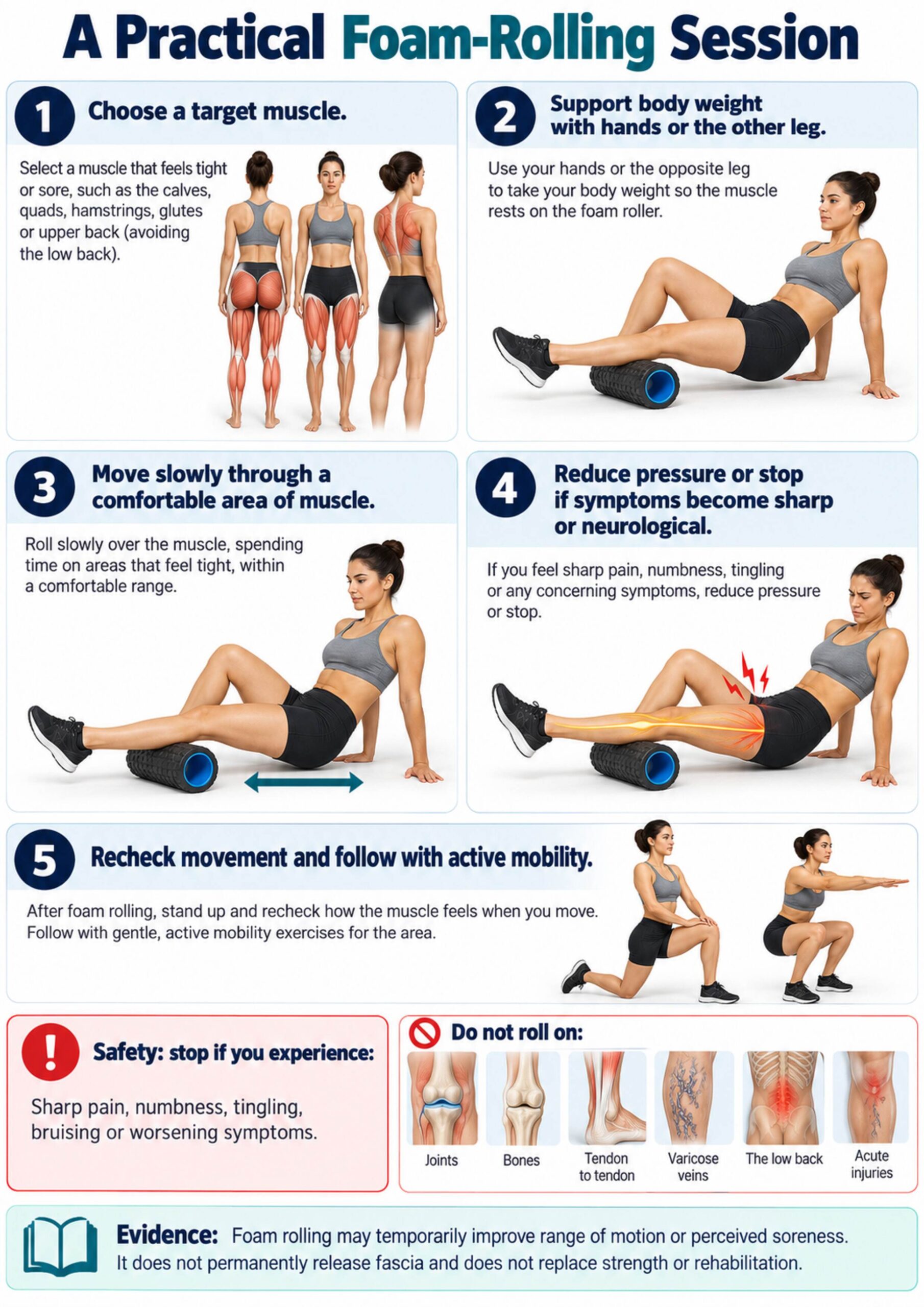
A useful routine is short enough that it does not replace the active work that follows. Choose only the muscle groups that feel relevant, use tolerable pressure, then reassess the movement you wanted to improve.
| Target | Position | Area to avoid | Active follow-up |
|---|---|---|---|
| Calf | Seated, hands behind | Back of knee and ankle | Ankle pumps or calf raises |
| Hamstrings | Seated, roller under thigh | Sitting bone and knee crease | Hip hinge or leg swing |
| Quadriceps | Forearm support, face down | Kneecap and hip bone | Squat or knee bend |
| Outer hip | Slight side angle | Greater trochanter | Side step or hip abduction |
- Begin with one or two regions instead of rolling the whole leg automatically.
- Use slow controlled passes through a comfortable area.
- Reduce pressure if the muscle tightens against the roller.
- Stand up and recheck the relevant movement.
- Continue with active mobility or strengthening while movement feels easier.
When foam rolling may fit
Foam rolling is most useful when it has a clear purpose, such as making an ankle, knee or hip movement temporarily more comfortable before exercise. A recent systematic review in athletes reported acute benefits for flexibility and perceived recovery but also emphasized variation in how self-myofascial release was applied.
- Before training when a limited movement improves after rolling.
- After exercise when it makes soreness easier to tolerate.
- Between strength sets only if it does not interfere with the session.
- During rehabilitation when the treating clinician includes it for a specific goal.
When to avoid or modify it
Do not roll directly over an acute injury, open wound, healing incision, suspected fracture, inflamed joint or area where pressure is medically restricted. People with altered sensation, bleeding risk, vascular disease or recent surgery should obtain individualized guidance before using strong pressure.
- Stop for sharp or rapidly increasing pain.
- Stop for numbness, tingling, burning or weakness.
- Avoid unexplained swelling, redness or heat until assessed.
- Do not roll a painful calf when a blood clot is a concern.
- Use another method when supporting body weight aggravates the wrist or shoulder.
Common mistakes to correct
The most common error is chasing pain with more pressure. Better results come from a stable position, a clear target and an active movement afterward that uses any temporary increase in comfort or range.
- Rolling too quickly to control position.
- Grinding directly over joints or prominent bones.
- Holding the breath and bracing through severe discomfort.
- Using the roller instead of addressing strength or training load.
- Assuming soreness proves tissue damage or “toxins” leaving the body.
A clinical review of self-myofascial release found no consensus on one optimal program because studies used different tools, pressures, durations and outcomes.
Conclusion
Foam rolling can temporarily improve how a leg movement feels and may help with post-exercise soreness, but it should remain a controlled, tolerable supplement. Target muscle tissue, avoid joints and vulnerable areas, recheck movement, and follow with active mobility or strength work.
Frequently asked questions
Does foam rolling break up fascia?
No evidence shows that routine self-rolling permanently breaks apart fascia. The immediate effects are better described as temporary changes in sensation, tolerance and range of motion.
Should foam rolling hurt?
It can feel tender, but the pressure should remain tolerable. Sharp, electrical, burning or spreading symptoms are reasons to reduce pressure or stop.
How long should I foam roll each muscle?
There is no single evidence-based duration for every person or goal. Use the minimum amount that produces a useful, comfortable change, then move to active exercise.
Is a harder roller better?
No. A harder roller increases pressure but does not guarantee a better result. Choose a density that lets you stay relaxed and control the movement.
Can I foam roll every day?
Some people tolerate gentle daily use, but frequency should reflect tissue sensitivity, training load and response afterward. Persistent bruising or increasing soreness means the dose is too high.
Can foam rolling replace stretching?
It can provide a temporary range-of-motion change, but stretching and active mobility have different roles. Select the method that improves the movement you need without provoking symptoms.
Can foam rolling replace strength training?
No. Rolling does not provide the progressive loading needed to build meaningful muscle strength, tendon capacity or movement control.
Should I roll directly over the iliotibial band?
Directly compressing the band is not necessary and can be painful. Work around the lateral quadriceps, hip muscles and tensor fasciae latae region instead.
Is foam rolling safe with varicose veins?
Avoid direct pressure over prominent or painful veins. Seek medical guidance when there is unexplained swelling, redness, warmth or calf pain.
When should a physical therapist assess the problem?
Arrange assessment when stiffness or pain persists, follows injury, limits walking or training, or occurs with swelling, weakness, numbness or recurrent symptoms.