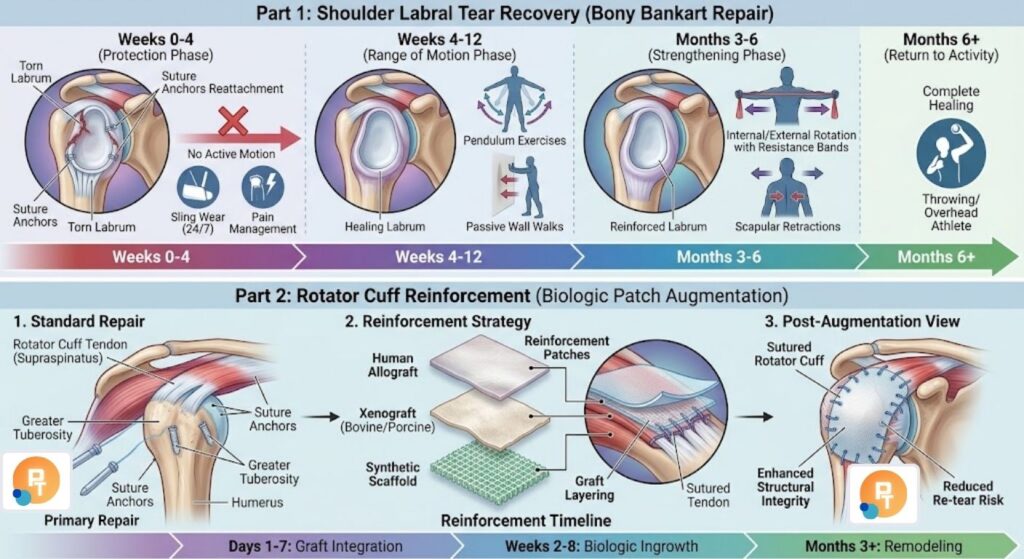
Shoulder labral tear recovery and rotator cuff reinforcement work together to restore shoulder stability, strength, and comfortable movement.
Rehabilitation typically combines symptom management, gradual mobility exercises, rotator cuff strengthening, and progressive functional training.
The appropriate approach depends on the location and severity of the labral injury, shoulder stability, and whether surgical repair was performed.
Understanding Shoulder Labral Tears and Their Effect on Stability
The shoulder labrum is a ring of fibrocartilage surrounding the glenoid, the shallow socket of the shoulder joint.
It helps deepen the socket and contributes to shoulder stability alongside the capsule, ligaments, and surrounding muscles.
A labral tear can develop after a fall, shoulder dislocation, sudden pulling injury, or repeated overhead loading.
Some labral changes are also associated with aging and may not be responsible for a person’s symptoms.
Common patterns include:
- SLAP tear: Involves the superior labrum, where the long head of the biceps tendon attaches.
- Bankart lesion: Involves the anteroinferior labrum and is commonly associated with anterior shoulder dislocation.
- Posterior labral tear: Affects the back of the socket and may occur with posterior instability or repeated loading.
- Degenerative labral changes: Develop gradually and may coexist with other shoulder conditions.
Symptoms can include deep shoulder pain, painful clicking or catching, reduced confidence during overhead activities, and a sensation that the shoulder might slip.
Not every clicking shoulder has a labral tear.
Similarly, identifying a tear on imaging does not automatically establish that it is the source of pain.
Why Rotator Cuff Reinforcement Matters During Recovery
The rotator cuff consists of four muscles: supraspinatus, infraspinatus, teres minor, and subscapularis.
These muscles help control rotation and maintain the position of the humeral head within the glenoid during movement.
After a labral injury, pain, reduced activity, and protective movement patterns may affect muscle performance.
Rehabilitation therefore aims to improve dynamic shoulder control without unnecessarily stressing sensitive or healing structures.
Important muscle groups include:
- Supraspinatus: Contributes to shoulder elevation and glenohumeral stability.
- Infraspinatus: Produces external rotation and supports posterior shoulder control.
- Teres minor: Assists external rotation and dynamic stabilization.
- Subscapularis: Produces internal rotation and contributes to anterior shoulder stability.
- Serratus anterior: Supports scapular upward rotation and positioning.
- Trapezius: Helps coordinate scapular movement during arm elevation.
Strengthening these muscles cannot mechanically reattach a detached labrum.
However, improving strength and neuromuscular control can help patients manage shoulder loading and regain function.
The American Academy of Orthopaedic Surgeons shoulder conditioning program provides examples of rehabilitation exercises targeting these muscles.
Physical Therapy Assessment Before Starting Exercises
A successful rehabilitation program begins by establishing what the shoulder can currently tolerate and which movements provoke symptoms.
The physical therapist should assess the injury history, functional limitations, symptom behavior, and possible instability rather than selecting exercises solely from an imaging report.
Relevant assessment components include:
- The mechanism of injury and any previous dislocations.
- Pain location, severity, irritability, and nighttime symptoms.
- Active and passive shoulder range of motion.
- Rotator cuff strength and exercise tolerance.
- Scapular coordination during arm elevation.
- Apprehension or instability during specific movements.
- Functional demands associated with work, exercise, or sport.
- Symptoms suggesting cervical spine or neurological involvement.
A patient who experiences pain while reaching overhead may need a different exercise starting point from someone whose main complaint is recurrent instability.
Special tests may help inform the clinical examination, but no single physical examination maneuver reliably confirms every labral lesion.
When there is significant traumatic instability, persistent mechanical locking, or unexplained weakness, further medical assessment may be necessary before progressing rehabilitation.
Stages of Shoulder Labral Tear Recovery
Rehabilitation is best organized around functional milestones rather than assuming that every patient will improve according to the same calendar.
For nonoperative rehabilitation, progression is primarily guided by symptoms, stability, movement quality, and tolerance to loading.
Following surgical repair, tissue-healing precautions and the surgeon’s specific protocol take priority.
| Rehabilitation stage | Main objective | Typical physical therapy approach |
|---|---|---|
| Early protection | Reduce symptoms and avoid provocative loading | Activity modification, permitted gentle movement, education |
| Mobility restoration | Recover comfortable, controlled movement | Supported range-of-motion exercises and gradual active movement |
| Initial strengthening | Restore low-load muscle control | Appropriate isometrics and light rotator cuff exercises |
| Progressive strengthening | Improve strength and endurance | Resistance bands, side-lying exercises, rows, and scapular training |
| Functional rehabilitation | Restore work and recreational capacity | Progressive reaching, carrying, pushing, and task-specific exercises |
| Return to demanding activity | Prepare for higher loads and unpredictable movement | Advanced strengthening, dynamic stabilization, and sport-specific progression |
Early Protection and Pain Management
During the initial recovery period, the goal is to reduce unnecessary irritation while maintaining movement that is safe for the injury.
Practical measures may include:
- Temporarily reducing painful overhead lifting.
- Avoiding positions that produce apprehension or a slipping sensation.
- Supporting the arm comfortably during sleep.
- Using cold therapy when it provides symptom relief.
- Maintaining normal movement of unaffected joints.
- Continuing comfortable daily activities within established precautions.
Complete inactivity is usually unnecessary during nonoperative care, although some injuries require temporary immobilization.
After surgical repair, sling use and permitted shoulder movement must follow the operating surgeon’s instructions.
Restoring Shoulder Range of Motion
Mobility exercises are introduced or progressed when the shoulder can tolerate movement without excessive pain or instability.
Options may include:
- Supported table slides.
- Gentle assisted shoulder elevation.
- Controlled external rotation within permitted limits.
- Comfortable active shoulder flexion.
- Scapular movement exercises.
The therapist should watch for excessive shoulder elevation, trunk leaning, guarding, and apprehension.
Important: Aggressive stretching is not appropriate for every labral injury.
In particular, surgically repaired tissue and shoulders with significant instability may require strict limits on rotation, extension, or combined abduction and external rotation.
Building Initial Rotator Cuff Strength
Once sufficient movement control has developed, low-load strengthening can help restore muscular function.
Initial exercises often involve:
- External rotation isometrics.
- Internal rotation isometrics.
- Scapular retraction exercises.
- Supported low-load shoulder movements.
- Gentle rhythmic stabilization when appropriate.
An isometric contraction produces muscle tension without substantial joint movement.
These exercises may be useful when larger movements are uncomfortable, but they still generate forces around the shoulder and must be selected according to the injury and surgical precautions.
Best Rotator Cuff Reinforcement Exercises
The following exercises are commonly used during shoulder rehabilitation.
They are not all suitable for the early stages of a labral injury, particularly after surgery.
1. Isometric External Rotation
This exercise targets the external rotators while limiting shoulder movement.
How to perform:
- Stand beside a wall with the affected elbow bent approximately 90 degrees.
- Place a small towel between the elbow and trunk if comfortable.
- Position the back of the hand against the wall.
- Gently press outward without moving the arm.
- Hold briefly, then relax.
Start with a comfortable, submaximal effort rather than pushing as hard as possible.
Avoid the exercise if it produces sharp pain, apprehension, or an unstable sensation.
2. Resistance Band External Rotation
Band external rotation strengthens the infraspinatus and teres minor.
How to perform:
- Attach a light resistance band to a secure anchor.
- Stand sideways with the affected arm farther from the anchor.
- Bend the elbow and keep it comfortably near the trunk.
- Rotate the forearm outward without twisting the torso.
- Return slowly to the starting position.
The movement should be controlled rather than forceful.
A light resistance that permits good technique is preferable to a heavier band that causes shoulder compensation.
3. Resistance Band Internal Rotation
Internal rotation strengthening primarily targets the subscapularis, with assistance from other internal rotators.
How to perform:
- Stand sideways with the affected arm nearest the anchor.
- Keep the elbow bent close to the trunk.
- Pull the band inward across the front of the body.
- Avoid rotating the torso.
- Return slowly under control.
This exercise should remain within a comfortable range.
It may need to be postponed after certain labral repairs or instability injuries.
4. Side-Lying External Rotation
Side-lying external rotation provides a useful way to progressively load the posterior rotator cuff.
How to perform:
- Lie on the unaffected side.
- Bend the affected elbow approximately 90 degrees.
- Keep the upper arm comfortably against the trunk.
- Rotate the forearm upward without moving the elbow away from the body.
- Lower slowly.
Initially, the weight of the forearm may provide sufficient resistance.
A small dumbbell can be introduced later if movement remains controlled and the shoulder tolerates the exercise.
5. Scapular Rows
Rows help strengthen muscles involved in scapular control, including the middle trapezius and rhomboids.
How to perform:
- Secure a resistance band at a comfortable height.
- Hold the band with the elbows near the body.
- Pull the elbows backward without excessive shoulder extension.
- Allow the shoulder blades to move naturally.
- Return slowly.
Avoid forcefully squeezing the shoulder blades throughout the entire movement.
Following labral repair, resisted rows should not begin until the rehabilitation protocol permits them.
6. Wall Slides
Wall slides can help restore arm elevation and train scapular movement.
How to perform:
- Stand facing a wall.
- Place the forearms or hands against the surface.
- Slide the arms upward within the comfortable range.
- Avoid excessive trunk extension or shrugging.
- Return slowly.
This is initially a mobility and movement-control exercise rather than a heavy strengthening exercise.
A resistance band around the forearms may be added at a later stage when appropriate.
7. Serratus Anterior Wall Press
The serratus anterior contributes to scapular control during reaching and overhead movement.
How to perform:
- Stand facing a wall with the hands placed at shoulder height.
- Keep the elbows comfortably straight.
- Gently push the upper back away from the wall by moving the shoulder blades forward.
- Avoid excessive spinal movement.
- Return to the starting position.
Because this exercise places load through the arm, it should only be introduced when weight-bearing exercises are permitted.
For patients recovering from surgery, even wall-based weight-bearing may be restricted initially.
For additional exercise examples, consult the official AAOS rotator cuff and shoulder conditioning guide.
How to Progress Rotator Cuff Strengthening Safely
Exercise progression depends on more than increasing resistance.
A patient may have enough strength to complete a movement but still lack the endurance or dynamic control required for repetitive overhead activity.
Useful progression criteria include:
- Comfortable active shoulder movement within the required range.
- No significant instability or apprehension during the exercise.
- Consistent movement quality without excessive compensation.
- Good tolerance to the current exercise resistance.
- No meaningful increase in symptoms later that day or the following day.
- Achievement of any surgeon-defined rehabilitation milestones.
For an appropriate nonoperative strengthening program, a therapist may initially prescribe one or two sets of controlled repetitions using light resistance, then adjust based on the response.
There is no universal repetition count that is optimal for every labral injury.
A practical progression might involve moving from supported isometrics to light band rotation, then to greater resistance and more demanding arm positions.
Progress only one or two variables at a time.
Increasing resistance, movement range, speed, and training volume simultaneously can make it difficult to identify why symptoms worsen.
When to Reduce Exercise Intensity
Consider modifying an exercise when:
- Pain becomes sharper or progressively increases.
- The shoulder develops a slipping sensation.
- Clicking is associated with pain, catching, or instability.
- Movement quality deteriorates.
- Symptoms remain substantially worse the following day.
Mild muscular fatigue is not automatically a problem.
Deep joint pain or apprehension should not be treated as ordinary strengthening discomfort.
Recovery After Surgical Labral Repair
Surgical rehabilitation differs from conservative rehabilitation because the repaired tissue requires protection while biological healing occurs.
The exact restrictions depend on the repair location, associated injuries, surgical technique, and other procedures performed.
For example, a superior labral repair involving the biceps anchor may require restrictions on resisted biceps loading.
An anterior stabilization procedure may place particular restrictions on external rotation and positions that stress the anterior capsule.
Postoperative rehabilitation commonly involves:
- A protected period with prescribed sling use.
- Permitted passive movement within specified limits.
- Gradual introduction of active-assisted movement.
- Restoration of active shoulder control.
- Progressive rotator cuff and scapular strengthening.
- Later functional loading and return-to-sport preparation.
The Mass General Brigham rehabilitation protocol for Type II SLAP repair illustrates a phased approach based on healing, examination findings, and functional criteria.
Patients should follow their own surgeon’s protocol rather than copying exercises or timelines from another person’s recovery.
When a rotator cuff repair is performed alongside labral surgery, strengthening may need to progress more conservatively because both repairs require protection.
Returning to Work, Gym Training, and Sports
Returning to activity is not simply a question of how many weeks have passed since the injury.
The shoulder must tolerate the specific forces, positions, and repetition involved in the intended activity.
For everyday tasks, useful milestones include:
- Dressing and personal care without significant symptoms.
- Reaching to commonly used shelves comfortably.
- Carrying light objects with appropriate control.
- Performing routine household tasks without symptom escalation.
For gym training, progression might include:
- Light resisted rotation and rowing.
- Controlled pressing movements when permitted.
- Gradual increases in load and range.
- More demanding overhead strengthening.
- Controlled return to the individual’s previous training exercises.
Bench pressing, dips, deep push-ups, and heavy overhead lifting can place substantial demands on the shoulder and should not automatically be resumed as soon as pain decreases.
Athletes may require additional preparation:
- Rotator cuff strength and endurance assessment.
- Dynamic stabilization in sport-specific positions.
- Gradual throwing or overhead-loading progression.
- Controlled exposure to higher movement speeds.
- Functional testing relevant to their sport.
A throwing athlete, for example, needs more than normal shoulder movement.
Rehabilitation must also develop the capacity to repeatedly control the shoulder during acceleration and deceleration.
Return to contact or overhead sports after surgical repair should be coordinated with the surgeon and rehabilitation team.
Common Rehabilitation Mistakes
Several exercise habits can delay functional progress or unnecessarily aggravate symptoms.
Frequent mistakes include:
- Strengthening too aggressively: Heavy resistance is introduced before movement control and tissue tolerance are adequate.
- Ignoring instability symptoms: Patients continue exercises despite apprehension or a slipping sensation.
- Stretching into vulnerable positions: End-range stretching may increase stress on healing tissue or an unstable shoulder.
- Focusing only on external rotation: Scapular control, internal rotation strength, endurance, and functional loading are neglected.
- Returning to sport based only on pain: Low pain does not necessarily mean sufficient strength or stability.
- Following an unsuitable postoperative protocol: Exercises appropriate after one type of labral procedure may be restricted after another.
- Stopping rehabilitation too early: Basic daily function may return before the shoulder can tolerate demanding activity.
The opposite problem is avoiding all shoulder loading long after restrictions have been lifted.
Progressive loading is necessary for restoring muscular capacity, but it should match the patient’s rehabilitation stage.
When to Seek Further Medical Assessment
Some shoulder symptoms require reassessment rather than continued exercise progression.
Arrange medical evaluation if you experience:
- Repeated dislocations or episodes of clear shoulder instability.
- Persistent painful locking or catching.
- Increasing weakness that is not explained by ordinary exercise fatigue.
- Significant pain that does not improve with an appropriately modified program.
- New numbness, tingling, or unexplained neurological symptoms.
- Marked loss of shoulder movement following injury.
After surgery, fever, wound drainage, increasing redness, uncontrolled pain, or persistent neurological symptoms require prompt contact with the surgical team.
A new traumatic shoulder deformity, suspected dislocation, or sudden loss of arm function requires urgent assessment.
Physical therapy should support recovery while recognizing when symptoms need evaluation beyond routine musculoskeletal rehabilitation.
Conclusion
Shoulder labral tear recovery and rotator cuff reinforcement should follow a progressive, individualized rehabilitation plan.
The central priorities are restoring comfortable movement, improving muscular control, developing shoulder strength, and preparing for functional demands without provoking instability.
Conservative rehabilitation and postoperative rehabilitation share many long-term goals, but they differ significantly in early precautions.
The safest exercise progression is based on the specific injury, clinical findings, functional response, and surgical restrictions when applicable.
Frequently Asked Questions
Can a shoulder labral tear heal without surgery?
Some people with labral tears recover satisfactory shoulder function without surgery through activity modification and physical therapy.
However, rehabilitation does not necessarily reattach a detached labrum.
The appropriate treatment depends on symptoms, the type of tear, shoulder stability, and individual activity demands.
How long does shoulder labral tear recovery take?
Recovery varies considerably.
Nonoperative rehabilitation may produce functional improvements over several weeks to months, while recovery after surgical repair often requires several months and may take longer for demanding overhead or contact sports.
The type of repair and associated injuries influence the timeline.
Can I strengthen my rotator cuff with a labral tear?
Yes, appropriately selected rotator cuff exercises are often part of conservative shoulder rehabilitation.
The safest exercise selection depends on whether the shoulder is stable, which movements provoke symptoms, and whether surgical restrictions apply.
What are the best exercises for shoulder labral tear recovery?
Common rehabilitation exercises include supported shoulder mobility, isometric rotation, resistance-band external and internal rotation, side-lying external rotation, scapular rows, and serratus anterior training.
No single exercise program is best for every labral tear, and postoperative patients require procedure-specific guidance.
Should I avoid overhead exercises with a labral tear?
Overhead exercises may need to be temporarily modified if they provoke pain or instability.
They can often be reintroduced progressively as strength, control, and tolerance improve.
Following surgical repair, overhead movement must remain within the prescribed restrictions.
Can rotator cuff strengthening prevent shoulder instability?
Rotator cuff strengthening can improve dynamic shoulder control and may help manage some instability symptoms.
However, it cannot correct every structural cause of instability, and patients with recurrent dislocations or significant instability may require specialist assessment.
Are resistance bands safe after labral repair surgery?
Resistance bands can be useful during postoperative rehabilitation, but not necessarily during the early healing period.
The timing and direction of resistance exercises depend on the repair and surgeon’s protocol.
Starting resisted exercise prematurely may place unnecessary stress on healing tissue.
Is clicking normal during shoulder labral tear recovery?
Painless shoulder clicking can occur and does not always indicate a serious problem.
Clicking associated with deep pain, locking, catching, or a sensation of instability deserves clinical reassessment, especially if it develops after surgery.
When can I return to weightlifting after a shoulder labral tear?
Return to weightlifting depends on strength, mobility, stability, symptom response, and the demands of specific lifts.
Light strengthening generally precedes heavy pressing, loaded overhead movements, and high-demand exercises.
After surgery, clearance must account for tissue healing and procedure-specific restrictions.
How do I know whether my shoulder rehabilitation is progressing?
Useful indicators include improved daily activity tolerance, comfortable shoulder movement, better rotator cuff strength, improved movement control, and fewer instability symptoms.
A physical therapist can reassess these findings and determine when the shoulder is ready for greater resistance or more demanding activities.