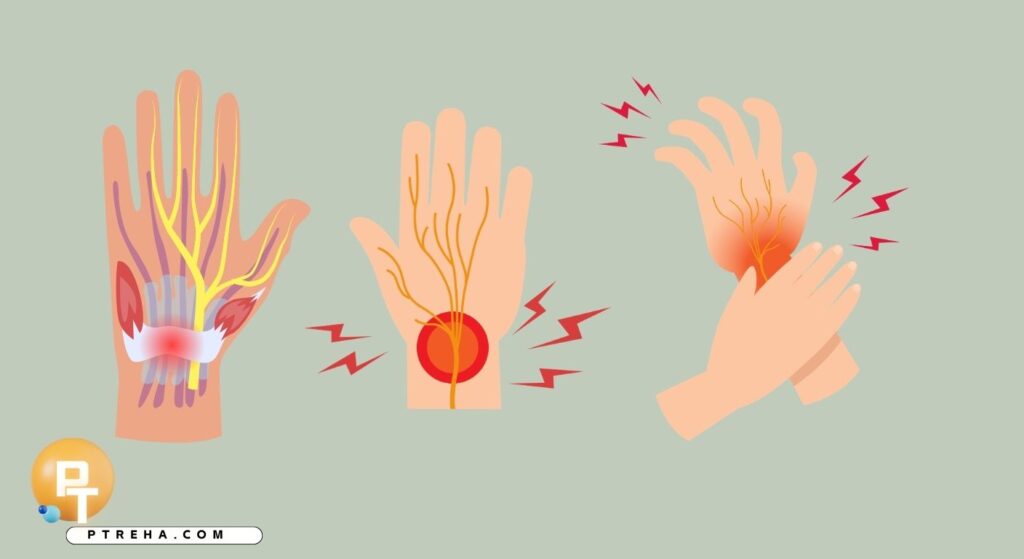
Carpal tunnel syndrome involves compression or irritation of the median nerve as it passes through the carpal tunnel at the wrist.
Management commonly combines symptom-guided activity modification, attention to wrist position, and selected conservative treatments; median nerve gliding may be used as an adjunct, but current evidence does not support presenting nerve gliding or exercise as a stand-alone treatment that reliably changes the long-term course of the disorder.
What Is Carpal Tunnel Syndrome?
The carpal tunnel is a confined passage on the palm side of the wrist.
The median nerve and several flexor tendons pass through it, so changes in tissue volume or pressure can affect the nerve.
Typical symptoms include tingling, numbness, or discomfort involving the thumb, index finger, middle finger, and the thumb-side of the ring finger.
Symptoms may also be felt in the hand and sometimes into the forearm, and night-time symptoms are common.
Typical symptom pattern
Common features that should prompt consideration of carpal tunnel syndrome include:
- Numbness or tingling in the median-nerve sensory territory.
- Symptoms that are worse at night or disturb sleep.
- Hand discomfort during sustained wrist positions.
- Symptoms provoked by prolonged gripping or repetitive hand activity.
- A sense of clumsiness with fine hand use.
- Difficulty with pinch or grip in more established cases.
- Symptoms that may improve after changing wrist or hand position.
- Symptoms that recur during specific work or leisure tasks.
A clinical diagnosis should not be based on one symptom alone.
History and physical examination are important, and the AAOS guideline identifies the CTS-6 clinical assessment as one approach that can be used to support diagnosis.
The goal of an ergonomic intervention is not to create a “perfect” wrist position. It is to reduce sustained or repeated loading that consistently aggravates the person’s symptoms.
Why Ergonomics Matter

Work demands can expose the wrist and hand to combinations of repetition, force, vibration, and non-neutral wrist positions.
Occupational research has linked forceful and highly repetitive hand use, vibration exposure, and prolonged wrist deviation with increased risk, although the strength of evidence varies between exposure types and studies.
Computer use deserves a more cautious interpretation.
Research has not established ordinary keyboard or mouse use as a simple direct cause of carpal tunnel syndrome, so ergonomic advice should focus on symptom-provoking exposure and task demands rather than blaming computer work itself.
Practical ergonomic adjustments
Useful changes include:
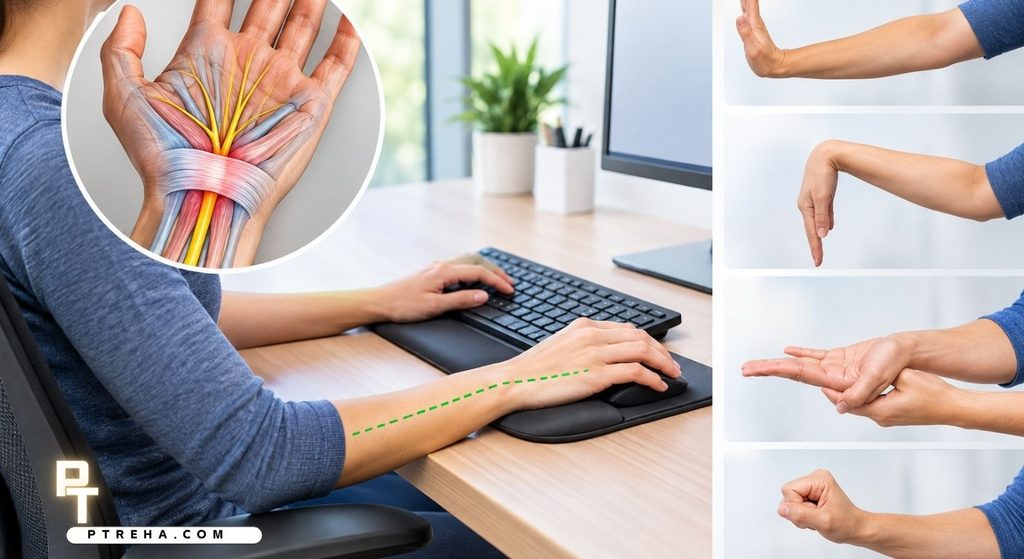
- Keep the keyboard and mouse close enough that the shoulders remain relaxed.
- Aim for a comfortable wrist position rather than prolonged wrist flexion or extension.
- Avoid pressing the wrist or palm firmly into a hard desk edge.
- Keep frequently used tools within easy reach.
- Reduce unnecessary grip force.
- Alternate demanding hand tasks with lighter activities.
- Use the largest practical handle that allows a relaxed grip.
- Reduce prolonged exposure to vibrating tools when possible.
- Change hand position during long tasks rather than holding one posture continuously.
- Adjust the workstation according to symptoms, job demands, and individual body dimensions.
Evidence for a particular “ergonomic” keyboard, mouse, chair, or desk as a treatment for established carpal tunnel syndrome is limited.
The useful principle is usually modification of the aggravating exposure, not purchase of a specific device.
Computer Workstation: A Practical Setup
For someone whose symptoms are aggravated during computer work, start with the simplest changes.
The keyboard and mouse should be positioned so the person does not need to reach forward continuously or hold the wrist in an extreme position.
A practical workstation check includes:
- Sit close enough to the desk to avoid reaching forward.
- Keep elbows comfortably near the trunk.
- Place the keyboard where the wrists can remain relaxed.
- Keep the mouse close to the keyboard.
- Avoid sustained pressure from the wrist against a sharp desk edge.
- Use the forearm for support when helpful rather than compressing the palm.
- Vary hand position during prolonged computer sessions.
- Use keyboard shortcuts when they reduce unnecessary mouse repetition.
- Consider speech or other input methods for selected tasks when hand symptoms are significant.
- Stop or modify a task when symptoms repeatedly escalate and do not settle after a position change.
A workstation change is most useful when it is connected to the person’s actual symptom behavior.
Someone may tolerate typing well but flare with prolonged mouse use, while another person may have the opposite pattern.
Example: office worker with night symptoms
Consider a person who develops tingling in the thumb, index, and middle fingers after long computer sessions and wakes with numbness at night.
A reasonable starting plan may be to modify wrist posture and mouse use during the day, reduce sustained gripping, and discuss a neutral-position night splint with a clinician or pharmacist.
Night Splinting and Wrist Position
A wrist splint that maintains a neutral or near-neutral wrist position can reduce symptoms for some people, particularly at night.
NHS patient guidance recommends a night splint that keeps the wrist straight, while current clinical guidance emphasizes that treatment should be individualized rather than applied as a rigid protocol.
Important practical points include:
- Choose a splint that is comfortable rather than excessively tight.
- Avoid using the splint to force the wrist into extension.
- Check the skin for pressure or irritation.
- Use it primarily when symptoms are linked to sleep or sustained wrist positioning.
- Reassess whether symptoms are actually improving.
- Combine splint use with appropriate activity modification when indicated.
- Seek professional advice when symptoms continue to progress despite conservative care.
A splint can help control exposure to aggravating wrist positions, but it should not be presented as a universal cure.
Median Nerve Gliding Exercises
Median nerve gliding exercises are intended to promote movement of the nerve relative to surrounding tissues rather than aggressively stretch the nerve.
Research suggests they may help some people as part of conservative care, but evidence is heterogeneous, and the AAOS guideline does not support exercise as a treatment that reliably improves long-term patient-reported outcomes for CTS.
For that reason, nerve gliding is best taught as a symptom-guided adjunct rather than as a mandatory routine for every patient.
A gentle median nerve slider
A clinician may select an appropriate slider based on the individual examination.
A conservative sequence can be performed as follows:
- Sit or stand with the shoulder relaxed rather than elevated.
- Begin with the elbow comfortably bent and the wrist in a relaxed position.
- Slowly straighten the elbow while keeping the wrist and fingers comfortable.
- Then bend the elbow again while allowing the wrist to move toward a slightly more open position.
- Alternate the two positions smoothly.
- Keep the movement gentle and continuous rather than holding the end position.
- Breathe normally throughout.
- Stop if symptoms become sharper, stronger, or remain increased after the set.
The exact sequence can be modified by a physical therapist because median nerve loading changes with the combined position of the shoulder, elbow, forearm, wrist, and fingers.
A slider should not be turned into a prolonged end-range nerve stretch.
Mild awareness of movement can be acceptable; repeatedly provoking familiar paresthesia is not the objective of a nerve-gliding exercise.
How to Dose Nerve Gliding Safely
There is no single evidence-based dose that applies to every patient.
Published protocols vary substantially, which is one reason current evidence should be interpreted cautiously.
A practical starting framework is:
- Use a small, comfortable range.
- Favor smooth repetitions over forceful stretching.
- Begin with a low volume and assess the response.
- Perform the exercise when symptoms are relatively settled.
- Avoid repeated testing immediately after a flare.
- Reassess symptoms during the following hours.
- Reduce the range if tingling becomes stronger.
- Stop the exercise if symptoms persistently worsen.
- Progress only when the current level is well tolerated.
- Use clinician supervision when symptoms are marked, persistent, or accompanied by weakness.
The exercise should produce movement, not a competition to reach the greatest possible nerve tension.
What Nerve Gliding Does Not Mean
Several common claims about neural mobility should be avoided because they overstate the evidence.
Nerve gliding does not prove that the nerve is “stuck,” does not establish that a particular tissue is the sole source of symptoms, and does not replace a clinical assessment.
Positive responses to a movement can help guide rehabilitation, but they are not by themselves diagnostic.
Avoid these approaches:
- Forcing the wrist into maximum extension.
- Holding a strong stretch because “the nerve needs to loosen.”
- Repeatedly reproducing numbness to make the exercise “work.”
- Increasing repetitions simply because symptoms remain unchanged.
- Treating nerve gliding as a substitute for diagnosis.
- Assuming all hand numbness is carpal tunnel syndrome.
- Continuing an exercise that causes a persistent symptom increase.
- Using a generic exercise sheet without considering the person’s presentation.
A systematic review found that the evidence for nerve-gliding effectiveness remains limited and that standard conservative care may be more appropriate as the foundation, with neural gliding considered a possible complementary intervention.
Combining Ergonomics With a Daily Management Plan
The most practical approach is often a combination of small adjustments rather than one isolated exercise.
For a person with mild symptoms, a typical self-management framework might look like this:
| Part of the day | Practical action | Purpose |
|---|---|---|
| Work setup | Adjust keyboard, mouse, and forearm support | Reduce aggravating wrist positions |
| During repetitive work | Change hand position and alternate tasks | Reduce continuous exposure |
| During gripping tasks | Relax grip and use larger handles where practical | Reduce unnecessary force |
| During symptom flares | Reduce or modify the provoking activity | Allow symptoms to settle |
| Evening | Check whether symptoms were linked to daytime tasks | Identify useful triggers to modify |
| Sleep | Consider a comfortable neutral wrist splint when appropriate | Reduce sustained wrist positioning |
| Exercise session | Perform gentle, symptom-guided nerve sliders | Encourage movement without aggressive tension |
| Follow-up | Monitor numbness, pain, function, and weakness | Determine whether the plan is helping |
The table is a framework, not a prescription.
Treatment should be adapted to the person’s symptom behavior, medical history, occupational demands, and examination findings.
Clinical Assessment and Differential Diagnosis
Carpal tunnel syndrome is a clinical problem, but hand paresthesia has a broad differential diagnosis.
A clinician may consider cervical radiculopathy, proximal median nerve disorders, ulnar neuropathy, peripheral neuropathy, or local musculoskeletal conditions depending on the history and examination.
Important assessment features include:
- Exact distribution of numbness or tingling.
- Night-time behavior.
- Aggravating and easing positions.
- Hand weakness or loss of dexterity.
- Sensory findings on examination.
- Motor findings, including thumb abduction strength.
- Neck and proximal upper-limb symptoms.
- Relevant medical conditions and previous wrist injury.
- Occupational force, repetition, and vibration exposure.
- Response to conservative management.
The AAOS guideline specifically emphasizes structured clinical assessment and identifies CTS-6 as a diagnostic tool that can be used in appropriate adult presentations.
Electrodiagnostic or imaging investigations are not automatically necessary for every presentation.
The decision depends on diagnostic uncertainty, severity, planned treatment, and the clinical context.
When to Seek Professional Assessment
Self-management is less appropriate when symptoms are persistent, progressive, or functionally significant.
Professional assessment is particularly important when:
- Numbness becomes constant rather than intermittent.
- Hand weakness is developing.
- Fine motor control is deteriorating.
- Objects are repeatedly being dropped.
- There is visible muscle wasting around the thumb.
- Symptoms are progressing despite activity modification.
- Symptoms extend beyond a typical median-nerve pattern.
- Neck symptoms or broader neurological symptoms are present.
- There has been significant wrist trauma.
- The diagnosis is uncertain.
- Symptoms are interfering substantially with sleep or daily function.
Persistent motor or sensory impairment deserves attention because prolonged nerve compression can become more difficult to manage.
Conclusion
Carpal tunnel syndrome management is more useful when it focuses on the person’s actual symptom behavior instead of treating a workstation, wrist, or nerve in isolation.
Ergonomic adjustments can reduce aggravating exposure, a neutral-position night splint may help night symptoms, and gentle median nerve gliding can be considered as a complementary exercise when it is well tolerated.
The key clinical principle is to avoid turning nerve gliding into aggressive nerve stretching.
Persistent numbness, developing weakness, thenar muscle wasting, or progressive functional loss warrants professional assessment rather than repeated self-treatment.
Frequently Asked Questions
What is carpal tunnel syndrome?
Carpal tunnel syndrome is a compression neuropathy involving the median nerve at the wrist.
It commonly produces numbness, tingling, or pain in the thumb, index, middle, and thumb-side of the ring finger, often with prominent night symptoms.
Can ergonomic adjustments cure carpal tunnel syndrome?
Ergonomic adjustments are better understood as exposure-management strategies than as a guaranteed cure.
They may reduce symptom-provoking wrist positions, force, repetition, or vibration, but evidence for specific workplace devices and arrangements is mixed.
Should I keep my wrist completely straight all day?
No.
The goal is not rigid immobilization throughout the day.
A comfortable wrist position and regular variation are generally more practical than maintaining one fixed posture continuously.
Do nerve gliding exercises stretch the median nerve?
They should not be treated as aggressive stretching exercises.
Properly performed sliders use changes in adjacent joints to encourage relative nerve movement while avoiding sustained end-range tension.
Should nerve gliding cause tingling?
Reproducing strong or persistent familiar paresthesia is not the goal.
The exercise should remain gentle, and symptoms that clearly worsen or remain aggravated afterward are a reason to reduce the range, stop, and reassess the program.
How often should I perform median nerve glides?
There is no universally established dose.
Research protocols vary, so frequency and repetitions should be individualized according to symptom response rather than copied rigidly from another patient or study.
Is a wrist splint useful at night?
A neutral-position wrist splint can help some people with night symptoms by limiting sustained wrist positioning during sleep.
It should be comfortable and should not create pressure-related problems.
Is computer use a direct cause of carpal tunnel syndrome?
Current research does not support a simple conclusion that ordinary computer use directly causes carpal tunnel syndrome.
Some work exposures involving force, repetition, vibration, or sustained wrist deviation have stronger occupational associations, so the individual task pattern matters.
When should I stop self-management and see a clinician?
Seek assessment when symptoms are persistent or progressively worsening, particularly when numbness becomes constant, weakness develops, fine motor function declines, or there is visible thumb muscle wasting.
Broader neurological symptoms or diagnostic uncertainty are also reasons for professional evaluation.
Can exercise replace medical treatment for carpal tunnel syndrome?
Exercise may have a role in conservative rehabilitation, but it should not be presented as a guaranteed replacement for other treatments.
Current guideline evidence indicates that exercise does not reliably improve long-term patient-reported outcomes, while treatment decisions should be based on severity, diagnosis, and individual circumstances.
Resources
- American Academy of Orthopaedic Surgeons — Clinical Practice Guideline on Carpal Tunnel Syndrome.
- NHS — Carpal Tunnel Syndrome.
- University Hospitals Plymouth NHS Trust — Carpal Tunnel Syndrome and Median Nerve Glides.
- PubMed — Effectiveness of Nerve Gliding Exercises on Carpal Tunnel Syndrome: A Systematic Review.
- PubMed — Strategies for the Prevention of Carpal Tunnel Syndrome in the Workplace: A Systematic Review.