
Yes—the quickest practical distinction is usually pain location: tennis elbow tends to hurt on the outside of the elbow, while golfer’s elbow tends to hurt on the inside. This guide explains the clues that separate them, the symptoms that need a closer assessment, and how to rebuild tendon capacity with sensible load management and progressive exercise.
Tennis elbow vs. golfer’s elbow: the quick difference
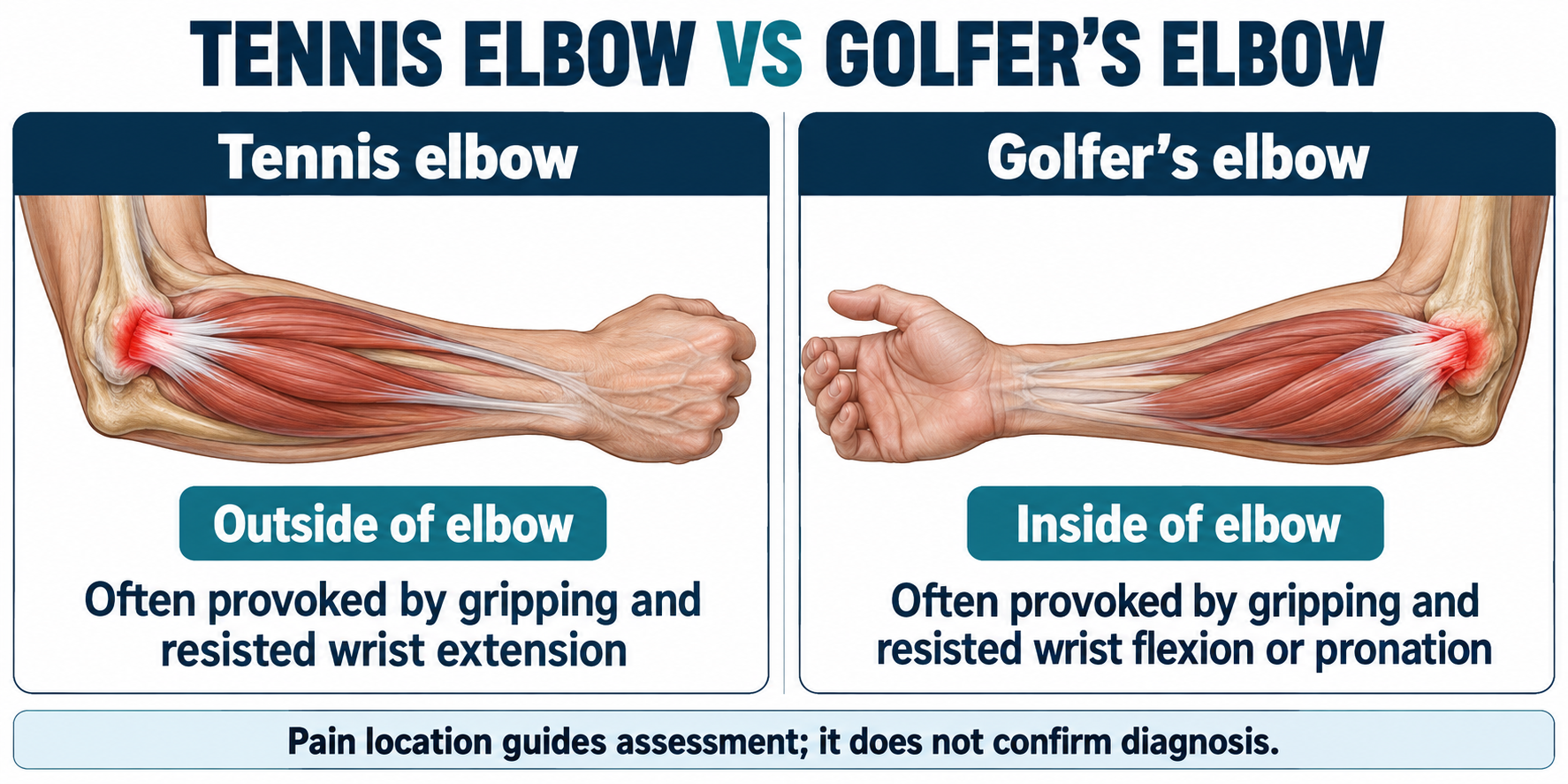
Both conditions are load-related problems at a forearm tendon attachment, and neither requires playing the sport in its name. Tennis elbow, also called lateral elbow tendinopathy, involves the wrist extensor tendon origin near the outer bony point; golfer’s elbow, or medial elbow tendinopathy, involves the flexor-pronator tendon origin near the inner bony point.
- Tennis elbow: tenderness on the outside of the elbow; gripping, lifting with the palm down, or resisted wrist extension may reproduce familiar pain.
- Golfer’s elbow: tenderness on the inside of the elbow; gripping, resisted wrist flexion, or turning the palm downward against resistance may reproduce familiar pain.
- Either condition: symptoms often build after a change in work, gym, racquet, throwing, gardening, or tool use rather than after one dramatic injury.
| Feature | Tennis elbow | Golfer’s elbow |
|---|---|---|
| Main pain area | Outside of the elbow | Inside of the elbow |
| Commonly provocative load | Grip plus wrist extension | Grip plus wrist flexion or forearm pronation |
| Main tendon group | Common wrist extensor origin | Common wrist flexor-pronator origin |
| Symptoms that need another look | Burning, altered sensation, marked weakness, or pain well away from the tendon | Tingling in the ring or little finger, marked weakness, or pain well away from the tendon |
Location and loading response are useful clues, not a diagnosis by themselves. The APTA Orthopedics clinical practice guideline for lateral elbow pain supports combining the history with examination findings rather than relying on a single test.
Check for symptoms that do not fit a simple tendon problem
Elbow pain can come from a joint, ligament, nerve, neck, fracture, infection, or inflammatory condition. Seek urgent medical help after major trauma or if the elbow is visibly deformed, very hot and swollen, or accompanied by fever or rapidly increasing pain.
- A sudden pop followed by bruising or a clear loss of strength
- Persistent numbness or tingling, especially into the hand
- Progressive hand weakness, clumsiness, or dropping objects
- Severe restriction, locking, or inability to move the elbow
- Unexplained night pain, systemic illness, or symptoms in several joints
Tingling in the ring and little fingers can point toward ulnar nerve irritation near the inner elbow. AAOS explains this pattern in its official cubital tunnel syndrome guidance; it should not simply be labeled golfer’s elbow.
Identify the load that changed before the pain began
The name of the activity matters less than the dose. A new tool, heavier racquet, longer computer session, increased gym volume, extra gardening, or more lifting can exceed the tendon’s current capacity even if the movement felt harmless at the time.
- What activity increased in frequency, force, speed, or duration?
- Does a wide, relaxed grip feel different from a hard, narrow grip?
- Is the pain worse with the elbow straight, bent, or both?
- Do symptoms settle during the day but rebound that evening or next morning?
- Which single task matters most for work, sport, or independence?
A short activity-and-symptom diary is often more useful than repeatedly pressing the sore spot. Record the task, load, immediate response, and next-day response for several sessions.
Settle irritation without completely resting the arm
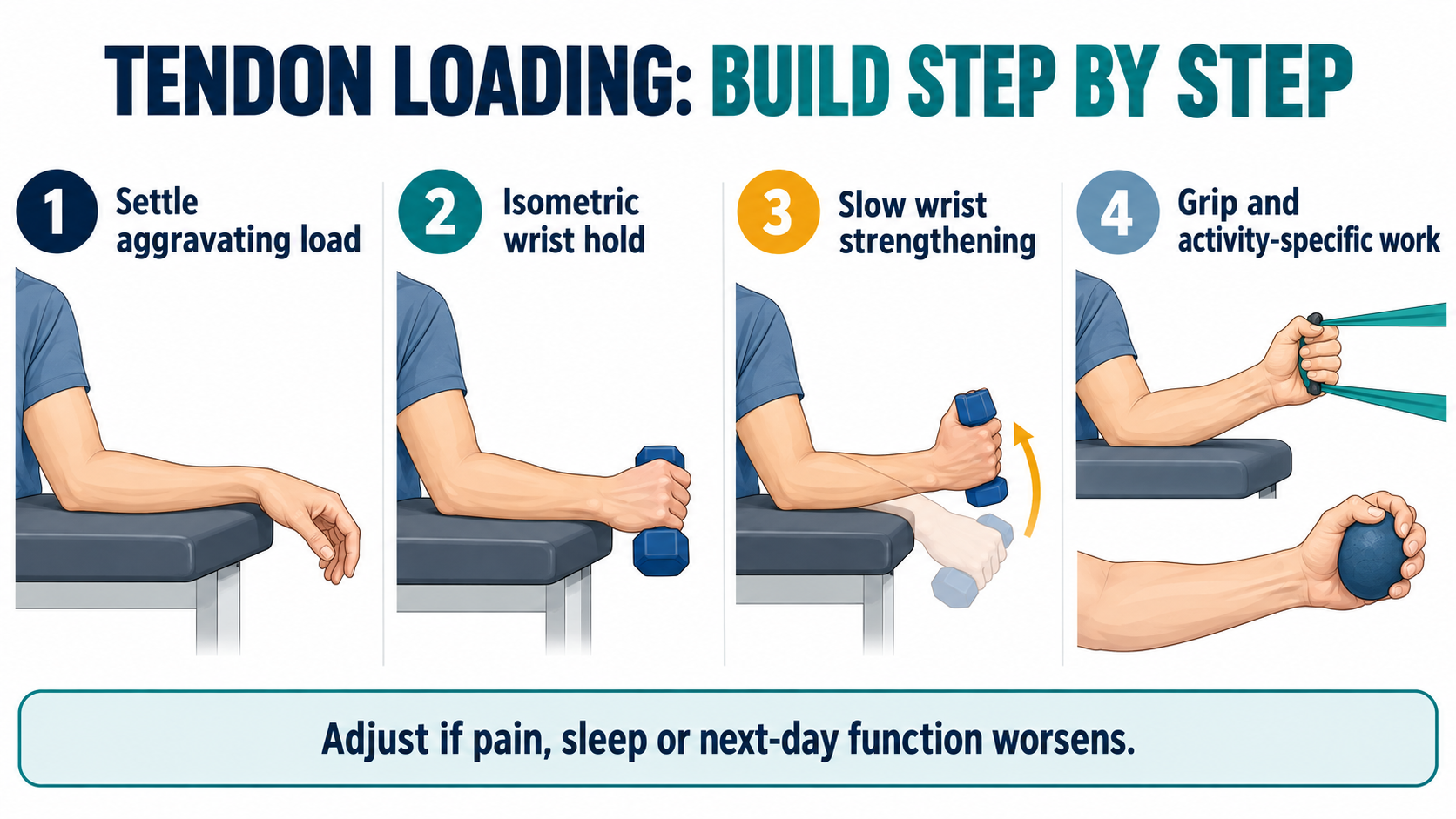
Relative rest means reducing the most provocative dose while continuing tolerable movement and daily activity. Complete rest may calm symptoms briefly, but it does not rebuild the tendon’s ability to grip, lift, type, swing, or use tools.
- Temporarily shorten high-repetition gripping sessions.
- Use two hands for heavy or awkward objects.
- Keep the load closer to the body when practical.
- Reduce wrist deviation and excessive grip force.
- Break one long task into shorter blocks with recovery time.
Ice, heat, or a counterforce strap may provide short-term comfort for some people, but they are optional supports rather than the core treatment. The AAOS pages on tennis elbow and golfer’s elbow both place rehabilitation and progressive exercise at the center of nonsurgical care.
Begin with a comfortable isometric wrist hold
An isometric exercise creates muscle force without visible joint movement. It is a practical starting point when moving through a full wrist range is irritable, although it is not mandatory and should not be treated as a pain cure.
- Support the forearm on a table with the wrist near neutral.
- For outer-elbow pain, gently resist wrist extension with the other hand.
- For inner-elbow pain, gently resist wrist flexion or pronation.
- Build a steady effort without holding your breath or crushing the grip.
- Stop if the exercise produces sharp pain, spreading symptoms, or tingling.
A reasonable trial is several comfortable holds with full relaxation between efforts. Choose the duration and effort that leaves symptoms stable later that day and the next morning rather than chasing a universal number.
Progress to slow wrist strengthening
Once a static hold is comfortable, move through a controlled range with a very light dumbbell, resistance band, or household object. For tennis elbow, emphasize wrist extension; for golfer’s elbow, emphasize wrist flexion and pronation while still training the rest of the forearm.
- Support the forearm and let the wrist move over the table edge.
- Lift and lower slowly through a tolerable range.
- Begin with a load that allows smooth motion and a relaxed shoulder.
- Progress repetitions or resistance—not both at the same time.
- Increase the elbow-straight position only after the bent-elbow version is controlled.
The AAOS therapeutic exercise program for epicondylitis provides illustrated wrist-extension and wrist-flexion progressions. Use it as a general reference; an individual plan may need different ranges, loads, or pacing.
Add grip, rotation, and whole-arm capacity
Wrist curls alone do not prepare the arm for a racquet, hammer, golf club, saucepan, or suitcase. Add grip, forearm rotation, elbow, and shoulder work that gradually resembles the demands you want to resume.
- Light ball or towel squeeze without breath-holding
- Slow palm-up and palm-down rotation with a light hammer or band
- Rows and carries with a comfortable wrist position
- Two-handed lifting before heavier one-handed lifting
- Technique practice at reduced speed or resistance
The aim is not zero sensation during every exercise. The aim is controlled loading that does not create a meaningful loss of function, sleep, or next-day capacity.
Adjust the dose by the symptom response
Some discomfort can be acceptable during tendon rehabilitation, but pain intensity is only one signal. Movement quality, confidence, function, sleep, and the response over the following day give a fuller picture.
- Continue: symptoms remain mild, movement stays smooth, and next-day function is unchanged.
- Modify: pain rises with each set, grip becomes guarded, or symptoms linger more than expected.
- Step back: sleep worsens, everyday tasks decline, or the arm is clearly more irritable the next day.
- Seek assessment: pain spreads, neurological symptoms appear, or progress stalls despite consistent changes.
When a session is too much, reduce resistance, range, repetitions, speed, or task duration. Keep one variable stable while changing another so you can tell what the tendon tolerated.
Return to work, the gym, racquet sports, or golf
Return should be based on task readiness rather than the calendar alone. Start below your usual volume, keep technique predictable, and increase only after the current level is tolerated during and after the session.
- Warm up with easy wrist, elbow, and shoulder movements.
- Use shorter work or practice blocks first.
- Avoid combining a heavier implement, faster speed, and longer session on the same day.
- Reintroduce the most provocative grip or swing last.
- Leave recovery time between demanding forearm sessions.
Equipment changes can reduce load, but they should solve an identified problem. Handle size, string tension, tool weight, work height, and swing or lifting technique are best adjusted around the actual task rather than by generic rules.
Know when professional assessment can help
An assessment is useful when the diagnosis is uncertain, neurological symptoms are present, work or sleep is substantially affected, or a graded program is not restoring function. A clinician can compare the elbow with the neck, shoulder, wrist, nerves, and nearby joints and tailor loading to your goals.
- Bring a clear timeline and the activity changes that preceded symptoms.
- Describe the exact location with one finger.
- List tasks that reproduce pain and tasks that remain comfortable.
- Report numbness, tingling, locking, swelling, or weakness.
- Bring relevant equipment or a short video of the provoking task when practical.
Imaging is not automatically required for a typical presentation, but it can be useful when trauma, another diagnosis, or failure to progress changes the clinical question. Medication and injection decisions should be discussed with a qualified prescriber because benefits, risks, and suitability vary.
Conclusion
Tennis elbow usually centers on the outer elbow and wrist-extensor loading, while golfer’s elbow usually centers on the inner elbow and flexor-pronator loading. Confirm that the pattern fits, reduce the aggravating dose without abandoning activity, then build from tolerable wrist work toward grip and task-specific strength; seek assessment when symptoms are atypical, neurological, severe, or not improving.
Frequently asked questions
Can I have tennis elbow without playing tennis?
Yes. Repeated gripping, lifting, tool use, computer work, gym training, and many other tasks can load the wrist extensor tendon; the sport name describes a common pattern, not a requirement.
Can I have golfer’s elbow without playing golf?
Yes. Any task that repeatedly combines gripping with wrist flexion or forearm pronation can irritate the inner-elbow tendon, including manual work, throwing, lifting, and some gym exercises.
Can tennis elbow and golfer’s elbow occur at the same time?
They can, although pain on both sides also broadens the list of possible causes. If both areas are persistently painful, a clinical assessment can check tendon, joint, nerve, and referred-pain contributors.
Does pain location confirm the diagnosis?
No. Outer or inner elbow pain provides a useful starting clue, but the history, response to specific loads, strength, movement, neurological screen, and alternative diagnoses all matter.
Should I stop exercising completely?
Usually not. Reduce or pause the task that clearly drives symptoms, maintain comfortable movement and general fitness, and use a graded strengthening plan that keeps the same-day and next-day response manageable.
Should tendon exercises hurt?
Mild, stable discomfort may be acceptable for some people, but sharp or escalating pain, spreading symptoms, tingling, loss of control, worse sleep, or poorer next-day function are reasons to reduce the dose or seek advice.
Is stretching enough to treat either condition?
Stretching may feel helpful and can address motion limits, but it does not replace progressive strengthening and task-specific load exposure. Avoid forceful stretching when it clearly aggravates the tendon or nerve symptoms.
Do braces or straps cure tennis elbow or golfer’s elbow?
No. A counterforce strap or wrist support may reduce symptoms during selected activities, but it does not rebuild capacity. Fit matters, and a brace that causes numbness, swelling, or more pain should be removed.
How long does recovery take?
Recovery varies with symptom duration, workload, general health, diagnosis, and the ability to modify and rebuild load. Track functional milestones—such as easier gripping, lifting, work, and sport—rather than comparing yourself with a fixed deadline.
When should I see a physiotherapist or doctor?
Arrange assessment if symptoms are severe, follow trauma, include numbness or progressive weakness, disrupt sleep or daily function, or fail to improve with a consistent graded plan. Urgent assessment is appropriate for deformity, a hot swollen joint, fever, or rapidly worsening symptoms.