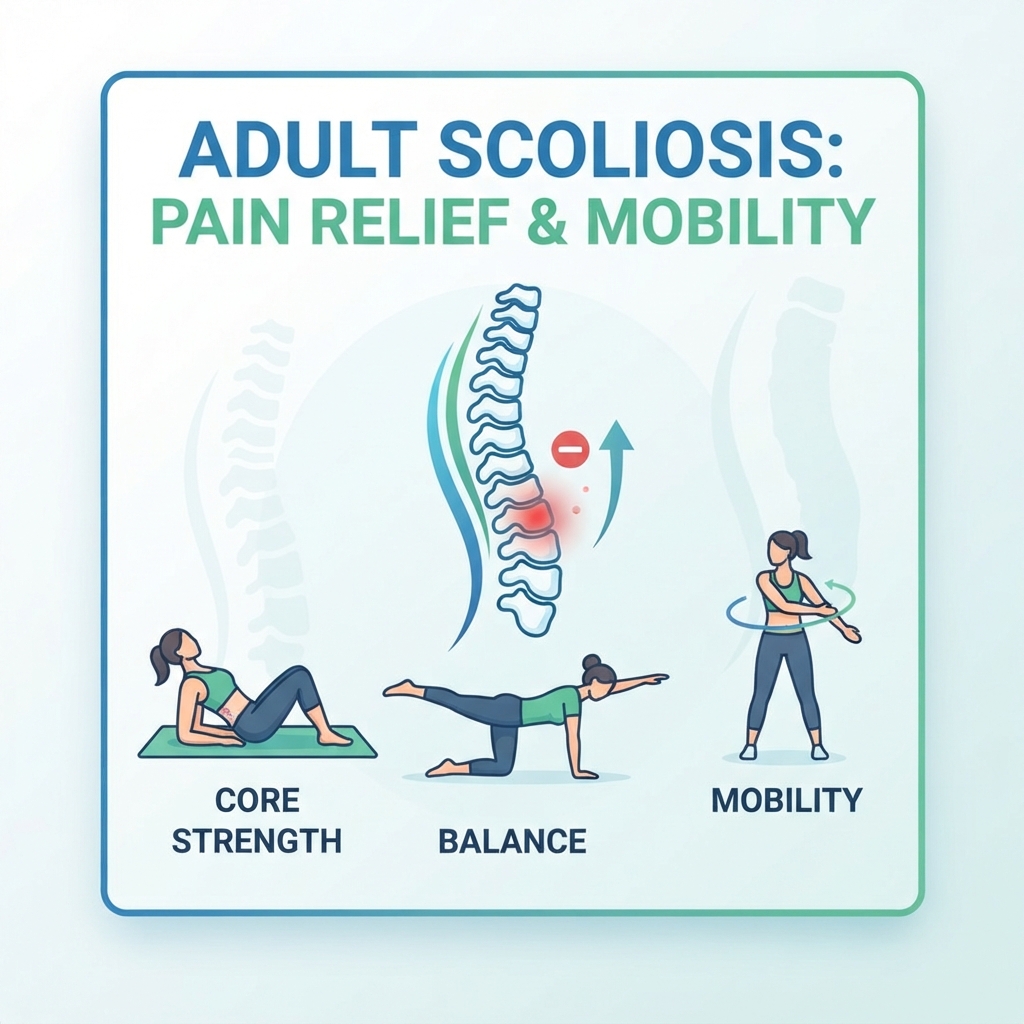
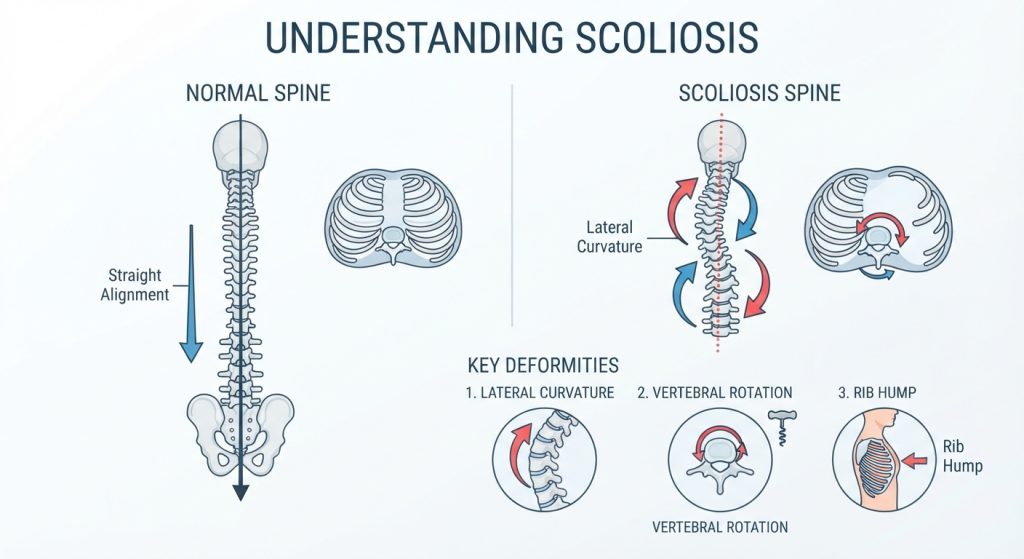
When the spine curves sideways (scoliosis) in adulthood, it usually happens for two reasons: either it is a curve you’ve had since your teen years that has carried into adulthood, or it develops later in life due to normal wear and tear on the discs and joints.
Why Does Adult Scoliosis Hurt?
The pain usually does not come from the bone curve itself. Instead, it comes from:
- Overworked Muscles: Because the spine is curved, some muscles have to work twice as hard to keep you standing straight, leading to fatigue and painful spasms.
- Asymmetric Pressure: One side of your body might get squeezed while the other side gets stretched, irritating the joints.
- Stiffness: The joints between your vertebrae lose their flexibility over time.
What are the Common Symptoms?
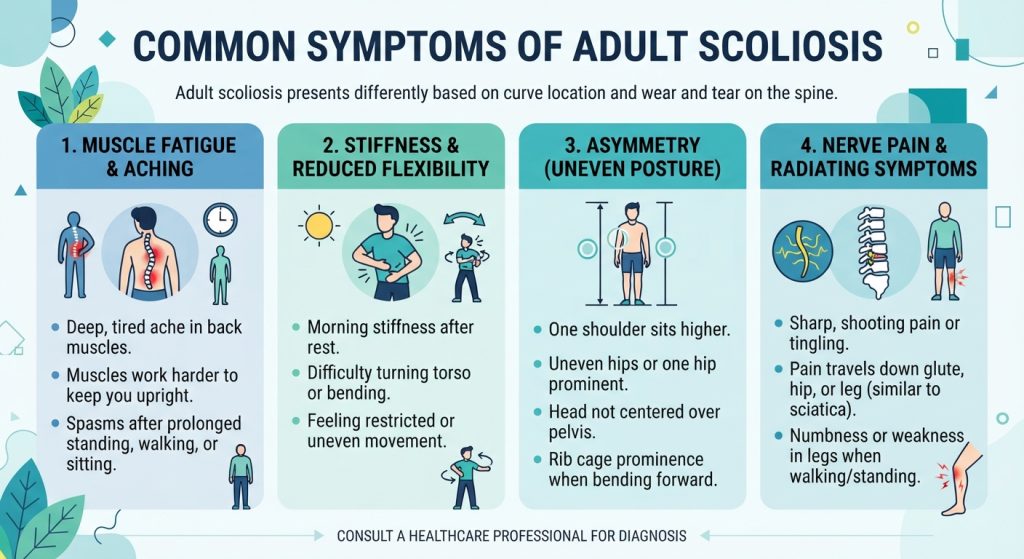
Adult scoliosis can present differently depending on the location of the curve and how much wear and tear is on the spine.
1. Muscle Fatigue and Aching
Because the spine is curved, the muscles on one side of your back have to work much harder to keep you upright. This leads to a deep, tired ache or muscle spasms, especially after standing, walking, or sitting for a long time.
2. Stiffness and Reduced Flexibility
You might feel stiff when you first wake up in the morning or after resting. Turning your torso, bending to the side, or twisting can feel restricted or uneven depending on the direction of your curve.
3. Asymmetry (Uneven Posture)
You or people around you might notice visual changes in your posture, such as:
- One shoulder sitting higher than the other.
- One hip appearing more prominent or higher.
- The head not being completely centered over your pelvis.
- One side of the rib cage sticking out more when bending forward.
4. Nerve Pain or Radiating Symptoms (In Some Cases)
If the spinal curve or arthritic bone spurs narrow the space where nerves pass through, you might feel:
- Sharp, shooting pain or tingling traveling down into one glute, hip, or leg (similar to sciatica).
- Numbness or weakness in the leg when walking or standing for extended periods.
How can adult scoliosis affect the legs?
Adult scoliosis can affect the legs primarily when the spinal curve or age-related wear and tear causes pressure on the nerves that travel down from your lower back into your lower extremities.
When those nerves are pinched, irritated, or compressed, it leads to specific leg symptoms:
- Radiating Pain (Sciatica): A sharp, burning, or shooting pain that starts in the lower back or glute and travels down the back or side of the thigh and leg. This happens when the curve narrows the space where a nerve root exits the spine.
- Numbness and Tingling: A “pins and needles” sensation, or a feeling of heaviness and numbness in part of the leg or foot, often triggered by walking or standing for too long.
- Leg Weakness: Feeling like your leg is buckling, heavy, or difficult to lift properly. This occurs when nerve compression affects the signals traveling to the leg muscles.
- Neurogenic Claudication (Walking Fatigue): A heavy, tired, or cramping sensation in both legs that develops after walking a short distance and forces you to sit down or lean forward. Leaning forward opens up the spinal canal, which is why many adults with scoliosis feel relief when pushing a shopping cart.
- Asymmetric Gait (Uneven Walking): If your spine and pelvis are tilted or uneven, your stride length on one side might be different from the other, causing secondary hip, knee, or ankle strain over time.
What treatment options are available?
Treatment options fall into two main categories: non-surgical care (used for most people) and surgery (reserved for severe cases).
1. Non-Surgical Care (Conservative)
- Targeted Physical Therapy:Exercises focused on core strength, postural alignment, and specialized methods (like Schroth therapy) to manage muscle imbalances.
- Medications:Over-the-counter anti-inflammatories (like ibuprofen) or prescription options to help manage pain and muscle spasms.
- Spinal Injections:Corticosteroid injections around irritated nerves or joints to provide temporary relief during painful flare-ups.
- Lifestyle Adjustments:Pacing activities, weight management to reduce physical load, and ergonomic changes.
2. Surgery
Surgery is generally only considered if pain is unmanageable, the curve is rapidly worsening, or nerve compression causes progressive leg weakness.
- Decompression:Removing bone or tissue to relieve pressure on pinched nerves.
- Spinal Fusion:Straightening and stabilizing the spine using rods, screws, and bone grafts.
Would you like to move on to the first simple mobility exercise for your daily routine?
Physical therapy for Scoliosis adult pain
Physical therapy focuses on three key goals:
- Postural Awareness
- Core and Spinal Stabilization
- Asymmetric Breathing and Stretching
Postural Awareness
This involves learning how your spine naturally holds itself and noticing when you are leaning to one side.
- What you do: Pay attention to how you sit, stand, and walk throughout the day. When standing, try to distribute your weight evenly across both feet instead of resting on one hip. When sitting, keep your pelvis level and your head centered over your shoulders.
- Why it helps: Adult scoliosis makes it easy to fall into habitual leaning patterns. Recognizing these habits stops you from putting extra, uneven stress on one side of your back.
Core and Spinal Stabilization
This focuses on building strength in the deep muscles around your abdomen, lower back, and pelvis to support your upper body.
- What you do: Practice gentle core exercises—such as gentle abdominal bracing or slow, controlled movements on your hands and knees—that keep your spine stable without twisting or bending it into painful positions.
- Why it helps: When your deep core and hip stabilizers are strong, they share the heavy lifting. This takes the pressure off the superficial back muscles that otherwise overwork and go into painful spasms.
Asymmetric Breathing and Stretching
This uses specific breathing patterns and targeted stretches to address the uneven, twisted shape of the ribcage and spine.
- What you do: While taking slow, deep breaths, focus on directing your air into the tight, compressed side of your ribcage to help expand it. Combine this with gentle stretches that open up the side of your body that feels shortened or restricted.
- Why it helps: Scoliosis can collapse one side of the chest while stretching the other. Breathing into the restricted areas helps improve ribcage flexibility and relieves tight, cramped muscles.
Scoliosis adult pain Diagnosis in Physical Therapy
When you visit a physical therapist for adult scoliosis, the evaluation goes beyond just looking at an X-ray. The goal is to see how your spine’s curve affects your daily movement, posture, and pain levels.
- Postural Assessment
- Range of Motion Testing
- Muscle Strength and Palpation
- Neurological Screening
Postural Assessment
The therapist checks how you stand and sit, looking at whether your shoulders, shoulder blades, and hips are level, and identifying which side of your trunk is compressed or expanded.
- What it involves: You stand relaxed while the therapist observes your alignment from the front, back, and side. They check if one shoulder is elevated, if your head is shifted to one side, and how your rib cage rotates.
- Why it matters: Because scoliosis creates a three-dimensional twist, seeing where your body leans or collapses helps map out your specific curve pattern.
Range of Motion Testing
They test how easily you can bend forward, backward, side-to-side, and rotate your torso, noting which directions feel stiff or restricted.
- What it involves: You are guided through basic movements like bending forward, leaning to the left and right, and gently turning your shoulders. The therapist notes where movement stops or causes discomfort.
- Why it matters: Spinal curves often lock certain joints into a fixed position while making other areas hyper-mobile. This test shows which segments need gentle mobility work.
Muscle Strength and Palpation
They check for areas of muscle guarding, deep spasms, and weakness in your core and hips that might be forcing your back to work too hard.
- What it involves: The therapist feels (palpates) the muscles along your spine to find hard knots or areas of chronic tension. They also test the strength of your abdominal muscles, glutes, and hips.
- Why it matters: Scoliotic curves force certain muscles to work overtime. Finding where muscles are overworked or weak guides what needs to be relaxed versus strengthened.
Neurological Screening
If you have leg pain, numbness, or tingling, they perform simple tests on your reflexes, sensation, and muscle strength to see if a nerve root is being pinched.
- What it involves: Using a reflex hammer, light touch tests, and simple resistance checks on your legs and feet, the therapist checks how your nerves are responding.
- Why it matters: If the spinal curve or arthritic changes press on a nerve root, it can cause symptoms down the leg. This screening ensures your nerves are safe and helps decide if medical imaging is needed.
Adult scoliosis pain Exercises
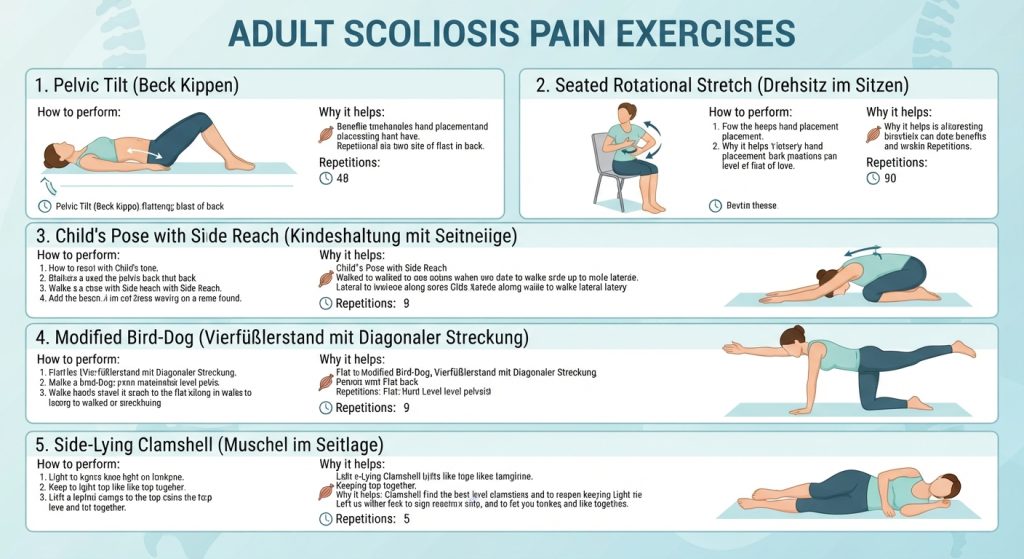
Pelvic Tilt (Beck Kippen)
- How to perform: Lie on your back with your knees bent and your feet flat on the floor, keeping your arms relaxed by your sides. Gently tighten your lower abdominal muscles and flatten your lower back against the floor, tilting your pelvis slightly upward. Hold for 3 to 5 seconds, then relax back to your natural starting curve.
- Why it helps: It engages your deep core muscles and mobilizes the lower back without putting twisting pressure on a scoliotic spine.
- Repetitions: 10 to 12 slow repetitions.
Seated Rotational Stretch (Drehsitz im Sitzen)
- How to perform: Sit upright on the edge of a chair with both feet flat on the floor. Place your right hand on the outside of your left knee and your left hand behind you on the chair seat. Inhale to sit tall, then exhale as you gently rotate your torso to the left. Hold for 20 to 30 seconds, breathing deeply, then switch sides.
- Why it helps: It addresses rotational stiffness in the mid-back (thoracic spine) that often accompanies spinal curves.
- Repetitions: 2 to 3 slow holds per side.
Child’s Pose with Side Reach (Kindeshaltung mit Seitneige)
- How to perform: Kneel on the floor, sit your hips back toward your heels, and walk your hands forward with your forehead resting on the ground. To stretch the tight side of your trunk, walk both hands along the floor to one diagonal side, breathing deeply into the stretched ribs. Hold, then walk your hands to the other side.
- Why it helps: It unloads the lower back while elongating the muscles along the side of the torso (like the quadratus lumborum).
- Repetitions: Hold for 30 to 45 seconds on each diagonal side.
Modified Bird-Dog (Vierfüßlerstand mit Diagonaler Streckung)
- How to perform: Get on your hands and knees with your wrists under your shoulders and knees under your hips. Draw your navel gently inward to engage your core. Slowly slide and lift just one arm straight forward, or one leg straight back, keeping your pelvis completely level. Lower it down and switch sides.
- Why it helps: It trains core stabilization and teaches your spine to stay supported against asymmetric loads.
- Repetitions: 8 to 10 slow, controlled repetitions per side.
Side-Lying Clamshell (Muschel im Seitlage)
- How to perform: Lie on your side with your knees bent at a 90-degree angle and your hips stacked directly on top of each other. Keeping your feet glued together, lift your top knee open like a clamshell without rolling your pelvis backward. Lower it slowly back down.
- Why it helps: It strengthens the gluteus medius, a key hip stabilizer that helps keep your pelvis level beneath a curved spine.
- Repetitions: 12 to 15 repetitions per side.
Prevent Scoliosis adult pain
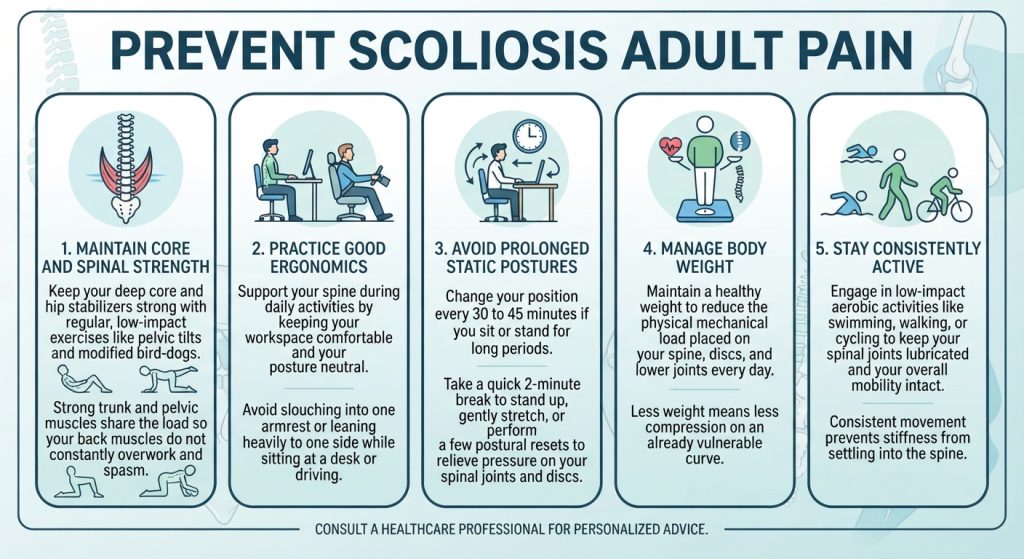
Maintain Core and Spinal Strength
Keep your deep core and hip stabilizers strong with regular, low-impact exercises like pelvic tilts and modified bird-dogs. Strong trunk and pelvic muscles share the load so your back muscles do not constantly overwork and spasm.
Practice Good Ergonomics
Support your spine during daily activities by keeping your workspace comfortable and your posture neutral. Avoid slouching into one armrest or leaning heavily to one side while sitting at a desk or driving.
Avoid Prolonged Static Postures
Change your position every 30 to 45 minutes if you sit or stand for long periods. Take a quick 2-minute break to stand up, gently stretch, or perform a few postural resets to relieve pressure on your spinal joints and discs.
Manage Body Weight
Maintain a healthy weight to reduce the physical mechanical load placed on your spine, discs, and lower joints every day. Less weight means less compression on an already vulnerable curve.
Stay Consistently Active
Engage in low-impact aerobic activities like swimming, walking, or cycling to keep your spinal joints lubricated and your overall mobility intact. Consistent movement prevents stiffness from settling into the spine.