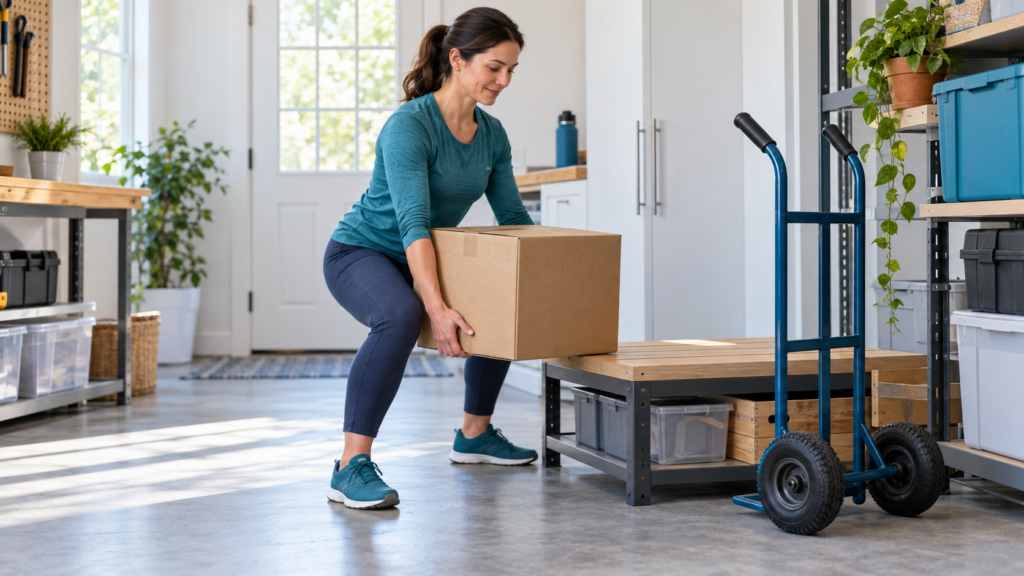
To lift heavy objects safely, first make the load manageable, clear the route and keep the object close as you move smoothly. Protecting your spine involves planning, appropriate equipment and building physical capacity as well as technique. Here is how to approach everyday lifting, recognise tasks that need help and respond if your back becomes painful.
Decide whether the object should be lifted by hand
A box that you can move once may still be too demanding to carry upstairs or lift repeatedly. Weight, size, grip and the surrounding space all matter; there is no single personal weight limit that makes every lift safe.
The NIOSH lifting assessment guidance considers reach, lifting height, frequency, duration and grip when evaluating two-handed workplace lifts. It is a task assessment tool, not a test of your individual lifting ability.
- Read a weight label if available; do not assume a small package is light.
- Check whether contents can shift or the container might break.
- Split the contents, use suitable handling equipment or arrange help when needed.
For example, emptying books from a storage box before moving it changes the demand more than trying to find a perfect back position. If you cannot control the object comfortably, redesign the task instead of testing your maximum.
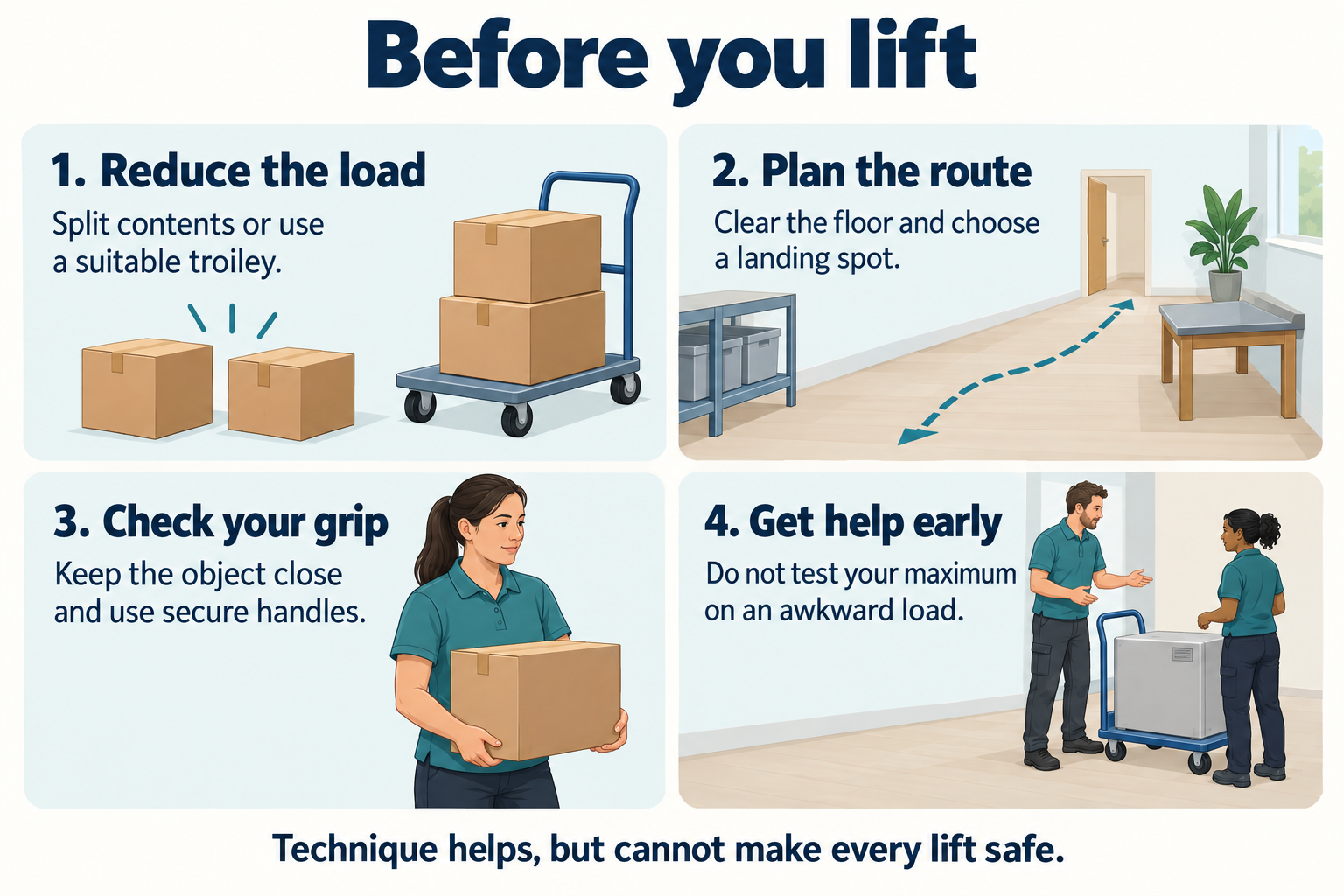
Prepare the route and the landing place
Know where the load will finish before picking it up. A short route can become difficult if you must step over toys, open a door while carrying or squeeze through a narrow gap.
- Clear loose items and check for slippery or uneven flooring.
- Open doors and make space at the destination.
- Choose stable footwear and clothing that allows movement.
- Use a stable intermediate surface for a long change in height.
Check that the receiving shelf or bench can support the object. Do not place an unstable stack where it could fall while you adjust your hands.
Use a controlled two-handed lifting sequence
For a manageable object in front of you, start close with a balanced stance. The HSE basic lifting technique guidance recommends a secure hold, slight bending through the back, hips and knees, and smooth movement.
- Place your feet apart, with one slightly forward if helpful.
- Bring the load near before lifting and establish a secure two-handed grip.
- Bend comfortably through your hips and knees; avoid forcing a deep squat.
- Rise steadily with the object close rather than snatching it upward.
Aim for a controlled trunk position, without deliberately rounding further as the load rises. Your spine does not need to be held rigidly straight; choose a comfortable movement that suits the task.
Before continuing, make a quick control check:
- Can you see where you are going?
- Is the grip secure without constant readjustment?
- Can you move without struggling or losing balance?
If any answer is no, put the object down safely and change the plan. A bulky item can be unsuitable for a solo lift even when it is relatively light.
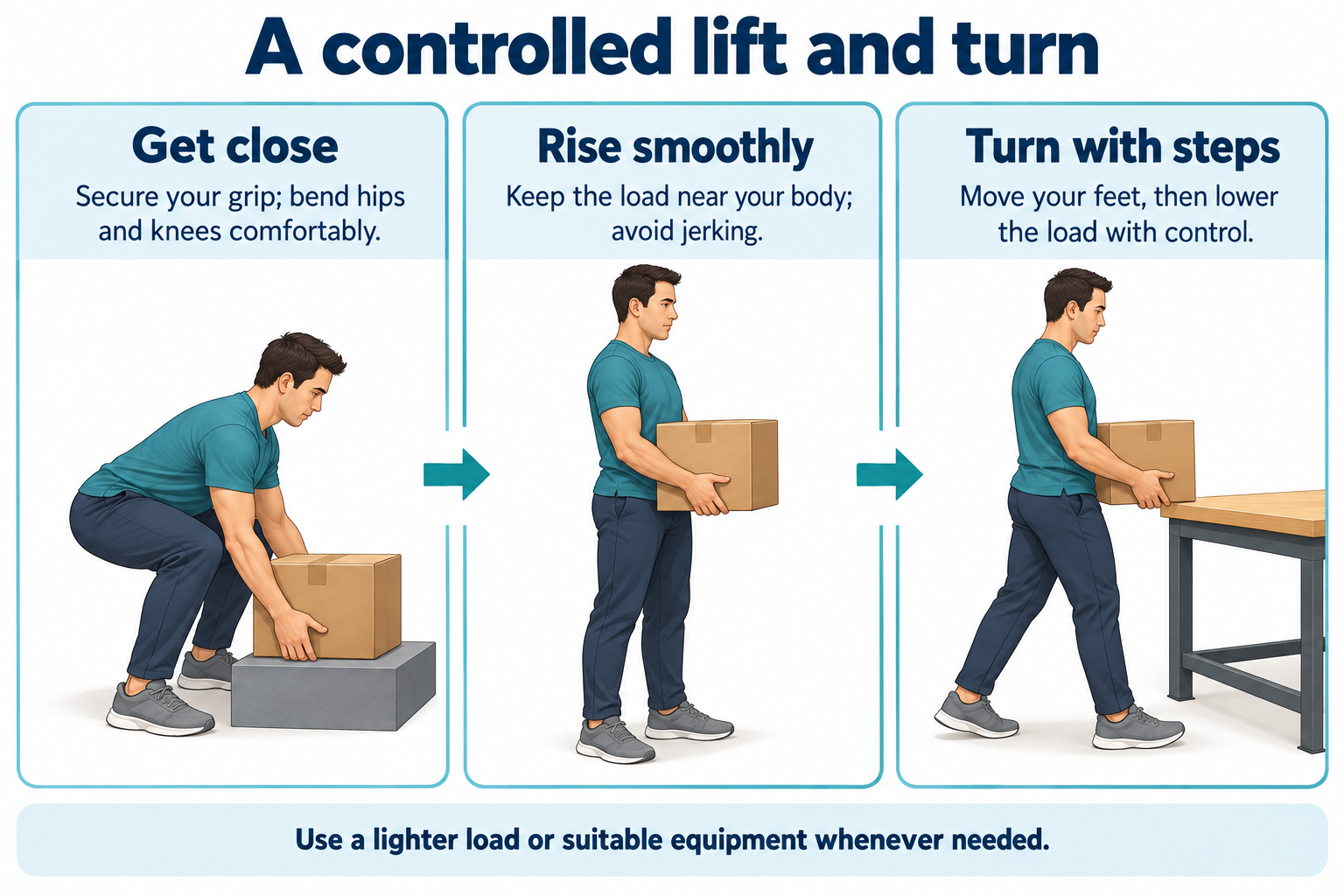
Carry, turn and lower without rushing
Keep the journey short and the load near your body. Change direction with small steps so your shoulders and hips turn together, rather than rotating under a heavy load with your feet planted.
- Face the landing surface before lowering.
- Lower smoothly using a comfortable hip and knee bend.
- Keep fingers clear of pinch points.
- Set the object down before sliding it into its final position.
Do not keep walking if the object blocks your view. Place it on a secure surface and arrange another method of transport.
Adapt awkward lifts instead of forcing the same technique
The Canadian Centre for Occupational Health and Safety lifting guidance emphasises reducing difficult reaches and using suitable grip points and working heights. A floor lift, deep car boot and high shelf are different problems.
| Situation | Main difficulty | Useful change |
|---|---|---|
| Box on the floor | Low starting position | Reduce its contents or use suitable equipment to raise it. |
| Object deep in a car boot | Long reach | Bring a manageable item nearer the edge before lifting. |
| High shelf | Overhead reach and poor control | Store heavy items lower; use appropriate access or lifting equipment. |
| Large furniture | Awkward shape and limited grip | Plan equipment, route and assistance before moving. |
| Repeated deliveries | Accumulated physical demand | Adjust load size, handling height and work-rest pattern. |
- Keep frequently handled heavy items at an accessible height.
- Avoid reaching over another object to grab a load.
- Use equipment appropriate to the load, floor and available space.
A trolley is not automatically suitable for stairs or rough ground. Follow its operating instructions and capacity limits; use specialist assistance when the route requires it.
Coordinate help for bulky objects
Having another person available does not automatically make an awkward lift safe. The CCOHS team handling advice recommends planning and coordinated movement when team handling is appropriate.
- Agree on the route, grip and destination before starting.
- Choose one person to give clear lifting and lowering instructions.
- Move together and stop if either person loses control.
- Use mechanical assistance when the load or route remains unsuitable.
For furniture, check doorways and turns before committing to the move. Moving a person requires a separate handling assessment and appropriate training or equipment; ordinary box-lifting tips are insufficient.
Manage repetition and fatigue
Technique is only one part of a demanding job. The HSE guidance on reducing handling risks prioritises changing the load, task and environment, including handling distances and work rates.
- Organise materials to reduce repeated floor-to-shelf transfers.
- Alternate tasks where practical and take recovery breaks.
- Reduce the load when fatigue begins to affect control.
- Report unsafe handling demands rather than relying on willpower.
At home, several smaller trips can be more manageable than one overloaded journey. At work, ask for a task assessment if the same lift repeatedly causes symptoms or feels difficult.
Build strength and practise with manageable loads
Regular exercise supports everyday physical capacity, but does not make unlimited lifting safe. The NHS strength activity guidance recommends strengthening major muscle groups on at least two days a week and building up gradually.
For a gentle starting point, the NHS home strength exercises include sit-to-stand and supported mini-squats. Choose a stable chair that cannot slide.
- Sit-to-stand: Sit with feet flat and apart, lean forward slightly, stand slowly, then sit with control. Try up to five comfortable repetitions.
- Supported mini-squat: Hold a stable support, bend your knees through a comfortable small range, then straighten. Try up to five repetitions.
- Task rehearsal: Practise the planned lift with an empty container before adding a manageable load.
These are starting examples, not a personalised rehabilitation prescription. If you have a recent injury, operation or condition affecting lifting, follow your treating clinician’s guidance and stop exercises that worsen symptoms.
Respond to pain and recognise warning signs
Stop a lift if pain is sharp, escalating or accompanied by loss of control. Back discomfort does not by itself establish a diagnosis or prove that a particular posture damaged your spine; Cambridge University Hospitals’ lifting and posture advice explains why there is no universally perfect posture.
- Place the load down safely and reduce the immediate demand.
- Keep moving gently as tolerated rather than spending prolonged periods in bed.
- Arrange assessment if pain persists, limits normal activities or repeatedly returns with lifting.
Seek urgent medical advice for sudden severe or rapidly worsening back pain, or back pain with fever or feeling unwell. The NHS back pain guidance identifies symptoms requiring emergency care:
- New bladder or bowel changes, including difficulty passing urine or loss of control.
- Numbness around the genitals or anus.
- Pain, weakness, tingling or numbness in both legs.
- Back pain with chest pain or following a serious accident.
Use your local emergency service when these warning signs occur. Do not attempt another lift to check whether the symptoms settle.
Conclusion
Make the task manageable first, then use a close grip, smooth movement and deliberate steps when turning. Suitable equipment, help and gradual strength development all support better handling decisions. If lifting repeatedly causes difficulty, change the task and seek an individual assessment.
Frequently asked questions
What is the safest way to lift a heavy box?
First decide whether to lift it by hand at all. For a manageable box, get close, establish a secure grip, bend comfortably and rise smoothly with the load near your body.
How much weight can I safely lift?
There is no single amount suitable for everyone or every task. Reach, grip, repetition, carrying distance and your current capacity influence the demand; uncertainty is a reason to reduce the load or get assistance.
Should my back stay completely straight?
You do not need to force a rigid straight line. Aim for comfortable control, using your hips and knees as well, and avoid sudden movement under a demanding load.
Do I have to squat all the way down?
No. A deep squat is not required for every lift. Adjust your stance and bend according to the object’s height and your comfortable range; change the task if you cannot get close.
Why should I hold the object close?
Reaching out makes controlling a load more demanding. A close position also helps you maintain a secure hold, provided the object is suitable to carry against your body.
How should I turn while carrying something?
Use small steps to face the new direction. Plan enough space for your feet and load, and avoid rushing a turn in a narrow area.
Is lifting with another person always safe?
No. Poor coordination, limited grip and an awkward route can still create problems. Agree on the plan and use suitable equipment if the team cannot comfortably control the object.
Which exercises can help prepare me for lifting?
Sit-to-stand, supported mini-squats and gradual task practice are useful starting options for some people. Your programme should match your health, current ability and the lifting demands you need to meet.
Can I lift when I already have back pain?
It depends on your symptoms and any medical restrictions. Avoid forcing a difficult heavy lift during a flare-up; discuss persistent difficulty with a clinician and rebuild activity gradually as appropriate.
What should I do if my back hurts after lifting?
Reduce the provoking demand and continue gentle activity as tolerated. Seek assessment for persistent or worsening symptoms, and obtain emergency care for bladder or bowel changes, saddle-area numbness or symptoms in both legs.