
Relief strategies for facet joint pain in the lower back usually begin with manageable activity, a tailored exercise plan, and short-term symptom control when appropriate. The first step is a sound assessment: back stiffness or arthritis on a scan does not, by itself, prove that a facet joint is the source of pain.
What facet joint pain means
Facet joints are small paired joints toward the back of the spine that help guide and limit movement. Like other joints, they can develop arthritis or become painful after irritation or injury.
Pain may be felt in the lower back and sometimes the buttock or thigh. These symptoms overlap with other back problems, so the pattern is useful information for your clinician rather than a diagnosis you can confirm at home.
- Note whether pain is central, one-sided, or spread across the back.
- Describe any buttock or leg symptoms as well as the back pain.
- Tell your clinician which movements and activities are difficult.
The American Academy of Physical Medicine and Rehabilitation’s overview of facet-mediated pain explains that facet-joint changes can also be present without symptoms. Treatment should address how you feel and function, not just an imaging label.
How clinicians assess the source of pain
An assessment starts with your history, movement, and a check for other explanations. Pain when leaning backward or twisting can occur, but deliberately repeating these movements is not a reliable home test for facet joint pain.
Scans can show joint changes without establishing whether they hurt. They may be useful when a clinician needs to investigate another condition or answer a question that would change treatment.
- Explain when the pain started and how it has changed.
- Mention previous injury, surgery, fever, unexplained weight loss, or cancer history.
- Report numbness, weakness, or changes in bladder or bowel function promptly.
The specialist review of lumbar facet-joint assessment describes the limitations of symptoms, physical tests, and imaging. A diagnostic medial branch block may be considered later when a specialist is evaluating whether a nerve-targeted procedure is appropriate.
Settle a flare without stopping all movement
During a flare, reduce the amount of an activity that repeatedly increases symptoms while keeping tolerable movement in your day. Short periods of comfortable rest can help you regroup; prolonged bed rest is not the usual approach to back pain.
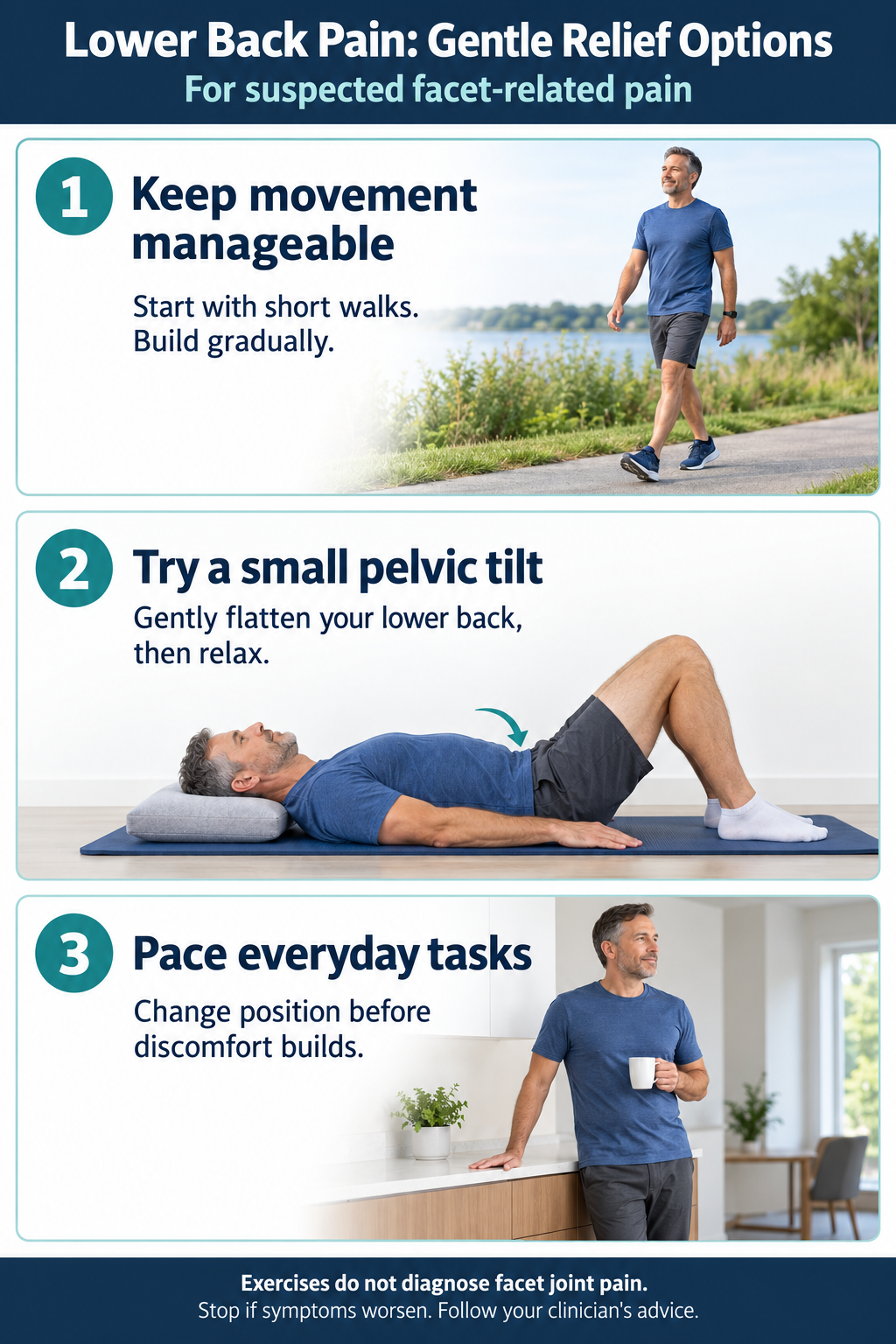
If standing at the kitchen counter brings on pain, for example, split the task into smaller parts and change position between them. This is a practical way to adjust the workload without deciding that standing is permanently unsafe.
- Choose a short walk or another movement you can manage.
- Take breaks before a task becomes overwhelming.
- Return to an easier version if symptoms clearly increase.
Wrapped warmth may help stiffness or muscle spasm. Use heat safely rather than treating it as a way to repair the joint.
- Keep a protective layer between the heat source and skin.
- Follow the product instructions and check your skin.
- Avoid sleeping on a heat pack or applying it where sensation is reduced.
Try gentle movement that suits your back
There is no single stretch that proves or cures lumbar facet pain. If an exercise is suitable for your circumstances, use a comfortable range and assess the response rather than forcing the back into a particular position.
A small pelvic tilt is one option: lie with knees bent and feet supported, gently flatten the small of your back, then relax. Keep your pelvis on the surface and breathe normally.
- Begin with a few comfortable attempts rather than a demanding session.
- Use a small movement without straining or holding your breath.
- Stop if pain worsens or new leg symptoms appear.
Another option, if comfortable, is a small knee roll: from bent-knee lying, let your knees move a little to one side, return to the middle, and try the other side. You can reduce the range or omit it if rotation aggravates symptoms.
- Move slowly and keep the upper body supported.
- Do not push into a painful end position.
- Follow individual restrictions after surgery, fracture, or another diagnosed condition.
Cambridge University Hospitals’ back mobility instructions illustrate pelvic tilts and knee rolls. They are general movement options, so ask a physiotherapist to adapt them if they do not suit you.
Build strength and activity around a useful goal
Physiotherapy can help you choose exercises and gradually rebuild the activities you have been avoiding. A plan may combine trunk and hip strengthening, mobility, and aerobic activity according to your abilities.
Make the goal concrete. Walking to the shops, standing through meal preparation, or returning to a hobby gives you a clearer target than trying to achieve a “perfect” spine position.
- Choose an amount you can repeat without a substantial flare.
- Increase one feature at a time, such as duration or resistance.
- Review the plan if every progression repeatedly makes symptoms worse.
The NIAMS overview of back-pain care explains how rehabilitation and activity fit into treatment. Hands-on treatment, when used, should support a broader plan rather than replace the work of rebuilding activity.
Adjust everyday tasks and resting positions
Try changes that make the next task easier instead of searching for one posture to maintain all day. Change between sitting, standing, and moving as your work allows.
For necessary lifting, arrange the task so the load is manageable and close enough to control. Seek help with bulky loads during a flare rather than repeatedly testing your limit.
- Place frequently used items within easy reach.
- Break longer jobs into shorter stages.
- Choose a resting position that feels comfortable and allows you to move again easily.
Keep track of the response to a useful change. If a different chair arrangement helps you work longer, retain it; if a complicated cushion setup adds no benefit, simplify it.
Discuss medicines rather than choosing a long-term routine alone
Medication decisions depend on your health, other medicines, and the type of pain. A pharmacist or clinician can advise whether an anti-inflammatory medicine is suitable and how to use it safely.
Do not assume that a tablet recommended to someone else is suitable for you. Tell the prescriber about relevant conditions and treatments before taking a new medicine.
- Mention kidney problems, previous stomach ulcers, and heart conditions.
- Report blood-thinning medicines and any pregnancy or possibility of pregnancy.
- Avoid combining pain medicines without checking the ingredients and advice.
Ask what benefit to look for, how long to try the medicine, and when to review it. If medication is not helping you move, sleep, or manage everyday tasks, discuss the next step rather than continuing it indefinitely.
Compare the main relief options
These approaches serve different purposes. Choosing one depends on the assessment, previous treatment, and what you want to regain.
| Option | Purpose | Main limitation |
|---|---|---|
| Activity pacing and position changes | Make everyday movement more manageable | Do not identify the painful structure |
| Individual exercise and physiotherapy | Rebuild movement, strength, and activity tolerance | Need adaptation and gradual progression |
| Heat or appropriate medication | Support short-term symptom management | May not suit everyone or address ongoing limitations |
| Diagnostic medial branch block | Assess the response to temporarily numbing nerves supplying the joint | Results require specialist interpretation |
| Radiofrequency denervation | Reduce pain signalling in selected patients | May not help, has risks, and relief can wear off |
Before accepting a treatment, ask how it fits into the whole plan. A useful outcome might be greater walking tolerance or fewer interrupted nights, not simply a lower pain score immediately afterward.
When nerve blocks or radiofrequency treatment enter the discussion
A medial branch block places local anesthetic near the small nerves supplying a facet joint. The response can help a specialist decide whether radiofrequency denervation is worth considering after simpler measures have not helped.
South Tees Hospitals’ explanation of medial branch blocks describes the procedure and the need for a shared decision. Follow the treating service’s instructions on preparation, medicines, transport, and recovery.
- Ask how to record pain and activity after the block.
- Tell the service about allergies, infection, blood thinners, and pregnancy.
- Do not stop prescribed medication unless your treating team instructs you to.
Radiofrequency denervation uses heat to target the relevant nerves. It does not rebuild the joint, and it is not appropriate for every person with back pain or arthritis on a scan.
The Evidence-Based Interventions guidance on lumbar radiofrequency denervation describes its role after non-operative treatment and a helpful diagnostic block. Benefits are not guaranteed; risks include bleeding, infection, and nerve injury, and pain can return.
Recognize symptoms that need medical attention
Arrange a review if symptoms are worsening, not improving, or interfering with ordinary activities. Mention pain that is worse at night or does not ease with rest, unexplained weight loss, or a new change in the shape of your back.
Seek urgent medical advice if severe pain starts suddenly, worsens quickly, or comes with feverishness or feeling generally unwell. The NHS back-pain warning signs also identify symptoms that require emergency care.
- New difficulty passing urine, loss of bladder or bowel control, or numbness around the genitals or anus.
- Pain, tingling, numbness, or weakness affecting both legs.
- Back pain with chest pain or following a serious accident.
Do not label these changes as a routine facet flare or keep exercising through them. Use your local emergency service when emergency symptoms occur.
Conclusion
Facet joint pain in the lower back is best approached with assessment, manageable activity, and a plan that gradually restores function. Start with appropriate conservative care, adapt exercises to your response, and discuss specialist options only when they fit your clinical situation.
Frequently asked questions
Does facet arthritis on an MRI prove the cause of pain?
No. Joint changes can exist without pain. Your clinician interprets imaging alongside the assessment and may consider further testing when it would guide a specific treatment.
Can leaning backward diagnose facet joint pain?
No. Pain with a movement is useful information but does not reliably identify the source. Avoid repeatedly provoking symptoms as a home diagnostic test.
Is walking a suitable relief strategy?
A short, comfortable walk can be a useful way to stay active. Adjust the duration and pace to your symptoms, and seek advice if walking causes increasing pain or neurological symptoms.
Which gentle exercise can I try?
If suitable for your condition, try a small pelvic tilt with knees bent and feet supported. Flatten the small of your back gently, then relax; stop if symptoms worsen.
Should I avoid bending or twisting forever?
A flare may require temporary adjustments, but it does not establish a lifelong movement ban. A physiotherapist can help you rebuild the movements needed for daily tasks.
Do I need complete bed rest?
Prolonged bed rest is not the usual recommendation for back pain. Use comfortable rest periods while retaining manageable activity, unless your treating clinician has given specific restrictions.
Are facet-joint injections and medial branch blocks the same?
No. One targets the joint itself; the other targets the nerves supplying it. Ask which procedure is being proposed, whether its purpose is diagnostic or therapeutic, and why it suits your case.
Will radiofrequency treatment cure the arthritis?
No. It targets pain signalling rather than repairing arthritis. Relief varies, may wear off, and must be weighed against the procedure’s risks.
When should I ask for a treatment review?
Ask when pain continues to limit life, the plan is not helping, or symptoms change. Bring details of activities, exercises, medicines, and their effects.
Which changes require emergency assessment?
Back pain with new bladder or bowel dysfunction, saddle numbness, symptoms in both legs, chest pain, or a serious accident requires emergency care. Do not assume these are ordinary facet symptoms.