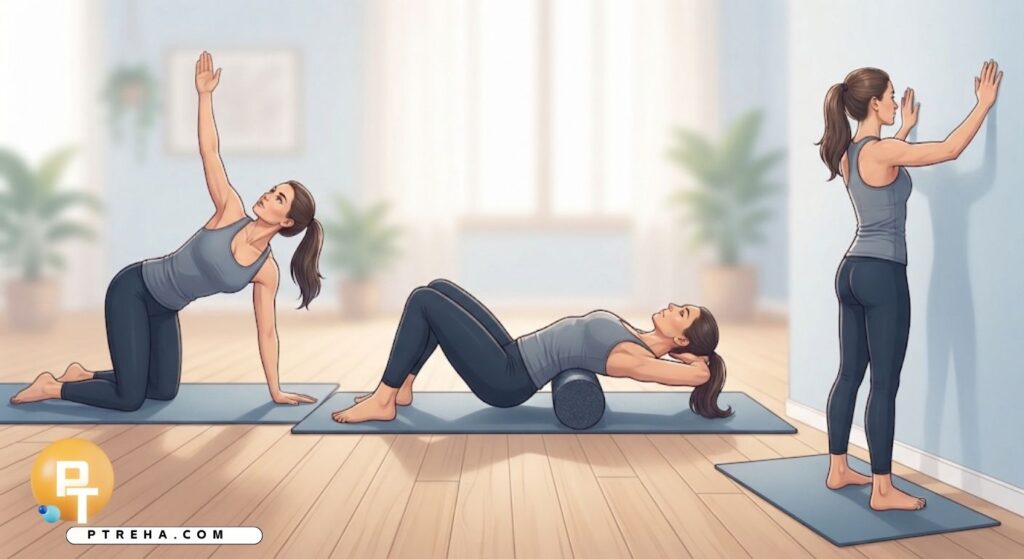
Thoracic stiffness and upper back tightness are common complaints, especially after long periods of sitting, repetitive work, reduced physical activity, or training that repeatedly loads the shoulders and upper body.
The most useful approach is usually not to force the spine into a particular posture, but to gradually restore comfortable thoracic movement, keep the body active, and strengthen the muscles that help control the trunk and shoulder girdle.
If the symptoms are severe, persistent, associated with neurological changes, trauma, systemic symptoms, or chest symptoms, professional assessment is more appropriate than simply adding more stretches.
What causes thoracic stiffness and upper back tightness?
The thoracic spine is the middle portion of the spine and connects mechanically with the ribs, sternum, shoulder girdle, and cervical and lumbar regions.
Because these structures work together, a feeling of upper back tightness does not necessarily mean that one specific muscle or spinal joint is “tight.”
Symptoms can develop when the thoracic region is repeatedly exposed to the same position or movement without enough variation.
Long periods of sitting can make extension and rotation feel restricted, while repetitive lifting, reaching, pulling, or overhead activity can increase muscular fatigue around the upper back.
Common contributors include:
- Prolonged sitting at a desk.
- Repeated computer or laptop use.
- Limited physical activity.
- Repetitive lifting or carrying.
- Sudden increases in exercise volume.
- Repetitive overhead activity.
- Reduced thoracic rotation during daily activities.
- Shoulder movement restrictions.
- Neck and upper-quarter symptoms.
- General muscular fatigue.
It is also important not to interpret stiffness as proof that a joint is physically “stuck.” Human thoracic movement varies considerably between individuals, and measurements of thoracic range of motion depend on the method used to assess it.
Key point: The goal is not to create an artificially straight or rigid upper back. The goal is to improve comfortable movement and the person’s ability to tolerate normal activities.
How to tell whether your upper back needs mobility or strength
A useful first step is to observe what actually provokes the symptoms.
If the upper back feels stiff after sitting but loosens when you stand, walk, or move, varying your position and introducing regular movement may be particularly useful.
If symptoms appear mainly during lifting, reaching, pulling, or prolonged activity, improving strength and work capacity may be more important than repeatedly stretching the area.
Ask yourself:
- Does sitting make the stiffness worse?
- Does walking make it feel better?
- Is rotation restricted to one side?
- Does reaching overhead reproduce symptoms?
- Does the discomfort appear after exercise?
- Does deep breathing affect the symptoms?
- Is the discomfort localized or spreading?
- Are there associated neck or shoulder symptoms?
- Does the problem repeatedly return after the same activity?
- Has your activity level recently changed?
This information can help determine whether the main problem is movement tolerance, muscular endurance, load management, or another condition requiring assessment.
The best exercises for thoracic stiffness
There is no single exercise that “unlocks” the thoracic spine for everyone.
Exercise selection should match the person’s movement limitations, symptoms, physical capacity, and goals.
Research has identified exercises targeting thoracic mobility, motor control, work capacity, and strength, but the evidence for individual thoracic exercises is not strong enough to claim that one specific exercise is universally superior.
A practical routine can include several movement categories.
1. Thoracic extension over a chair

Sit on a stable chair with your feet supported.
Place your hands across your chest and gently extend your upper back over the backrest while keeping the movement comfortable.
Avoid forcing the lower back into excessive extension.
Think about moving through the upper and middle back rather than trying to create a large movement.
Try:
- Slow controlled repetitions.
- Comfortable range of motion.
- Relaxed breathing.
- No forceful end-range pressure.
- Returning to the starting position between repetitions.
2. Open-book thoracic rotation
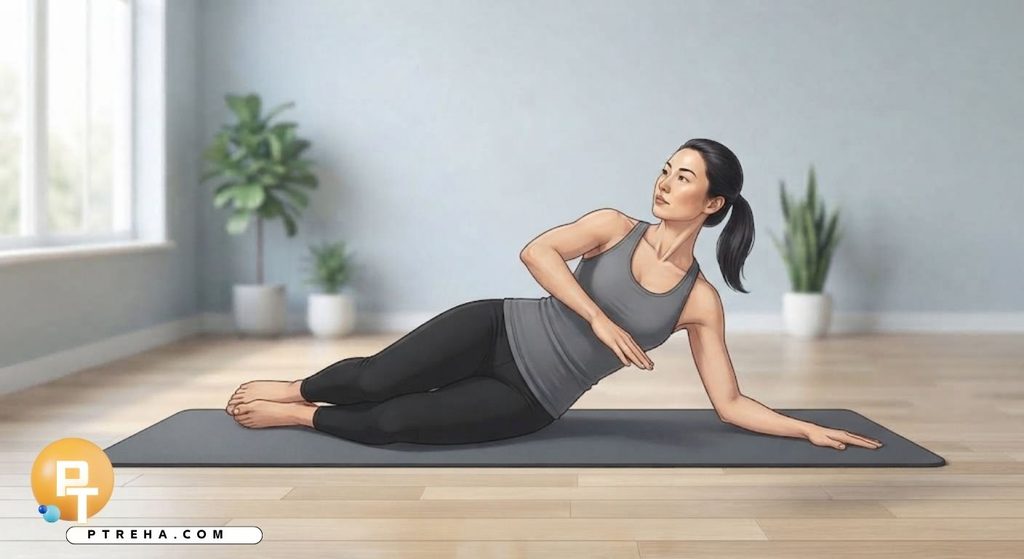
Lie on your side with the hips and knees comfortably bent.
Keep the knees together while slowly rotating the upper arm and trunk toward the opposite side.
This exercise emphasizes thoracic rotation while reducing the amount of movement required from the lower body.
Useful cues include:
- Keep the knees together.
- Move slowly.
- Follow the hand with your eyes if comfortable.
- Breathe normally.
- Stop before sharp pain.
- Compare both sides.
A noticeable difference between sides can be useful information, but asymmetry by itself does not establish a diagnosis.
3. Cat-camel movement
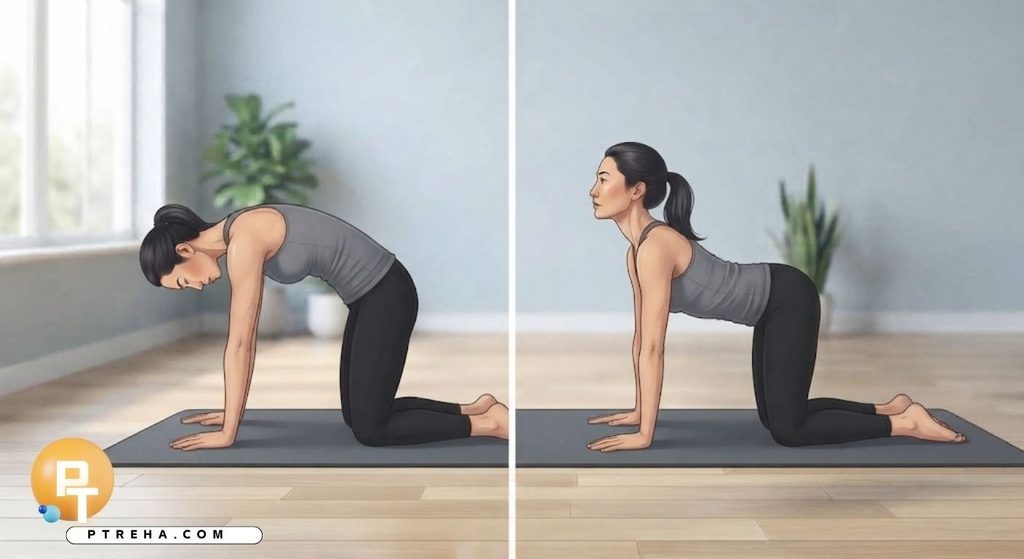
Start on your hands and knees and gently move between thoracic flexion and extension.
The purpose is not to reach an extreme position.
Instead, use the exercise to explore comfortable spinal movement and reduce the tendency to remain in one position for long periods.
Focus on:
- Slow movement.
- Smooth transitions.
- Comfortable breathing.
- Whole-spine movement.
- Avoiding aggressive stretching.
4. Quadruped thoracic rotation
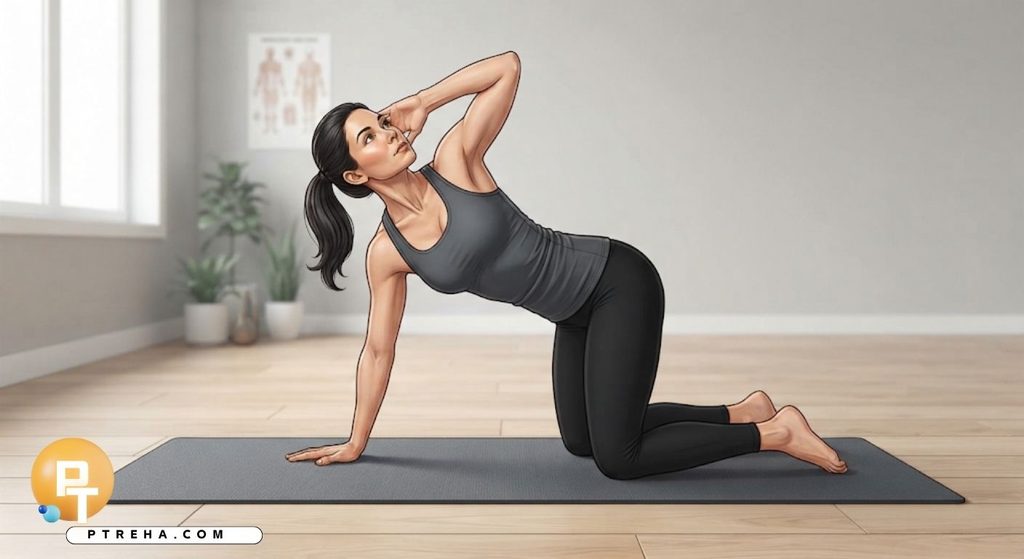
From a hands-and-knees position, place one hand behind your head and rotate the elbow toward the ceiling.
Keep the movement controlled rather than trying to force the elbow as high as possible.
This can be useful when rotation feels restricted during activities such as reaching, turning, or sport.
5. Wall-supported upper-back movement

Stand with your back near a wall and gently move your arms through a comfortable range while maintaining relaxed breathing.
The purpose is to combine thoracic positioning with shoulder movement rather than treating the thoracic spine in isolation.
This may be particularly relevant for people who notice upper-back tightness during:
- Overhead reaching.
- Dressing.
- Reaching into cupboards.
- Exercise.
- Computer work.
- Manual tasks.
A simple daily routine for upper back tightness
You do not necessarily need a long stretching session.
A short routine performed consistently can be easier to maintain.
One practical sequence is:
- Gentle walking or general movement.
- Thoracic extension over a chair.
- Open-book rotation.
- Cat-camel movement.
- Quadruped thoracic rotation.
- Shoulder blade control exercises.
- A light strengthening exercise.
- Return to normal daily activity.
Perform the movements slowly and use a range that feels comfortable.
A useful rule is that exercise should not require you to repeatedly push through sharp or escalating pain.
If a particular exercise consistently aggravates symptoms rather than gradually improving tolerance, change the exercise, reduce its intensity, or seek an individual assessment.
Strengthen the muscles around the upper back
Mobility is only part of the solution.
If the upper back repeatedly becomes uncomfortable during work, lifting, or exercise, strengthening and improving muscular endurance may help you tolerate those activities more effectively.
Useful exercise categories include:
- Rowing movements.
- Scapular retraction exercises.
- Serratus anterior exercises.
- Thoracic extensor endurance exercises.
- Resistance-band pulling.
- Controlled shoulder elevation.
- Carrying exercises.
- General trunk strengthening.
- Upper-body resistance training.
- Functional pulling and pushing movements.
The aim is not to permanently pull the shoulders backward.
Excessive conscious retraction can itself become uncomfortable.
Instead, develop the ability to move the shoulder blades and thoracic spine through different positions while maintaining good control.
Example: resistance-band row
Attach a resistance band securely and hold it with both hands.
Pull the band toward your body while allowing the shoulder blades to move naturally, then slowly return to the starting position.
The important elements are:
- Controlled resistance.
- Smooth shoulder movement.
- Avoiding excessive shrugging.
- Maintaining comfortable spinal positioning.
- Gradually increasing resistance as tolerated.
Strengthening should complement mobility rather than replace it.
Improve your desk setup without chasing perfect posture
People often assume that upper-back tightness means they need to maintain a perfectly upright posture all day.
That is not necessary.
There is no single posture that should be maintained continuously.
Even a good sitting position can become uncomfortable if held without movement for a long period.
Instead, make your workstation reasonably supportive and change positions regularly.
Useful adjustments include:
- Keep the screen at a comfortable viewing height.
- Position the keyboard and mouse so the arms are supported comfortably.
- Avoid repeatedly reaching far forward for the mouse.
- Keep frequently used objects within easy reach.
- Use a chair that allows comfortable support.
- Change between sitting and standing when practical.
- Take brief movement breaks.
- Walk during suitable breaks.
- Perform a few thoracic movements between periods of concentrated work.
Think of ergonomics as position variation and load management, not as maintaining one perfect posture.
Use movement breaks to prevent stiffness
If your symptoms are strongly associated with prolonged sitting, changing position may be more useful than performing one large stretching session at the end of the day.
A movement break can be very simple.
For example:
- Stand up.
- Walk around the room.
- Rotate the trunk gently.
- Reach overhead.
- Perform a few shoulder movements.
- Take several relaxed breaths.
- Return to work.
The exact duration does not need to be rigid.
The important principle is to avoid spending most of the working day in one unchanged position.
This approach also makes sense because thoracic posture and mobility are influenced by the position of the body and the activity being performed.
What about foam rolling and massage?
Foam rolling can feel useful for some people with upper-back tightness, particularly as a short-term way to introduce movement and reduce the sensation of stiffness.
However, the sensation of tightness does not necessarily mean that a muscle or joint needs to be physically “released.”
Use a foam roller conservatively:
- Choose a comfortable pressure.
- Move slowly.
- Avoid rolling aggressively over painful areas.
- Do not use it as a substitute for active movement.
- Follow it with normal thoracic movement.
- Stop if symptoms become sharper or progressively worse.
Massage and manual therapy may also be used as part of physiotherapy.
Their role should generally be considered alongside exercise, education, activity modification, and the person’s functional goals rather than as the only intervention.
Evidence for thoracic manipulation in upper-quarter musculoskeletal disorders is mixed, with studies varying substantially in conditions, comparison treatments, and outcomes.
This supports using manual therapy selectively rather than presenting it as a universal solution for upper-back tightness.
A practical plan for fixing thoracic stiffness
A useful approach is to combine mobility, strength, and regular activity rather than repeatedly stretching the same area.
If you sit at a desk
Try:
- Frequent changes of position.
- Short walking breaks.
- Thoracic extension movements.
- Thoracic rotation exercises.
- Light resistance-band rows.
- Comfortable shoulder movements.
If you train at the gym
Consider:
- Reviewing recent changes in training volume.
- Balancing pushing and pulling exercises.
- Maintaining thoracic rotation and extension mobility.
- Progressing resistance gradually.
- Avoiding sudden increases in overhead volume.
- Allowing adequate recovery between demanding sessions.
If stiffness is worse in the morning
Consider:
- Gentle walking after getting up.
- Light spinal mobility.
- Gradual exposure to normal activities.
- Avoiding aggressive stretching immediately after waking.
- Monitoring whether stiffness improves with movement.
- Seeking assessment if morning stiffness is persistent or accompanied by other concerning symptoms.
If symptoms occur after prolonged driving
Try:
- Adjusting the seat for comfortable support.
- Changing position when safe.
- Taking movement breaks on longer journeys.
- Walking briefly after stopping.
- Performing gentle thoracic rotation after the journey.
When thoracic stiffness may need professional assessment
Upper-back tightness is often manageable, but thoracic symptoms deserve appropriate clinical attention when the presentation does not behave like a straightforward mechanical problem.
Thoracic pain can occasionally be associated with inflammatory, infectious, neoplastic, metabolic, neurological, or traumatic conditions.
Seek medical assessment if you have:
- Significant or unexplained trauma.
- Severe pain that begins suddenly.
- Rapidly worsening symptoms.
- Fever or feeling systemically unwell.
- Unexplained weight loss.
- A history of cancer.
- Significant immunosuppression.
- Severe night pain.
- Persistent pain that does not respond to conservative management.
- New neurological symptoms.
Urgent assessment is particularly important for neurological changes such as significant weakness, changes in coordination or walking, or other symptoms suggesting spinal cord involvement.
Thoracic red-flag frameworks specifically emphasize neurological symptoms and systemic or cancer-related features when assessing thoracic spinal pain.
Chest symptoms should not automatically be assumed to come from the thoracic spine.
Chest pain, particularly when accompanied by breathing difficulty or other concerning symptoms, requires appropriate medical evaluation rather than self-treatment as a musculoskeletal problem.
How long does it take to improve?
There is no reliable universal timeline for thoracic stiffness because the cause, symptom severity, activity level, physical capacity, and contributing factors differ between individuals.
Some people notice that movement becomes easier relatively quickly, while recurring symptoms may require a longer period of exercise and load management.
Monitor practical changes rather than looking only for complete absence of symptoms.
Useful signs of progress include:
- Sitting becomes more comfortable.
- Rotation feels easier.
- Reaching becomes less restricted.
- Exercise tolerance improves.
- Stiffness settles more quickly after inactivity.
- You can perform daily activities with less discomfort.
- You need fewer movement breaks to remain comfortable.
- Strength exercises become easier.
- Symptoms become less disruptive.
If symptoms are not improving, repeatedly return, or increasingly interfere with daily activities, an assessment by a physiotherapist or medical professional can help identify the relevant contributing factors.
Helpful exercise and symptom-management table
| Problem pattern | Practical approach | What to avoid |
|---|---|---|
| Stiff after sitting | Change position, walk, gentle extension and rotation | Staying in one position for hours |
| Tight after exercise | Review training load and recovery, use gentle mobility | Repeatedly forcing painful stretches |
| Limited rotation | Open-book and controlled rotation exercises | Forcing end-range rotation |
| Upper-back fatigue | Strength and endurance exercises | Only stretching without strengthening |
| Desk-related discomfort | Workstation adjustments and movement breaks | Chasing a single “perfect” posture |
| Symptoms after lifting | Gradual load progression and technique review | Sudden increases in lifting volume |
| Morning stiffness | Gentle movement and gradual activity | Aggressive stretching immediately after waking |
| Recurrent symptoms | Clinical assessment and individualized exercise | Repeatedly treating symptoms without identifying contributing factors |
Conclusion
The most practical way to address thoracic stiffness and upper back tightness is to improve the region’s ability to move and tolerate everyday load.
Combine comfortable thoracic mobility exercises with progressive strengthening, regular movement breaks, sensible workstation habits, and gradual exposure to the activities that matter to you.
You do not need to constantly “correct” your posture or aggressively release your upper-back muscles.
The more useful objective is to develop a back that can comfortably move, work, exercise, and recover across different positions and activities.
When symptoms are persistent, severe, associated with neurological or systemic features, or follow significant trauma, professional assessment should take priority over self-treatment.
Frequently Asked Questions
1. Why is my upper back always tight?
Upper-back tightness can have several contributors, including prolonged static positions, repetitive activity, muscular fatigue, reduced physical activity, and sensitivity associated with pain.
Tightness is a symptom rather than a diagnosis, so persistent symptoms should be assessed in context rather than automatically attributed to one muscle.
2. Can stretching fix thoracic stiffness?
Stretching can be useful when it improves comfortable movement, but it is not always necessary or sufficient.
A combination of mobility, strengthening, activity modification, and regular movement is often more useful than repeatedly stretching the same area.
3. How often should I do thoracic mobility exercises?
There is no single frequency that is appropriate for everyone.
Gentle mobility can be incorporated regularly, particularly when symptoms are associated with prolonged inactivity, while strengthening should be progressed according to the person’s tolerance and training level.
4. Is sitting causing my upper-back tightness?
Prolonged sitting can contribute to symptoms in some people, particularly when it involves little movement or frequent sustained positions.
However, sitting itself is not necessarily harmful, and there is no single sitting posture that must be maintained continuously.
5. Should I crack my upper back?
Some people experience temporary relief after spinal movement or self-manipulation, but cracking is not necessary for improving thoracic mobility.
Avoid repeatedly forcing spinal movements, particularly when they cause pain, dizziness, neurological symptoms, or other unusual symptoms.
6. Is foam rolling good for upper-back tightness?
Foam rolling may provide a temporary change in the sensation of stiffness for some people.
It should be considered an optional tool rather than a requirement, and active movement and strengthening remain important parts of managing recurrent symptoms.
7. Can weak upper-back muscles cause tightness?
Reduced strength or endurance can contribute to discomfort during prolonged or demanding activities, although “weakness” should not automatically be assumed to be the cause of tightness.
A well-designed strengthening program can improve the capacity of the upper back and shoulder girdle to tolerate load.
8. Why does my upper back feel tight when I work at a computer?
Computer work often involves prolonged sitting and relatively low movement variability.
Instead of trying to maintain one perfect posture, adjust the workstation reasonably and introduce regular changes in position, walking, and comfortable thoracic and shoulder movement.
9. When should I see a physiotherapist for upper-back tightness?
Consider physiotherapy assessment when symptoms persist, repeatedly return, limit exercise or daily activities, or do not respond to sensible self-management.
A physiotherapist can assess thoracic, cervical, shoulder, rib-cage, neurological, and functional factors and develop an individualized rehabilitation plan.
10. Can thoracic stiffness cause neck or shoulder discomfort?
The thoracic spine, ribs, shoulder girdle, and cervical region interact during upper-limb movement, so symptoms may occur across more than one region.
However, the presence of neck or shoulder symptoms does not prove that thoracic stiffness is the cause, and persistent or complex symptoms should be assessed rather than assumed to originate from the thoracic spine.
Resources
- NHS — Back pain: NHS Back Pain guidance
- American College of Radiology — Thoracic Back Pain Appropriateness Criteria: ACR Thoracic Back Pain Criteria
- PubMed — Clinical reasoning framework for thoracic spine exercise prescription: PubMed research article
- PubMed — Thoracic spine mobility systematic review: PubMed systematic review
- PubMed — Active measurement of thoracic range of motion: PubMed meta-analysis
- JOSPT — International framework for red flags for serious spinal pathology: JOSPT red-flag framework