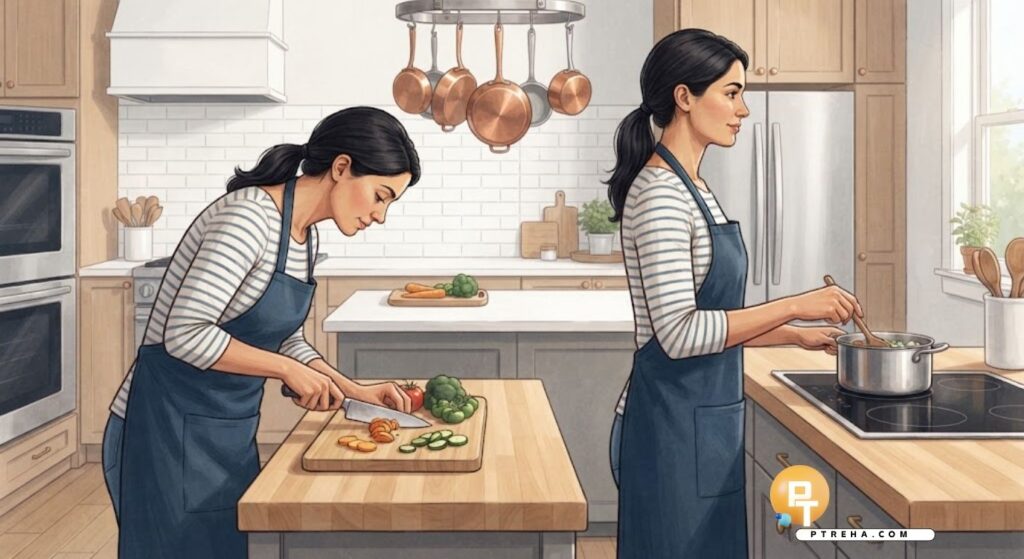
Cooking can become surprisingly demanding when meal preparation involves prolonged standing, repeated reaching, chopping, lifting cookware, bending into low cabinets, and working at a counter that does not suit your body.
Good kitchen ergonomics aims to reduce unnecessary back and shoulder strain by bringing the task closer to you, limiting prolonged awkward positions, managing heavier loads, and changing positions regularly rather than trying to maintain one “perfect” posture.
Why cooking can strain your back and shoulders
Kitchen work combines several physical demands that are familiar in physical therapy and occupational ergonomics.
One movement may be harmless by itself, but repeated or sustained exposure can increase muscular fatigue and aggravate sensitive tissues.
Common kitchen stressors include:
- Leaning forward over a counter for prolonged periods.
- Reaching into high cupboards.
- Repeated chopping and stirring.
- Carrying heavy pots with the arms away from the body.
- Twisting between the counter, sink, and stove.
- Bending repeatedly into low cupboards.
- Loading and unloading a low dishwasher.
- Standing in one position for a long meal-preparation session.
- Working with elevated shoulders because the surface is too high.
- Reaching forward because frequently used items are too far away.
The principle is not that bending, reaching, or lifting are inherently dangerous.
The issue is the dose: how much force is required, how often the task is repeated, how long a position is maintained, and whether the body has opportunities to change position and recover.
The NIOSH guidance on ergonomic risk factors identifies awkward posture, repetition, lifting, forceful movement, overhead work, and static posture among factors associated with musculoskeletal problems.
Watch the position of the task, not just your posture
A common mistake is repeatedly telling yourself to “stand up straight” while leaving the cutting board, pan, or ingredient in an awkward location.
Instead, change the task first:
- Move the bowl toward you.
- Raise an item that is too low.
- Lower an item that requires repeated shoulder elevation.
- Turn your feet toward the task.
- Slide heavy objects before lifting when practical.
- Clear enough counter space to work close to your body.
From a physical therapy perspective, this is often more practical than continuously correcting individual joints during a long cooking session.
Set up the kitchen around your most common tasks
An ergonomic kitchen does not require a complete renovation.
Small changes in where you store and prepare things can reduce hundreds of unnecessary reaches and bends over time.
Start by identifying what you use almost every day.
Keep commonly used items:
- Between roughly hip and shoulder level when possible.
- Near their point of use.
- Within comfortable arm reach.
- Away from very low shelves if they are heavy.
- Away from overhead shelves if they are frequently handled.
- At the front of deep cupboards instead of at the back.
- In easy-to-open drawers where appropriate.
For example, if your cutting board is beside the stove but the knives, oils, and seasonings are across the room, meal preparation creates repeated reaching, turning, and walking.
A better arrangement groups related tasks together.
Create simple kitchen work zones
A practical setup might include:
- Preparation zone: cutting board, knives, mixing bowls, seasonings.
- Cooking zone: pans, utensils, oils, pot holders.
- Washing zone: detergent, brushes, towels, frequently washed utensils.
- Breakfast zone: coffee, tea, cups, cereal, toaster.
- Storage zone: heavier appliances and less frequently used cookware.
This reduces unnecessary movement without eliminating movement entirely.
Some walking and position changes are beneficial because remaining static for a long time can also become uncomfortable.
The broader ergonomic principle is consistent with OSHA ergonomics guidance, which emphasizes reducing exposure to excessive lifting, bending, overhead reaching, force, awkward positions, and highly repetitive tasks.
Adjust counter work for chopping, mixing, and food preparation
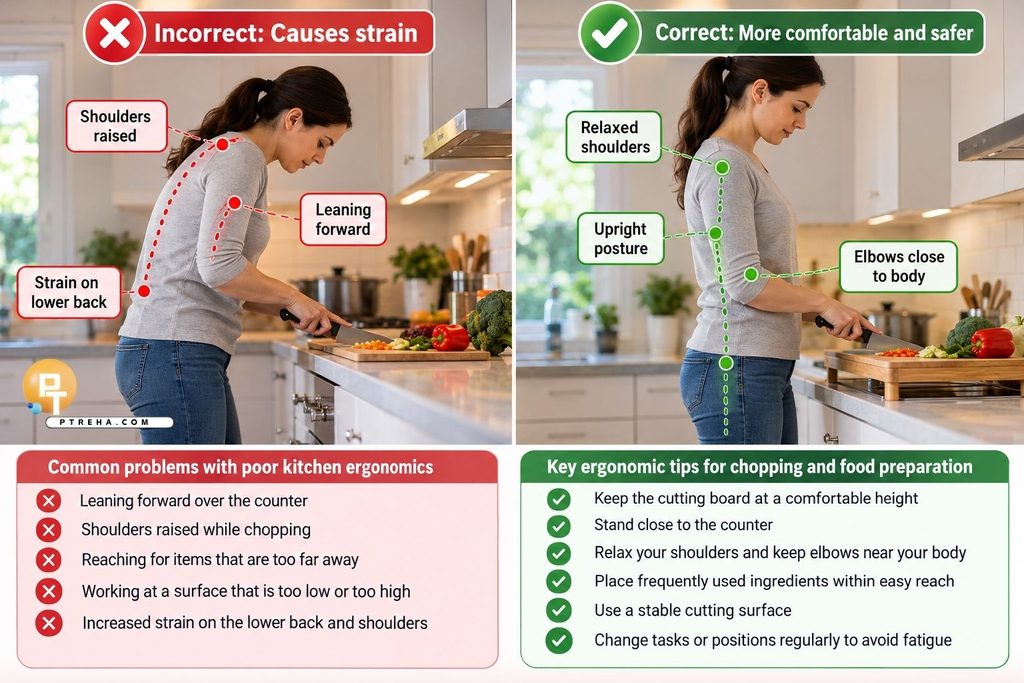
Counter height matters because different tasks require different amounts of precision and force.
A surface that feels comfortable for mixing a salad may feel too high when forcefully cutting a large vegetable.
Conversely, a very low surface may cause excessive trunk flexion during detailed preparation.
Signs that the working height may not suit the task include:
- Constantly shrugging the shoulders.
- Holding the elbows unusually high.
- Leaning heavily over the counter.
- Bending the neck far forward to see the food.
- Repeatedly shifting backward to create room for the arms.
- Experiencing shoulder fatigue before the rest of the body feels tired.
For routine light preparation, place the task where your elbows can remain relatively close to your sides and your shoulders can stay relaxed.
For tasks requiring more downward force, a slightly lower working position may feel more efficient because you can use more of your body rather than generating all the force through the shoulders and wrists.
Make chopping easier on your shoulders and back
Try these adjustments:
- Place the cutting board directly in front of you.
- Work close enough that you do not have to reach.
- Keep your shoulders relaxed rather than elevated.
- Position frequently used ingredients beside the board.
- Use a stable cutting surface.
- Keep knives appropriately maintained for the task.
- Avoid repeatedly cutting at the far edge of a deep counter.
- Move the food instead of repeatedly reaching across the board.
- Alternate demanding preparation with easier tasks.
- Sit for selected preparation tasks when appropriate and safe.
If the counter is clearly too low for a light preparation task, a secure raised cutting surface may reduce prolonged forward bending.
Any raised surface must remain stable enough that it does not introduce a cutting or slipping hazard.
Use better mechanics at the sink, dishwasher, stove, and oven
The kitchen sink often encourages prolonged forward leaning because the hands work below the top of the counter and slightly in front of the body.
Instead of maintaining one fixed position while washing a large number of dishes, regularly reposition yourself.
Helpful strategies include:
- Stand close to the sink.
- Avoid reaching across a sink full of objects.
- Bring items toward your side before scrubbing them.
- Alternate hand positions when practical.
- Divide a long washing session into smaller batches.
- Occasionally place one foot on a secure low support if comfortable.
- Change which foot is supported.
- Take a brief position-change break during lengthy tasks.
- Avoid twisting to place dishes behind you.
- Turn your whole body toward the drying area.
The Canadian Centre for Occupational Health and Safety guidance on standing work recommends changing working positions frequently and avoiding excessive bending, stretching, and twisting.
It also notes that tools and frequently used controls should be arranged so they can be reached without unnecessary bending or twisting.
Loading the dishwasher
Dishwashers introduce another common problem: repeated bending combined with reaching.
A useful sequence is:
- Bring dishes close to the dishwasher first.
- Face the dishwasher rather than twisting toward it.
- Bend through the hips and knees as needed.
- Keep heavier dishes close to your body.
- Load several nearby objects before returning upright.
- Change position if prolonged bending becomes uncomfortable.
You do not need to keep the spine perfectly straight.
Normal spinal movement is expected.
The goal is simply to avoid unnecessarily holding a deeply bent or twisted position while repeatedly handling loads.
Working at the stove and oven
At the stove:
- Use front burners when practical for frequently handled cookware.
- Position pan handles where they can be reached comfortably and safely.
- Keep commonly used utensils nearby.
- Move closer instead of reaching across the cooktop.
- Avoid prolonged stirring with the shoulder elevated.
- Switch hands for appropriate low-risk tasks when comfortable.
For the oven:
- Move close before reaching inside.
- Open the door fully when safe.
- Use both hands for a heavy baking dish when appropriate.
- Avoid lifting and twisting simultaneously.
- Turn your feet toward the destination before carrying the dish.
- Clear the destination counter before removing hot cookware.
Safety around heat always takes priority over ergonomic convenience.
Lift pots, appliances, and groceries with less unnecessary strain
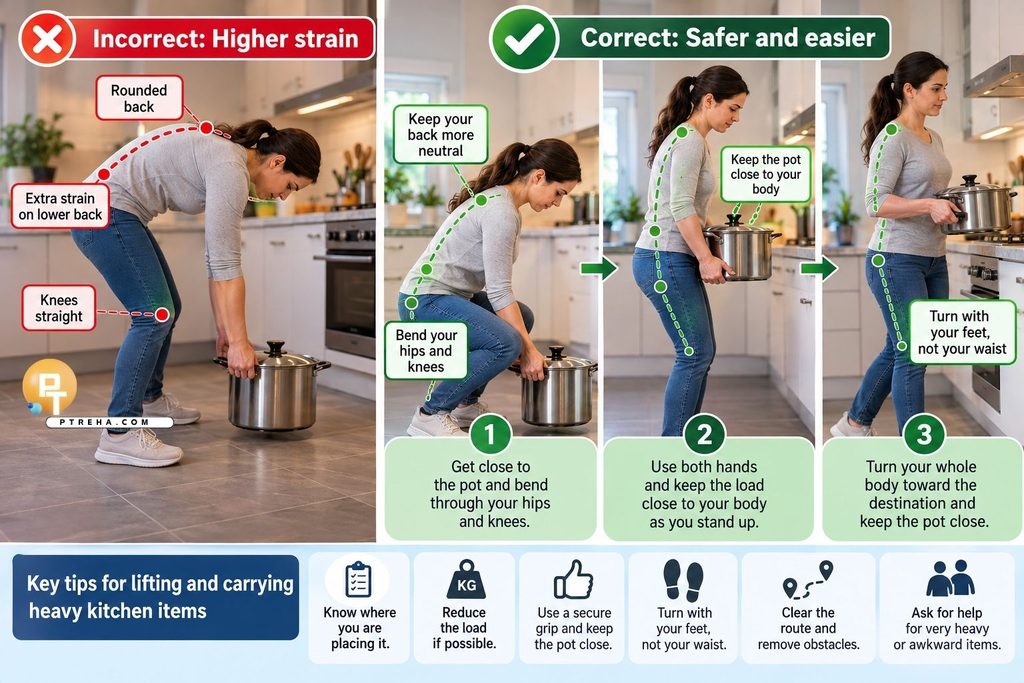
There is no single lifting posture that guarantees protection from back pain.
Load weight, object size, distance from the body, frequency, fatigue, individual capacity, and the surrounding environment all matter.
In a kitchen, one of the most useful principles is simple: reduce the load and keep manageable loads reasonably close to you.
Before lifting a heavy pot, appliance, or shopping bag:
- Know where you are placing it.
- Clear obstacles from the route.
- Move close to the object.
- Get a secure grip.
- Reduce the contents when practical.
- Use two hands for awkward loads.
- Keep the object relatively close to your trunk.
- Turn with your feet instead of twisting under a heavy load.
- Ask for help when the object exceeds your comfortable capacity.
- Make two trips instead of forcing one overloaded trip.
A large pot full of water is a good example.
Rather than carrying it across the kitchen unnecessarily, place the empty pot where you need it first and add water closer to that location when the kitchen setup permits.
Slide before you carry
Some objects do not need to be lifted immediately.
You may be able to:
- Slide a heavy appliance forward before picking it up.
- Move a pot along the counter before lifting it.
- Divide groceries into smaller loads.
- Transfer food into smaller containers.
- Store frequently used heavy appliances on the counter.
- Use a small cart for multiple heavy items when appropriate.
Reducing the distance between the load and your body can be as important as thinking about the lifting motion itself.
Manage standing fatigue instead of searching for a perfect posture
People often assume there is one ideal standing posture they should maintain throughout cooking.
Clinically, a more useful approach is to encourage postural variability.
Even a relatively comfortable posture can become tiring when maintained for too long.
During a longer cooking session, alternate among:
- Standing evenly on both feet.
- Shifting weight from one leg to the other.
- Taking a few steps around the kitchen.
- Briefly resting one foot on a secure low support.
- Sitting for suitable preparation tasks.
- Walking while waiting for food to cook.
- Changing from chopping to washing or organizing.
- Taking a brief recovery break.
Prolonged standing may contribute to muscular fatigue and discomfort in the back, neck, shoulders, legs, and feet, particularly when the worker has little opportunity to change position.
Consider the floor and footwear
Standing comfort is influenced by more than posture.
Pay attention to:
- Supportive, comfortable footwear.
- Adequate traction on kitchen flooring.
- Wet or slippery areas.
- Hard flooring during prolonged preparation.
- Mats that remain flat and do not create a trip hazard.
- Adequate space to reposition your feet.
An anti-fatigue mat may improve comfort for some people who stand for prolonged periods, but it should be stable, appropriately positioned, and easy to clean.
Reduce shoulder strain during reaching, stirring, and overhead storage
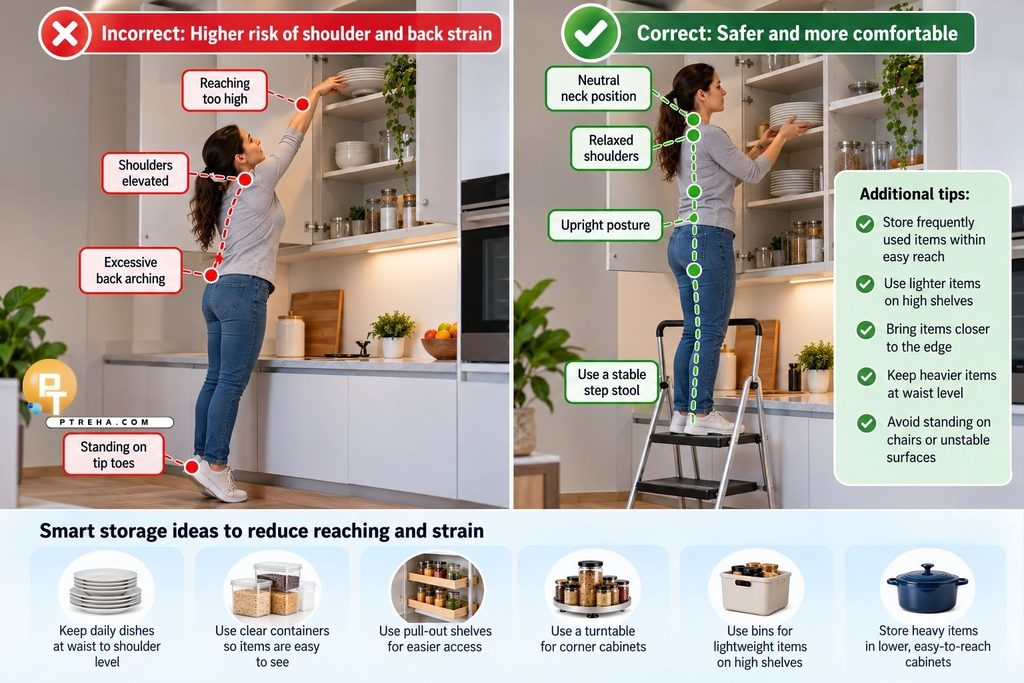
Shoulder discomfort in a kitchen often develops during tasks performed with the arm repeatedly elevated or held away from the body.
Common examples include:
- Reaching into a high cupboard.
- Stirring a large pot for a long time.
- Handling heavy cookware with one arm.
- Reaching across a deep counter.
- Using an appliance stored above shoulder level.
- Repeatedly moving dishes onto an overhead shelf.
Whenever possible, reorganize the kitchen so high storage is reserved for lighter, less frequently used objects.
Frequently used objects are usually easier to handle when they are stored within comfortable reach.
For high cabinets
Use these strategies:
- Move frequently used dishes to a lower shelf.
- Store light objects overhead instead of heavy cookware.
- Avoid repeatedly reaching at your maximum range.
- Use an appropriate stable step stool when necessary.
- Bring objects toward you before lowering them.
- Never climb onto unstable chairs or countertops.
- Avoid storing heavy objects where they must be lowered from overhead.
If a shoulder is already painful, repeatedly testing how high you can reach while cooking may simply irritate it further.
Temporarily reorganizing the kitchen can reduce exposure while the underlying problem is properly assessed.
Reduce lower-back strain during everyday cooking
Back discomfort during cooking is often associated with prolonged static standing, repeated forward bending, lifting, or combining bending with rotation.
The solution is rarely to make the spine rigid.
Instead:
- Move closer to the work surface.
- Bring ingredients toward you.
- Avoid leaving frequently used items on the floor.
- Use drawers rather than deep low shelves where possible.
- Face the task before lifting.
- Change position frequently.
- Break long preparation sessions into stages.
- Use a seat for appropriate tasks.
- Avoid holding a bent position while searching through cabinets.
- Keep regularly used heavy objects between low and high extremes.
Kitchen task and ergonomic adjustment
| Kitchen task | Common physical demand | Practical adjustment |
|---|---|---|
| Chopping | Forward leaning, repeated arm movement | Bring the board closer and adjust working height |
| Washing dishes | Sustained standing and forward reach | Stand close, reposition dishes, change stance |
| Stirring | Repetitive shoulder movement | Keep the pot close and elbow nearer the body |
| High cupboards | Overhead reaching | Relocate frequently used items lower |
| Low cupboards | Repeated bending | Store frequent or heavier items higher |
| Dishwasher | Repeated bending and reaching | Face the machine and work in small batches |
| Heavy cookware | Lifting and carrying | Reduce load, use two hands, clear destination first |
| Oven | Low reaching plus load handling | Move close, prepare destination, avoid turning under load |
| Long meal preparation | Static standing | Alternate tasks, positions, walking, and sitting |
These modifications should be individualized.
A strategy that helps one person may not be appropriate for someone with balance limitations, recent surgery, neurological symptoms, significant arthritis, or another condition affecting movement.
Use symptoms as feedback without assuming every ache is an injury
Temporary muscle fatigue after a long cooking session does not automatically mean tissue damage.
Likewise, persistent pain should not simply be dismissed as “poor posture.”
Pay attention to patterns.
Consider modifying the task when you notice:
- Pain consistently increasing during one activity.
- Shoulder fatigue during overhead reaching.
- Back discomfort after prolonged forward leaning.
- Symptoms appearing during heavy lifting.
- Numbness or tingling associated with a particular position.
- Symptoms that continue to worsen despite reducing the provoking task.
- Increasing difficulty performing normal daily activities.
A physical therapist can assess movement, strength, load tolerance, task demands, and environmental factors when symptoms interfere with normal activity.
Seek appropriate medical assessment more urgently when back or shoulder symptoms follow significant trauma or are accompanied by concerning features such as marked weakness, major loss of function, progressive neurological symptoms, severe unexplained systemic symptoms, or changes in bladder or bowel control.
Ergonomic advice is intended to improve task demands and comfort.
It should not be used to diagnose the cause of persistent pain.
Conclusion
Effective kitchen ergonomics is less about holding a perfect posture and more about designing the task around the person.
Keep frequently used items within comfortable reach, work close to the counter, reduce unnecessary lifting and overhead reaching, change positions regularly, and reorganize demanding tasks before they repeatedly provoke back or shoulder discomfort.
Small changes can be particularly useful because cooking involves the same activities day after day.
When discomfort persists, progresses, or limits everyday function despite sensible task modifications, an individualized clinical assessment is more appropriate than continuing to experiment with posture alone.
Frequently Asked Questions
What is the best posture for standing in the kitchen?
There is no single posture that needs to be maintained throughout cooking.
A comfortable alignment combined with frequent position changes is generally more practical than trying to remain rigidly upright.
Stand close enough to the task that you are not constantly leaning or reaching, and change your stance as the activity changes.
How can I stop my lower back from hurting while cooking?
Start by looking at what happens immediately before the discomfort appears.
Prolonged forward leaning, repeated bending, heavy lifting, and static standing are common contributors.
Move frequently used items closer, change position more often, divide long cooking sessions into stages, and sit for suitable preparation tasks when appropriate.
Why do my shoulders hurt when chopping vegetables?
The working surface may be too high, the cutting board may be too far away, or the task may require prolonged repetitive arm activity.
Try bringing the board closer, relaxing the shoulders, keeping the elbows nearer the body, and changing tasks before substantial fatigue develops.
Should I stand perfectly straight while cooking?
No.
The human body is designed to move, and normal bending is not inherently harmful.
The more useful goal is to avoid unnecessarily prolonged or highly demanding positions and to vary your posture throughout the task.
Is sitting while preparing food better for my back?
It can be useful for selected tasks, particularly if prolonged standing increases symptoms.
Sitting is not automatically superior to standing, however.
Choose a stable seat and arrange the work so that you can remain close to the food without excessive reaching or bending.
How should I lift a heavy cooking pot?
Move close to the pot, establish a secure grip, know where you are placing it, and reduce the load if it feels difficult to control.
When appropriate, use two hands and turn your feet toward the destination rather than carrying a heavy object while simultaneously twisting.
Where should heavy kitchen appliances be stored?
Frequently used heavy appliances are generally easier to handle when stored at a height that does not require deep bending or overhead lifting.
If an appliance is used every day, keeping it securely on the counter may eliminate repeated lifting altogether.
Can an anti-fatigue mat help while cooking?
A suitable mat may improve standing comfort for some people, especially on hard flooring.
It should lie flat, provide secure footing, and not create a slipping or tripping hazard.
Position changes remain important even when using a mat.
Should I stretch my back and shoulders while cooking?
Brief comfortable movement can help interrupt prolonged static positions, but there is no single stretch everyone needs.
Walking, changing stance, moving the shoulders comfortably, or switching tasks may be enough.
Persistent symptoms require assessment rather than increasingly aggressive stretching.
When should kitchen-related back or shoulder pain be assessed?
Consider professional assessment when pain persists, repeatedly interferes with cooking or other daily activities, progressively worsens, or is accompanied by weakness, numbness, significant loss of movement, or other concerning symptoms.
Sudden severe symptoms following trauma or symptoms accompanied by significant neurological or systemic warning signs require appropriate medical evaluation.