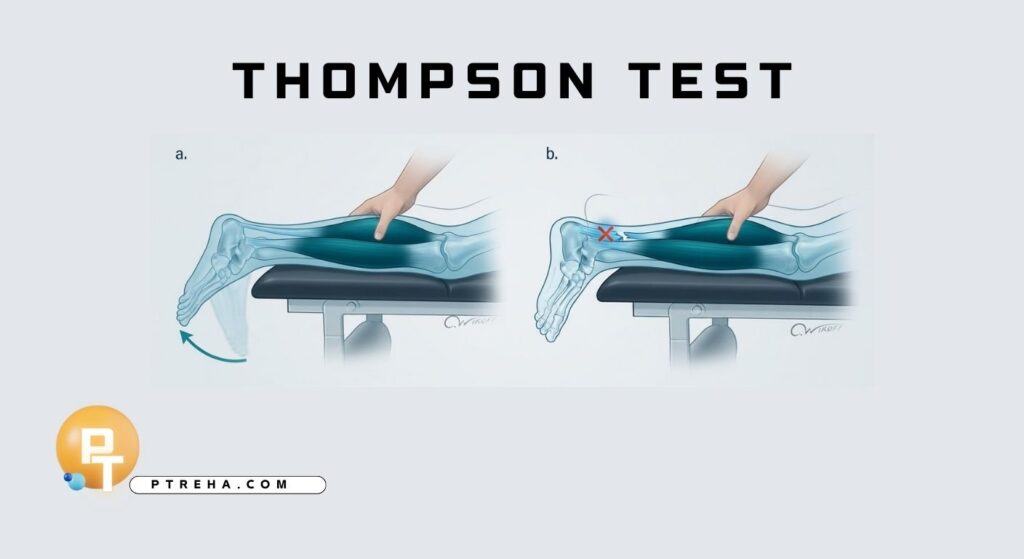
The Thompson Test is a simple orthopedic clinical assessment used when an Achilles tendon rupture is suspected. By gently compressing the calf and observing the resulting ankle movement, the clinician assesses whether force from the calf musculature is being transmitted through the Achilles tendon to produce plantarflexion.
What Is the Thompson Test?
The Thompson Test, also called the Simmonds-Thompson test or calf-squeeze test, is an orthopedic special test used primarily during the clinical assessment of a suspected Achilles tendon rupture.
The test relies on the mechanical connection between the gastrocnemius-soleus complex and the foot through the Achilles tendon. When the calf is compressed, shortening of the calf musculature normally produces plantarflexion of the ankle.
In an Achilles tendon rupture, transmission of this force can be disrupted. The examiner therefore compares the movement produced by calf compression on the suspected side with the opposite side.
The Thompson Test is not an outcome measure, strength test, or functional performance test. It is a clinical assessment that contributes to the diagnosis of Achilles tendon rupture alongside the history and other examination findings.
Purpose of the Thompson Test
The main purposes of the test are to:
- Assess continuity of the Achilles tendon when rupture is suspected.
- Identify absent or substantially reduced plantarflexion produced by calf compression.
- Contribute to the clinical diagnosis of an acute Achilles tendon rupture.
- Provide information that can help determine whether further clinical assessment or imaging is appropriate.
- Compare the involved limb with the contralateral limb rather than relying on an isolated observation.
The test is particularly useful because an Achilles rupture can sometimes be overlooked when the patient can still walk or actively move the ankle.
“The key observation is the movement of the foot produced by calf compression, not pain alone.”
Thompson Test Indications
The Thompson Test may be considered when there is clinical suspicion of an Achilles tendon injury, particularly when the patient reports findings such as:
- Sudden posterior ankle or lower-leg pain during forceful activity.
- A reported popping or snapping sensation.
- A feeling of being struck in the back of the leg.
- New weakness during ankle plantarflexion.
- Difficulty with push-off during walking.
- Suspected Achilles tendon discontinuity on palpation.
- Clinical findings suggesting an acute Achilles tendon rupture.
The test is less useful when interpreted without the patient’s history and the remainder of the physical examination.
Thompson Test Contraindications and Precautions
There is no universally established test-specific absolute contraindication to performing a gentle Thompson Test in an appropriate clinical examination.
Relevant precautions include:
- Do not perform the maneuver aggressively or repeatedly when acute pain is severe.
- Use additional caution following Achilles tendon surgery or during tendon rehabilitation, where loading restrictions may apply.
- Avoid treating the maneuver as a self-test when an acute rupture is suspected.
- Consider wounds, significant swelling, fractures, or other acute injuries that may make positioning or calf compression inappropriate.
- Stop the examination if the maneuver produces concerning pain or other symptoms.
The purpose is assessment, not stress-testing the tendon. In a patient with a suspected acute rupture, unnecessary loading should be avoided while appropriate medical assessment is arranged.
Patient Position
A commonly described position is:
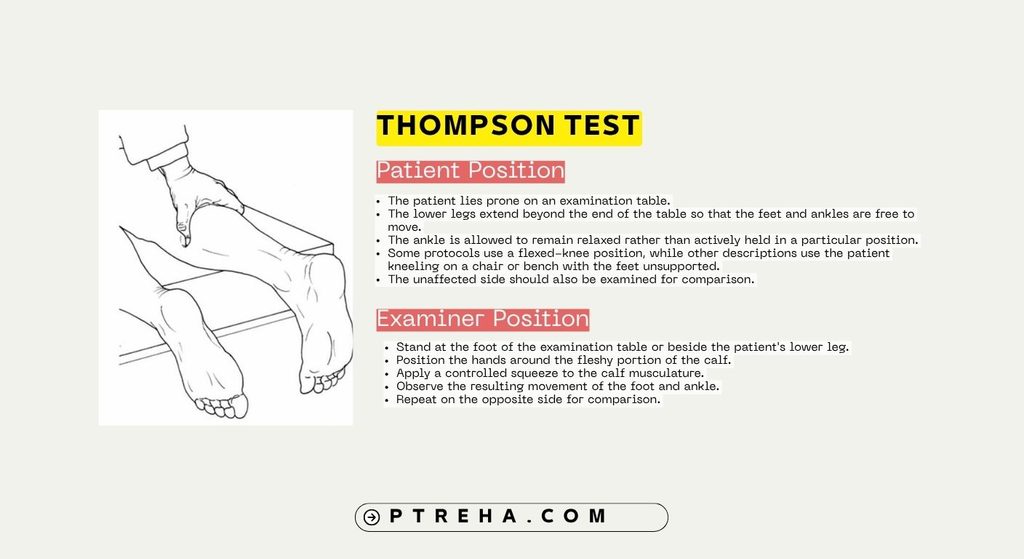
- The patient lies prone on an examination table.
- The lower legs extend beyond the end of the table so that the feet and ankles are free to move.
- The ankle is allowed to remain relaxed rather than actively held in a particular position.
- Some protocols use a flexed-knee position, while other descriptions use the patient kneeling on a chair or bench with the feet unsupported.
- The unaffected side should also be examined for comparison.
The important practical feature is that the foot must be free enough for plantarflexion to be observed.
Examiner Position
The examiner should:
- Stand at the foot of the examination table or beside the patient’s lower leg.
- Position the hands around the fleshy portion of the calf.
- Apply a controlled squeeze to the calf musculature.
- Observe the resulting movement of the foot and ankle.
- Repeat on the opposite side for comparison.
The examiner should avoid compressing directly over a painful or injured area when this is unnecessary.
How to Perform the Thompson Test
A commonly used clinical procedure is:
- Position the patient prone with the feet free beyond the end of the examination table.
- Allow the lower limb and ankle to relax.
- Observe the resting position of both feet before applying compression.
- Gently squeeze the muscular portion of the calf on the unaffected side.
- Observe the resulting plantarflexion of the foot.
- Repeat the same maneuver on the suspected side.
- Compare the amount and character of foot movement between limbs.
- Integrate the finding with the patient’s history, palpation, active movement, strength examination, and other relevant clinical findings.
The comparison between sides is important because the examination is based on the mechanical response to calf compression rather than on an independently defined universal movement threshold.
What Constitutes a Positive Test?
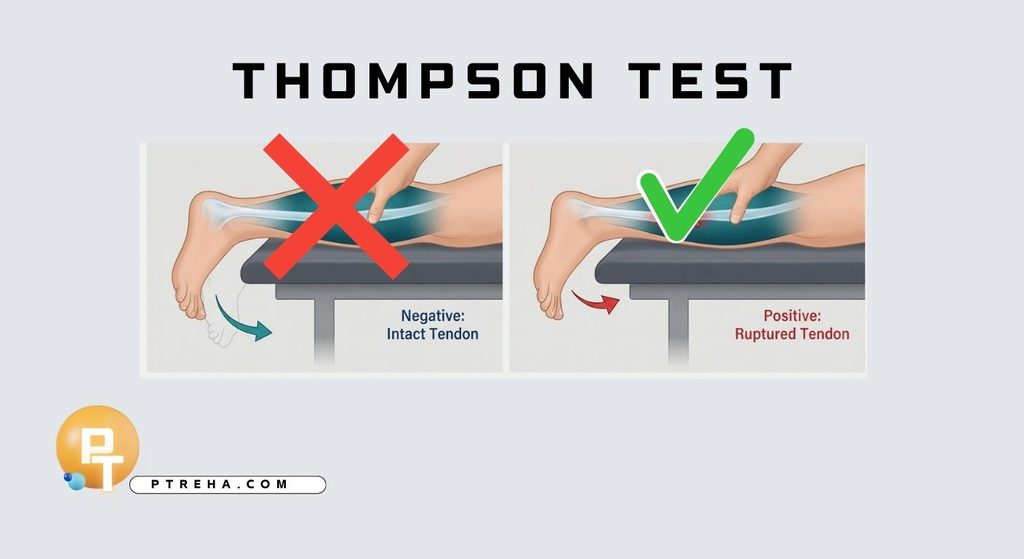
A positive Thompson Test is commonly described as absence of the expected plantarflexion response, or clearly reduced plantarflexion compared with the contralateral limb, when the calf is squeezed.
The exact visual appearance of the foot can vary between individuals and examination protocols. For this reason, the finding should be described clearly in the clinical record rather than relying only on the word “positive.”
For example, documenting “no observable plantarflexion with calf squeeze compared with the opposite side” is more informative than simply writing “positive Thompson.”
What Does a Positive Thompson Test Mean?
An abnormal Thompson Test raises the clinical suspicion of an Achilles tendon rupture, particularly a complete rupture in the acute setting.
It does not independently establish the complete clinical picture. Diagnosis should take into account the mechanism of injury, symptoms, inspection, palpation, active plantarflexion, functional findings, and other appropriate examinations.
The test is especially relevant because preserved active ankle movement does not necessarily exclude an Achilles rupture. Other structures can contribute to plantarflexion, so movement of the ankle should not automatically be interpreted as proof that the Achilles tendon is intact.
Negative Thompson Test
A negative or preserved response means that plantarflexion occurs when the calf is compressed and is sufficiently similar to the contralateral limb for the examiner to consider the response preserved.
This finding makes a complete Achilles rupture less likely, but it does not rule out every form of Achilles tendon injury.
Partial rupture, chronic rupture, or other clinical circumstances can allow some plantarflexion to remain. Therefore, a preserved Thompson response should always be interpreted within the overall examination.
Anatomy Involved in Thompson Test
The Thompson Test depends on the normal transmission of force through several anatomical structures:
- Gastrocnemius muscle — contributes to plantarflexion and forms part of the calf musculature being compressed.
- Soleus muscle — an important plantarflexor whose force is transmitted through the Achilles tendon.
- Achilles tendon — connects the calf musculature to the calcaneus and transmits muscular force to the foot.
- Calcaneus — the heel bone where the Achilles tendon inserts.
- Ankle plantarflexor mechanism — produces the observed downward movement of the foot.
The Thompson Test does not isolate one individual muscle. The observed response reflects the integrated mechanical relationship between the calf musculature, Achilles tendon, and foot.
Conditions Detected / Associated With the Test
The Thompson Test is primarily associated with:
- Acute Achilles tendon rupture, particularly when complete rupture is suspected.
- Clinical assessment of suspected disruption of Achilles tendon continuity.
It is not primarily a test for Achilles tendinopathy. Tendinopathy requires assessment of symptoms, loading response, tendon findings, and the broader clinical presentation.
The test may be less conclusive in partial tears and chronic ruptures, where plantarflexion can remain possible.
Clinical Significance
The Thompson Test can contribute to clinical decision-making in several ways:
- A clearly abnormal response can substantially increase suspicion of an Achilles rupture.
- A preserved response can reduce suspicion of a complete rupture but cannot exclude every Achilles tendon injury.
- The test can be performed rapidly as part of the physical examination.
- It can help clinicians recognize an injury that may otherwise resemble an ankle sprain.
- When examination findings are equivocal, ultrasound or other imaging may provide additional information depending on the clinical question.
In many acute presentations, history and physical examination provide the core diagnostic information. Imaging is not automatically required simply because an Achilles rupture is suspected, although ultrasound or MRI may be useful when the diagnosis or extent of injury remains uncertain or when additional information is needed for management.
“A preserved ankle movement does not, by itself, prove that the Achilles tendon is intact.”
Sensitivity and Specificity
Published research supports the Thompson/calf-squeeze test as an important clinical examination maneuver for suspected Achilles rupture, but its diagnostic estimates are not a universal fixed pair of numbers.
A systematic review and meta-analysis evaluating clinical measures for Achilles tendon injuries found that diagnostic performance varied among studies and that the calf-squeeze test produced the highest reported sensitivity and specificity among the clinical measures evaluated. The review also emphasized that the available evidence was based on a limited number of eligible studies.
For that reason, sensitivity and specificity should be interpreted according to the specific study population, reference standard, test protocol, and clinical setting rather than quoted as universal properties of every Thompson Test.
Diagnostic Accuracy
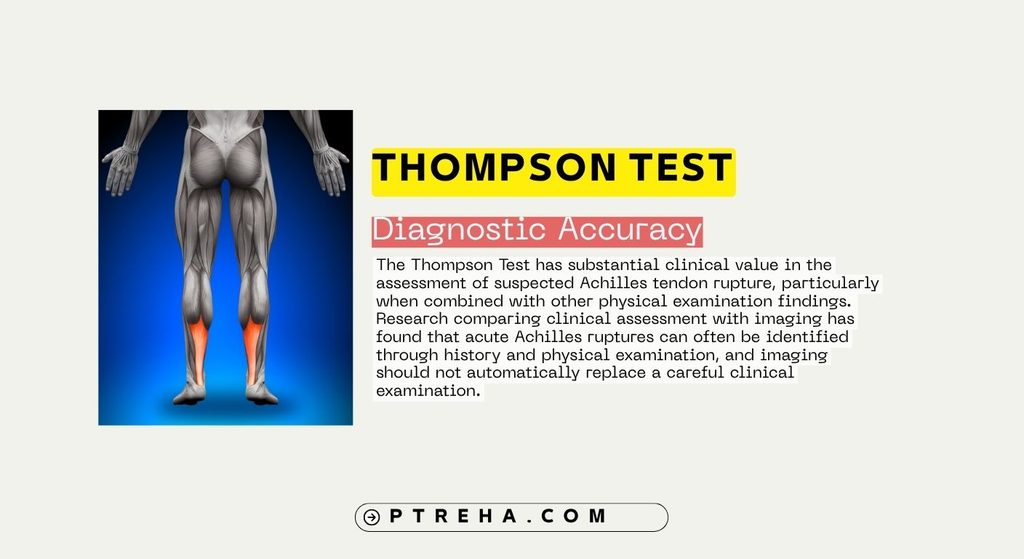
The Thompson Test has substantial clinical value in the assessment of suspected Achilles tendon rupture, particularly when combined with other physical examination findings.
Research comparing clinical assessment with imaging has found that acute Achilles ruptures can often be identified through history and physical examination, and imaging should not automatically replace a careful clinical examination.
However, diagnostic accuracy is different from reliability or clinical usefulness. A test can be highly useful in a clinical pathway without being sufficient to determine the diagnosis in every patient.
Ultrasound can be particularly useful when additional confirmation or anatomical information is needed. Evidence from a systematic review and meta-analysis supports high diagnostic performance of ultrasound for complete Achilles ruptures in surgically treated populations, although those results apply to the studied imaging protocols and populations rather than to every clinical setting.
Common Mistakes in Thompson Test
- Squeezing the calf too forcefully or unnecessarily.
- Testing only the injured side instead of comparing both limbs.
- Allowing the patient’s foot to remain supported so that movement cannot be observed.
- Failing to position the patient consistently.
- Interpreting any plantarflexion as proof that the Achilles tendon is intact.
- Assuming a negative Thompson Test excludes partial or chronic Achilles tendon injury.
- Using the test without considering the injury mechanism and clinical history.
- Recording only “positive” or “negative” without describing what was actually observed.
- Treating the Thompson Test as a substitute for the complete clinical assessment.
Tips for Performing the Thompson Test
- Position the patient so both feet can move freely.
- Demonstrate or assess the unaffected side first when appropriate.
- Use a controlled, consistent calf squeeze.
- Watch the foot rather than concentrating only on the patient’s pain response.
- Compare the involved and uninvolved sides.
- Consider the possibility of partial or chronic injury when plantarflexion is preserved.
- Combine the finding with palpation, active movement, functional examination, and the clinical history.
- Arrange appropriate medical evaluation when an Achilles rupture is suspected, particularly after an acute traumatic event.
Summary
- The Thompson Test is an orthopedic clinical assessment used primarily when Achilles tendon rupture is suspected.
- It involves gently squeezing the calf while observing plantarflexion of the foot.
- Absent or clearly reduced plantarflexion compared with the opposite side increases suspicion of Achilles tendon rupture, especially in an acute presentation.
- Preserved plantarflexion does not exclude every Achilles tendon injury, particularly partial or chronic rupture.
- The test should be interpreted together with the patient’s history and the rest of the physical examination rather than used in isolation.
- Ultrasound or other imaging may be appropriate when the clinical findings are uncertain or additional anatomical information is required.
A properly performed Thompson Test is quick and clinically useful, but its real value comes from placing the finding within the complete assessment of the patient rather than treating one maneuver as a stand-alone diagnosis.
Resources
AAOS OrthoInfo — Achilles Tendon Rupture (Tear)
Achilles Tendon Rupture (Tear) — AAOS OrthoInfo
American Academy of Orthopaedic Surgeons — Clinical Practice Guidelines
AAOS Clinical Practice Guidelines
Reiman et al. — The Utility of Clinical Measures for the Diagnosis of Achilles Tendon Injuries: A Systematic Review With Meta-analysis
PubMed — Systematic review and meta-analysis
Maffulli et al. — Achilles Tendon Ruptures: Presentation, Physical Examination, and Diagnosis
PMC — Review of Achilles tendon rupture diagnosis
Simmonds-Thompson Test — Clarification of the Clinical Mechanism
PMC — Clarification of the Simmonds-Thompson test
Achilles Tendon Rupture — StatPearls / NCBI Bookshelf
NCBI Bookshelf — Achilles Tendon Rupture