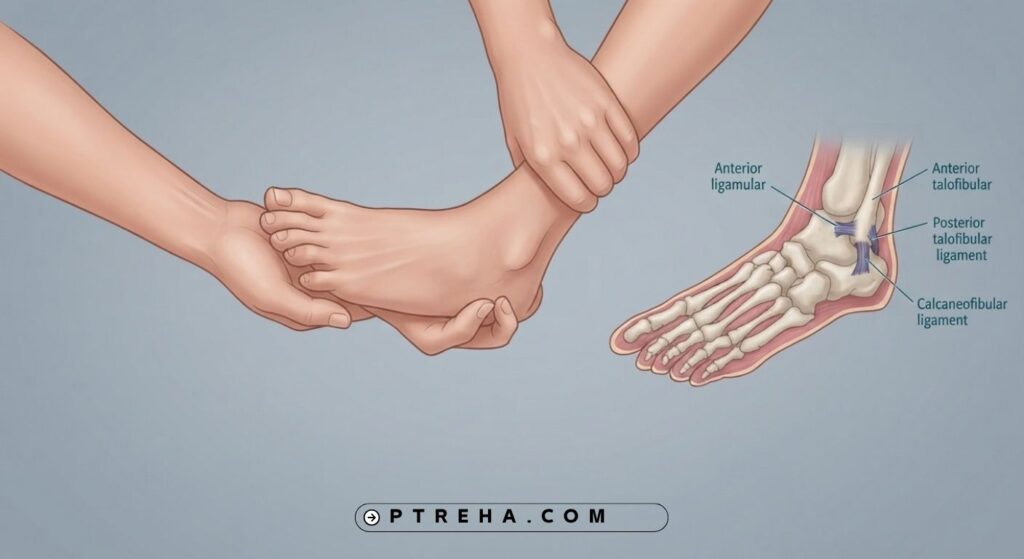
The Talar Tilt Test is an orthopedic special test used during the physical examination of the ankle to assess excessive inversion or eversion movement and to contribute to the assessment of ankle ligament integrity. The inversion version is particularly associated with assessment of the lateral ligament complex, especially the calcaneofibular ligament (CFL). It is not, by itself, sufficient to establish the presence, severity, or exact extent of a ligament injury.
What Is the Talar Tilt Test?
The Talar Tilt Test is a manual stress test in which the clinician stabilizes the distal leg and applies an inversion or eversion stress to the rearfoot and talus.
In the commonly described inversion technique, the clinician stabilizes the distal tibia and fibula while applying an inversion force to the calcaneus and talus. This places stress on the lateral ankle structures, with particular clinical emphasis on the calcaneofibular ligament.
The test is therefore best classified as an orthopedic special test and clinical assessment, rather than an outcome measure or functional performance test.
Different descriptions of the maneuver exist. Some protocols emphasize the CFL with the ankle near neutral, while variations in ankle position can alter which lateral ligament structures are stressed. Consequently, the exact technique should be documented rather than assuming that every “talar tilt” maneuver is identical.
“The Talar Tilt Test is a stress test, not a stand-alone diagnosis.”
Purpose of the Talar Tilt Test
The Talar Tilt Test may be used to:
- Assess ankle joint laxity during inversion or eversion stress.
- Contribute to the clinical examination of suspected lateral ankle ligament injury.
- Assess the mechanical response of the ankle to an inversion stress, particularly in relation to the calcaneofibular ligament.
- Compare the symptomatic ankle with the contralateral side.
- Complement other examination findings, such as ligament palpation, swelling, bruising, range-of-motion assessment, and the anterior drawer test.
- Contribute to the assessment of patients with recurrent ankle sprains or suspected chronic ankle instability.
The test should be interpreted as one component of a broader examination. Evidence indicates that manual ankle stress tests have limitations, and their findings can vary with technique and examiner experience.
Talar Tilt Test Indications
The test may be considered when the clinical presentation raises concern about ligamentous instability or injury, particularly after an inversion-type ankle injury.
Common clinical situations include:
- Acute lateral ankle sprain.
- Suspected injury involving the lateral ankle ligament complex.
- Recurrent ankle sprains.
- Suspected chronic ankle instability.
- Subjective reports of ankle giving way when ligamentous laxity is part of the differential assessment.
- Follow-up examination when assessing changes in mechanical stability over time.
The presence of pain, swelling, guarding, or acute tissue irritability should influence whether and how strongly the maneuver is applied.
Talar Tilt Test Contraindications and Precautions
There is not a universally established list of Talar Tilt Test-specific absolute contraindications. Instead, the clinician should consider general precautions associated with applying manual stress to an acutely injured ankle.
Use caution when:
- There is severe acute pain or substantial guarding.
- A fracture or major structural injury has not been adequately excluded.
- The ankle is acutely swollen and highly irritable.
- The patient cannot tolerate manual loading of the injured tissues.
- There is suspected dislocation, gross instability, or another injury requiring urgent medical assessment.
- The clinician is uncertain whether the examination maneuver is appropriate for the patient’s injury stage.
The test should never be performed aggressively simply to determine whether a large amount of movement can be produced.
If fracture is suspected, fracture-screening procedures and appropriate medical evaluation take priority over ligament stress testing.
Patient Position
A commonly described position is:
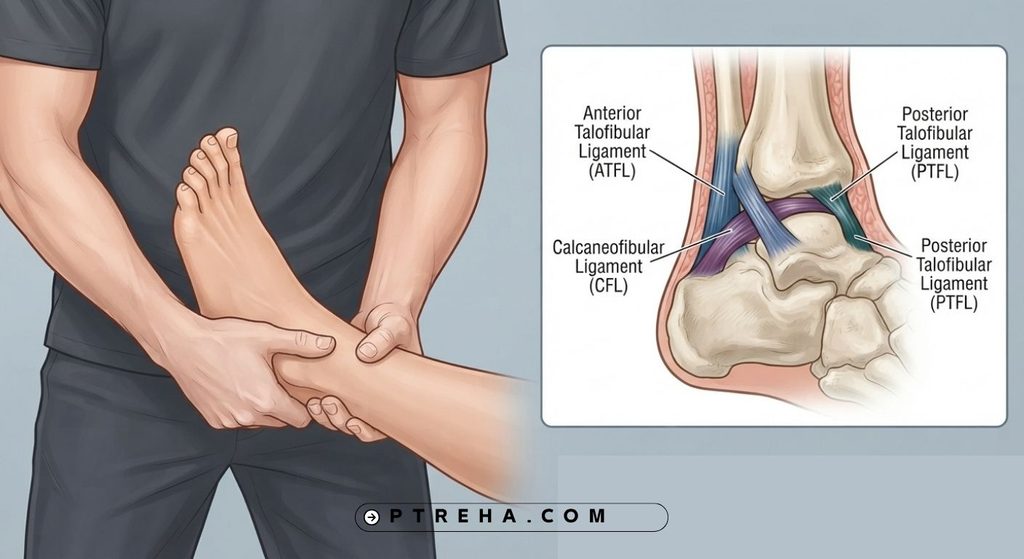
- Position the patient sitting or supine, depending on the clinician’s preferred examination setup.
- Flex the knee sufficiently to allow the ankle and rearfoot to be relaxed.
- Place the ankle in a neutral or standardized position appropriate to the chosen protocol.
- Ensure that the patient is relaxed as much as possible.
- Expose the ankle adequately so that the clinician can observe and palpate relevant structures.
A published description of the inversion stress test uses a flexed knee with the ankle in neutral, while other clinical descriptions use variations in ankle position. The selected position should therefore be consistent and documented.
Examiner Position
The examiner should:
- Position themselves so the ankle can be stabilized and the rearfoot can be controlled comfortably.
- Use one hand to stabilize the distal tibia and fibula.
- Use the other hand to grasp the calcaneus or rearfoot securely.
- Maintain control of the limb throughout the maneuver.
- Apply the stress smoothly rather than using a sudden or forceful movement.
- Observe movement and note the patient’s pain or apprehension response.
The exact hand placement can vary between examination techniques, but stabilization of the distal leg is essential for interpreting movement of the foot relative to the leg.
How to Perform the Talar Tilt Test
For the commonly described inversion Talar Tilt Test:
- Explain the maneuver to the patient and obtain consent.
- Position the patient comfortably with the knee flexed and the ankle in the selected test position.
- Stabilize the distal tibia and fibula with one hand.
- Grasp the calcaneus or rearfoot with the other hand.
- Maintain the distal leg firmly while controlling the foot.
- Apply a controlled inversion stress to the rearfoot and talus relative to the stabilized leg.
- Assess the amount and quality of movement.
- Ask about or observe reproduction of the patient’s familiar pain.
- Compare the response with the uninvolved side when appropriate.
- Release the stress and reassess the patient’s symptoms.
The maneuver should be controlled and limited to what is clinically appropriate. Excessive force does not necessarily provide better information and may increase pain or guarding.
A medial or eversion talar tilt maneuver is a different application of the same general stress-testing concept and may be used when assessing medial ankle ligament laxity. It should not be confused with the inversion version commonly used for the lateral ligament complex.
What Constitutes a Positive Test?
For the inversion version, a commonly used clinical interpretation is that greater talar/rearfoot inversion or laxity on the symptomatic side compared with the contralateral side, particularly when accompanied by relevant symptoms, may represent an abnormal finding.
However, there is no universally applicable manual-movement cutoff that can be used as a pass/fail criterion across all patients and examination protocols.
Side-to-side comparison is particularly useful because individual ankle laxity varies. Even then, increased movement does not by itself establish which ligament is completely torn or determine the precise grade of injury.
What Does a Positive Talar Tilt Test Mean?
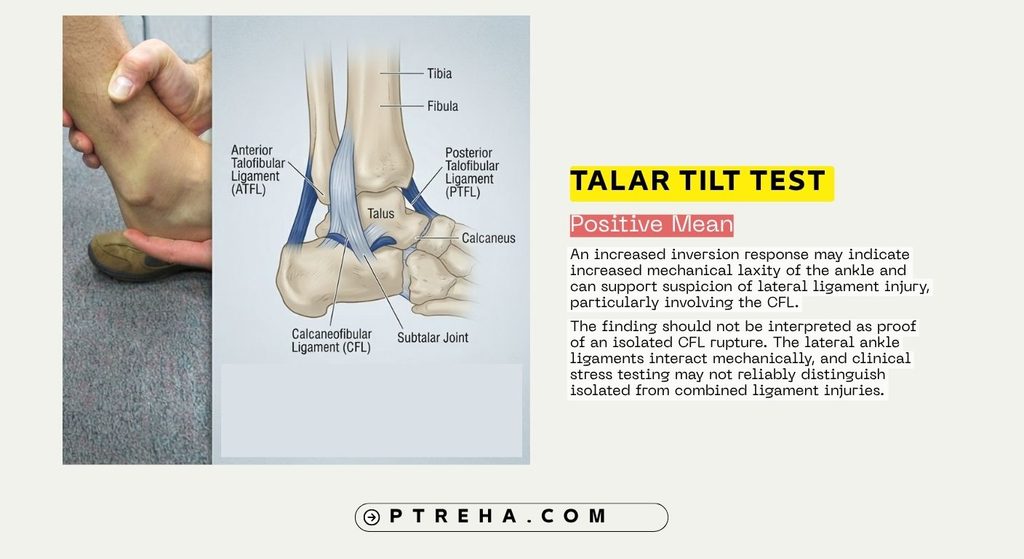
An increased inversion response may indicate increased mechanical laxity of the ankle and can support suspicion of lateral ligament injury, particularly involving the CFL.
The finding should not be interpreted as proof of an isolated CFL rupture. The lateral ankle ligaments interact mechanically, and clinical stress testing may not reliably distinguish isolated from combined ligament injuries.
Pain during the maneuver also requires careful interpretation. Pain may indicate tissue irritability or injury but does not automatically establish ligamentous laxity.
The result should therefore be integrated with the injury mechanism, location of tenderness, swelling and bruising, functional limitations, anterior drawer testing, and other relevant clinical findings.
Negative Talar Tilt Test
A Talar Tilt Test that does not demonstrate a meaningful side-to-side difference reduces the clinical evidence for mechanically increased inversion laxity, but it does not by itself exclude a lateral ankle ligament injury.
Clinical tests vary in their ability to detect different forms and severities of ligament injury. A negative or non-provocative result should therefore be interpreted alongside the patient’s history and other examination findings.
Anatomy Involved in Talar Tilt Test
Relevant structures include:
- Calcaneofibular ligament (CFL): an important lateral ankle ligament that is particularly stressed during inversion testing with the ankle positioned appropriately.
- Anterior talofibular ligament (ATFL): another major component of the lateral ligament complex. Its contribution to the stress response depends partly on ankle position and the exact technique used.
- Talus: the talus participates in the movement being assessed within the ankle mortise.
- Calcaneus: the rearfoot is commonly grasped and moved during the manual inversion maneuver.
- Distal tibia and fibula: these structures are stabilized by the examiner to provide a reference against which rearfoot movement is assessed.
- Deltoid ligament complex: relevant when an eversion or medial talar tilt maneuver is performed.
The test does not mechanically isolate a single ligament under every examination condition. Research using ultrasound has demonstrated that more than one lateral ligament may be lengthened during commonly used ankle stress maneuvers.
Conditions Detected / Associated With the Test
The Talar Tilt Test can contribute to assessment of:
- Lateral ankle ligament sprain.
- Suspected calcaneofibular ligament injury.
- Mechanical ankle laxity following ankle trauma.
- Recurrent lateral ankle sprain.
- Chronic ankle instability when considered together with the patient’s history and broader clinical examination.
- Medial ligament laxity when an appropriately performed eversion version of the test is used.
It is more accurate to describe these conditions as associated with the clinical use of the test rather than saying that the test independently detects or diagnoses them.
Clinical Significance
The Talar Tilt Test can be clinically useful because it provides information about the mechanical response of the ankle to a controlled inversion or eversion stress.
Its significance is greatest when the result agrees with other findings. For example, increased laxity accompanied by localized lateral ligament tenderness and a compatible injury mechanism provides more clinically meaningful information than an isolated movement finding.
Important considerations include:
- Compare sides when the uninvolved side is suitable as a reference.
- Consider pain separately from mechanical laxity.
- Consider muscle guarding, apprehension, swelling, and the patient’s injury stage.
- Use the anterior drawer test and other examination findings when assessing lateral ligament injury.
- Do not use the test alone to determine the exact ligament injury grade.
- Do not assume that increased talar tilt establishes chronic ankle instability.
- Consider imaging or further medical assessment when the clinical presentation warrants it.
A systematic review and meta-analysis of clinical tests for talocrural and subtalar ligament injury concluded that no evaluated test demonstrated both very high sensitivity and very high specificity, and reported that the Talar Tilt Test can contribute to identifying CFL injury but that a highly sensitive clinical test for the CFL was lacking.
“Interpret the amount of movement together with the patient’s symptoms and the rest of the examination—not in isolation.”
Sensitivity and Specificity
Sensitivity and specificity for the Talar Tilt Test are not universal values because diagnostic performance varies according to the population, reference standard, examination protocol, injury definition, and outcome being assessed.
A systematic review and meta-analysis of clinical tests for ligamentous injury found that the Talar Tilt Test could contribute to ruling in calcaneofibular ligament injury, while also noting limitations in the available evidence and the absence of a highly sensitive clinical test for the CFL.
Individual studies have reported different diagnostic performance depending on the population and reference standard. For example, one study of patients with recent lateral ankle sprain compared clinical examination with ultrasound and reported test-specific sensitivity values for identifying complete CFL tears; those findings should not be generalized to all ankle injuries or all Talar Tilt protocols.
For this reason, a single sensitivity or specificity figure should not be presented as a universal property of the Talar Tilt Test.
Diagnostic Accuracy
The Talar Tilt Test has clinical diagnostic value as part of an ankle examination, but its diagnostic accuracy is limited when it is used in isolation.
A systematic review of clinical tests for ligamentous injuries found important limitations in the available evidence and concluded that the Talar Tilt Test can help identify CFL injury while also emphasizing that clinical examination does not reliably provide complete information about ligament injury in every patient.
Manual stress testing may also be influenced by examiner technique, patient guarding, pain, ankle position, and the inherent variability of manual assessment.
Therefore, the test should be regarded as a component of clinical reasoning, rather than a definitive stand-alone diagnostic procedure.
Common Mistakes in Talar Tilt Test
- Applying the maneuver too forcefully.
- Failing to stabilize the distal tibia and fibula.
- Changing the ankle position between examinations without documenting it.
- Comparing the injured ankle with an inappropriate reference side.
- Treating any pain during inversion as proof of ligament rupture.
- Treating increased movement as proof of a complete ligament tear.
- Assuming that the test isolates only the CFL under every protocol.
- Ignoring muscle guarding or patient apprehension.
- Performing the test aggressively during a highly irritable acute injury.
- Using a universal angular cutoff without considering the examination protocol and patient population.
- Interpreting the result without considering the anterior drawer test and other clinical findings.
- Assuming that a negative test excludes all lateral ankle ligament injury.
Tips for Performing the Talar Tilt Test
- Establish the patient’s symptoms before applying the stress.
- Examine the less symptomatic side first when clinically appropriate so the patient understands the maneuver and the examiner has a reference for movement.
- Keep the distal leg well stabilized.
- Use a smooth, controlled stress rather than a sudden thrust.
- Maintain a consistent ankle position when comparing sides.
- Observe both movement and symptom reproduction.
- Document whether the main finding was pain, increased laxity, apprehension, or a combination.
- Consider the injury stage before deciding how much stress is appropriate.
- Interpret the result alongside palpation, swelling, bruising, range of motion, functional findings, and other ligament tests.
- Avoid assigning a ligament injury grade from the Talar Tilt Test alone.
Summary
- The Talar Tilt Test is an orthopedic special test and clinical assessment used to examine ankle laxity under inversion or eversion stress.
- The commonly described inversion maneuver is particularly relevant to assessment of the calcaneofibular ligament and lateral ankle ligament complex.
- The test is performed by stabilizing the distal leg and applying a controlled inversion stress to the rearfoot and talus.
- Increased side-to-side laxity may support suspicion of mechanical ligamentous involvement, but it does not independently establish a specific ligament tear or injury grade.
- There is no single universal cutoff or diagnostic accuracy value that applies to every patient and Talar Tilt protocol.
The most useful approach is to treat the Talar Tilt Test as one component of a structured ankle examination. Careful technique, appropriate patient positioning, side-to-side comparison, symptom assessment, and integration with other clinical findings are more important than producing a large amount of movement.
Resources and External References
Physical Examination of the Ankle: A Review of the Original Orthopedic Special Test Description and Scientific Validity of Common Tests for Ankle Examination — detailed review of ankle stress-test techniques and their clinical basis.
Diagnostic Accuracy of Clinical Tests Assessing Ligamentous Injury of the Talocrural and Subtalar Joints: A Systematic Review With Meta-Analysis — systematic review examining the diagnostic performance of clinical ligament tests.
The Manual Stress Test May Not Be Sufficient to Differentiate Ankle Ligament Injuries — research examining the limitations of manual stress testing for differentiating lateral ligament injury patterns.
Calcaneofibular Ligament Injury — StatPearls/NCBI Bookshelf — clinical overview of CFL injury and examination considerations.
Evaluation of Anterotalofibular and Calcaneofibular Ligament Stress Tests Utilizing Musculoskeletal Ultrasound Imaging — study examining ligament lengthening during ankle stress maneuvers.
Examining Ankle-Joint Laxity Using 2 Knee Positions and With Simulated Muscle Guarding — research addressing manual ankle laxity testing and factors affecting the examination.
External links: PubMed — Diagnostic Accuracy of Clinical Tests Assessing Ligamentous Injury · PMC — Physical Examination of the Ankle Review · NCBI Bookshelf — Calcaneofibular Ligament Injury