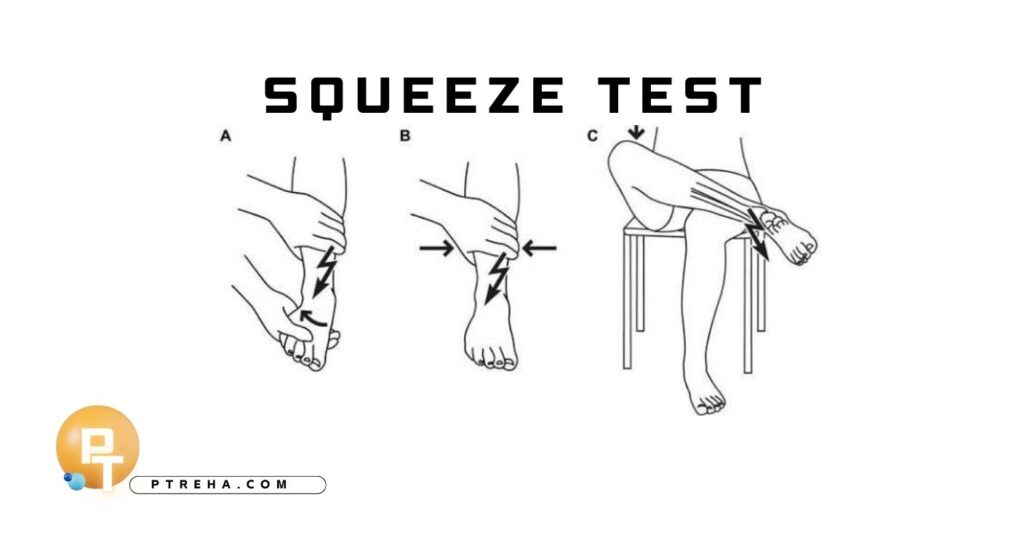
The Squeeze Test is an orthopedic special test used during the clinical examination of an ankle injury when a syndesmotic injury (“high ankle sprain”) is suspected. It involves compressing the tibia and fibula together above the ankle and assessing whether this reproduces the patient’s characteristic pain around the distal tibiofibular syndesmosis. It is useful as part of a broader examination, but it should not be used alone to establish a diagnosis.
What Is the Squeeze Test?
The Squeeze Test is an orthopedic special test and clinical assessment maneuver for the ankle. It is primarily used to assess whether compression of the lower-leg bones reproduces symptoms that may be associated with injury to the distal tibiofibular syndesmosis.
The syndesmosis is the ligamentous complex connecting the distal tibia and fibula. Injury to this region is often referred to as a syndesmotic ankle sprain or high ankle sprain.
During the test, the examiner compresses the tibia and fibula together at the calf. Pain reproduced at the distal syndesmosis can increase clinical suspicion of syndesmotic involvement, particularly when it agrees with the patient’s injury mechanism, symptom location, and other examination findings.
The important distinction is that the Squeeze Test is not a stand-alone diagnostic test. Current evidence indicates that clinical tests for syndesmotic injury have limitations, and diagnosis may require a combination of history, examination, and, when appropriate, imaging.
Purpose of the Squeeze Test
The Squeeze Test may be used to:
- Assess for clinical signs that may be associated with syndesmotic injury.
- Reproduce the patient’s familiar distal tibiofibular or ankle pain during compression.
- Add information to an ankle examination when the injury mechanism or symptom pattern raises suspicion of a high ankle sprain.
- Complement other findings such as syndesmotic ligament tenderness and stress testing.
- Help determine whether further investigation of the syndesmosis may be warranted.
A finding from the Squeeze Test should be interpreted in the context of the entire clinical examination rather than in isolation.
Squeeze Test Indications
The test may be considered when the clinical presentation suggests possible syndesmotic involvement, such as:
- An ankle injury involving external rotation of the foot, particularly with the ankle dorsiflexed.
- Pain or tenderness around the distal tibiofibular syndesmosis.
- An ankle sprain with symptoms that do not fit neatly with an isolated lateral ankle ligament injury.
- Persistent post-traumatic ankle symptoms in which syndesmotic injury remains part of the differential assessment.
- Suspected high ankle sprain during sports or trauma assessment.
The injury mechanism can provide an important clue, but no single mechanism is required for syndesmotic injury.
Squeeze Test Contraindications and Precautions
There is no universally established test-specific contraindication unique to the Squeeze Test. However, the maneuver should be performed cautiously when compression could aggravate an acute injury.
Relevant precautions include:
- Suspected fracture of the tibia or fibula.
- Marked acute pain or significant tissue irritability.
- Suspected gross ankle or syndesmotic instability.
- Recent surgery where compression is restricted by the postoperative plan.
- Significant swelling or acute trauma where manual stressing may be inappropriate.
- Symptoms suggesting a proximal fibular injury, particularly when pain is reproduced higher in the leg.
The examiner should not repeatedly compress an acutely injured limb simply to obtain a clearer response. Clinical judgment and the overall injury presentation should guide whether the maneuver is appropriate.
Patient Position
A commonly described approach is performed with the patient positioned comfortably so that the lower leg is accessible.
- The patient may be positioned sitting or lying, depending on the clinician’s examination sequence.
- The lower leg should be relaxed.
- The ankle should be accessible so the examiner can identify the location of any reproduced symptoms.
- The uninvolved side can be examined when comparison is clinically useful.
Different clinical protocols exist, so positioning should be consistent with the protocol being used and the patient’s condition.
Examiner Position
The examiner should:
- Position themselves so both sides of the patient’s lower leg can be comfortably reached.
- Use both hands to apply medial compression to the tibia and fibula.
- Maintain sufficient control to apply a deliberate but tolerable compression.
- Observe the patient’s pain response and ask where the familiar symptom is reproduced.
The goal is not to apply maximal force. The maneuver should be controlled and stopped if it produces excessive or unfamiliar pain.
How to Perform the Squeeze Test
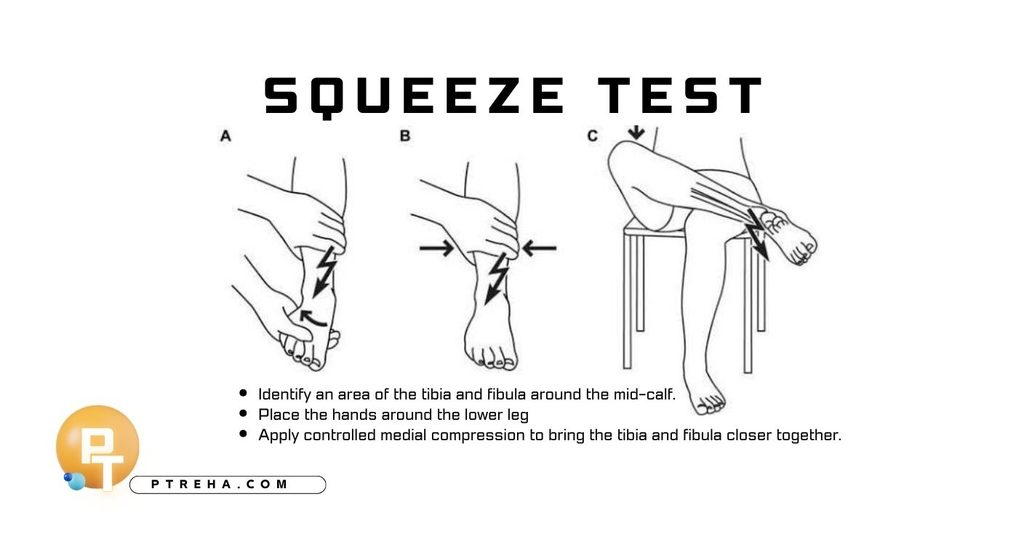
A commonly described syndesmosis Squeeze Test can be performed as follows:
- Position the patient comfortably with the lower leg supported and relaxed.
- Identify an area of the tibia and fibula around the mid-calf.
- Place the hands around the lower leg so the tibia and fibula can be compressed toward one another.
- Apply controlled medial compression to bring the tibia and fibula closer together.
- Ask the patient whether the maneuver reproduces their familiar symptoms.
- Pay particular attention to whether pain is reproduced around the distal tibiofibular syndesmosis near the ankle.
- Record the location and quality of the symptom rather than simply documenting whether the maneuver caused “pain.”
- Interpret the finding alongside palpation, injury mechanism, functional limitations, and other appropriate clinical tests.
Descriptions of the maneuver generally involve proximal compression of the tibia and fibula with assessment for reproduction of pain more distally around the syndesmosis.
What Constitutes a Positive Test?
For this orthopedic special test, a positive Squeeze Test is commonly described as reproduction of pain at the distal tibiofibular syndesmosis during compression of the tibia and fibula above the ankle.
The response should ideally resemble the patient’s familiar complaint rather than being nonspecific discomfort caused simply by pressing on a tender limb.
A positive response does not independently establish a syndesmotic tear, determine its severity, or demonstrate whether the syndesmosis is mechanically unstable.
What Does a Positive Squeeze Test Mean?
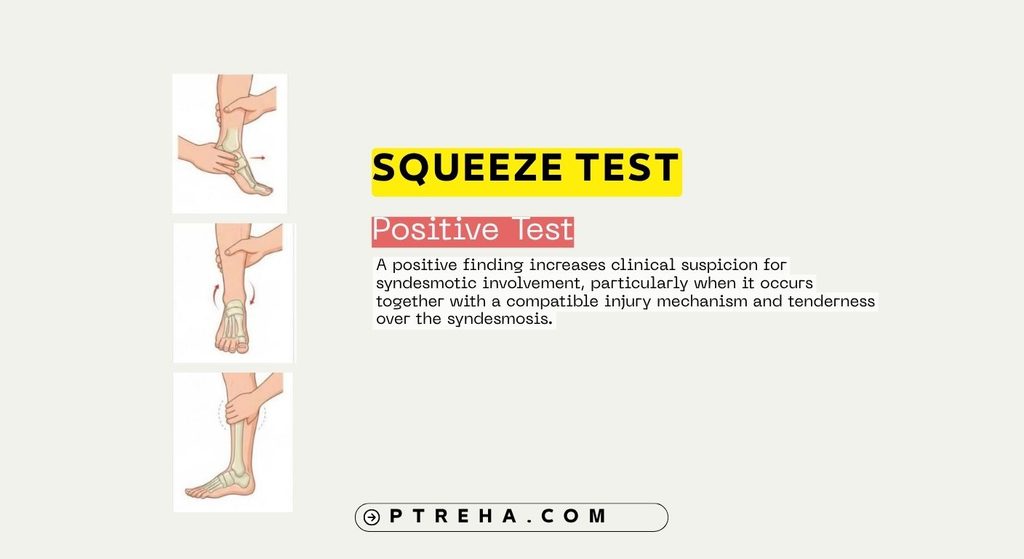
A positive finding increases clinical suspicion for syndesmotic involvement, particularly when it occurs together with a compatible injury mechanism and tenderness over the syndesmosis.
Evidence supporting the test is mixed. A systematic review of clinical tests found that individual tests could not reliably identify syndesmotic injury with certainty, while later systematic-review evidence found the Squeeze Test to have relatively high specificity compared with several other clinical tests.
In one study of patients presenting within two weeks of an ankle sprain, MRI was used as the reference standard. The Squeeze Test had 30% sensitivity and 88% specificity in that study, illustrating why a negative result cannot reliably exclude injury and why the figures should not be treated as universal test characteristics.
Pain occurring more proximally should also be interpreted carefully. Proximal pain can occur with more extensive injury patterns, including a Maisonneuve injury, and therefore should not automatically be classified as a typical distal syndesmotic response.
Negative Squeeze Test
A negative Squeeze Test means that the maneuver does not reproduce the characteristic distal syndesmotic symptoms.
It does not reliably rule out syndesmotic injury. The relatively limited sensitivity reported in individual studies is an important reason clinicians should not use a negative Squeeze Test as the sole basis for excluding the condition.
A patient can therefore have a clinically relevant syndesmotic injury despite a non-painful Squeeze Test.
Anatomy Involved in Squeeze Test
Relevant structures include:
- Distal tibia — the medial bone forming the ankle mortise.
- Fibula — the lateral bone forming the lateral side of the ankle mortise.
- Distal tibiofibular syndesmosis — the ligamentous complex maintaining the relationship between the distal tibia and fibula.
- Anterior inferior tibiofibular ligament (AITFL) — one of the major stabilizing components of the syndesmosis.
- Posterior inferior tibiofibular ligament (PITFL) — an important posterior stabilizing structure.
- Interosseous membrane and related interosseous structures — part of the connective tissue system extending between the tibia and fibula.
The squeeze maneuver does not selectively isolate one of these ligaments. A patient’s pain response therefore cannot be used to determine which individual syndesmotic structure is injured without additional assessment.
Conditions Detected / Associated With the Test
The Squeeze Test is primarily associated with clinical assessment for:
- Ankle syndesmotic injury
- High ankle sprain
- Acute traumatic injuries in which distal tibiofibular ligament involvement is suspected
The test does not independently distinguish among all possible causes of lower-leg or ankle pain. It also does not establish the grade, exact anatomical extent, or mechanical stability of a syndesmotic injury.
Clinical Significance
The Squeeze Test can contribute useful information when it is integrated with other findings.
- A pain response at the distal syndesmosis may increase suspicion of syndesmotic injury.
- The result is more informative when consistent with the injury mechanism and localized syndesmotic tenderness.
- A negative test does not reliably exclude syndesmotic injury.
- Clinical tests should not be used alone to determine whether a syndesmotic injury is stable or unstable.
- When clinical suspicion remains significant, additional diagnostic evaluation may be required.
- Imaging can be particularly important when the diagnosis, injury extent, or stability will influence management.
The 2021 systematic review and meta-analysis concluded that no individual clinical test demonstrated both high sensitivity and high specificity. Its findings support combining more sensitive examination findings with the Squeeze Test rather than relying on one maneuver alone.
“A Squeeze Test is one piece of the examination, not the diagnosis.”
Sensitivity and Specificity
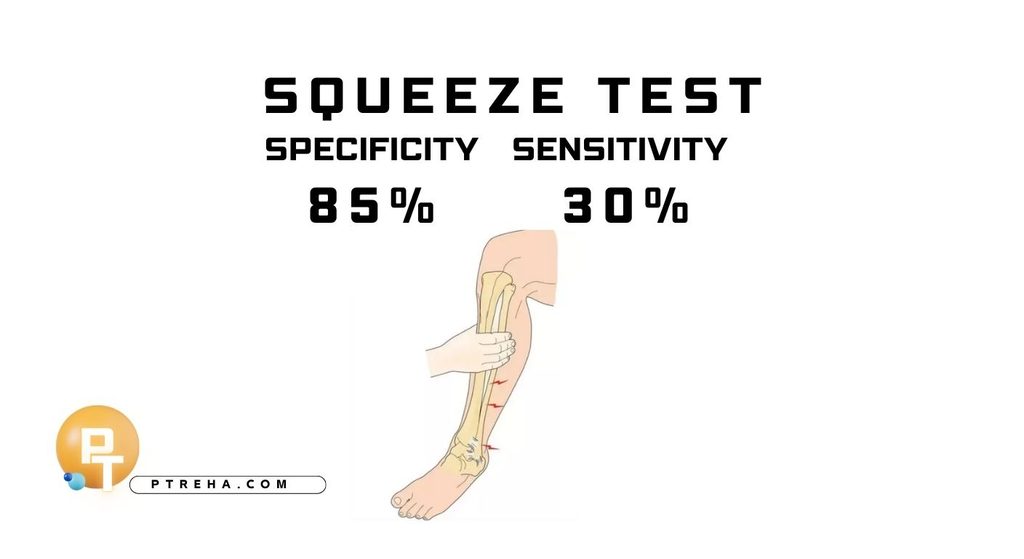
The diagnostic characteristics of the Squeeze Test are protocol- and population-dependent, so no single sensitivity or specificity value should be presented as universal.
In a prospective study of 87 patients with ankle sprain presenting within two weeks of injury, with MRI used as the reference standard, the Squeeze Test demonstrated 88% specificity. Its reported sensitivity in that study was 30%.
A later systematic review and meta-analysis covering six studies and 512 participants reported a pooled specificity of 85% (95% CI 81–89%) for the Squeeze Test across four studies.
These findings support a practical interpretation: the Squeeze Test may provide useful information when positive, but a negative result should not be treated as definitive evidence that syndesmotic injury is absent.
Diagnostic Accuracy
Diagnostic accuracy of the Squeeze Test remains limited by differences in patient populations, reference standards, examination protocols, and study methods.
The available evidence supports using the test as one component of a clinical assessment, not as an isolated diagnostic tool. Systematic reviews have specifically cautioned that clinicians cannot rely on a single clinical test to identify syndesmotic injury with certainty.
Importantly, clinical examination findings also do not independently establish whether a syndesmotic injury is stable enough for nonoperative treatment or unstable enough to require surgical management. Additional imaging or other diagnostic evaluation may be necessary depending on the clinical situation.
Common Mistakes in Squeeze Test
- Applying excessive force instead of controlled compression.
- Recording simply “painful” without documenting where the pain occurred.
- Assuming any ankle pain represents a positive syndesmotic finding.
- Using the test without considering the injury mechanism.
- Treating a negative result as proof that syndesmotic injury is absent.
- Using the test alone to determine injury severity or stability.
- Repeating the maneuver unnecessarily in an acutely painful patient.
- Ignoring the possibility of a proximal fibular injury when pain is reproduced higher in the leg.
Tips for Performing the Squeeze Test
- Explain the maneuver before applying compression.
- Compare the patient’s response with their familiar symptoms.
- Focus on pain location rather than pain intensity alone.
- Use controlled, consistent pressure.
- Integrate the result with syndesmotic palpation and other appropriate clinical tests.
- Consider the mechanism of injury and functional presentation.
- Avoid making a definitive diagnosis from this maneuver alone.
- Refer for further medical or imaging assessment when the overall presentation raises concern for significant syndesmotic injury or associated fracture.
Summary
- The Squeeze Test is an orthopedic special test used in the assessment of suspected ankle syndesmotic injury.
- The commonly described technique involves compressing the tibia and fibula at the calf and assessing for reproduction of pain around the distal syndesmosis.
- A positive response may increase suspicion of syndesmotic involvement, but it does not establish the diagnosis or injury severity by itself.
- Evidence suggests the test can have relatively high specificity but limited sensitivity, with results varying between studies and protocols.
- Clinical interpretation should combine the Squeeze Test with history, palpation, other examination findings, and imaging when clinically indicated.
The most important clinical point is to avoid treating the Squeeze Test as a stand-alone decision tool. A patient with suspected syndesmotic injury should be assessed systematically, particularly when the mechanism, pain distribution, tenderness, or functional limitations suggest a more significant injury.
Resources and External Links
Sman AD, Hiller CE, Refshauge KM. Diagnostic accuracy of clinical tests for diagnosis of ankle syndesmosis injury. British Journal of Sports Medicine.
Read the systematic review in British Journal of Sports Medicine
Sman AD et al. Diagnostic accuracy of clinical tests for ankle syndesmosis injury.
View the diagnostic accuracy study on PubMed
Vancolen SY et al. Diagnostic accuracy of clinical tests assessing ligamentous injury of the ankle syndesmosis: systematic review with meta-analysis.
View the systematic review and meta-analysis on PubMed
Comparison of Magnetic Resonance Imaging to Physical Examination for Syndesmotic Injury after Lateral Ankle Sprain.
Read the original study in Foot & Ankle International
Diagnostic standards and classification of acute isolated syndesmotic injuries.
View the evidence on PubMed