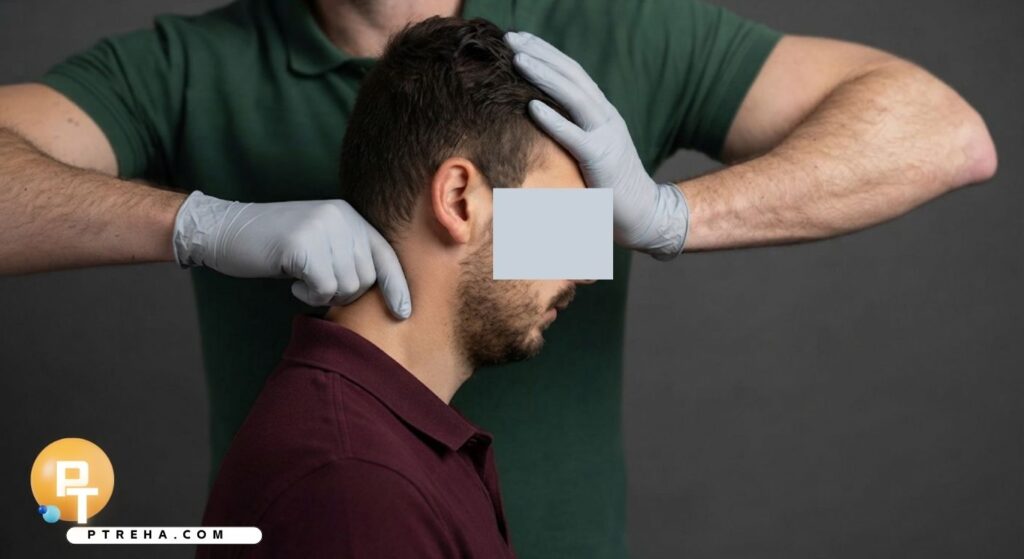
The Sharp-Purser Test is a clinical assessment historically used to evaluate possible anterior atlantoaxial instability, particularly in people with conditions such as rheumatoid arthritis that can affect the upper cervical spine. Because the maneuver involves movement and an anterior-to-posterior force applied to the head while the upper cervical region is positioned in flexion, it should be approached cautiously and interpreted only within a broader clinical assessment. Evidence regarding its diagnostic accuracy, reliability, and safety is inconsistent, so the test should not be treated as a stand-alone method for establishing cervical instability.
What Is the Sharp-Purser Test?
The Sharp-Purser Test is an orthopedic/clinical upper-cervical assessment traditionally used to screen for possible atlantoaxial instability.
The test is intended to assess whether anterior translation of the atlas relative to the axis may be present during upper-cervical flexion. The underlying clinical concern is that instability at the atlantoaxial region could allow abnormal movement of the atlas and potentially affect structures surrounding the upper cervical spinal cord.
The test has historically been associated particularly with patients with rheumatoid arthritis and cervical involvement. However, upper-cervical instability can have other causes, so the clinical context should not be reduced to rheumatoid arthritis alone.
Importantly, the Sharp-Purser Test does not directly visualize the transverse ligament, dens, spinal cord, or atlantoaxial joint. A manual clinical finding therefore cannot substitute for appropriate imaging or specialist evaluation when structural instability is suspected.
Purpose of the Sharp-Purser Test
The traditional purposes of the Sharp-Purser Test include:
- Screening for possible atlantoaxial instability.
- Assessing for abnormal movement between the atlas and axis during the described maneuver.
- Identifying symptoms that may occur with upper-cervical movement in a patient at risk of cervical instability.
- Contributing to decisions about whether cervical examination or intervention should be modified.
- Identifying patients who may require further medical investigation rather than routine cervical manual therapy.
The test is best regarded as one component of clinical reasoning rather than a definitive diagnostic procedure.
Sharp-Purser Test Indications
The test has historically been considered when there is clinical concern about upper-cervical instability, particularly in patients with disorders associated with cervical ligamentous or osseous involvement.
Potential clinical contexts include:
- Rheumatoid arthritis with suspected cervical spine involvement.
- Known or suspected atlantoaxial instability.
- Certain inflammatory or systemic disorders associated with upper-cervical instability.
- Neurological symptoms that raise concern about upper-cervical spinal cord involvement.
- A known structural abnormality of the upper cervical spine where the clinician is determining whether cervical examination or treatment requires additional precautions.
The presence of risk factors does not automatically mean that the Sharp-Purser maneuver should be performed. The decision to test must consider whether moving the cervical spine is appropriate and safe.
Sharp-Purser Test Contraindications and Precautions
Because the test itself applies movement and manual force to the upper cervical region, safety should take priority over completing the maneuver.
Relevant precautions include:
- Known atlantoaxial instability.
- Known significant upper-cervical structural abnormality.
- Recent cervical trauma where instability has not been excluded.
- New or unexplained neurological symptoms suggesting possible spinal cord involvement.
- Significant symptoms that worsen with cervical positioning or movement.
- A medical history associated with increased risk of upper-cervical instability.
- Situations in which appropriate imaging or specialist assessment has already identified instability.
A clinician should not perform a provocative maneuver simply to confirm a suspected instability when the clinical history already indicates that cervical movement may be unsafe.
The 2020 systematic review specifically raised concerns about the potential for harm associated with the Sharp-Purser Test and concluded that its clinical use may be inappropriate because of inconsistent validity, poor inter-rater reliability, and safety concerns.
Patient Position
The commonly described procedure uses:
- The patient seated.
- The head positioned in slight upper-cervical flexion rather than maximal cervical flexion.
- The clinician initially observes the patient’s response to the position.
- Neurological symptoms such as numbness or tingling are specifically considered during the assessment.
Published descriptions of the test vary in details, including the exact amount of cervical positioning. One commonly described protocol uses approximately 20–30° of head flexion, but this should not be interpreted as a universal requirement or a validated safety threshold.
Examiner Position
The examiner is positioned close enough to control the patient’s head and stabilize the cervical region.
In the commonly described technique:
- One hand stabilizes the patient’s head or forehead.
- The other hand is used to stabilize the C2 spinous process.
- The examiner maintains control of the head throughout the maneuver.
- The force is applied carefully and in a controlled manner rather than as a rapid thrust.
The precise hand placement may differ between descriptions of the maneuver. The important clinical principle is controlled stabilization and avoidance of unnecessary force.
How to Perform the Sharp-Purser Test
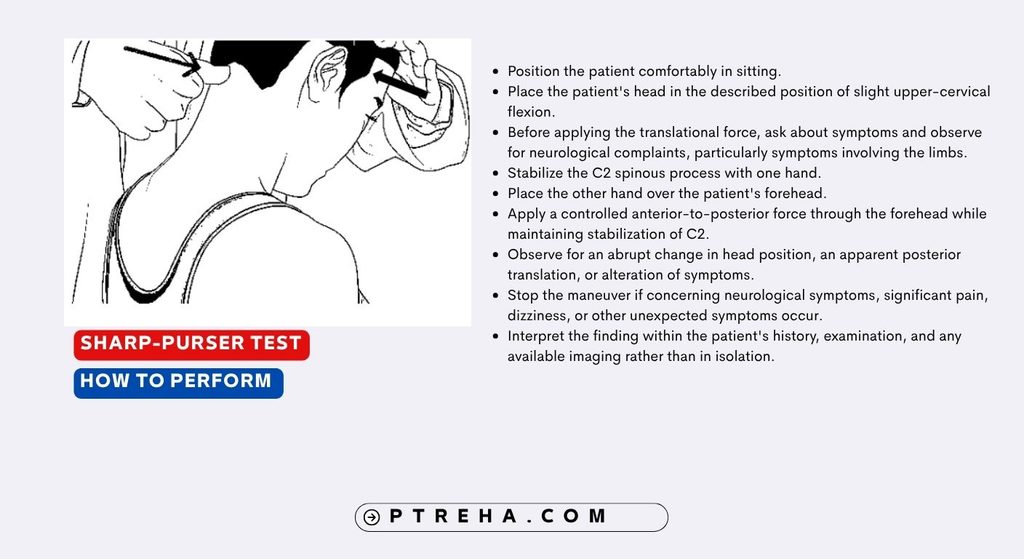
The traditional procedure can be described as follows:
- Position the patient comfortably in sitting.
- Place the patient’s head in the described position of slight upper-cervical flexion.
- Before applying the translational force, ask about symptoms and observe for neurological complaints, particularly symptoms involving the limbs.
- Stabilize the C2 spinous process with one hand.
- Place the other hand over the patient’s forehead.
- Apply a controlled anterior-to-posterior force through the forehead while maintaining stabilization of C2.
- Observe for an abrupt change in head position, an apparent posterior translation, or alteration of symptoms.
- Stop the maneuver if concerning neurological symptoms, significant pain, dizziness, or other unexpected symptoms occur.
- Interpret the finding within the patient’s history, examination, and any available imaging rather than in isolation.
The published description of the traditional test includes resolution of previously produced neurological symptoms or an observable posterior movement of the head as findings considered indicative of an abnormal response.
Because of the potential consequences of manipulating an unstable upper cervical spine, the maneuver should not be performed aggressively or repeatedly simply to obtain a clearer response.
What Constitutes a Positive Sharp-Purser Test?
Unlike a simple range-of-motion measurement, the Sharp-Purser Test has traditionally been described using a positive test response.
A traditionally positive response may involve:
- Apparent posterior translation of the head relative to the stabilized cervical segment.
- A sudden change or reduction of symptoms that had appeared with upper-cervical flexion.
- An abrupt movement that may be accompanied by a palpable or audible change.
The terminology should be used cautiously because the literature has not established one universally accepted interpretation of the maneuver.
A positive clinical response should be considered a finding suggestive of possible upper-cervical instability, not proof of a specific ligament injury or a definitive diagnosis.
What Does a Positive Sharp-Purser Test Mean?
A positive Sharp-Purser response may increase clinical concern for atlantoaxial instability, particularly when it occurs in a patient whose history and other examination findings already raise suspicion.
It does not independently establish:
- Atlantoaxial instability as a confirmed diagnosis.
- Transverse ligament rupture.
- Spinal cord compression.
- A specific degree of atlantoaxial displacement.
- The exact anatomical structure responsible for the finding.
The appropriate response to a concerning finding is clinical reassessment and, when indicated, medical or specialist investigation rather than simply repeating the maneuver.
One clinical study in people with rheumatoid arthritis reported diagnostic findings for the test, but subsequent systematic reviews found substantial heterogeneity between studies and insufficient consistency to establish universal diagnostic performance.
“A concerning Sharp-Purser response should trigger clinical caution, not confidence in a diagnosis.”
Negative Sharp-Purser Test
A response without the traditionally described abnormal movement or symptom change does not reliably exclude upper-cervical instability.
This is particularly important because studies of the Sharp-Purser Test have produced widely differing estimates of diagnostic performance. A systematic review found substantial heterogeneity and concluded that the available evidence does not support treating the test as a dependable stand-alone method for identifying or excluding atlantoaxial instability.
Therefore, a non-concerning response should be interpreted alongside the patient’s history, neurological examination, risk factors, and relevant imaging rather than used as permission to disregard other evidence of possible instability.
Anatomy Involved in the Sharp-Purser Test
Relevant anatomy includes:
- Atlas (C1): The first cervical vertebra, which articulates with the occiput above and the axis below.
- Axis (C2): The second cervical vertebra, characterized by the dens, which projects superiorly from the vertebral body.
- Dens: A bony projection of C2 around which the anterior arch of C1 and associated ligamentous structures are organized.
- Transverse ligament of the atlas: An important stabilizing structure that helps maintain the relationship between the dens and the anterior arch of C1.
- Atlantoaxial joint: The articulation between C1 and C2, permitting substantial cervical rotation while relying on ligamentous and osseous structures for stability.
- Upper cervical spinal cord: A critical neurological structure that can potentially be affected by pathological displacement or narrowing in the upper cervical region.
The test does not directly measure the integrity of any single ligament. Its clinical interpretation depends on the mechanical and neurological response to the maneuver.
Conditions Detected / Associated With the Test
The Sharp-Purser Test has primarily been associated with assessment of:
- Possible anterior atlantoaxial instability.
- Cervical spine involvement associated with rheumatoid arthritis.
- Other clinical situations in which upper-cervical instability is suspected.
The test has also appeared in clinical reports involving other conditions. However, its presence in a case report does not establish that the test is diagnostically validated for that condition.
The most appropriate terminology is therefore “assessment for possible atlantoaxial instability” rather than claiming that the test detects a particular disease.
Clinical Significance
The Sharp-Purser Test can be clinically relevant because suspected upper-cervical instability changes the risk profile of cervical assessment and intervention.
A clinician should consider:
- The patient’s underlying medical history.
- Presence or absence of neurological symptoms.
- Previous cervical imaging.
- Mechanism of injury when trauma is involved.
- Signs suggesting cervical spinal cord involvement.
- Whether cervical manual therapy or loading is appropriate.
- Whether further medical evaluation is warranted.
The broader literature on upper-cervical instability emphasizes that evidence for clinical tests is limited and heterogeneous. A systematic review of upper-cervical instability tests found that diagnostic performance varied considerably between tests and studies, with important methodological limitations.
“The Sharp-Purser Test is a clinical finding within a larger assessment—not a substitute for structural imaging.”
Sensitivity and Specificity
Diagnostic accuracy estimates for the Sharp-Purser Test are not sufficiently consistent to provide a single universal sensitivity or specificity value.
A systematic review identified substantial variation among diagnostic studies. Reported sensitivity ranged from 0.19 to 1.00 across six studies, while specificity ranged from 0.71 to 0.98 across four studies. These values came from different study populations and protocols and therefore should not be interpreted as universal characteristics of the test. Meta-analysis was not possible because of statistical heterogeneity.
An earlier study involving 123 outpatients with rheumatoid arthritis reported a sensitivity of 88% for subluxation greater than the study’s specified radiographic threshold and specificity of 96%. Those findings belong to that particular population and diagnostic protocol and should not be generalized to all patients or clinical settings.
Consequently, the safest interpretation is that the diagnostic performance of the Sharp-Purser Test remains protocol- and population-dependent and insufficiently consistent for universal application.
Diagnostic Accuracy
The Sharp-Purser Test has been studied against radiographic or other structural reference standards, but the overall evidence is heterogeneous.
A systematic review published in 2020 identified 32 relevant studies and found that the diagnostic studies differed sufficiently that statistical pooling was not possible. The review concluded that the test demonstrated inconsistent validity and poor inter-rater reliability, while also raising safety concerns.
Earlier research reported more favorable diagnostic performance in selected patients with rheumatoid arthritis. However, differences in patient populations, reference standards, test procedures, and interpretation make direct comparison between studies difficult.
For this reason, the Sharp-Purser Test should not be used as the sole basis for diagnosing or excluding atlantoaxial instability.
Common Mistakes in Sharp-Purser Test
- Performing the test routinely without first considering the patient’s risk factors.
- Applying excessive force to obtain a more obvious movement.
- Repeating the maneuver when the initial response is unclear.
- Treating an audible or palpable “clunk” as definitive proof of instability.
- Assuming that absence of a response rules out instability.
- Using the test as a substitute for appropriate imaging.
- Assuming that rheumatoid arthritis is the only clinical context in which instability can occur.
- Ignoring neurological symptoms during the assessment.
- Continuing the maneuver despite concerning symptoms.
- Using the result independently of the patient’s history and broader neurological examination.
- Treating the test as a test of one isolated ligament rather than a clinical maneuver involving the upper cervical region.
Tips for Performing the Sharp-Purser Test
- Establish the clinical reason for considering the test before touching the patient.
- Review relevant medical history and previous cervical imaging when available.
- Perform an appropriate neurological assessment when upper-cervical instability is a concern.
- Explain the maneuver to the patient before starting.
- Use controlled positioning and force.
- Avoid aggressive or repeated movements.
- Stop immediately if concerning neurological or other significant symptoms develop.
- Do not use a reassuring response to override strong clinical suspicion.
- Interpret the result in conjunction with the entire clinical presentation.
- When instability is suspected, prioritize appropriate medical evaluation over provocative manual testing.
Summary
- The Sharp-Purser Test is an upper-cervical clinical assessment traditionally used to screen for possible atlantoaxial instability.
- The commonly described maneuver involves upper-cervical flexion, stabilization around C2, and a controlled anterior-to-posterior force through the forehead.
- A traditionally positive response may involve posterior translation of the head or a change in symptoms, but interpretation is not universally standardized.
- A positive or negative response does not independently confirm or exclude atlantoaxial instability.
- Diagnostic studies have produced inconsistent results, and systematic reviews have raised concerns regarding validity, reliability, and safety.
- When upper-cervical instability is suspected, clinical history, neurological findings, appropriate imaging, and medical assessment are more important than relying on a single manual test.
The Sharp-Purser Test remains an important historical test to understand in physical therapy education, particularly when studying upper-cervical instability. In contemporary practice, however, it should be approached with substantial clinical caution and interpreted within a comprehensive assessment rather than used as an isolated diagnostic maneuver.