
The Milgram Test is a clinical assessment involving a sustained bilateral active leg raise performed with the patient in a supine position. It has traditionally been described as a maneuver for assessing the lumbar region and observing symptom reproduction during increased lumbopelvic loading.
Although older clinical descriptions have associated the maneuver with lumbar disc or intrathecal pathology, the Milgram Test should not be interpreted as a standalone diagnostic test. Its findings are best considered alongside the patient’s history, neurological examination, movement assessment, and other appropriate clinical tests.
What Is the Milgram Test?
The Milgram Test is an orthopedic clinical assessment of the lumbar and lumbopelvic region. It is not an established outcome measure with a universally accepted scoring system.
During the commonly described maneuver, the patient actively raises both straight legs from the examination surface and maintains the position. The maneuver places an active mechanical demand on the lumbopelvic region and requires contribution from the hip flexors, abdominal musculature, and trunk stabilizing systems.
Traditional descriptions have proposed that the maneuver increases intrathecal pressure. However, this physiological rationale should not be interpreted as evidence that the test selectively stresses or identifies a particular disc, nerve root, or other spinal structure.
The patient’s response may include pain reproduction, difficulty maintaining the position, or other changes in movement behavior. These findings are nonspecific and require clinical context.
“A provocative response is a clinical finding, not a diagnosis.”
Purpose of the Milgram Test
The Milgram Test may be used to:
- Observe tolerance to a sustained bilateral active leg-raise maneuver.
- Assess the patient’s response to an active lumbopelvic loading task.
- Determine whether the maneuver reproduces the patient’s familiar symptoms.
- Observe movement control and symptom behavior during sustained effort.
- Contribute to a broader examination of patients presenting with lumbar-region complaints.
- Provide a standardized maneuver that can be repeated during reassessment when the same procedure is used.
The test should not be used in isolation to determine the presence or absence of a specific lumbar disorder.
Milgram Test Indications
The maneuver may be considered during assessment of patients presenting with:
- Low-back pain.
- Lumbar-region discomfort associated with lower-extremity symptoms.
- Symptoms that appear to change with lumbopelvic loading.
- Suspected lumbar musculoskeletal involvement.
- A clinical presentation in which reproduction of familiar symptoms during active bilateral leg elevation would provide useful information.
The decision to perform the maneuver should depend on the patient’s symptom irritability, functional status, neurological presentation, and overall clinical examination.
Milgram Test Contraindications and Precautions
A universally established list of Milgram-specific contraindications is not clearly established. General clinical safety principles should therefore guide its use.
Use appropriate caution when:
- The patient’s symptoms are severe or highly irritable.
- The maneuver is likely to substantially aggravate the presenting complaint.
- The patient cannot safely control both lower limbs.
- There are concerning neurological findings requiring further medical assessment.
- The patient’s medical condition makes vigorous active leg elevation or increased lumbopelvic loading inappropriate.
- The patient develops marked pain, neurological symptoms, dizziness, or another concerning response during the maneuver.
The examiner should not force the patient to maintain the position simply to complete a predetermined duration.
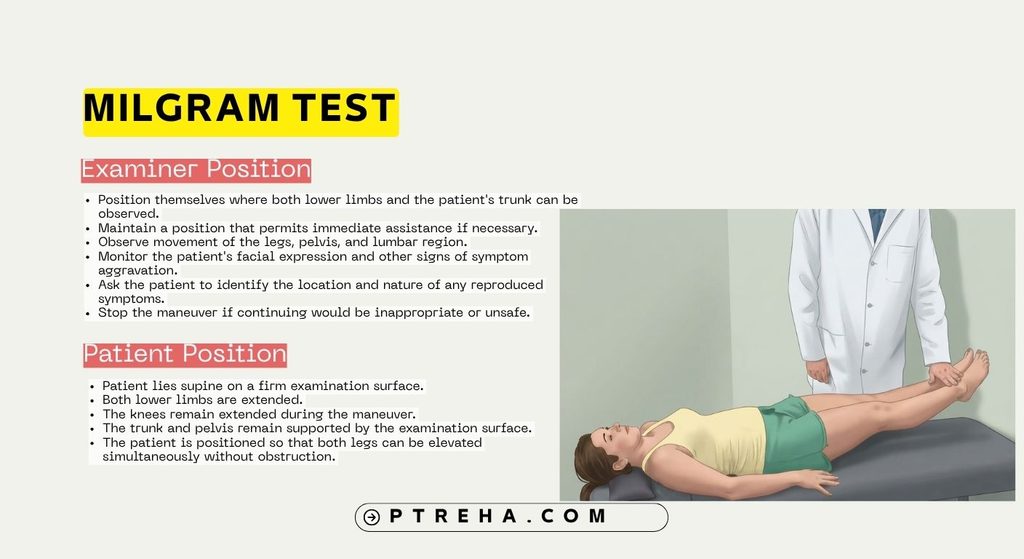
Patient Position
A commonly described position is:
- Patient lies supine on a firm examination surface.
- Both lower limbs are extended.
- The knees remain extended during the maneuver.
- The trunk and pelvis remain supported by the examination surface.
- The patient is positioned so that both legs can be elevated simultaneously without obstruction.
Different descriptions of the Milgram Test use different leg-elevation heights and holding durations. These should be regarded as protocol-specific descriptions rather than universal diagnostic thresholds.
Examiner Position
The examiner should:
- Position themselves where both lower limbs and the patient’s trunk can be observed.
- Maintain a position that permits immediate assistance if necessary.
- Observe movement of the legs, pelvis, and lumbar region.
- Monitor the patient’s facial expression and other signs of symptom aggravation.
- Ask the patient to identify the location and nature of any reproduced symptoms.
- Stop the maneuver if continuing would be inappropriate or unsafe.
How to Perform the Milgram Test
A commonly described procedure is:
- Position the patient supine with both knees extended.
- Explain the maneuver and ask the patient to report any familiar pain or neurological symptoms.
- Ask the patient to actively raise both straight legs from the examination surface.
- The patient maintains the elevated position while keeping the knees extended.
- Observe the patient’s lumbar and pelvic movement and overall control.
- Ask whether the maneuver reproduces the patient’s familiar symptoms.
- Monitor for excessive guarding, breath-holding, loss of control, or significant symptom aggravation.
- Stop the maneuver if the patient’s symptoms become substantially aggravated or another concerning response develops.
- Document the actual response and the protocol used rather than relying solely on a positive/negative label.
Some traditional descriptions use a sustained hold of approximately 30 seconds, while other descriptions differ in their exact procedure. Because protocols vary, duration and leg position should not be presented as universal diagnostic cutoffs.
Interpretation
The Milgram Test is most appropriately interpreted by documenting the patient’s actual response.
Relevant observations may include:
- Reproduction of familiar low-back pain.
- Reproduction of familiar lower-extremity symptoms.
- Inability to maintain the elevated position.
- Difficulty initiating the movement.
- Excessive compensatory movement.
- Guarding or apprehension.
- Symptoms developing only after sustained loading.
- No meaningful reproduction of the patient’s presenting symptoms.
An inability to maintain the position does not automatically indicate disc pathology. The maneuver requires active contribution from several muscle groups and sufficient movement control and symptom tolerance.
Similarly, pain during the maneuver does not establish that the intervertebral disc, nerve root, thecal sac, or another specific structure is responsible for the symptoms.
What Does a Positive Milgram Test Mean?
Traditional descriptions sometimes classify the Milgram Test as positive when the patient develops pain during the maneuver or cannot maintain the required position.
This terminology should be used cautiously.
A painful response indicates that the maneuver reproduced symptoms under a particular mechanical demand. It does not independently establish:
- Lumbar disc herniation.
- Lumbar radiculopathy.
- Nerve-root compression.
- Spinal stenosis.
- Intrathecal pathology.
- A space-occupying lesion.
The finding should instead be integrated with the patient’s history, neurological findings, movement examination, and other relevant clinical tests.
Negative Milgram Test
If the patient performs the maneuver without reproducing the relevant symptoms and demonstrates adequate movement control, the clinician may document no symptom reproduction during the Milgram maneuver.
This does not prove that lumbar pathology or neurological involvement is absent.
A single clinical maneuver should not be used to exclude a disorder when the history and other examination findings remain concerning or suggestive.
Anatomy Involved in Milgram Test

The Milgram Test involves multiple anatomical and physiological systems rather than isolating one specific structure.
Relevant structures include:
- Lumbar spine: subjected to mechanical loading during the maneuver.
- Lumbopelvic region: contributes to maintaining trunk and pelvic stability.
- Hip flexor musculature: contributes substantially to active elevation of the lower limbs.
- Abdominal musculature: contributes to trunk and pelvic stabilization.
- Spinal and intervertebral structures: experience mechanical loading but are not selectively isolated by the test.
- Peripheral and spinal neural structures: may contribute to symptoms when neurological symptoms are reproduced, but symptom reproduction alone does not identify a specific neural lesion.
The traditional physiological explanation emphasizes increased intrathecal pressure during the maneuver. This does not mean that the test selectively compresses a particular nerve root or intervertebral disc.
Conditions Detected / Associated With the Test
The Milgram Test has historically been discussed in association with:
- Low-back pain.
- Lumbar spinal disorders.
- Intervertebral disc pathology.
- Symptoms potentially associated with lumbar nerve-root involvement.
- Intrathecal or extrathecal pathology.
These associations should not be interpreted as proof that the Milgram Test can independently diagnose these conditions.
For example, a patient with lumbar radicular symptoms may undergo the maneuver as part of a broader examination. Neurological examination and other clinically appropriate assessments remain important when neurological involvement is suspected.
Clinical Significance
The Milgram Test may contribute to clinical reasoning by:
- Showing how symptoms respond to an active lumbopelvic loading maneuver.
- Identifying whether a specific movement reproduces familiar symptoms.
- Providing information about tolerance to sustained bilateral leg elevation.
- Allowing observation of movement control and compensatory strategies.
- Providing a maneuver that can be repeated during reassessment under the same protocol.
- Contributing to decisions about further examination or modification of rehabilitation activities.
Its clinical usefulness is greatest when the observed response is interpreted in relation to the patient’s complete presentation.
The maneuver should not replace neurological assessment, functional assessment, or appropriate medical investigation when these are indicated.
“The clinical context surrounding the response is more important than the label assigned to the maneuver.”
Sensitivity and Specificity
Reliable, contemporary sensitivity and specificity values for the Milgram Test itself are not sufficiently established to provide a universal estimate.
Therefore, sensitivity and specificity values from other lumbar examination procedures should not be transferred to the Milgram Test.
This distinction is particularly important because tests that appear mechanically similar may assess different clinical questions and use different protocols.
Diagnostic Accuracy
The diagnostic accuracy of the Milgram Test as an isolated clinical maneuver is not sufficiently established to support its use as a standalone diagnostic test.
Older descriptions have associated the maneuver with possible intrathecal or extrathecal pathology. These historical interpretations should not be treated as modern evidence that the test can independently identify a specific spinal disorder.
When lumbar radiculopathy, disc-related disorders, spinal stenosis, or serious spinal pathology is suspected, diagnosis should be based on the complete clinical presentation and appropriate additional assessment.
Common Mistakes in Milgram Test
- Treating the test as a definitive test for disc herniation.
- Assuming reproduced pain automatically indicates nerve-root compression.
- Treating inability to maintain the position as proof of spinal pathology.
- Ignoring the contribution of the hip flexors and abdominal musculature.
- Failing to distinguish familiar symptoms from nonspecific discomfort.
- Treating one particular hold duration as a universal diagnostic threshold.
- Treating one particular leg-elevation height as a universal cutoff.
- Forcing the patient to continue despite significant symptom aggravation.
- Recording only “positive” or “negative” without describing the actual response.
- Ignoring neurological findings obtained during the rest of the examination.
- Confusing the Milgram Test with the passive straight-leg-raise test.
Tips for Performing the Milgram Test
- Explain the maneuver before beginning.
- Establish the patient’s familiar symptoms during the history and examination.
- Observe movement quality as well as symptom reproduction.
- Ask the patient whether any reproduced symptoms are familiar.
- Monitor breathing and unnecessary breath-holding.
- Avoid forcing the patient to maintain the position when symptoms become inappropriate or excessive.
- Document the actual protocol used.
- Record the patient’s symptom response rather than relying solely on a positive/negative label.
- Interpret the finding alongside the patient’s history and neurological examination.
- Do not use the test as a substitute for appropriate neurological assessment.
- Avoid assigning a specific spinal diagnosis based solely on the maneuver.
Summary
- The Milgram Test is an orthopedic clinical assessment involving sustained bilateral active leg elevation.
- It is traditionally used during examination of the lumbar and lumbopelvic region.
- The maneuver places an active mechanical demand on the lumbopelvic system and has traditionally been described as increasing intrathecal pressure.
- Pain reproduction or inability to maintain the position is not specific enough to independently diagnose disc herniation, radiculopathy, spinal stenosis, or intrathecal pathology.
- Different descriptions use different technical parameters, so duration and leg-elevation height should not be treated as universal diagnostic cutoffs.
- The test is most useful when its findings are integrated with the patient’s history, neurological examination, movement assessment, and other appropriate clinical findings.
- Current evidence does not justify assigning a universal sensitivity, specificity, or diagnostic accuracy value to the Milgram Test.
The Milgram Test can be used as one observational maneuver within a broader lumbar examination. Its greatest clinical value comes from accurately describing the patient’s response and interpreting that response within the context of the complete clinical presentation.
Resources
- PubMed — Reliability of the Straight Leg Raise Test for Suspected Lumbar Radicular Pain: systematic review examining reliability of a different but commonly used lumbar examination procedure. PubMed reference
- PubMed — Systematic Review of the Passive Straight Leg Raising Test: discusses protocol and interpretation issues surrounding the straight-leg-raise examination. PubMed reference
- PubMed — Test of Lasègue: Systematic Review: reviews diagnostic accuracy of straight-leg-raise and crossed straight-leg-raise testing for disc herniation. PubMed reference
- PMC — Combination Testing in Orthopedic and Neurologic Physical Examination: discusses the historical physiological rationale for Milgram and related maneuvers. Full-text article
- Foundations of Athletic Training — Lumbar Spinal Conditions: provides a commonly taught description of the Milgram maneuver and its traditional interpretation. Reference chapter