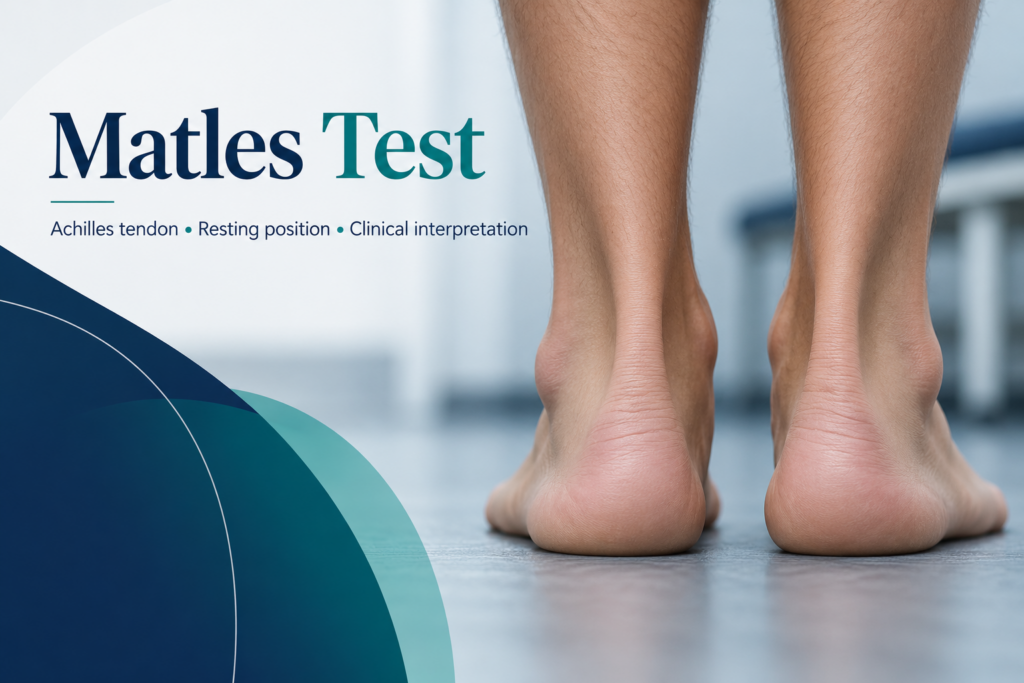
The Matles Test compares resting foot position with the patient lying prone and the knees bent. Loss of resting plantarflexion on the symptomatic side supports suspicion of an Achilles tendon rupture, but the finding belongs within a complete clinical assessment.
What Is the Matles Test?
This orthopedic special test is an observation of resting ankle posture during knee flexion. It is not a resisted strength test or a measurement of tendon-gap size.
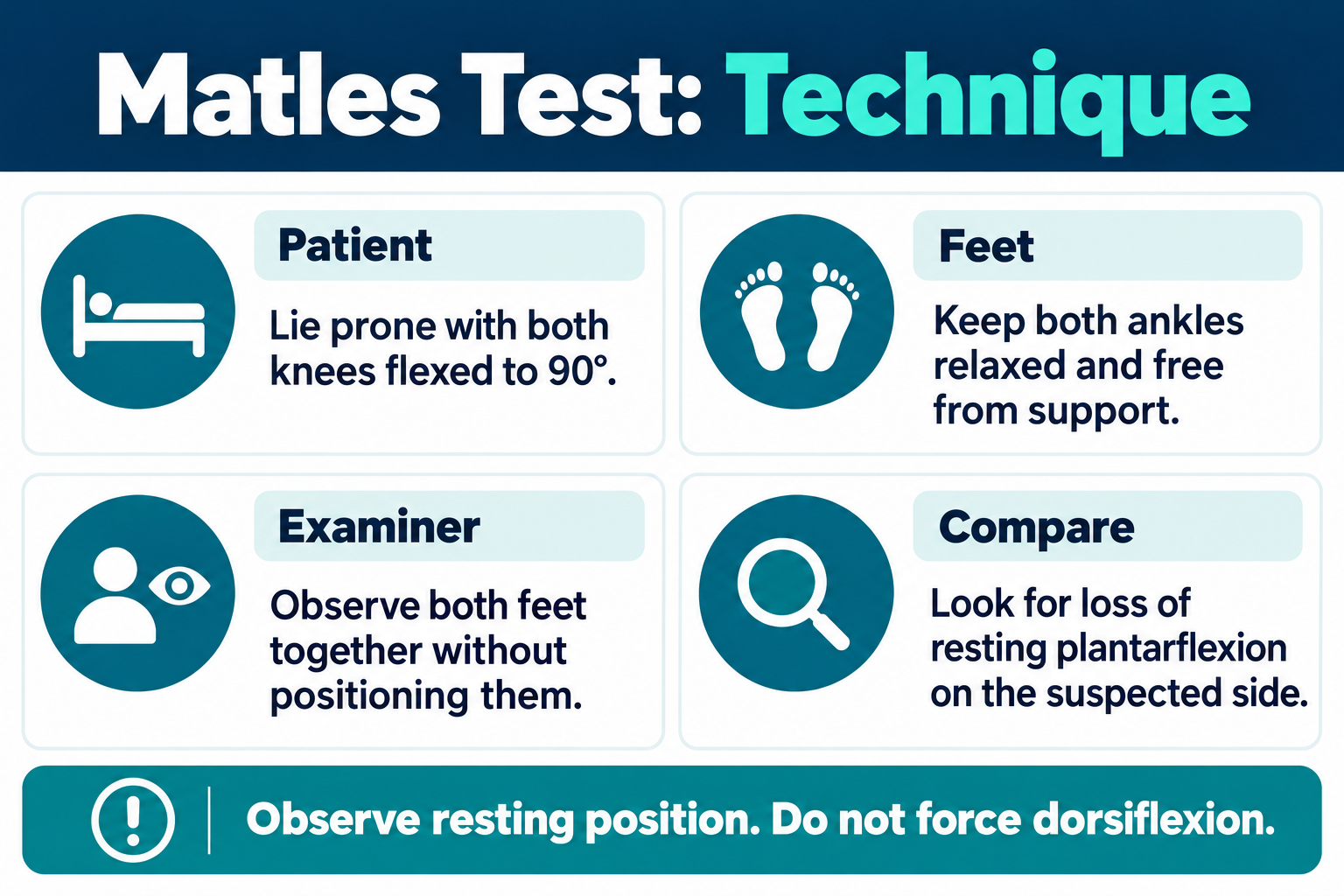
The MSK Medicine Matles Test demonstration describes the prone position with the knees flexed to 90 degrees and the feet relaxed. The examiner compares the resting position of the feet rather than asking the patient to point the toes.
Purpose and Indications
- Contribute to examination when Achilles tendon rupture is suspected.
- Identify loss of resting plantarflexion relative to the opposite side.
- Add an observation to history, palpation and calf-squeeze testing.
Use the test to address a focused question about possible tendon disruption. It does not assess overall ankle function, quantify calf strength or establish readiness for activity.
Contraindications and Precautions
There is no need to apply an external stretching force to obtain the resting-position finding. The following are practical safety precautions, rather than a validated list of test-specific contraindications.
- Check that lying prone and bending the knees are safe and tolerable.
- Respect movement restrictions after surgery or a known injury.
- Do not force knee flexion or ankle dorsiflexion.
- If pain or positioning difficulties prevent assessment, record the test as limited rather than interpreting it as negative.
Suspected acute rupture warrants prompt medical assessment. Avoid turning the examination into repeated stretching or demanding functional challenges.
Patient Position
- Lie prone on an examination plinth.
- Flex both knees to 90 degrees for the described protocol.
- Allow both ankles to relax without the feet resting against a support.
Examiner Position
- Stand where both feet can be viewed together.
- Check that knee positions are comparable.
- Avoid holding either foot in a position that changes its resting posture.
How to Perform the Matles Test
- Explain that the examination compares the feet at rest.
- Position the patient prone and ask them to bend both knees to the described position.
- Ask the patient to relax the ankles rather than actively pointing or lifting the feet.
- Observe both resting foot positions together.
- Note whether the suspected side has lost plantarflexion and rests closer to neutral or dorsiflexion.
- Record the side, observed posture and any positioning limitations.
The specified knee position defines the technique; it is not a diagnostic cutoff. Avoid assigning a universal resting ankle angle as normal for every patient.
What Constitutes a Positive Test?
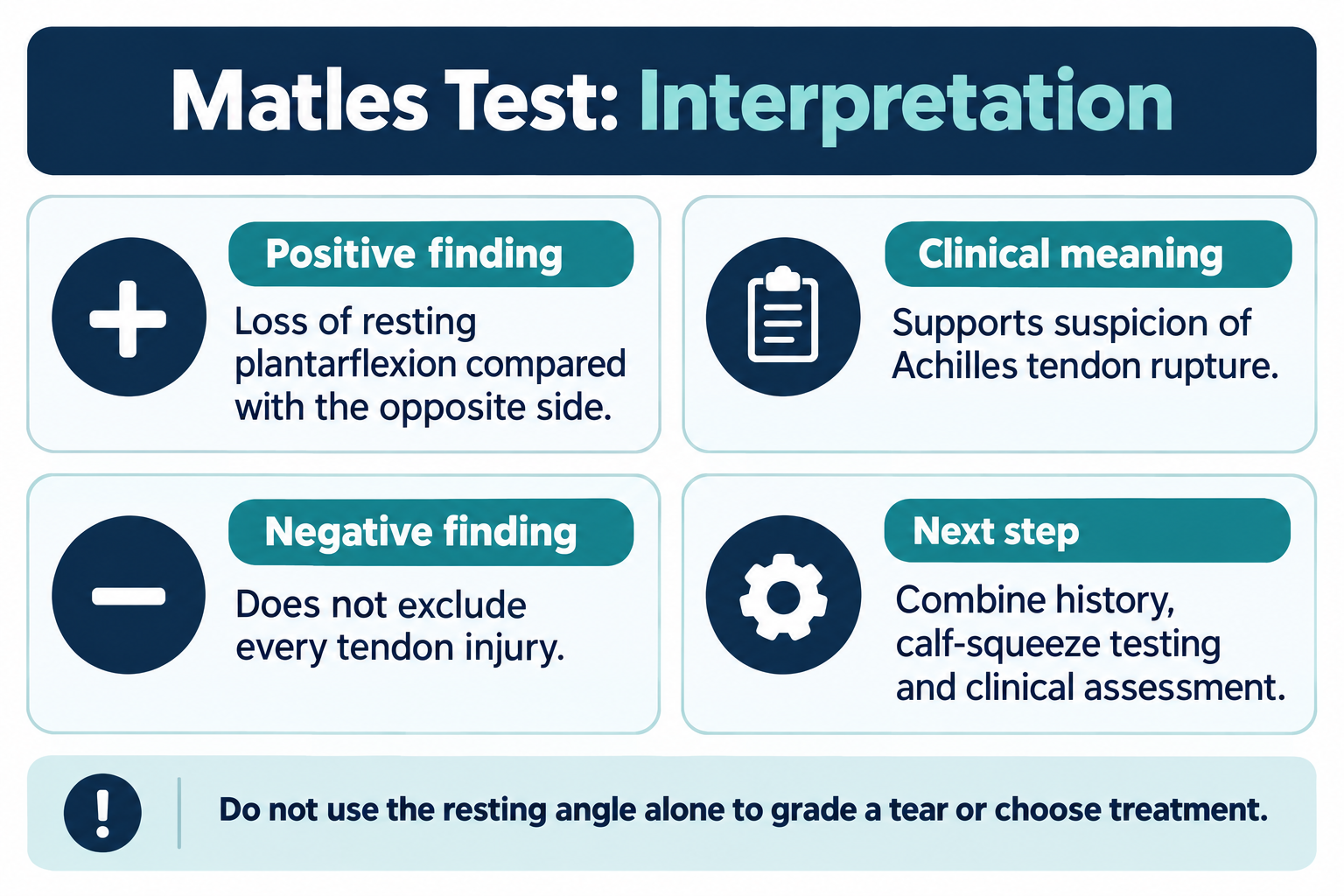
A positive finding is loss of resting plantarflexion, typically with the affected foot resting toward neutral or dorsiflexion compared with the opposite side. Interpret the posture in context rather than requiring an invented minimum angular difference.
If the difference is uncertain, describe it as equivocal. An observation that cannot be made confidently should not be converted into a definite positive or negative label.
What Does a Positive Matles Test Mean?
The finding supports concern for Achilles tendon rupture. It does not independently establish the precise tear location, gap, extent of residual continuity or best treatment.
Clinical diagnosis draws on several findings. The AAOS explanation of Achilles tendon rupture assessment describes the importance of history and examination, with imaging considered when useful to clarify the injury.
What Does a Negative Result Mean?
A negative result means that the expected loss of resting plantarflexion was not demonstrated in that examination. It does not exclude every tendon injury, particularly when the concern is a partial tear or the overall presentation remains suspicious.
The comparison side is also a limitation when it has previous injury, surgery or a different resting posture. Document that context rather than assuming it provides an unaffected reference.
Relevant Anatomy
- Achilles tendon: transmits force from the gastrocnemius-soleus complex to the calcaneus.
- Gastrocnemius and soleus: contribute to ankle plantarflexion through the tendon.
- Ankle and knee position: define the examination setup and influence the posture being observed.
The Matles Test observes the behavior of a connected muscle-tendon system. It does not isolate one calf muscle or measure that muscle’s strength.
Sensitivity, Specificity and Diagnostic Accuracy
In Maffulli’s prospective study of clinical Achilles rupture tests, the Matles Test had sensitivity of 88% and specificity of 85%. The study included 174 patients with unilateral complete subcutaneous Achilles tendon tears and 28 patients with suspected but no actual tear; the comparison group had no tear identified on imaging.
These estimates describe that study’s clinical testing and population. They are not universal figures for partial tears, postoperative assessment or every clinical setting. They also show why neither result supplies absolute certainty.
Diagnostic accuracy concerns how a finding distinguishes injury from no injury. It does not demonstrate that different examiners will agree, and it does not turn resting posture into a validated treatment-selection measure.
Clinical Significance and Associated Conditions
- The test is principally relevant to suspected Achilles tendon rupture, rather than a general test for heel pain.
- Interpret it alongside the injury history, palpation and other appropriate findings.
- Discordant or inconclusive results require further clinical assessment; imaging may help clarify uncertainty.
- Do not use a positive finding alone to choose surgical versus nonsurgical care.
Common Mistakes and Practical Tips
- Actively positioning the ankles: ask for relaxation and observe the resting posture.
- Supporting the feet: make sure contact is not changing their position.
- Comparing unlike knee positions: use a consistent setup.
- Ignoring the opposite side’s history: note previous injury or surgery.
- Overinterpreting the angle: avoid universal normal values, tear grades or gap estimates.
Summary
- The Matles Test observes resting foot position during prone knee flexion.
- Use the described knee position and allow the ankles to relax freely.
- Loss of resting plantarflexion supports suspicion of Achilles tendon rupture.
- A negative result does not settle every suspected tendon injury.
- Interpret findings with the history and wider examination, and investigate uncertainty appropriately.
A clearly documented resting-position comparison adds useful information. Its value comes from the complete assessment, not from treating one posture as a complete diagnosis.