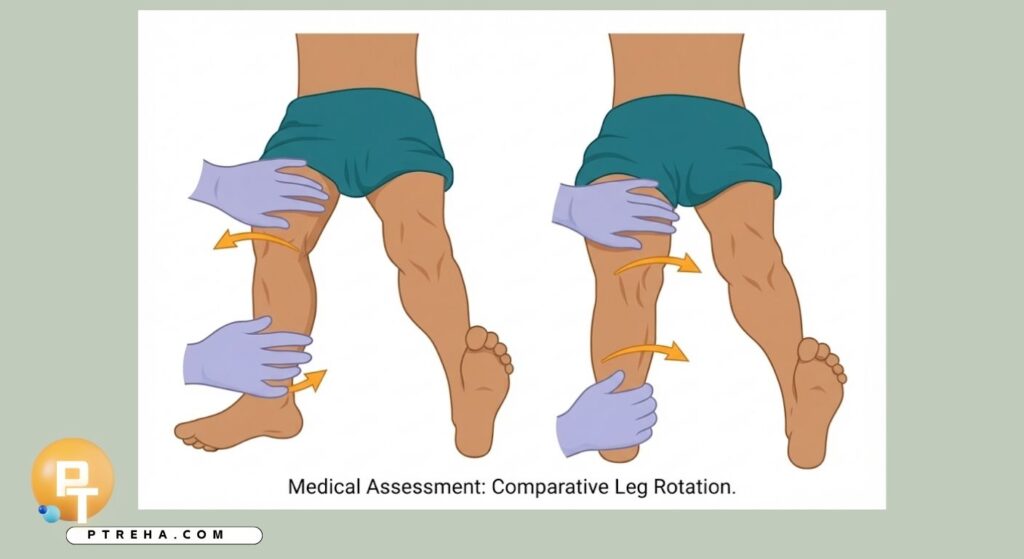
The Log Roll Test is an orthopedic clinical assessment used during examination of the hip, particularly when the clinician wants to assess symptoms and movement associated with passive hip rotation.
It is commonly performed with the patient lying supine while the relaxed lower limb is gently rotated internally and externally.
The finding can contribute useful information about possible hip-joint involvement, but it should always be interpreted alongside the patient’s history and the rest of the physical examination.
What Is the Log Roll Test?
The Log Roll Test is an orthopedic special test and clinical assessment of the hip.
It involves gently rotating the patient’s relaxed lower limb while minimizing active muscular effort.
The maneuver is commonly used to determine whether passive hip rotation reproduces the patient’s familiar symptoms.
It can also provide information about rotational movement, resistance, and differences between the symptomatic and opposite hip.
The test is often included early in a comprehensive hip examination because it requires relatively little active participation from the patient.
A contemporary review of hip examination describes beginning the supine assessment with the Log Roll Test and emphasizes observing the patient’s response to passive rotation.
Importantly, the Log Roll Test is not a stand-alone diagnostic test.
A painful response may support clinical suspicion of hip-joint involvement, but it does not establish a specific pathology such as a labral tear, femoroacetabular impingement syndrome, or osteoarthritis.
Purpose of the Log Roll Test
The Log Roll Test may be used to:
- Assess pain during passive hip rotation.
- Determine whether passive movement reproduces the patient’s familiar symptoms.
- Examine the quality of passive hip rotation.
- Compare rotational behavior between the two hips.
- Identify findings that may suggest involvement of intra-articular hip structures.
- Contribute to the assessment of a painful or irritable hip.
- Provide additional information when combined with other hip examination findings.
- Help guide whether further clinical assessment is warranted.
The purpose is therefore broader than simply deciding whether a test is “positive” or “negative.”
The clinician should consider what symptom is reproduced, where it occurs, how it compares with the patient’s usual complaint, and how the finding fits with the rest of the examination.
Log Roll Test Indications
The test may be considered when a patient presents with:
- Hip pain.
- Groin pain suspected to originate from the hip.
- Pain associated with hip rotation.
- Suspected intra-articular hip involvement.
- Mechanical hip symptoms requiring further assessment.
- Possible hip instability when other relevant clinical findings are present.
- Symptoms where comparison of passive hip rotation may be clinically useful.
The Log Roll Test should not be performed simply because a patient reports any lower-extremity pain.
The history should first help determine whether the hip is a plausible source of symptoms and whether passive hip examination is appropriate.
Log Roll Test Contraindications and Precautions
There is no universally established list of specific contraindications unique to the Log Roll Test.
Instead, clinicians should apply general examination safety principles and consider the patient’s clinical presentation.
Relevant precautions include:
- Avoid forceful rotation when the hip is highly irritable.
- Do not aggressively move a patient with severe acute pain.
- Use particular caution when significant acute trauma has occurred.
- Consider possible fracture or dislocation before performing unnecessary hip movement.
- Follow postoperative movement precautions when applicable.
- Stop the maneuver if significant or unexpected symptoms develop.
- Modify the examination when the patient’s medical or functional status makes passive movement inappropriate.
- Avoid interpreting protective muscle guarding as a specific structural finding without further assessment.
The Log Roll Test should be performed gently.
It is an examination maneuver, not a technique intended to force additional hip range of motion.
Patient Position
A commonly described position is:
- Patient lying supine.
- Tested lower limb relaxed.
- Hip positioned close to neutral flexion and extension.
- Hip positioned without unnecessary abduction or adduction.
- Knee generally extended.
- Pelvis positioned comfortably and kept as stable as possible.
The exact position can vary depending on the clinical protocol.
Some descriptions of the Log Roll Test emphasize manually rotating the extended leg into internal and external rotation, while other hip examination protocols use the maneuver to observe passive external rotation after internally rotating the limb.
These variations should not be treated as interchangeable tests.
The clinician should identify the protocol being used before interpreting a particular finding.
Examiner Position
The examiner should:
- Stand beside the tested leg.
- Maintain comfortable control of the lower limb.
- Support the limb without unnecessary force.
- Place the controlling hand on the thigh when appropriate.
- Maintain the hip in the selected starting position.
- Rotate the limb smoothly.
- Observe the patient’s verbal and non-verbal response.
- Compare sides when clinically appropriate.
Placing the examiner’s hand on the thigh can help minimize unwanted movement at the knee and keep the examination focused on the hip.
How to Perform the Log Roll Test
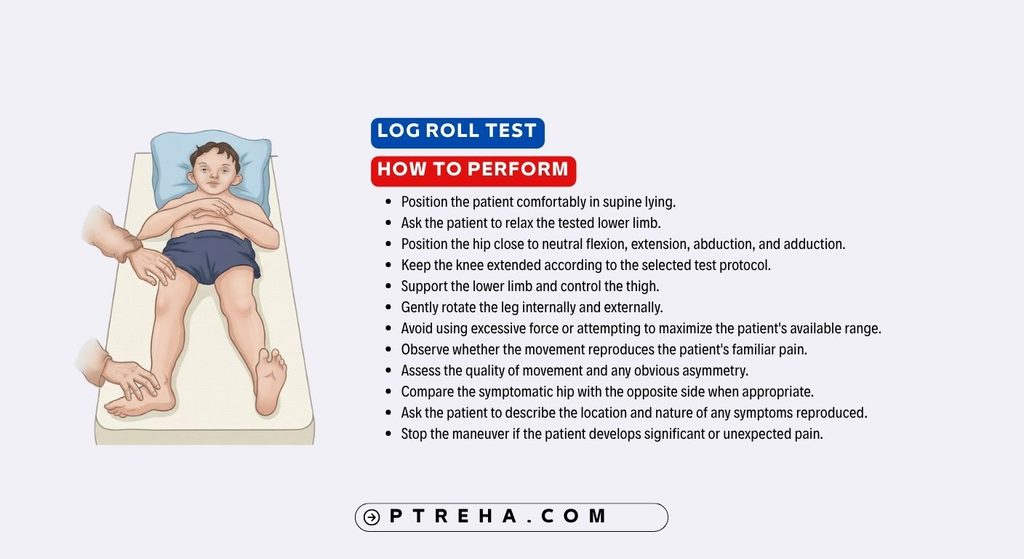
A commonly used version of the Log Roll Test can be performed as follows:
- Position the patient comfortably in supine lying.
- Ask the patient to relax the tested lower limb.
- Position the hip close to neutral flexion, extension, abduction, and adduction.
- Keep the knee extended according to the selected test protocol.
- Support the lower limb and control the thigh.
- Gently rotate the leg internally and externally.
- Avoid using excessive force or attempting to maximize the patient’s available range.
- Observe whether the movement reproduces the patient’s familiar pain.
- Assess the quality of movement and any obvious asymmetry.
- Compare the symptomatic hip with the opposite side when appropriate.
- Ask the patient to describe the location and nature of any symptoms reproduced.
- Stop the maneuver if the patient develops significant or unexpected pain.
The movement should remain controlled throughout the procedure.
The objective is not to force the hip into an extreme rotational position but to observe the patient’s response to gentle passive movement.
Interpretation of the Log Roll Test
Interpretation should focus primarily on the clinical response to passive hip rotation.
Pain reproduced during the maneuver may increase suspicion that the hip joint is contributing to the patient’s symptoms.
However, pain alone does not establish the precise anatomical structure or pathology responsible.
The location of the pain is particularly important.
For example, reproduction of the patient’s familiar deep groin or hip pain may be more clinically meaningful than generalized discomfort that does not resemble the presenting complaint.
A classic description of the hip examination notes that log rolling can be useful for localizing symptoms to the hip and that absence of a painful response does not completely exclude the hip as a source of symptoms.
Evaluation of the Hip: History and Physical Examination
The finding should therefore be interpreted in combination with:
- Patient history.
- Symptom location.
- Symptom behavior.
- Hip range of motion.
- Strength examination.
- Other provocative tests.
- Gait and functional assessment.
- Lumbar spine examination when indicated.
- Imaging or medical investigation when clinically appropriate.
“A clinical finding becomes more useful when it matches the patient’s history.”
What Constitutes a Positive Log Roll Test?
The terminology positive Log Roll Test is used in some orthopedic literature when the maneuver reproduces relevant hip pain.
However, clinicians should be careful with this terminology because different versions of the Log Roll Test exist.
For the commonly described painful hip examination maneuver, a clinically relevant positive finding would generally involve reproduction of the patient’s familiar hip or groin symptoms during passive rotation.
This should not be confused with a universal pass/fail criterion.
A separate maneuver sometimes called the Log Roll Test or Dial Test is used in the assessment of hip rotational behavior and possible capsular instability.
In that protocol, the clinician passively rotates the hip internally and then allows it to return toward external rotation.
Because these are related but clinically distinct applications, the exact protocol should always be documented.
What Does a Positive Log Roll Test Mean?
A painful Log Roll Test may indicate that the hip is a potential contributor to the patient’s symptoms.
It can increase clinical suspicion of intra-articular hip involvement, particularly when the pain reproduced is consistent with the patient’s presenting complaint.
However, the result does not independently diagnose:
- Labral pathology.
- Femoroacetabular impingement syndrome.
- Hip osteoarthritis.
- Synovitis.
- Capsular pathology.
- Hip instability.
- Femoral neck stress injury.
- Any other specific hip disorder.
This distinction is essential.
Physical examination tests of the hip have variable diagnostic performance, and systematic reviews have concluded that the evidence is insufficient to treat most individual hip examination maneuvers as definitive stand-alone diagnostic tests.
Systematic Review of the Diagnostic Performance of Orthopedic Physical Examination Tests of the Hip
Negative Log Roll Test
A non-painful Log Roll Test does not completely exclude the hip as a source of symptoms.
A patient may have hip pathology without reproducing symptoms during a particular examination maneuver.
Therefore, a non-provocative response should be considered together with:
- The patient’s history.
- Active and passive range of motion.
- Other hip tests.
- Strength findings.
- Functional limitations.
- Gait findings.
- Relevant spinal or pelvic examination findings.
The Log Roll Test should not be used as a stand-alone rule-out test for all hip disorders.
Anatomy Involved in the Log Roll Test
The primary anatomical region involved is the hip joint.
Relevant structures include:
- Femoral head: The proximal articular surface of the femur that articulates with the acetabulum.
- Acetabulum: The socket of the hip joint that receives the femoral head.
- Articular cartilage: Covers the articulating surfaces of the hip joint.
- Joint capsule: Surrounds the hip joint and contributes to passive stability.
- Capsular ligaments: Provide passive restraint to hip movement.
- Acetabular labrum: Fibrocartilaginous tissue surrounding the acetabular rim.
- Surrounding muscles: May influence resistance and guarding even though the maneuver is intended to minimize active muscular contribution.
The maneuver should not be described as isolating a single ligament, muscle, nerve, or other anatomical structure.
Hip movement results from interaction between the joint surfaces, capsule, surrounding soft tissues, anatomical morphology, and neuromuscular response.
Conditions Associated With the Log Roll Test
The Log Roll Test may contribute to the clinical assessment of:
- Intra-articular hip pathology.
- Hip joint irritability.
- Hip osteoarthritis.
- Labral pathology.
- Femoroacetabular impingement-related presentations.
- Hip instability or capsular insufficiency.
- Other causes of painful hip rotation.
The term associated with is important.
A finding during the Log Roll Test does not independently confirm any of these conditions.
Diagnosis depends on the overall clinical picture and, where appropriate, additional investigation.
For example, increased passive external rotation has been discussed in relation to possible capsular laxity or hip instability, but rotational behavior is influenced by individual anatomy and should not be interpreted in isolation.
Clinical Significance
The Log Roll Test can be clinically useful because it provides information about how the hip responds to relatively gentle passive rotation.
The finding may help the clinician decide whether to investigate the hip further or consider alternative sources of symptoms.
It can contribute to decisions about:
- Additional hip examination.
- Range-of-motion assessment.
- Strength testing.
- Functional movement assessment.
- Assessment of the lumbar spine.
- Further medical evaluation.
- Imaging when clinically indicated.
- Rehabilitation planning.
The test may be particularly informative when the patient’s familiar symptoms are reproduced.
For example, if the patient’s primary complaint is deep groin pain and the same familiar pain occurs during passive hip rotation, that finding may strengthen the clinical impression that the hip deserves further investigation.
It still does not identify the exact pathology responsible.
Sensitivity and Specificity
A universal sensitivity or specificity value should not be assigned to the Log Roll Test.
The diagnostic literature for hip physical examination tests is heterogeneous, with differences in patient populations, reference standards, protocols, and diagnoses being investigated.
A systematic review of hip orthopedic examination tests found that only a relatively small proportion of commonly described tests had been evaluated in methodologically strong diagnostic studies, highlighting the limitations of applying isolated diagnostic statistics across different clinical settings.
More recent systematic-review evidence also continues to show substantial variability in the diagnostic performance of physical examination tests for prearthritic intra-articular hip pathology.
Therefore, a sensitivity or specificity number should only be quoted when the exact population, pathology, protocol, reference standard, and study are specified.
Diagnostic Accuracy
The Log Roll Test should not be considered a definitive diagnostic test.
Its clinical role is better understood as part of a multimodal clinical examination.
The available literature supports caution when interpreting individual hip examination maneuvers.
A systematic review of diagnostic accuracy found that most hip physical examination tests had limited diagnostic properties and concluded that few tests had sufficient evidence to dictate clinical decision-making as stand-alone examinations.
This means the Log Roll Test is most useful when it contributes to a pattern of findings rather than being used to make an isolated diagnosis.
Common Mistakes in the Log Roll Test
Common mistakes include:
- Using excessive force.
- Moving the leg too quickly.
- Failing to relax the patient.
- Allowing unnecessary knee movement.
- Allowing pelvic movement to influence the maneuver.
- Ignoring the patient’s familiar symptom pattern.
- Treating any discomfort as diagnostic.
- Assuming asymmetry automatically represents pathology.
- Using an arbitrary range-of-motion cutoff.
- Treating the maneuver as a stand-alone diagnostic test.
- Diagnosing a labral lesion solely from a painful response.
- Assuming increased external rotation automatically means hip instability.
- Failing to consider individual anatomical variation.
- Performing the test aggressively in a highly irritable hip.
Another common mistake is documenting only “positive” or “negative” without describing the actual finding.
A more useful clinical record describes what happened: for example, whether familiar groin pain was reproduced, whether movement was asymmetrical, and whether the response differed from the opposite side.
Tips for Performing the Log Roll Test
For a clinically useful examination:
- Explain the maneuver before beginning.
- Ask the patient to relax the lower limb.
- Use gentle passive rotation.
- Maintain consistent positioning.
- Control the thigh rather than unnecessarily moving the knee.
- Observe the patient’s symptoms throughout the movement.
- Ask whether the reproduced sensation is familiar.
- Compare the opposite hip when appropriate.
- Avoid forcing end-range movement.
- Consider anatomical variation when interpreting asymmetry.
- Record the actual clinical finding rather than relying only on “positive” or “negative.”
- Interpret the result with the complete hip examination.
- Stop if symptoms become excessive.
The quality of the information obtained is more important than how far the limb is rotated.
Log Roll Test vs. Dial Test
The terms Log Roll Test and Dial Test are sometimes used inconsistently in clinical literature, which can create confusion.
In one commonly described Log Roll Test, the examiner gently rotates the extended lower limb internally and externally and observes pain or other hip findings.
The Dial Test involves internally rotating the hip and then releasing the limb so that it passively returns toward external rotation.
It is primarily discussed in relation to rotational behavior and possible capsular instability.
These maneuvers should not automatically be treated as identical.
When documenting the examination, specify the actual technique used and the finding observed.
Log Roll Test in a Complete Hip Examination
The Log Roll Test is most useful when integrated into a systematic assessment.
A comprehensive hip examination may consider:
- Patient history.
- Symptom location and behavior.
- Standing posture.
- Gait.
- Active hip movement.
- Passive hip range of motion.
- Strength.
- Provocative maneuvers.
- Palpation.
- Lumbar and pelvic examination when relevant.
- Neurological examination when indicated.
- Functional activities.
- Imaging or other investigations when clinically justified.
This broader approach reduces the risk of assigning too much importance to one examination finding.
Hip pain can arise from multiple structures and can overlap with symptoms from the lumbar spine, pelvis, and surrounding soft tissues.
A single test therefore cannot reasonably characterize the entire clinical problem.
Summary
- The Log Roll Test is an orthopedic clinical assessment of the hip that examines the response to passive hip rotation.
- It is commonly performed with the patient supine and the relaxed lower limb gently rotated internally and externally.
- Reproduction of familiar hip or groin pain may increase suspicion of hip-joint involvement but does not establish a specific diagnosis.
- A non-painful response does not completely exclude the hip as a source of symptoms.
- Increased or altered rotational behavior may provide additional information but must be interpreted in relation to individual anatomy and the broader examination.
- There is no universal sensitivity, specificity, cutoff, or diagnostic rule that should be applied to every version of the Log Roll Test.
The Log Roll Test is most valuable when it is used as one component of a structured hip examination.
Careful technique, attention to the patient’s familiar symptoms, and cautious interpretation allow the maneuver to provide useful clinical information without overstating what the test can establish.