The Lachman Test is an orthopedic special test used during knee examination to assess anterior translation of the tibia relative to the femur and, clinically, the integrity of the anterior cruciate ligament (ACL).
In physical therapy practice, it is most useful when combined with the injury history, symptoms, comparison with the opposite knee, other ligament tests, and—when indicated—medical imaging or specialist assessment rather than interpreted as an isolated diagnostic finding.
What Is the Lachman Test?
The Lachman Test is a manual orthopedic examination technique commonly used when an ACL injury is suspected.
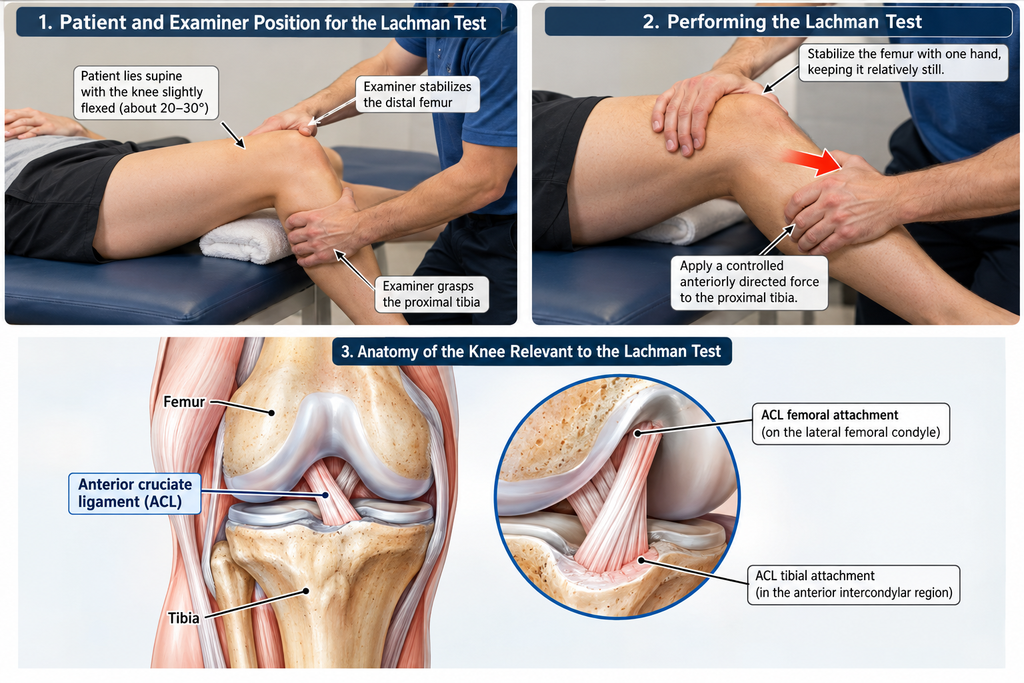
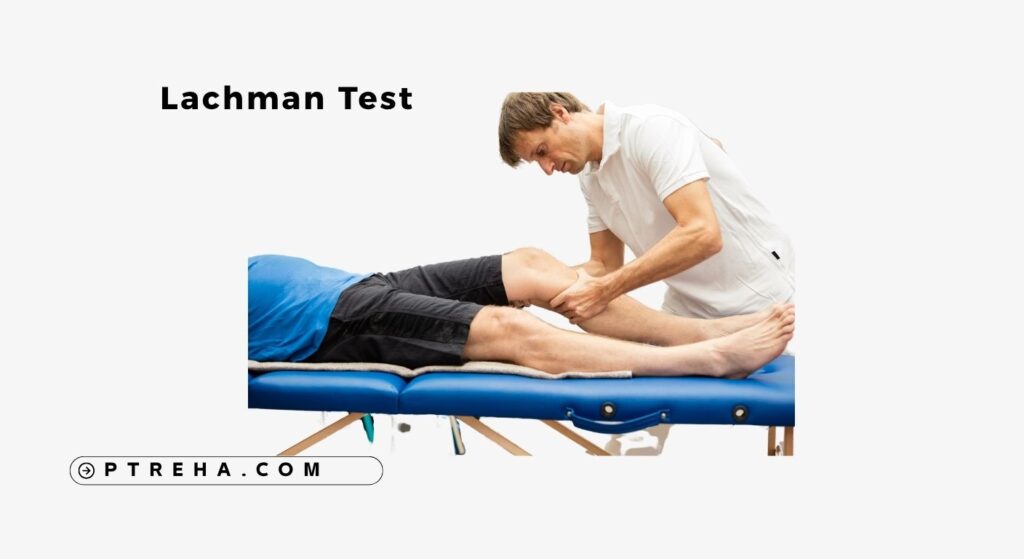
The examiner stabilizes the femur and applies an anteriorly directed force to the proximal tibia while the knee is held in slight flexion.
The test primarily evaluates two clinically important findings:
- The amount of anterior tibial translation relative to the femur.
- The quality of the endpoint felt when the tibia is translated anteriorly.
- Side-to-side differences when compared with the uninvolved knee.
- Whether guarding, pain, swelling, or positioning limits interpretation.
The test is especially valuable because it examines anterior knee stability without requiring the knee to be flexed as far as during the anterior drawer test.
A detailed clinical overview from the NCBI Bookshelf’s Lachman Test review describes the test as a physical examination maneuver for evaluating suspected ACL injury and emphasizes proper stabilization, positioning, and interpretation.
“A Lachman finding should be interpreted as part of the knee examination, not as a diagnosis in isolation.”
Purpose of the Lachman Test
The main purpose of the Lachman Test is to assess anterior knee laxity in the context of possible ACL injury.
A physical therapist may use it to:
- Assess anterior translation of the tibia relative to the femur.
- Examine the mechanical restraint normally provided in part by the ACL.
- Investigate suspected ACL injury after an appropriate history.
- Compare anterior laxity between the symptomatic and contralateral knees.
- Assess the quality of the endpoint during anterior translation.
- Add information to a broader ligamentous knee examination.
- Help determine whether further medical evaluation may be appropriate.
- Contribute to clinical reasoning following a twisting, pivoting, or landing injury.
- Reassess knee stability when clinically appropriate during follow-up.
- Complement other tests rather than replace the complete knee examination.
The Lachman Test should not be used to determine the patient’s overall knee function, strength, balance, readiness for sport, or rehabilitation status by itself.
Lachman Test Indications
The test may be appropriate when the history and examination raise suspicion of ACL injury or anterior knee instability.
Examples include:
- A non-contact pivoting or cutting mechanism.
- A sudden change in direction associated with knee symptoms.
- A landing injury with rotational or valgus loading.
- A report that the knee gave way during activity.
- Acute knee swelling following a relevant traumatic mechanism.
- Subjective instability during cutting or pivoting activities.
- Follow-up evaluation of a knee with a known or suspected ACL injury.
- Examination of anterior knee laxity as part of a comprehensive ligament assessment.
A reported “pop,” swelling, or giving-way episode may increase clinical suspicion in an appropriate injury context, but none of these features individually confirms an ACL tear.
Lachman Test Contraindications and Precautions
There is no widely accepted list of unique absolute contraindications specifically established for the routine Lachman Test.
The examination should nevertheless follow normal musculoskeletal safety principles.
Clinically important precautions include:
- Severe pain that prevents meaningful examination.
- Marked guarding that makes the endpoint difficult to assess.
- Significant acute swelling that interferes with positioning or relaxation.
- Suspected fracture or major acute structural injury requiring medical evaluation.
- Recent trauma where forceful testing would be inappropriate.
- Inability to position the knee safely.
- Postoperative restrictions that limit manual ligament testing.
- Neurovascular concerns following significant knee trauma.
The examiner should not repeatedly apply force simply to obtain a clearer finding when the patient cannot relax or tolerate the procedure.
In an acutely injured knee, the priority is safe assessment.
A technically poor test performed through severe guarding provides less useful information than a carefully modified examination or appropriate referral.
Patient Position
A commonly described manual Lachman technique uses the following patient position:
- The patient lies supine.
- The tested leg remains relaxed.
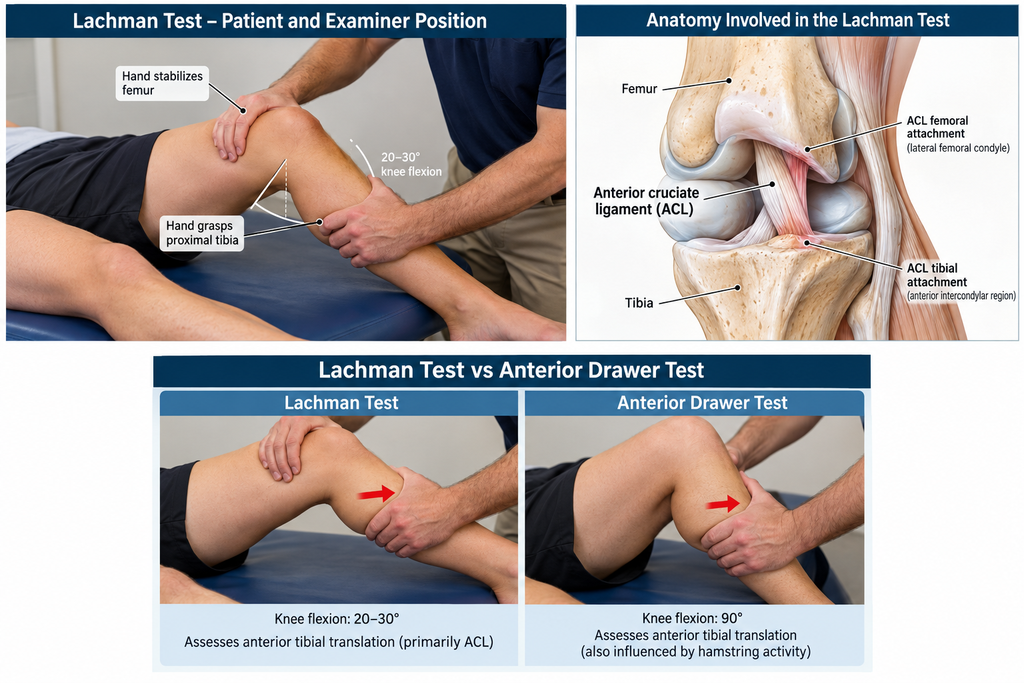
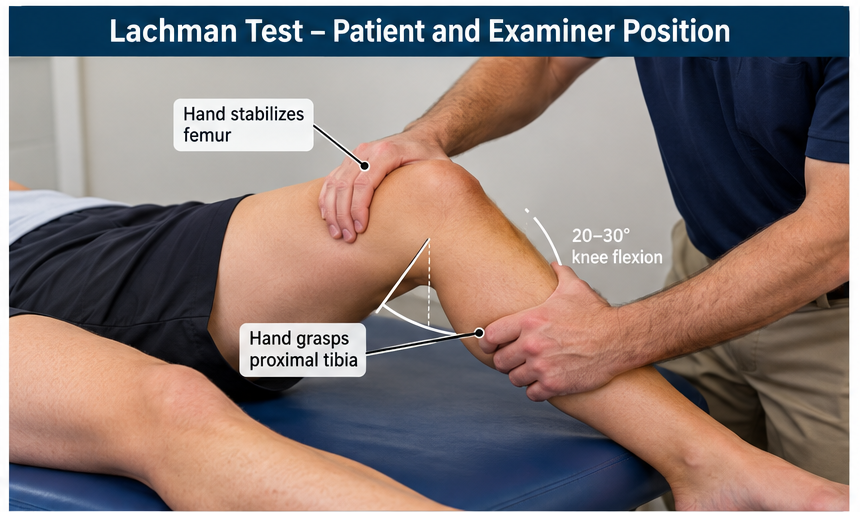
- The knee is held in slight flexion, commonly around 20–30 degrees in descriptions of the traditional technique.
- The heel or lower leg is supported as necessary.
- The quadriceps and hamstrings should be as relaxed as possible.
- The opposite knee can be examined for comparison when clinically appropriate.
The flexion angle is part of the commonly taught manual technique rather than a universal diagnostic cutoff.
Small variations in leg rotation, examiner hand placement, patient anatomy, and clinical circumstances occur between techniques.
Examiner Position
The examiner generally positions themselves beside the involved knee.
For the traditional manual technique:
- One hand stabilizes the distal femur.
- The other hand grasps the proximal tibia.
- The examiner maintains the knee in slight flexion.
- The femur should remain relatively stable during the maneuver.
- The patient’s muscles should remain as relaxed as possible.
- The examiner evaluates both tibial excursion and endpoint quality.
Hand placement may need modification in patients with larger thighs, smaller examiner hands, pain, swelling, or difficulty maintaining relaxation.
The goal is not to generate maximal force.
It is to produce a controlled anterior translation while maintaining adequate femoral stabilization.
How to Perform the Lachman Test
A commonly used manual Lachman Test can be performed as follows:
- Place the patient in a relaxed supine position.
- Position the knee in slight flexion, commonly within the range used for the traditional Lachman technique.
- Support the leg so unnecessary muscular activity is minimized.
- Stabilize the distal femur with one hand.
- Grasp the proximal tibia with the other hand.
- Ensure the tibia begins from a neutral, comfortable position rather than being inadvertently held anteriorly.
- Apply a controlled anteriorly directed force to the proximal tibia while stabilizing the femur.
- Observe and feel the amount of anterior tibial translation.
- Assess the quality of the endpoint as anterior translation reaches its limit.
- When safe and clinically relevant, compare the findings with the opposite knee.
- Integrate the finding with the patient’s injury mechanism, swelling, symptoms, other ligament tests, and the rest of the examination.
The movement should be deliberate rather than abrupt.
A poorly stabilized femur can make apparent tibial translation difficult to interpret.
What Constitutes a Positive Lachman Test?
The terms positive and negative are clinically used for the Lachman Test, although interpretation should not rely on a single rigid displacement threshold.
A Lachman Test may be considered clinically positive when the examiner identifies findings such as:
- Greater anterior tibial translation than expected, particularly relative to the contralateral knee.
- Increased side-to-side laxity.
- A soft or poorly defined endpoint rather than the firmer restraint expected from an intact ACL.
- A combination of increased translation and altered endpoint quality.
The comparison knee is important because physiological ligamentous laxity varies between individuals.
A patient may naturally demonstrate greater laxity than another patient without having an ACL injury.
For that reason, interpreting an absolute amount of motion without considering the individual’s opposite knee can be misleading.
Endpoint Quality
Endpoint quality is an important component of the examination.
When anterior translation is restrained effectively, the examiner may perceive a relatively firm endpoint.
With substantial ACL insufficiency, the endpoint may feel softer or less clearly defined.
Endpoint interpretation is nevertheless examiner-dependent and can be affected by:
- Muscle guarding.
- Swelling.
- Pain.
- Hand placement.
- Femoral stabilization.
- Patient anatomy.
- Associated knee injuries.
- Examiner experience.
The endpoint should therefore be interpreted alongside the amount of translation and the remainder of the clinical examination.
What Does a Positive Lachman Test Mean?
A positive Lachman Test raises clinical suspicion for ACL insufficiency or injury, particularly when it fits the patient’s injury mechanism and other findings.
It does not independently establish:
- Whether an ACL tear is partial or complete.
- The exact morphology of an ACL injury.
- Whether associated meniscal injury is present.
- Whether another ligament is also injured.
- The patient’s functional stability during sport.
- Whether surgery is necessary.
- Whether a patient is ready to return to activity.
Those questions require additional assessment.
Associated injuries can also affect the clinical picture, making a complete knee examination important.
For a physical therapist, a clearly abnormal Lachman finding after significant trauma is therefore information used to guide clinical reasoning and, where appropriate, referral—not a substitute for a complete diagnostic work-up.
Negative Lachman Test
A negative Lachman Test generally means that the examiner does not detect clinically concerning anterior translation or endpoint alteration during the maneuver.
A negative finding can reduce suspicion of clinically significant ACL injury, but it cannot absolutely exclude one in every patient.
Interpretation may be limited by:
- Acute pain.
- Protective muscle guarding.
- Significant swelling or hemarthrosis.
- Inadequate femoral stabilization.
- Partial ACL injury.
- Associated injuries.
- Variation in examiner technique.
- Difficulty comparing with the opposite leg.
If the history strongly suggests ACL injury despite an apparently negative examination, the complete clinical picture remains more important than a single maneuver.
“When the history and the Lachman finding disagree, investigate the discrepancy rather than allowing one test to override the entire examination.”
Anatomy Involved in the Lachman Test
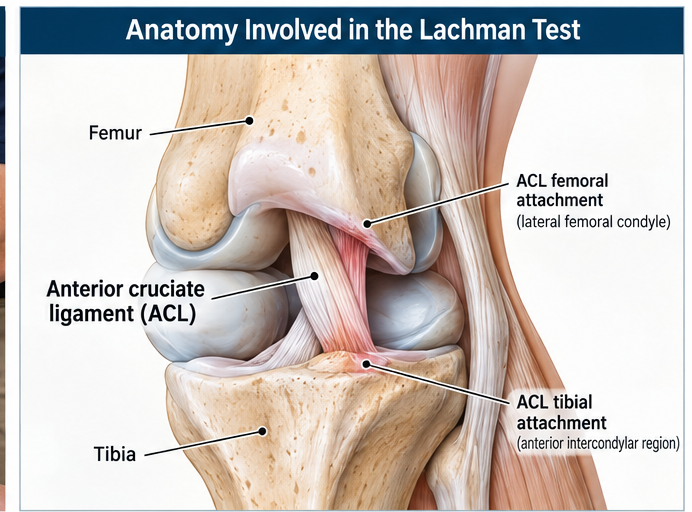
The primary anatomical structure of interest is the anterior cruciate ligament.
Relevant anatomy includes:
- Anterior cruciate ligament: an important restraint to anterior translation of the tibia relative to the femur and a contributor to rotational knee stability.
- Femur: stabilized by the examiner during the maneuver.
- Tibia: translated anteriorly during testing.
- Tibiofemoral joint: the joint where the tested translation occurs.
- ACL femoral attachment: located on the lateral femoral condyle within the intercondylar region.
- ACL tibial attachment: located in the anterior intercondylar region of the tibia.
- Hamstrings: muscle activation can resist anterior tibial translation and interfere with testing.
- Joint capsule and other ligamentous structures: contribute to overall knee stability and can influence clinical findings.
The ACL contains functionally distinct fiber regions that experience different loading as knee position changes.
The Lachman Test should therefore be described as an assessment of anterior knee laxity with particular clinical relevance to ACL integrity—not as a maneuver that perfectly isolates one group of ACL fibers from every other knee structure.
Conditions Associated With the Test
An abnormal Lachman Test is most strongly associated with ACL insufficiency or injury.
It may occur in the clinical context of:
- Complete ACL rupture.
- Partial ACL injury.
- Chronic ACL deficiency.
- Combined ligamentous knee injury.
- Traumatic knee instability involving the ACL.
- Recurrent giving-way following ACL injury.
The test does not independently determine the presence or absence of meniscal, chondral, collateral ligament, or other intra-articular pathology.
Those conditions require their own history, examination findings, and diagnostic assessment.
Clinical Significance
The Lachman Test remains an important component of the clinical examination for suspected ACL injury.
In practice, it can help the physical therapist:
- Increase or decrease suspicion of ACL injury.
- Identify clinically meaningful side-to-side anterior laxity.
- Evaluate endpoint quality.
- Combine physical findings with the mechanism of injury.
- Decide whether additional assessment is appropriate.
- Communicate objective examination findings to other clinicians.
- Select additional orthopedic tests appropriately.
- Avoid basing clinical reasoning only on symptoms such as pain.
- Support reassessment when repeated testing is clinically justified.
The test becomes much more useful when considered alongside other information.
For example, an athlete who experiences a pivoting knee injury followed by rapid swelling, instability, and a clearly abnormal Lachman examination presents a different clinical picture from a patient with atraumatic knee pain and symmetrical Lachman findings.
Sensitivity and Specificity
Diagnostic accuracy estimates for the Lachman Test vary between systematic reviews because studies differ in populations, injury chronicity, partial versus complete tears, reference standards, examiner conditions, and statistical methods.
A systematic review and meta-analysis examining suspected acute ACL injury included eight studies and reported pooled Lachman sensitivity of 0.79 and specificity of 0.91.
These estimates apply to the studies and acute-injury populations included in that analysis rather than serving as universal performance characteristics for every clinical setting.
Another systematic review and meta-analysis specifically examining clinical tests for ACL tears while addressing potential effects of concomitant ligament injury and statistical methodology reported overall pooled Lachman estimates of approximately 81% sensitivity and 85% specificity.
Importantly, the authors concluded that Lachman accuracy—particularly for some clinical presentations—may be lower than reported in earlier literature.
These differences illustrate why stating that the Lachman Test has one fixed sensitivity or specificity is inappropriate.
Diagnostic performance can depend on:
- Acute versus post-acute presentation.
- Partial versus complete injury.
- Associated ligament injury.
- Patient guarding.
- Examiner technique.
- Whether the patient is awake or anesthetized in research settings.
- Reference standard used by the study.
- Study design and risk of bias.
Consequently, diagnostic-accuracy figures should inform clinical reasoning rather than function as universal guarantees.
Diagnostic Accuracy
The Lachman Test has substantial clinical value in suspected ACL injury, but diagnostic accuracy should not be confused with diagnostic certainty.
A well-performed test can change the probability that an ACL injury is present.
It cannot independently describe the entire structural condition of the knee.
Clinical confidence becomes stronger when several findings agree, including:
- A compatible mechanism of injury.
- Relevant symptoms.
- Effusion or swelling pattern when present.
- Abnormal anterior laxity.
- Altered endpoint quality.
- Findings from complementary ligament tests.
- Appropriate imaging when clinically indicated.
This is particularly important with partial ACL injury, where clinical examination findings may be less obvious.
The appropriate question is therefore not simply:
“Is the Lachman Test positive?”
The more clinically useful question is:
“How does this Lachman finding change the overall probability of ACL injury in this patient?”
Common Mistakes in the Lachman Test
Technical errors can make the examination difficult to interpret.
Inadequate femoral stabilization
If the femur moves with the tibia, true anterior tibial translation becomes harder to appreciate.
Allowing the patient to guard
Hamstring contraction may resist anterior translation.
Give the patient time to relax and support the leg comfortably.
Testing at an unsuitable knee angle
Excessive knee flexion changes the mechanics of the maneuver and can make the test resemble an anterior drawer examination.
Gripping too far down the tibia
Hand placement should allow controlled movement of the proximal tibia.
Using excessive force
The goal is assessment of translation and endpoint quality, not maximal displacement.
Ignoring endpoint quality
Translation alone does not capture all clinically useful information.
Failing to compare sides
Normal laxity varies substantially between people.
Calling any lax knee an ACL tear
Generalized or physiological laxity can produce considerable movement without traumatic ACL deficiency.
Ignoring associated injury
A traumatic knee examination should not stop after the Lachman Test.
Repeating an intolerable test
Pain and guarding often make repeated forceful testing less informative rather than more informative.
Tips for Performing the Lachman Test
Several practical habits can improve the usefulness of the test.
- Explain the maneuver before beginning.
- Position the patient comfortably.
- Support the leg to encourage relaxation.
- Palpate before applying force so hand placement is secure.
- Stabilize the femur carefully.
- Translate the tibia smoothly rather than jerking it forward.
- Observe the patient’s muscular response.
- Compare with the opposite knee when appropriate.
- Assess both excursion and endpoint quality.
- Record factors that limit interpretation.
- Consider the injury mechanism before interpreting the result.
- Use complementary examination findings rather than relying on one test.
For clinicians with smaller hands examining a patient with a large thigh, obtaining effective stabilization can be difficult.
Adjusting examiner position or using an accepted modified technique may be more appropriate than struggling to reproduce an idealized textbook grip.
Documenting the Lachman Test
Documentation should describe what was actually observed rather than simply recording “Lachman positive.”
A useful clinical note might include:
- Side tested.
- Patient tolerance.
- Presence of guarding.
- Relative anterior translation.
- Comparison with the contralateral knee.
- Endpoint quality.
- Pain or other limiting factors.
- Relevant accompanying examination findings.
For example:
Lachman examination demonstrates greater anterior tibial translation on the involved side compared with the contralateral knee, with a less distinct endpoint.
Examination limited mildly by guarding.
Findings increase suspicion of ACL injury and are interpreted with the remainder of the knee assessment.
This conveys considerably more information than a single positive/negative label.
Lachman Test Versus Anterior Drawer Test
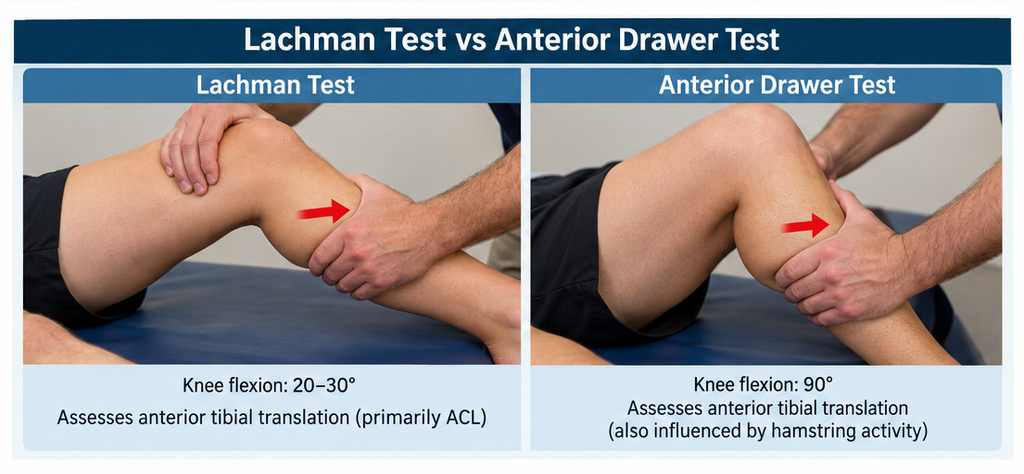
Both tests assess anterior tibial translation, but they use different knee positions.
The Lachman Test:
- Uses relatively slight knee flexion.
- Stabilizes the femur while translating the proximal tibia.
- Is commonly used when ACL injury is suspected.
- Allows assessment of translation and endpoint quality.
The anterior drawer test:
- Uses greater knee flexion.
- Also evaluates anterior tibial translation.
- Can be influenced by hamstring activity and tibial starting position.
- Provides complementary rather than identical examination information.
They should not be viewed as interchangeable simply because both involve anterior movement of the tibia.
Lachman Test Versus Pivot Shift Test
The Lachman and pivot shift tests examine different aspects of ACL-related instability.
The Lachman Test primarily provides clinical information about anterior tibial translation and endpoint quality.
The pivot shift maneuver is intended to reproduce or assess rotatory instability phenomena associated with an ACL-deficient knee.
Therefore:
- A patient may not respond identically to both tests.
- Guarding can particularly affect dynamic instability testing.
- The tests provide complementary information.
- Neither test should replace the broader clinical examination.
Using multiple appropriately selected examination findings generally provides a more informative picture than expecting one maneuver to answer every question about ACL function.
Role of the Lachman Test in Physical Therapy
For the physical therapist, the Lachman Test is primarily an assessment and clinical reasoning tool.
Its role may include:
- Recognizing findings consistent with possible ACL injury.
- Determining whether additional evaluation is warranted.
- Documenting anterior knee laxity.
- Contributing to communication with referring clinicians.
- Establishing findings during an initial musculoskeletal examination.
- Repeating the examination selectively when clinically useful.
It should not be used independently to make decisions about surgery, determine detailed structural pathology, or decide return-to-sport readiness.
Return-to-sport assessment requires a much broader evaluation of symptoms, strength, functional capacity, movement performance, psychological readiness, sport demands, and the overall rehabilitation course.
Summary
- The Lachman Test is an orthopedic special test used to assess anterior tibial translation and clinically evaluate possible ACL insufficiency.
- The traditional technique uses slight knee flexion while the examiner stabilizes the femur and translates the proximal tibia anteriorly.
- Increased anterior translation relative to the opposite knee and an altered or soft endpoint can increase suspicion of ACL injury.
- Diagnostic accuracy is clinically useful but varies across populations, injury types, examination conditions, and study methodologies.
- The Lachman Test should always be interpreted alongside the injury history, complete knee examination, and additional diagnostic assessment when indicated.
The Lachman Test remains one of the most useful manual components of an ACL examination when performed correctly.
Its real clinical value comes not from labeling a knee simply “positive” or “negative,” but from combining the quality of the finding with the patient’s mechanism, symptoms, comparative laxity, associated examination findings, and overall clinical presentation.