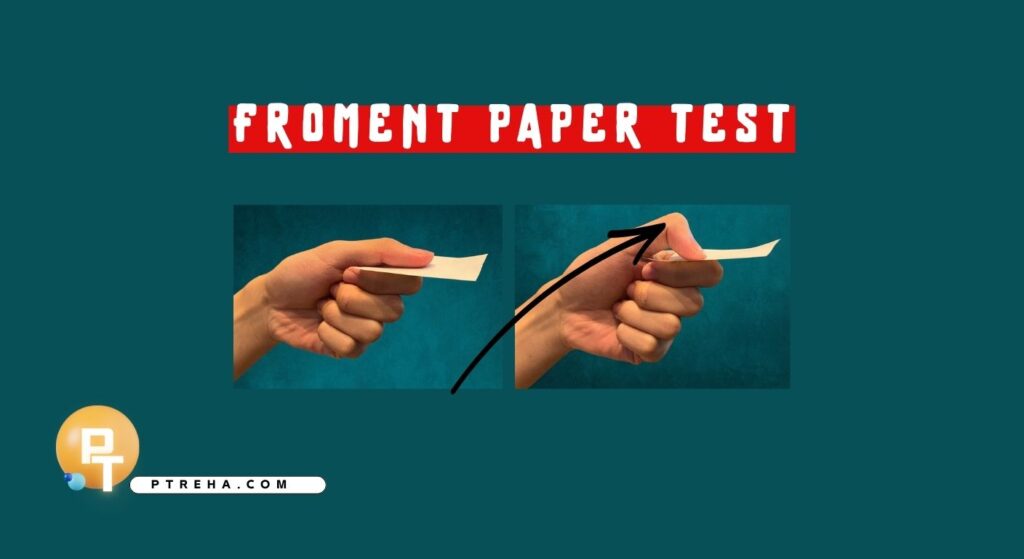
The Froment Paper Test, also called Froment’s sign, is a bedside neurological clinical assessment used during examination of hand motor function. It challenges the patient to maintain a paper pinch between the thumb and index finger while the examiner attempts to pull the paper away, with particular attention to compensatory flexion of the thumb interphalangeal (IP) joint.
What Is the Froment Paper Test?
The Froment Paper Test is best classified as a neurological clinical assessment and motor sign, rather than an outcome measure or a general functional performance test.
The maneuver is commonly used to assess motor function associated with the ulnar nerve, particularly the ability to generate thumb adduction through the adductor pollicis. The examiner observes whether the patient can maintain the paper pinch without excessive flexion of the thumb IP joint.
When adductor pollicis function is reduced, the patient may compensate by recruiting the flexor pollicis longus (FPL). Because FPL flexes the thumb IP joint and is innervated through the anterior interosseous nerve, a branch of the median nerve, visible IP flexion can appear while the patient tries to maintain the pinch. This compensatory movement is the classic Froment sign.
The test should not be interpreted as an isolated diagnostic examination. A finding suggestive of a Froment sign can contribute to the clinical assessment of possible ulnar motor dysfunction, but it does not by itself establish the cause or exact site of a nerve lesion.
Purpose of the Froment Paper Test
The test can be used to:
- Assess thumb pinch performance in a maneuver that stresses thumb adduction.
- Observe for compensatory thumb IP joint flexion during the pinch.
- Contribute to the neurological examination when ulnar motor dysfunction is suspected.
- Help identify motor involvement when considered alongside other findings from the hand and upper-limb examination.
- Provide a simple bedside observation that can be compared between hands when clinically appropriate.
The examination is most useful as one component of a broader assessment rather than as a stand-alone diagnostic test.
Froment Paper Test Indications
Common clinical indications include:
- Suspected ulnar nerve dysfunction involving motor function of the hand.
- Weakness or reduced dexterity affecting thumb-index pinch.
- Clinical examination of a patient with symptoms suggestive of an ulnar neuropathy.
- Follow-up of known neurological impairment when changes in hand motor function are being monitored.
- Comparison of hand motor performance when one side is clinically symptomatic.
The test may be relevant in conditions affecting the ulnar nerve at different anatomical levels, so the result should be considered together with sensory findings, other motor tests, symptom distribution, and the remainder of the neurological examination.
Froment Paper Test Contraindications and Precautions
There is no universally established test-specific contraindication for the Froment Paper Test.
Use routine clinical precautions:
- Avoid forceful resistance when the hand or thumb is acutely painful or injured.
- Modify or stop the maneuver if it aggravates pain, neurological symptoms, or an acute musculoskeletal problem.
- Use extra care after recent surgery, fracture, or significant soft-tissue injury according to the patient’s clinical restrictions.
- Do not interpret poor paper grip as neurological weakness without considering pain, effort, comprehension, and mechanical limitations of the thumb or hand.
The pulling force should be sufficient to challenge the patient’s grip but should not become unnecessarily aggressive.
Patient Position
A commonly used clinical position is:
- Seat the patient comfortably with the forearm supported if needed.
- Position the hand so the thumb and index finger can perform a lateral or key-type pinch.
- Ask the patient to hold a small piece or strip of paper between the thumb and the radial side of the index finger.
- Keep the hand in a comfortable position that allows the patient to concentrate on maintaining the pinch.
There is more than one minor variation in how the maneuver is demonstrated clinically, so the same basic procedure should be used consistently when comparing findings between sides or during follow-up.
Examiner Position
The examiner should:
- Sit or stand where the patient’s thumb and index finger are clearly visible.
- Place one hand or finger as necessary to stabilize the paper without obstructing observation of the thumb.
- Pull the paper gradually away from the patient’s grasp.
- Watch specifically for movement at the thumb IP joint.
- Compare sides when appropriate, particularly when the clinical question involves unilateral weakness.
The examiner should focus on the movement strategy, not simply on whether the paper can ultimately be removed.
How to Perform the Froment Paper Test
The commonly described paper-pinch procedure is performed as follows:
- Give the patient a small strip or sheet of paper.
- Ask the patient to hold it firmly between the thumb and radial side of the index finger.
- Instruct the patient to maintain the pinch while the examiner attempts to pull the paper away.
- Observe the thumb throughout the maneuver.
- Look for excessive or noticeable flexion of the thumb IP joint as the patient attempts to maintain the paper grip.
- Repeat on the opposite hand when a side-to-side comparison is clinically useful.
The important observation is whether the patient maintains thumb adduction or instead appears to rely on IP joint flexion to preserve the pinch.
What Constitutes a Positive Test?
For this neurological sign, the term positive Froment sign is clinically appropriate.
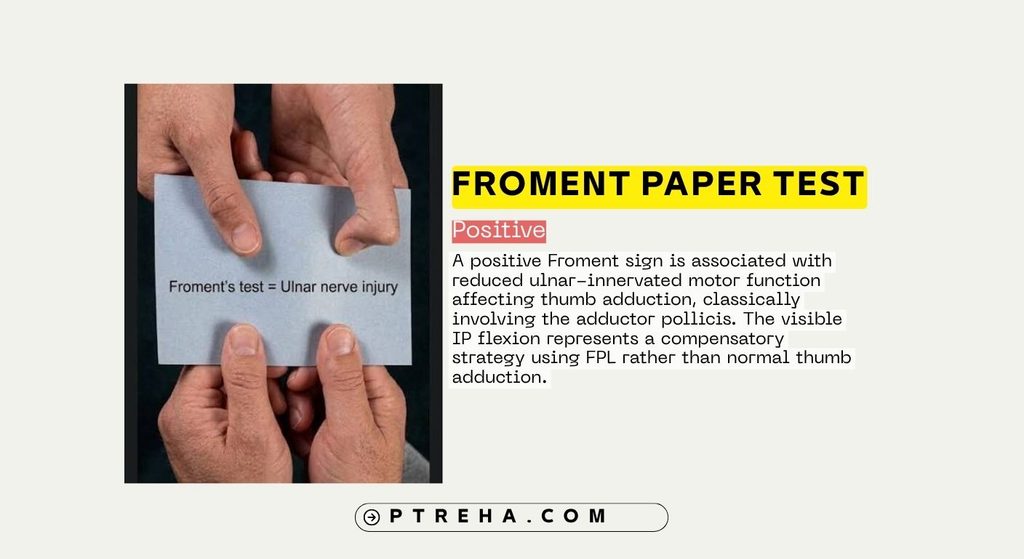
A classic positive finding is flexion of the thumb IP joint during the attempted paper pinch, particularly when the movement is clearly being used as a compensatory strategy to maintain the grip. This reflects recruitment of the flexor pollicis longus when normal thumb adduction is reduced.
The examiner should not rely on a fixed angle of thumb flexion or another universal numerical threshold. No such cutoff should be treated as a universal requirement for interpreting the sign.
What Does a Positive Froment Paper Test Mean?
A positive Froment sign is associated with reduced ulnar-innervated motor function affecting thumb adduction, classically involving the adductor pollicis. The visible IP flexion represents a compensatory strategy using FPL rather than normal thumb adduction.
It does not, by itself, establish:
- The exact anatomical level of the ulnar nerve lesion.
- The underlying cause of the nerve dysfunction.
- The severity of the neuropathy.
- Whether the problem is located at the elbow, wrist, or another site.
- A complete neurological diagnosis without supporting clinical findings.
For this reason, the Froment Paper Test should be interpreted as one finding within a broader neurological and musculoskeletal examination.
“The compensatory movement is often more informative than the ability to hold the paper alone.”
Negative Froment Paper Test
When the patient maintains the paper pinch without the characteristic compensatory IP flexion, the sign is generally described as negative.
A negative finding means that the classic Froment sign was not observed during that maneuver. It does not prove that ulnar nerve function is completely normal and does not exclude all forms, levels, or degrees of ulnar neuropathy.
Clinical interpretation should still consider other motor findings, sensory symptoms, weakness, muscle wasting, and functional complaints.
Anatomy Involved in Froment Paper Test
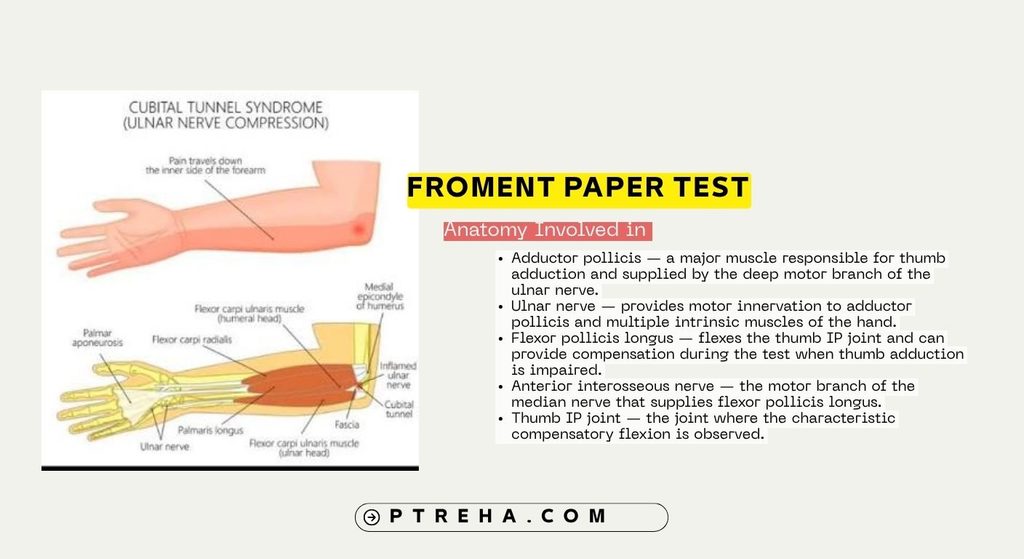
The principal anatomical and neurological structures include:
- Adductor pollicis — a major muscle responsible for thumb adduction and supplied by the deep motor branch of the ulnar nerve.
- Ulnar nerve — provides motor innervation to adductor pollicis and multiple intrinsic muscles of the hand.
- Flexor pollicis longus — flexes the thumb IP joint and can provide compensation during the test when thumb adduction is impaired.
- Anterior interosseous nerve — the motor branch of the median nerve that supplies flexor pollicis longus.
- Thumb IP joint — the joint where the characteristic compensatory flexion is observed.
The test is intended to challenge a movement requiring coordinated hand and thumb function; it should not be described as directly isolating one muscle without qualification.
Conditions Detected / Associated With the Test
The Froment Paper Test is most commonly associated with:
- Ulnar neuropathy involving motor impairment of the hand.
- Ulnar nerve palsy with weakness affecting thumb adduction.
- Other clinical situations in which ulnar motor function is being investigated.
A visible Froment sign is a clinical finding, not a diagnosis. The examiner should determine the broader clinical pattern before attributing the finding to a specific neuropathy or lesion.
Clinical Significance
The Froment Paper Test can contribute useful information when assessing:
- Thumb-index pinch mechanics.
- Possible ulnar motor involvement.
- Asymmetry between the symptomatic and less symptomatic hand.
- Motor findings that support or complement other neurological examination results.
- Changes in hand motor performance during rehabilitation or clinical follow-up.
A positive finding becomes more meaningful when it fits with other evidence of ulnar dysfunction, such as weakness of other ulnar-innervated intrinsic muscles or sensory symptoms in an appropriate distribution. Clinical examination resources describe Froment sign alongside other motor assessments such as finger abduction, small-finger abduction, and other ulnar nerve tests.
Sensitivity and Specificity
There is no universally established sensitivity or specificity value that should be applied to the Froment Paper Test across all patients and clinical settings.
A multicenter study of adults already diagnosed with ulnar neuropathy at the elbow compared several clinical motor signs with electrodiagnostic findings. Froment’s sign showed relationships with motor nerve conduction findings in that study, but the sample was small and the study population was specifically composed of patients with diagnosed ulnar neuropathy. The results therefore should not be treated as universal diagnostic-performance estimates.
Diagnostic Accuracy
The Froment Paper Test should not be presented as a stand-alone diagnostic test for ulnar neuropathy.
Its value is primarily as a bedside clinical sign of motor dysfunction that can support the overall examination. When the diagnosis, localization, or severity of a peripheral nerve disorder remains uncertain, the clinician may need additional neurological examination and, when clinically indicated, electrodiagnostic testing or other investigations.
Common Mistakes in Froment Paper Test
- Judging the test only by whether the patient can hold the paper.
- Failing to observe the thumb IP joint during the maneuver.
- Pulling the paper too aggressively.
- Confusing ordinary thumb movement with compensatory IP flexion.
- Assuming a positive sign automatically identifies the location of an ulnar lesion.
- Treating the finding as a diagnosis rather than a clinical sign.
- Ignoring pain, stiffness, prior injury, reduced effort, or limited thumb mobility.
- Comparing both hands inconsistently.
- Using an invented angle or numerical threshold to classify the result.
Tips for Performing the Froment Paper Test
- Make the procedure simple and demonstrate the required pinch clearly.
- Use the same paper-pinch setup when comparing sides.
- Pull steadily rather than suddenly.
- Watch the thumb IP joint closely throughout the attempt.
- Observe the rest of the hand for additional motor abnormalities.
- Combine the result with sensory examination and other ulnar motor tests.
- Document the actual observed movement rather than writing only “positive” or “negative.”
- Repeat the maneuver when the first attempt is unclear, provided repetition is clinically appropriate.
“A Froment sign is a clue to motor dysfunction, not a complete neurological diagnosis.”
Summary
The Froment Paper Test is a neurological clinical assessment used to examine thumb pinch function in the context of possible ulnar motor dysfunction.
The patient holds paper between the thumb and index finger while the examiner attempts to pull it away, with observation of the thumb IP joint during the effort.
The classic Froment sign is compensatory thumb IP flexion, reflecting recruitment of the flexor pollicis longus when thumb adduction is impaired.
The finding should be interpreted in the context of the complete neurological and musculoskeletal examination and should not be used alone to establish the cause or location of a nerve lesion.
There is no universal sensitivity, specificity, or diagnostic cutoff that can be safely applied to all patients.
The Froment Paper Test remains useful as a quick bedside observation, particularly when combined with other assessments of ulnar nerve motor and sensory function.
Resources and External References
NCBI MedGen — Froment Sign
NCBI MedGen: Froment sign definition and clinical description
Clinical Review — Hand manifestations of cervical and peripheral nerve disorders
Clinical review of hand manifestations of cervical myelopathy, radiculopathy, radial and ulnar neuropathies
Goldman et al. — Analysis of clinical motor testing for adult patients with diagnosed ulnar neuropathy at the elbow
PubMed record and study details
NCBI Bookshelf — Electrodiagnostic Evaluation of Ulnar Neuropathy
Clinical reference on ulnar neuropathy and Froment sign