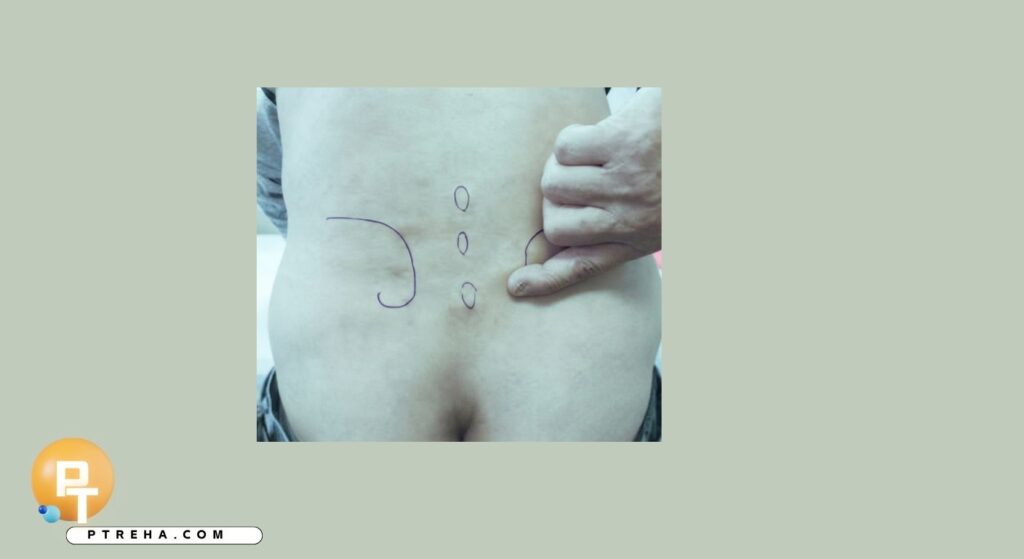
The Fortin Finger Test is a clinical pain-location assessment used in the examination of patients with lumbopelvic pain when a sacroiliac joint (SIJ) pain source is being considered. It is simple to perform, but its finding should be interpreted as one part of a broader clinical examination rather than as a stand-alone diagnosis.
What Is the Fortin Finger Test?
The Fortin Finger Test, also called Fortin’s sign, asks the patient to identify the location of their familiar pain with one finger.
In the original description, the clinician observes whether the patient repeatedly points to an area over or immediately adjacent to the posterior superior iliac spine (PSIS) when identifying their usual pain. The test was developed as a clinical sign to help identify patients in whom the SIJ might be contributing to lumbopelvic pain.
It is important to classify the Fortin Finger Test accurately. It is best understood as a clinical assessment of pain location, rather than a strength test, range-of-motion measurement, functional performance test, or isolated tissue test.
The test does not directly measure SIJ movement or prove that the SIJ is the anatomical pain generator.
Purpose of the Fortin Finger Test
The Fortin Finger Test may be used to:
- Identify the patient’s familiar pain location during a lumbopelvic examination.
- Determine whether the reported pain is localized around the PSIS/SIJ region.
- Contribute to the clinical reasoning process when SIJ-related pain is being considered.
- Help guide the selection of additional SIJ examination procedures.
- Document the patient’s pain distribution for comparison during the clinical assessment.
The original study found that patients selected using the Fortin Finger Test subsequently demonstrated pain reproduction with SIJ injection. However, that study involved a small selected sample, and later literature has highlighted limitations in the evidence surrounding individual SIJ clinical tests.
Fortin Finger Test Indications
The assessment may be considered when a patient presents with:
- Localized lower-back or posterior pelvic pain.
- Pain near the PSIS region.
- Lumbopelvic pain in which the SIJ is part of the differential diagnosis.
- Posterior pelvic pain that needs to be distinguished from other possible lumbar, hip, or pelvic pain sources.
- A clinical presentation in which pain location may help determine which additional examination procedures are appropriate.
The test is particularly useful as a pain-location observation, not as an isolated diagnostic maneuver.
Fortin Finger Test Contraindications and Precautions
There are no well-established Fortin Finger Test-specific contraindications that justify treating the maneuver as inherently hazardous.
General clinical precautions still apply:
- Do not repeatedly provoke severe or unnecessarily distressing pain simply to reproduce the patient’s symptom.
- Ensure that the patient understands what they are being asked to identify.
- Consider communication, language, cognitive, or sensory factors that could affect the patient’s ability to localize pain.
- Interpret the finding in the context of the patient’s complete history and physical examination.
- Consider alternative sources of posterior pelvic or low-back pain rather than assuming that pain over the PSIS originates from the SIJ.

Patient Position
The Fortin Finger Test is primarily based on patient-reported pain localization, so a highly restrictive standardized position is not essential.
A commonly practical approach is:
- Position the patient comfortably, often standing.
- Ensure that the lumbar and posterior pelvic region can be accessed visually if needed.
- Ask the patient to identify the location of their usual or familiar pain.
- Ask the patient to use one finger rather than the whole hand to indicate the most painful area.
The exact clinical setup can vary according to the examination and patient presentation.
Examiner Position
The examiner should:
- Stand where the patient’s posterior pelvic region can be observed clearly.
- Avoid leading the patient toward a particular anatomical location.
- Observe the patient’s spontaneous pointing response.
- Record the location indicated by the patient.
- Compare the reported location with relevant anatomical landmarks.
A neutral question is preferable to wording that suggests the SIJ as the expected source of pain.
How to Perform the Fortin Finger Test
- Explain that you want the patient to identify the location of their familiar pain.
- Ask the patient to point with one finger to the place where they normally feel the pain.
- Avoid giving the patient an anatomical landmark to point toward before they respond.
- Observe whether the patient identifies a localized area around the PSIS/SIJ region.
- If appropriate, repeat the instruction to ensure that the patient is identifying their usual pain, rather than a pain created by the examination.
- Record the patient’s reported location.
- Integrate this finding with the history and other examination findings.
The essential feature is the patient’s spontaneous localization of familiar pain, rather than tenderness produced by the examiner.
“Pain location can guide clinical reasoning, but pain location alone does not establish the pain generator.”
Interpretation
A finding consistent with the Fortin Finger Test is the patient’s ability to localize their familiar pain with one finger to the region around the PSIS/SIJ.
This finding can increase clinical suspicion that the SIJ region may be relevant to the patient’s presentation, but it does not establish that the SIJ is definitively the source of pain.
This distinction is important because several structures and disorders can produce pain in the posterior pelvic and lower-back region.
The original Fortin study reported that all 16 selected patients subsequently had provocation-positive SIJ injections. However, those patients were selected from a larger group using the same sign, and methodological reviews have questioned the quality and diagnostic validity of the evidence for individual SIJ tests.
What Does a Positive Fortin Finger Test Mean?
The term positive Fortin Finger Test is commonly used when the patient’s familiar pain is localized with one finger to the characteristic PSIS/SIJ region.
Clinically, this should be interpreted as a supporting finding, rather than a definitive diagnosis.
A positive finding may justify further assessment of possible SIJ involvement, particularly with an appropriate cluster of pain-provocation tests and consideration of competing lumbar and hip sources.
Research examining SIJ diagnosis has generally found that combinations of appropriately selected examination findings are more useful than relying on one clinical sign alone. Even clusters of SIJ provocation tests have limitations, and the certainty of the available evidence varies.
Negative Fortin Finger Test
If the patient does not localize their familiar pain to the PSIS/SIJ region, the finding does not support the characteristic Fortin sign.
However, this should not automatically be interpreted as evidence that the SIJ cannot contribute to the patient’s symptoms.
Pain distribution can vary, and the diagnostic value of an individual pain-location finding depends on the clinical context and the reference standard used.
Anatomy Involved in Fortin Finger Test
Relevant anatomical structures include:
- Posterior superior iliac spine (PSIS): a palpable bony landmark on the posterior pelvis.
- Sacroiliac joint: the articulation between the sacrum and ilium.
- Sacrum: the triangular bone forming the posterior portion of the pelvic ring.
- Ilium: the large component of the innominate bone forming the lateral pelvis.
- Posterior pelvic soft tissues: multiple muscles, ligaments, fascia, and other tissues occupy the region around the SIJ.
The Fortin Finger Test does not isolate any of these structures. It identifies where the patient experiences their familiar pain.
That distinction is clinically important: localization near an anatomical structure is not equivalent to demonstrating that the structure is the pain generator.
Conditions Detected / Associated With the Test
The Fortin Finger Test is primarily associated with clinical assessment of:
- Sacroiliac joint-related pain
- Lumbopelvic pain
- Posterior pelvic pain
It should not be presented as a test that independently detects or confirms SIJ dysfunction.
The original study investigated patients considered to have SIJ dysfunction, but subsequent reviews have identified substantial methodological limitations in the evidence for individual SIJ tests.
Clinical Significance
The main clinical value of the Fortin Finger Test is that it provides a quick description of where the patient experiences their familiar pain.
This can help the clinician:
- Develop an initial differential diagnosis.
- Decide which additional examination procedures are appropriate.
- Compare the patient’s pain distribution with other clinical findings.
- Avoid prematurely attributing all posterior pelvic pain to the SIJ.
- Incorporate patient-reported symptoms into clinical reasoning.
A broader assessment remains necessary because lumbar, hip, pelvic, and other musculoskeletal disorders can produce overlapping pain distributions.
“Use the Fortin finding to ask better clinical questions—not to end the diagnostic process.”
Sensitivity and Specificity
A universally accepted sensitivity or specificity value for the Fortin Finger Test should not be presented.
The original study reported a selected group of patients with the Fortin finding who subsequently demonstrated positive SIJ injection responses, but this design does not establish a universally applicable sensitivity and specificity for the sign. A methodological systematic review also rated the original Fortin study poorly and highlighted limitations in the evidence base for SIJ clinical tests.
More recent evidence has generally emphasized the limitations of relying on individual SIJ examination findings and the importance of interpreting clinical tests within a broader examination.
Diagnostic Accuracy
The Fortin Finger Test should not be treated as a stand-alone diagnostic test with established universal diagnostic accuracy.
Research on SIJ pain suggests that clinical reasoning based on multiple examination findings can be more informative than an isolated test. For example, studies have investigated clusters of SIJ pain-provocation tests rather than relying solely on pain localization.
Importantly, diagnostic accuracy depends on the population studied, the reference standard, the clinical protocol, and the definition of SIJ pain.
Common Mistakes in Fortin Finger Test
- Leading the patient: Telling the patient to point directly at the SIJ can influence the response.
- Using the whole hand: The classic finding involves localization with one finger.
- Confusing location with diagnosis: Pointing near the PSIS does not prove SIJ pathology.
- Ignoring other pain sources: Lumbar and hip disorders can produce overlapping symptoms.
- Treating the sign as a mobility test: The Fortin Finger Test does not measure SIJ mobility.
- Using examiner palpation as a substitute: The patient’s reported pain location is the central feature.
- Overinterpreting a single finding: The result should be integrated with history and other examination findings.
- Ignoring the patient’s familiar pain: The assessment should concern the patient’s usual symptom rather than an unrelated area of tenderness.
Tips for Performing the Fortin Finger Test
- Use neutral instructions.
- Ask about the patient’s familiar pain, not simply the most tender area.
- Let the patient point before discussing the suspected anatomical source.
- Observe the exact location rather than relying only on the patient’s verbal description.
- Document the location consistently.
- Use the finding to guide further examination rather than to prematurely label the condition.
- Combine the result with an appropriate differential diagnosis.
- Consider multiple SIJ pain-provocation findings when SIJ pain remains clinically suspected.
- Remember that the test is a clinical sign, not a direct measurement of SIJ pathology.
Summary
- The Fortin Finger Test is a clinical pain-location assessment used when SIJ-related pain is being considered.
- The patient identifies their familiar pain with one finger, typically in relation to the PSIS/SIJ region.
- A characteristic finding may support consideration of the SIJ as part of the differential diagnosis, but it does not independently establish the SIJ as the pain generator.
- The evidence for individual SIJ clinical tests has important methodological and diagnostic limitations.
- Clinical interpretation is strongest when the finding is integrated with the patient’s history, differential diagnosis, and other appropriate examination findings.
The Fortin Finger Test is valuable because it is simple and patient-centered, but its simplicity should not be confused with diagnostic certainty. In clinical practice, the most useful approach is to treat the patient’s pain location as one piece of evidence within a structured lumbopelvic examination.
Resources and External References
- Fortin JD, Falco FJE — The Fortin Finger Test: An Indicator of Sacroiliac Pain (PubMed)
- Specificity, Sensitivity, and Predictive Values of Clinical Tests of the Sacroiliac Joint — Systematic Review
- Clinical Tests of the Sacroiliac Joint — Reliability Review (PubMed)
- Clinical Tests of the Sacroiliac Joint — Validity Review (PubMed)
- Diagnosis of Sacroiliac Joint Pain: Validity of Individual Provocation Tests and Composites of Tests (PubMed)
- Diagnostic Accuracy of Clusters of Pain Provocation Tests for Detecting Sacroiliac Joint Pain — Systematic Review and Meta-analysis
- Challenges in Diagnosing Sacroiliac Joint Pain — Narrative Review (PubMed)