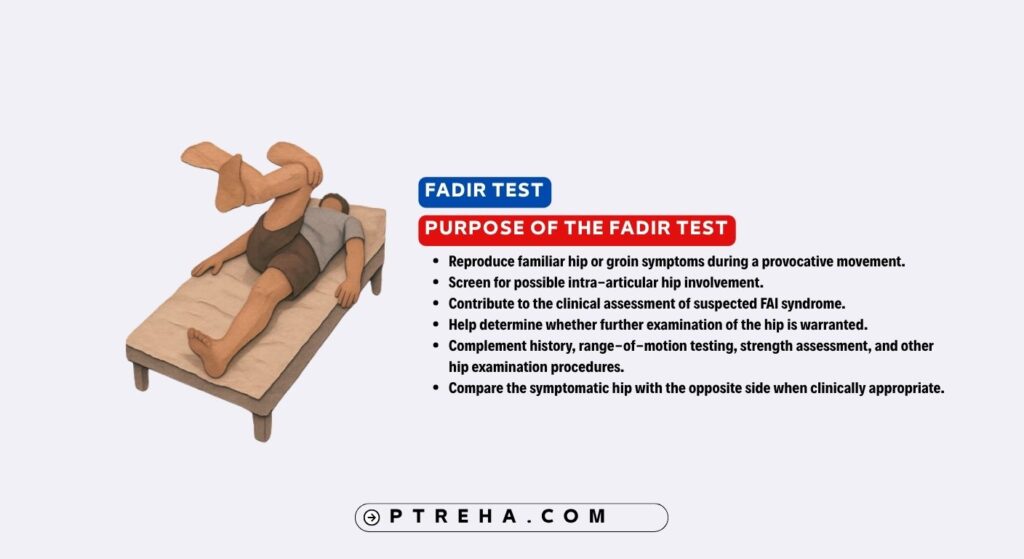
The FADIR Test stands for Flexion, Adduction, and Internal Rotation. It is an orthopedic provocative maneuver used during the physical examination of the hip, particularly when assessing patients with hip or groin pain.
The patient is positioned supine while the examiner passively moves the hip into flexion, adduction, and internal rotation. The maneuver is intended to reproduce the patient’s familiar symptoms rather than to measure a single isolated anatomical structure.
FADIR is frequently included when femoroacetabular impingement (FAI) syndrome or other intra-articular hip pathology is being considered. However, the test is not sufficiently specific to establish a diagnosis by itself. Systematic reviews have consistently described its clinical role as more useful for screening than for independently confirming FAI.
Purpose of the FADIR Test
The FADIR Test may be used to:
- Reproduce familiar hip or groin symptoms during a provocative movement.
- Screen for possible intra-articular hip involvement.
- Contribute to the clinical assessment of suspected FAI syndrome.
- Help determine whether further examination of the hip is warranted.
- Complement history, range-of-motion testing, strength assessment, and other hip examination procedures.
- Compare the symptomatic hip with the opposite side when clinically appropriate.
The test should be interpreted as one component of a broader clinical examination rather than as an isolated diagnostic procedure.
FADIR Test Indications
FADIR may be considered when a patient presents with:
- Anterior hip or groin pain.
- Hip pain reproduced by flexion or rotational activities.
- Symptoms associated with activities requiring substantial hip flexion.
- Clinical features suggesting possible intra-articular hip involvement.
- Suspected FAI syndrome as part of a broader hip assessment.
- Possible acetabular labral pathology requiring further clinical investigation.
The indication should come from the patient’s history and overall examination rather than from the presence of hip pain alone.
FADIR Test Contraindications and Precautions
There is not a universally established list of FADIR-specific absolute contraindications. Instead, the clinician should apply normal precautions for passive hip examination.
Use appropriate caution when:
- The patient has severe or unexplained acute hip pain.
- There is a recent significant hip injury for which movement has not yet been medically assessed.
- A fracture or other serious structural injury is suspected.
- The available hip range of motion is substantially restricted and forcing the maneuver would provoke unnecessary pain.
- The patient cannot comfortably tolerate the required position.
- The clinician is concerned that the maneuver may aggravate the patient’s symptoms.
The hip should be moved progressively and under patient feedback rather than being forced aggressively into end range.
Patient Position
The commonly described FADIR procedure is performed with the patient:
- Lying supine on the examination table.
- Relaxed, with the pelvis positioned comfortably and as neutrally as practical.
- With the hip and knee of the tested limb flexed.
- With the examiner controlling the limb throughout the maneuver.
A commonly described version brings the hip toward approximately 90° of flexion before combining adduction and internal rotation. However, descriptions of the maneuver vary between clinical protocols, so the exact position should not be treated as a universal standardized angle.
Examiner Position
The examiner should:
- Stand beside the tested hip.
- Support the patient’s lower limb securely.
- Control the knee and lower leg so that the hip movement is deliberate and passive.
- Observe pelvic movement during the maneuver.
- Monitor the patient’s facial expression and verbal response.
- Ask where the patient feels the discomfort or familiar symptom.
- Compare findings with the opposite hip when clinically appropriate.
The examiner should avoid using excessive force to obtain a larger range of motion.
How to Perform the FADIR Test
A commonly used supine procedure is:
- Place the patient comfortably in the supine position.
- Flex the tested hip and knee while supporting the limb.
- Bring the hip into flexion within the patient’s available comfortable range.
- Move the hip toward adduction, bringing the thigh toward or across the body’s midline.
- Combine the movement with internal rotation of the hip.
- Apply only controlled passive movement appropriate to the patient’s available range.
- Ask the patient whether the maneuver reproduces their familiar symptoms.
- Record the location, quality, and nature of the symptoms rather than simply recording pain as present or absent.
- Repeat on the opposite side when appropriate for comparison.
One published clinical examination protocol describes moving the hip into approximately 90° of flexion followed by adduction and internal rotation with controlled overpressure. Other protocols use different movement sequences or end-range positions, demonstrating why the exact technique should be documented when findings are being compared clinically or in research.
Interpretation of the FADIR Test
A clinically meaningful FADIR finding generally involves reproduction of the patient’s familiar hip or groin symptoms during the maneuver.
The location of the reproduced symptom is important. Anterior or groin pain may increase suspicion of an intra-articular hip source, but pain can also be experienced in other regions, including the lateral hip or buttock. Therefore, symptom location should be interpreted alongside the history and the remainder of the examination.
A painful response does not establish that femoroacetabular impingement is present.
“A painful FADIR finding is a clinical clue, not a diagnosis.”
The FADIR maneuver can stress or compress several tissues around the hip and reproduce symptoms from more than one disorder. This limits its ability to identify one specific pathological structure.
What Does a Positive FADIR Test Mean?
When the term positive FADIR is used clinically, it commonly refers to reproduction of the patient’s relevant hip or groin symptoms during the maneuver.
This finding may support consideration of intra-articular hip pathology, including FAI syndrome, in the appropriate clinical context. It can therefore be useful as part of a screening examination.
However, a positive FADIR does not independently establish:
- Femoroacetabular impingement syndrome.
- A cam or pincer morphology.
- An acetabular labral tear.
- Cartilage damage.
- A specific site of tissue injury.
Those conclusions require integration of symptoms, physical examination findings, and, when indicated, appropriate imaging or other diagnostic information.
Negative FADIR Test
If the FADIR maneuver does not reproduce the patient’s familiar symptoms, the finding may reduce suspicion for some forms of intra-articular hip involvement in the appropriate clinical context.
It does not, however, exclude every hip disorder.
A patient may have clinically important hip pathology despite a non-provocative FADIR maneuver. Consequently, a non-painful response should be considered alongside the patient’s history, range of motion, strength, functional limitations, and other examination findings.
Anatomy Involved in FADIR Test
The maneuver involves movement of the:
- Hip joint.
- Femoral head and neck region.
- Acetabulum.
- Acetabular rim.
- Acetabular labrum.
- Hip joint capsule.
- Surrounding muscles and soft tissues that influence hip motion.
The combined position of flexion, adduction, and internal rotation brings the femoral head and neck into a relationship with the acetabular region that can reproduce symptoms in some patients.
It is important not to interpret the maneuver as selectively testing the labrum or a single portion of the femoroacetabular joint. The mechanical and symptomatic response involves multiple anatomical structures and depends on the patient’s individual anatomy and movement pattern.
Conditions Detected / Associated With the Test
FADIR findings can be associated with:
- Femoroacetabular impingement syndrome.
- Other forms of intra-articular hip pathology.
- Acetabular labral pathology in appropriate clinical populations.
- Hip-related groin pain.
The important distinction is that the FADIR maneuver does not independently detect or confirm these conditions.
For example, FAI syndrome involves more than an anatomical morphology or a painful movement alone. Clinical diagnosis requires consideration of symptoms and other findings. The FADIR result therefore contributes to the assessment rather than replacing it.
Clinical Significance
The FADIR Test can be clinically useful because it is relatively simple and can reproduce symptoms during a controlled provocative movement.
Its main clinical value includes:
- Screening: Evidence supports its use as a screening maneuver for possible intra-articular hip involvement and FAI-related presentations.
- Symptom reproduction: The examiner can determine whether a familiar symptom occurs during a specific hip position.
- Clinical reasoning: The result can help determine which areas of the hip examination require further attention.
- Differential assessment: The finding can be considered alongside lumbar spine, pelvic, muscular, and other hip examinations.
- Treatment planning: Understanding which movements reproduce symptoms may help guide subsequent functional assessment and rehabilitation.
- Referral decisions: Persistent or unexplained symptoms, particularly when accompanied by concerning clinical features, may warrant further medical evaluation.
A systematic review of systematic reviews found that the evidence supporting FADIR is strongest for its role as a screening tool, while limitations in study methods and reference standards make it inappropriate to treat the maneuver as a stand-alone diagnostic test.
Sensitivity and Specificity
Reported sensitivity and specificity for FADIR vary substantially between studies.
This variation is related to differences in patient populations, definitions of FAI or labral pathology, reference standards, imaging methods, and test protocols. A systematic review of FADIR specifically reported wide ranges of diagnostic performance and concluded that its overall diagnostic utility remained unclear, although its screening role was supported.
A later umbrella review similarly concluded that the evidence for FADIR as a screening test was relatively stronger than the evidence supporting it as a confirmatory diagnostic test.
For this reason, a single sensitivity or specificity value should not be presented as the universal performance of the FADIR Test.
Diagnostic Accuracy
The diagnostic accuracy of FADIR depends heavily on the clinical question and the reference standard used.
Research has evaluated the maneuver against different combinations of radiographs, MRI, CT, arthroscopic findings, clinical criteria, and other reference standards. These differences make direct comparison between studies difficult.
The broader literature therefore supports a cautious interpretation: FADIR can contribute useful information during hip assessment, but it should not be used alone to confirm or exclude FAI or labral pathology.
Common Mistakes in FADIR Test
Avoid these frequent clinical errors:
- Treating any pain during FADIR as proof of FAI.
- Assuming that the test specifically isolates the acetabular labrum.
- Ignoring the location and character of the patient’s symptoms.
- Using excessive force to reach an end position.
- Failing to distinguish familiar symptoms from nonspecific stretching discomfort.
- Ignoring pelvic compensation during the maneuver.
- Comparing sides without considering differences in previous injury or mobility.
- Using a single FADIR result instead of completing a broader hip examination.
- Treating radiographic morphology and symptomatic FAI syndrome as interchangeable concepts.
- Assuming that a non-painful FADIR excludes all intra-articular hip pathology.
Tips for Performing the FADIR Test
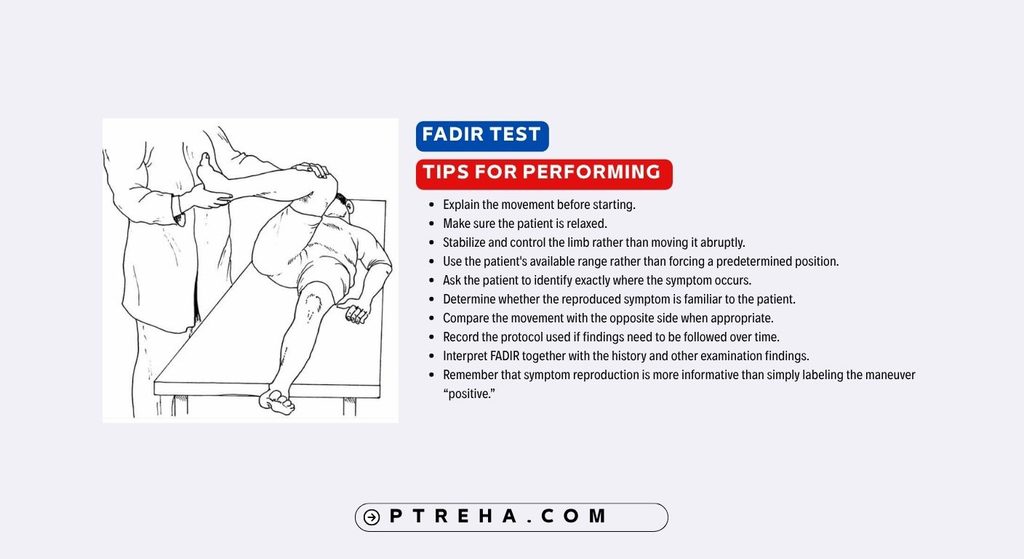
For a more useful clinical examination:
- Explain the movement before starting.
- Make sure the patient is relaxed.
- Stabilize and control the limb rather than moving it abruptly.
- Use the patient’s available range rather than forcing a predetermined position.
- Ask the patient to identify exactly where the symptom occurs.
- Determine whether the reproduced symptom is familiar to the patient.
- Compare the movement with the opposite side when appropriate.
- Record the protocol used if findings need to be followed over time.
- Interpret FADIR together with the history and other examination findings.
- Remember that symptom reproduction is more informative than simply labeling the maneuver “positive.”
For clinicians reviewing the broader examination of FAI, the physical examination literature on femoroacetabular impingement provides useful context on how FADIR fits alongside range-of-motion and other provocative procedures.
For a broader evidence-based perspective, the systematic review of clinical tests for FAI and acetabular labral tear explains why these maneuvers should generally be interpreted as screening or contributing tests rather than isolated diagnostic tools.
The umbrella review of diagnostic accuracy for FAI is also useful when evaluating the current evidence and the limitations of published sensitivity and specificity estimates.
Summary
- The FADIR Test is an orthopedic provocative assessment involving hip flexion, adduction, and internal rotation.
- It is commonly used to reproduce familiar symptoms and screen for possible intra-articular hip involvement.
- A painful or symptom-reproducing response does not independently diagnose FAI, a labral tear, or another specific pathology.
- Published diagnostic-performance results vary considerably according to population, protocol, and reference standard.
- FADIR is most appropriately interpreted as one component of a comprehensive hip examination.
FADIR is valuable when used for what it can actually tell the clinician: whether a particular hip position reproduces relevant symptoms. Its usefulness increases when the finding is integrated with the patient’s history, symptom behavior, range of motion, strength, functional limitations, and other appropriate clinical tests rather than being treated as a stand-alone diagnosis.
Sources:
Fernandes et al. — Umbrella Review of Systematic Reviews
Supports the current evidence that FADIR is more consistently supported as a screening tool than as a stand-alone diagnostic test.
Diagnostic Accuracy of Clinical Tests and Imaging Exams for Femoroacetabular ImpingementShanmugaraj et al. — Systematic Review of the FADIR Test
Specifically evaluates the diagnostic utility of FADIR and highlights substantial variability in reported sensitivity and specificity.
How Useful Is the FADIR Test for Diagnosing Femoroacetabular Impingement?Reiman et al. — Systematic Review and Meta-analysis of Clinical Tests
Useful for explaining why FADIR has screening value but should not be treated as a confirmatory diagnostic test.
Diagnostic Accuracy of Clinical Tests for Hip FAI/Labral Tear