The External Rotation Stress Test is a manual orthopedic provocation test used during assessment of a suspected ankle syndesmosis injury, often called a high ankle sprain. Reproduction of pain over the distal tibiofibular region can raise suspicion, but the result does not establish the diagnosis or determine whether the injury is mechanically unstable.
What Is the External Rotation Stress Test?
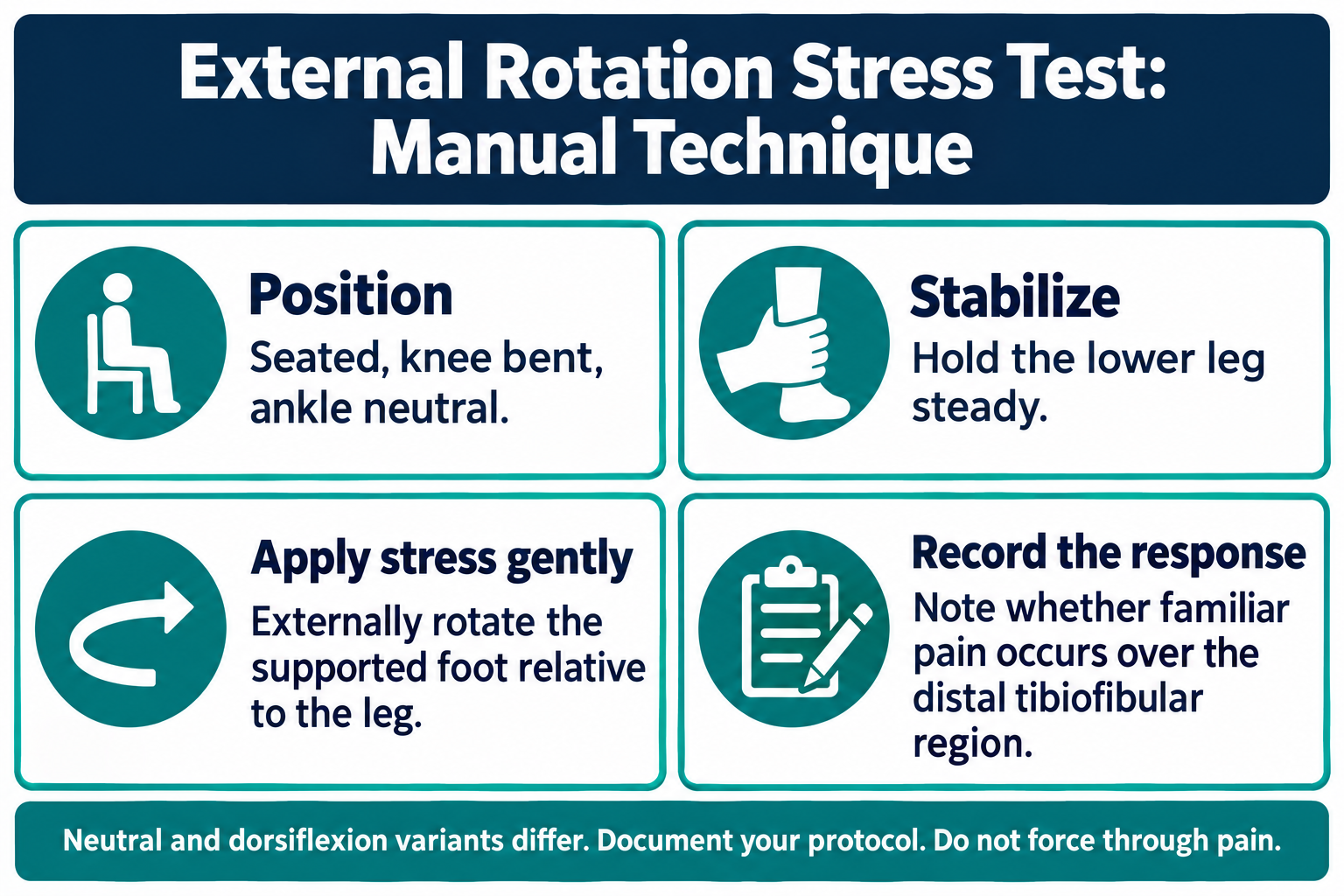
The examiner stabilizes the lower leg and externally rotates the foot relative to it, noting the location and nature of any symptoms. This article describes the seated, non-weight-bearing manual ankle test, rather than an imaging-based stress examination.
Neutral-ankle and dorsiflexion variants are described in the literature. The review of ankle special-test techniques documents this variation; name the protocol used rather than treating all external rotation tests as identical.
Purpose and Indications
- Investigate possible syndesmotic involvement after an ankle injury.
- Assess whether controlled external rotation reproduces the patient’s familiar pain near the distal tibiofibular joint.
- Add information to the history, palpation and wider ankle examination.
Select the test because it addresses a clinical question. It is not a general measure of ankle strength, balance, mobility or readiness to return to sport.
Contraindications and Precautions
These are general safety considerations for a manual stress examination, rather than a validated list of unique contraindications for this test.
- Do not stress an ankle with a suspected fracture or dislocation before appropriate medical assessment.
- Respect restrictions following surgery or a known injury for which rotational stress is prohibited.
- Use a controlled maneuver; stop if pain, apprehension or guarding prevents safe assessment.
- Do not force the foot farther simply to obtain a positive response.
When the maneuver cannot be performed adequately, document it as limited or not tested. That is more informative than recording an unqualified negative result.
Patient Position
- Seat the patient on the examination plinth with the lower leg accessible.
- Keep the knee bent and the leg relaxed.
- For the neutral variant described here, support the ankle in neutral rather than deliberately adding dorsiflexion.
Examiner Position
- Position yourself where both the lower leg and foot can be supported comfortably.
- Use one hand to stabilize the lower leg against rotation.
- Use the other to support and control the foot as a unit.
How to Perform the External Rotation Stress Test
- Explain the maneuver and ask the patient to report where symptoms occur.
- Confirm the selected ankle position and allow the leg to relax.
- Stabilize the lower leg so the movement is not simply rotation of the whole limb.
- Gently externally rotate the supported foot relative to the stabilized leg.
- Ask whether this reproduces familiar pain, particularly near the distal tibiofibular region above the ankle joint.
- Release the stress and document symptom location, response and any limitations.
If using a dorsiflexion-external rotation variant, record that explicitly. Do not transfer research estimates between neutral, dorsiflexion, weight-bearing and radiographic protocols without checking how the study performed and interpreted its test.
What Constitutes a Positive Test?
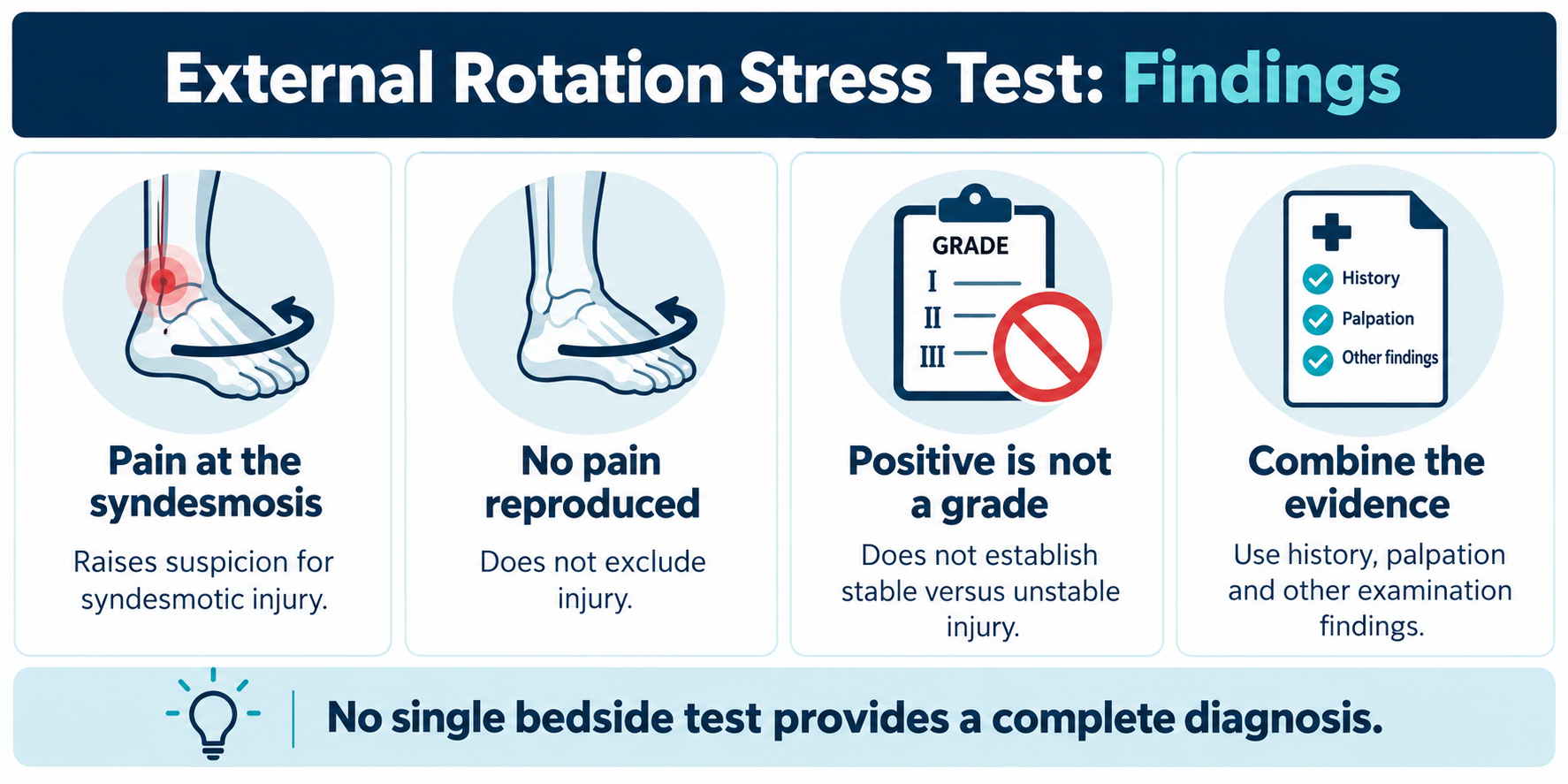
Reproduction of pain over the syndesmotic region during the intended maneuver is a positive symptom-provocation finding. Record the location rather than labeling any ankle discomfort as evidence of syndesmotic injury.
There is no universal bedside pain-intensity score, rotation angle or force threshold that independently confirms the injury. Symptoms elsewhere require interpretation according to the broader examination.
What Does a Positive Result Mean?
A positive result raises concern for syndesmotic injury when it fits the history and other findings. It does not identify a particular torn ligament, establish injury grade or prove mechanical instability.
A systematic review of syndesmosis clinical tests found that no individual test combined high sensitivity with high specificity. It also concluded that bedside tests cannot definitively separate stable from unstable injuries; further investigation may be needed for management decisions.
What Does a Negative Result Mean?
A negative result means the relevant pain was not reproduced during that examination. It does not rule out syndesmotic injury.
If the patient’s history and other findings remain concerning, reconsider the overall assessment rather than allowing one negative maneuver to end the investigation.
Anatomy Involved
- Distal tibia and fibula: form the bony relationship examined in a syndesmotic assessment.
- Syndesmotic ligament complex: includes the anterior and posterior inferior tibiofibular ligaments and interosseous structures.
- Talus and surrounding ankle structures: contribute to the response when the foot is rotated relative to the leg.
The maneuver loads a connected ankle complex. Pain provocation does not demonstrate isolation of a single ligament.
Associated Conditions and Clinical Significance
- The test contributes to assessment of suspected syndesmotic ankle injury.
- Its findings should be integrated with mechanism, symptom location, palpation and other suitable tests.
- Record the protocol and symptoms clearly so later examinations can be interpreted meaningfully.
- Do not use the result alone to prescribe surgery, clear sport participation or exclude associated injuries.
Sensitivity, Specificity and Diagnostic Accuracy
Accuracy depends on the population, timing, protocol and reference standard. A single percentage would give a misleading impression of precision for every bedside examination.
In research comparing ankle clinical tests with MRI, investigators evaluated the dorsiflexion-external rotation variant alongside other examination findings. Those findings should not be presented as universal performance estimates for the neutral variant described here.
Reliability, diagnostic accuracy and clinical usefulness are different concepts. Examiners agreeing on a response does not necessarily mean the test correctly identifies an injury.
Common Mistakes and Practical Tips
- Rotating the entire leg: stabilize the lower leg before applying foot rotation.
- Changing protocols without documenting it: state whether the ankle was neutral or dorsiflexed.
- Calling every pain response positive: record the precise symptom location and whether it is familiar.
- Forcing through guarding: stop and record the limitation.
- Overinterpreting the finding: distinguish symptom reproduction from confirmed injury and mechanical instability.
Summary
- The External Rotation Stress Test is a manual provocation test for suspected ankle syndesmotic injury.
- Support the patient, stabilize the leg and gently externally rotate the foot using a documented protocol.
- Pain over the syndesmotic region raises suspicion but does not confirm the diagnosis.
- A negative result does not exclude injury.
- Neither the presence nor absence of pain establishes stable versus unstable injury.
Use the test to add a focused observation to a complete ankle assessment. Let the combined clinical picture guide further investigation and management.