
Cozen Test is an orthopedic special test and pain-provocation test used during the clinical assessment of lateral elbow pain. It is most commonly associated with the assessment of lateral elbow tendinopathy (LET), historically called lateral epicondylitis or tennis elbow.
What Is the Cozen Test?
The test challenges wrist extension against manual resistance while the clinician observes whether the maneuver reproduces the patient’s familiar lateral elbow pain. It is therefore primarily a provocative clinical assessment, not an outcome measure or standalone diagnostic procedure.
The exact hand and elbow position can vary between descriptions and clinical protocols. A commonly described approach uses the elbow extended, forearm pronated, and resisted wrist extension, while other descriptions position the elbow in flexion. The protocol should therefore be documented when the test is used clinically.
“Reproduction of the patient’s familiar lateral elbow pain is more clinically meaningful than simply producing discomfort somewhere in the forearm.”
Purpose of the Cozen Test
The Cozen Test may be used to:
- Provoke symptoms associated with lateral elbow tendinopathy.
- Assess the response of the lateral elbow region to resisted wrist extension.
- Support the clinical examination when lateral elbow pain is suspected.
- Compare symptoms with other findings such as localized tenderness and grip-related pain.
- Contribute to differential clinical reasoning when combined with the patient’s history and other examination procedures.
The test should not be interpreted in isolation. Lateral elbow pain can have several possible sources, and clinical assessment needs to consider alternative diagnoses when the presentation is atypical.
Cozen Test Indications
Cozen Test may be considered when a patient reports:
- Lateral elbow pain associated with gripping or hand use.
- Pain during activities involving resisted wrist extension.
- Symptoms around the lateral epicondylar region.
- Activity-related elbow pain that raises suspicion of lateral elbow tendinopathy.
- Pain reproduced by loading the wrist extensor mechanism.
It can be particularly useful as one component of an examination when the patient’s symptoms are mechanically reproduced by loading the wrist extensors.
Cozen Test Contraindications and Precautions
There is no universally established list of Cozen Test-specific absolute contraindications. Instead, the clinician should apply normal precautions associated with provocative musculoskeletal testing.
Use caution when:
- The patient has severe or rapidly worsening elbow pain.
- Acute trauma raises suspicion of fracture or significant tissue injury.
- There is marked swelling, bruising, or substantial irritability.
- The patient cannot safely tolerate resisted loading.
- Recent surgery or another procedure makes resisted loading inappropriate.
- Neurological symptoms or other findings suggest that the presentation may not be primarily related to lateral elbow tendinopathy.
The test should not be repeatedly forced through substantial pain simply to obtain a stronger response. The amount of resistance should be appropriate to the patient’s presentation.
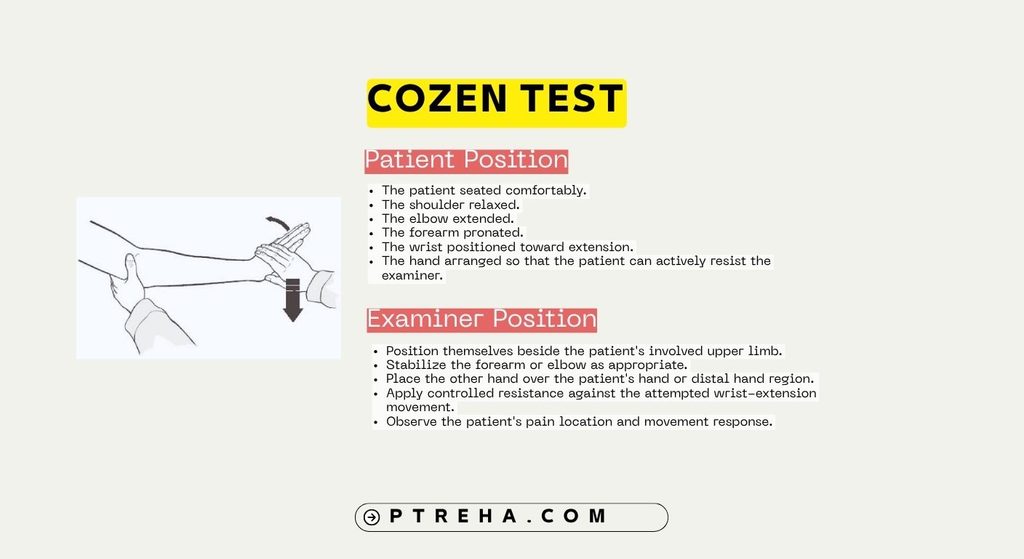
Patient Position
One commonly described protocol uses:
- The patient seated comfortably.
- The shoulder relaxed.
- The elbow extended.
- The forearm pronated.
- The wrist positioned toward extension.
- The hand arranged so that the patient can actively resist the examiner.
Some clinical descriptions use the elbow in approximately flexion rather than full extension. Because variations exist, clinicians should avoid treating one positioning variation as the only valid version of Cozen Test.
Examiner Position
The examiner should:
- Position themselves beside the patient’s involved upper limb.
- Stabilize the forearm or elbow as appropriate.
- Place the other hand over the patient’s hand or distal hand region.
- Apply controlled resistance against the attempted wrist-extension movement.
- Observe the patient’s pain location and movement response.
Palpation of the lateral elbow can also be incorporated into the broader examination, but palpation itself is not the Cozen Test.
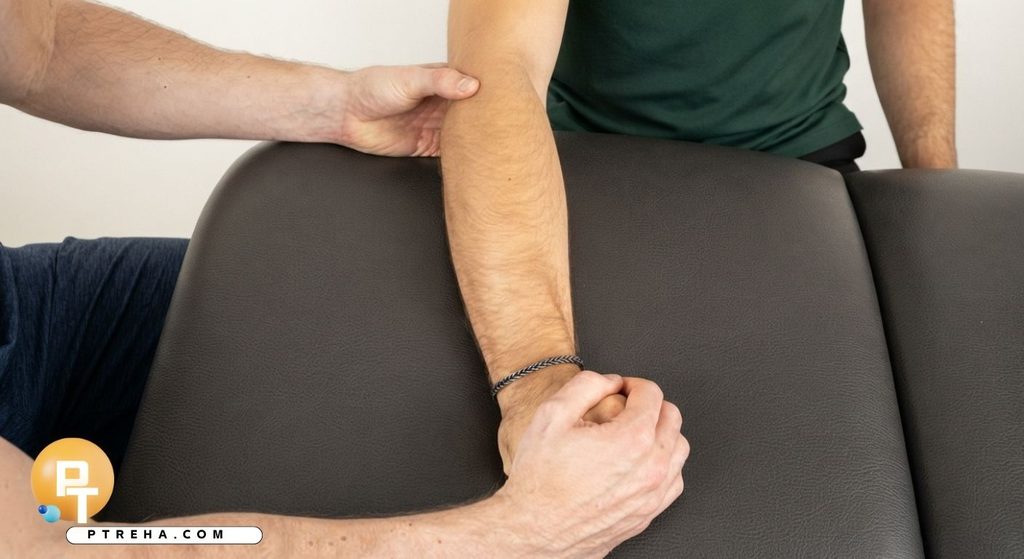
How to Perform the Cozen Test
A commonly used clinical procedure is:
- Position the patient comfortably with the forearm pronated.
- Position the elbow according to the selected protocol, commonly with the elbow extended.
- Ask the patient to actively extend the wrist.
- Apply gradual manual resistance against wrist extension.
- Maintain appropriate stabilization so that the movement is not replaced by excessive elbow, shoulder, or forearm compensation.
- Ask the patient to identify the location and character of any pain.
- Determine whether the maneuver reproduces the patient’s familiar lateral elbow symptoms.
- Stop or reduce the resistance if symptoms become excessive or the movement cannot be performed safely.
The important clinical observation is not simply whether the maneuver produces any pain. The clinician should determine whether it reproduces the patient’s recognizable symptoms in the relevant lateral elbow region.
What Constitutes a Positive Test?
For the commonly described provocative version of Cozen Test, a positive finding is generally considered to be reproduction of pain at the lateral elbow during resisted wrist extension.
However, this finding should not automatically be interpreted as confirmation of lateral elbow tendinopathy.
Pain during resisted wrist extension is a clinical finding that contributes to the overall examination. Its diagnostic meaning depends on the patient’s history, symptom distribution, palpation findings, functional limitations, and alternative diagnoses being considered.
What Does a Positive Cozen Test Mean?
A positive Cozen Test indicates that resisted wrist extension reproduces lateral elbow symptoms.
This finding can support the clinical suspicion of lateral elbow tendinopathy when it agrees with the rest of the patient’s presentation. Clinical sources describe resisted wrist-extension pain as one of the commonly used examination findings in lateral elbow tendinopathy.
Importantly, a positive test does not establish the diagnosis by itself. Other disorders can produce lateral elbow pain, and provocative tests have limitations when used independently. A systematic review also identified substantial heterogeneity among diagnostic studies of Cozen Test, including differences in patient selection, examiner procedures, reference standards, and test application.
Negative Cozen Test
A test that does not reproduce the patient’s familiar lateral elbow pain provides less support for a pain response to resisted wrist extension during that particular examination.
It should not automatically be interpreted as proof that lateral elbow tendinopathy is absent. The result may depend on symptom irritability, test positioning, resistance, timing, patient effort, and the clinical presentation.
A negative response should therefore be considered alongside other examination findings rather than used as an isolated exclusion criterion.
Anatomy Involved in Cozen Test
The test loads the wrist extensor mechanism and places mechanical demand on tissues contributing to wrist extension.
Relevant structures include:
- Common extensor tendon region at the lateral elbow.
- Extensor carpi radialis brevis (ECRB), which is frequently discussed in relation to lateral elbow tendinopathy.
- Other wrist extensor muscles that contribute to the resisted movement.
- Lateral epicondylar region of the distal humerus.
- The radiocapitellar and surrounding lateral elbow region, which may also be relevant when considering differential diagnoses.
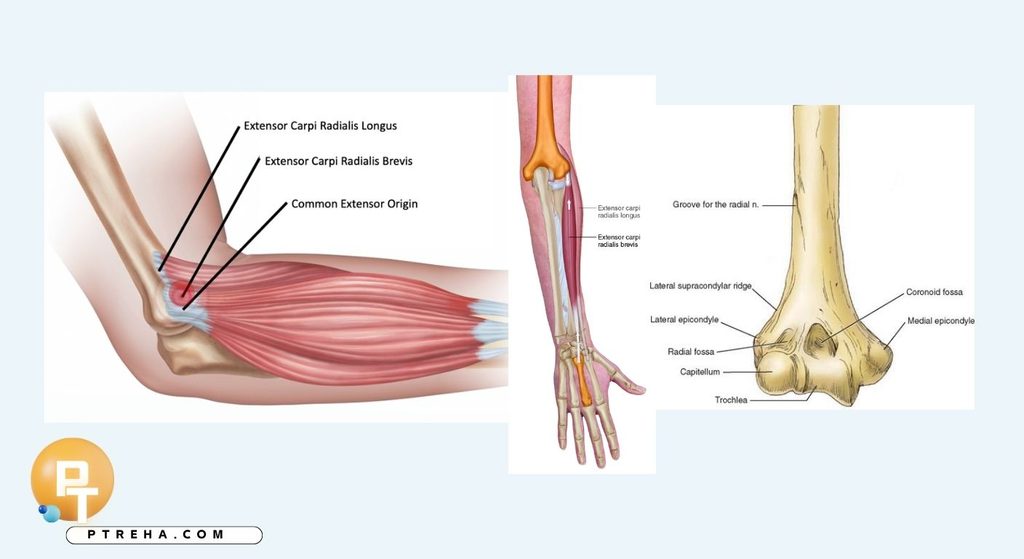
It is important not to describe Cozen Test as isolating one particular muscle or tendon. Resisted wrist extension involves multiple structures, and the clinical maneuver loads a broader kinetic system rather than providing a selective tissue test.
Conditions Detected / Associated With the Test
Cozen Test is most commonly associated with:
- Lateral elbow tendinopathy (LET).
- Lateral elbow pain associated with resisted wrist extension.
The historical term “lateral epicondylitis” is still widely encountered, although current literature commonly uses lateral elbow tendinopathy because the disorder is not adequately characterized as a simple inflammatory condition.
Other causes of lateral elbow symptoms should remain in the differential diagnosis. Depending on the presentation, these may include radiocapitellar joint pathology, radial tunnel or posterior interosseous nerve-related disorders, cervical referred symptoms, and other intra-articular or regional conditions.
Clinical Significance
Cozen Test can contribute useful information when it is integrated into a broader physical examination.
Clinically, consider:
- Whether the patient’s familiar pain is reproduced.
- The exact location of the reproduced symptoms.
- Whether symptoms occur with resisted wrist extension.
- Whether palpation produces concordant lateral elbow pain.
- Whether gripping or functional activities reproduce similar symptoms.
- Whether the findings fit the patient’s history and activity-related complaints.
- Whether findings suggest an alternative diagnosis.
Current clinical guidance emphasizes a broader assessment of lateral elbow pain rather than relying on one provocative maneuver. The 2022 physical therapy clinical practice guideline addresses history, differential diagnosis, tests and measures, and functional impairments in adults with lateral elbow pain and tendinopathy.
“A useful provocative test is one piece of the examination—not the diagnosis itself.”
Sensitivity and Specificity
Diagnostic accuracy evidence for Cozen Test exists, but it should be interpreted cautiously.
A systematic review of examination tests for lateral elbow tendinopathy reported a sensitivity of 91% for Cozen Test in the included evidence. However, the review emphasized substantial heterogeneity between studies and noted that the test was relatively poorly investigated. Most included diagnostic studies also had unclear or high risk of bias.
Because diagnostic performance can change according to the population, reference standard, test protocol, examiner, and clinical setting, the reported sensitivity should not be treated as a universal value for every patient or protocol.
The same systematic review does not establish a universal specificity value that can safely be applied across clinical settings. Therefore, a single sensitivity or specificity figure should not be used to determine whether an individual patient has or does not have lateral elbow tendinopathy.
Diagnostic Accuracy
Cozen Test has been investigated as a diagnostic examination test for lateral elbow tendinopathy, but the evidence is not sufficiently uniform to treat the test as a standalone diagnostic procedure.
The systematic review of diagnostic examination tests found potentially useful diagnostic performance but emphasized heterogeneity in inclusion criteria, examiner characteristics, test application, equipment, and reference standards.
Individual studies have also produced different findings. For example, one study examining adults with lateral elbow symptoms reported different performance and agreement findings for Cozen Test depending on the physical-activity group, illustrating why diagnostic values should not automatically be generalized to other populations.
The practical conclusion is that Cozen Test can contribute to clinical reasoning, but diagnosis should be based on the overall clinical presentation and examination, with additional investigations considered when the diagnosis remains uncertain or an alternative pathology is suspected.
Common Mistakes in Cozen Test
- Treating the test as a definitive diagnostic test.
- Applying resistance too aggressively.
- Focusing only on whether any pain occurs rather than whether familiar symptoms are reproduced.
- Failing to document the patient’s pain location.
- Allowing compensatory movement at the elbow, shoulder, or trunk.
- Using different test positions without documenting the protocol.
- Assuming that pain necessarily identifies one specific tendon.
- Ignoring the patient’s history and functional complaints.
- Failing to consider differential diagnoses when symptoms do not fit lateral elbow tendinopathy.
- Repeating the maneuver unnecessarily when the patient’s symptoms are highly irritable.
Tips for Performing the Cozen Test
For a clinically useful examination:
- Explain the procedure before applying resistance.
- Start with controlled resistance rather than maximal force.
- Stabilize the limb without unnecessarily increasing discomfort.
- Ask the patient to identify exactly where the pain occurs.
- Compare the response with the patient’s usual symptoms.
- Record the test position and resistance method when consistency matters.
- Combine the test with palpation, grip-related assessment, functional activities, and other relevant examination findings.
- Consider the cervical spine, radial nerve-related symptoms, and radiocapitellar or intra-articular pathology when the presentation is atypical.
- Avoid interpreting pain alone as proof of tendon pathology.
- Use the result to refine clinical reasoning rather than replace it.
Summary
- Cozen Test is an orthopedic provocative clinical assessment commonly used in the examination of lateral elbow pain.
- The commonly described maneuver involves resisted wrist extension, with the clinician assessing whether the patient’s familiar lateral elbow symptoms are reproduced.
- A reproduced lateral elbow pain response may support suspicion of lateral elbow tendinopathy, but it does not independently establish the diagnosis.
- Diagnostic research has reported potentially useful accuracy, but important methodological heterogeneity limits the generalizability of individual diagnostic values.
- The test is most useful when interpreted together with the patient’s history, palpation, functional complaints, other examination findings, and differential diagnosis.
Cozen Test remains a practical component of the physical therapist’s elbow examination, particularly when the patient’s symptoms are reproduced by resisted wrist extension. Its value is greatest when the clinician treats the result as one piece of a structured clinical assessment rather than a standalone diagnostic answer.
Resources and External References
- Diagnostic accuracy of examination tests for lateral elbow tendinopathy – Systematic Review
- Lateral Elbow Pain and Muscle Function Impairments – APTA Clinical Practice Guideline
- Lateral Elbow Pain and Muscle Function Impairments – PubMed
- Lateral elbow tendinosis: review of diagnosis and management
- Development of a core outcome set for lateral elbow tendinopathy
- Evaluation and Management of Elbow Tendinopathy