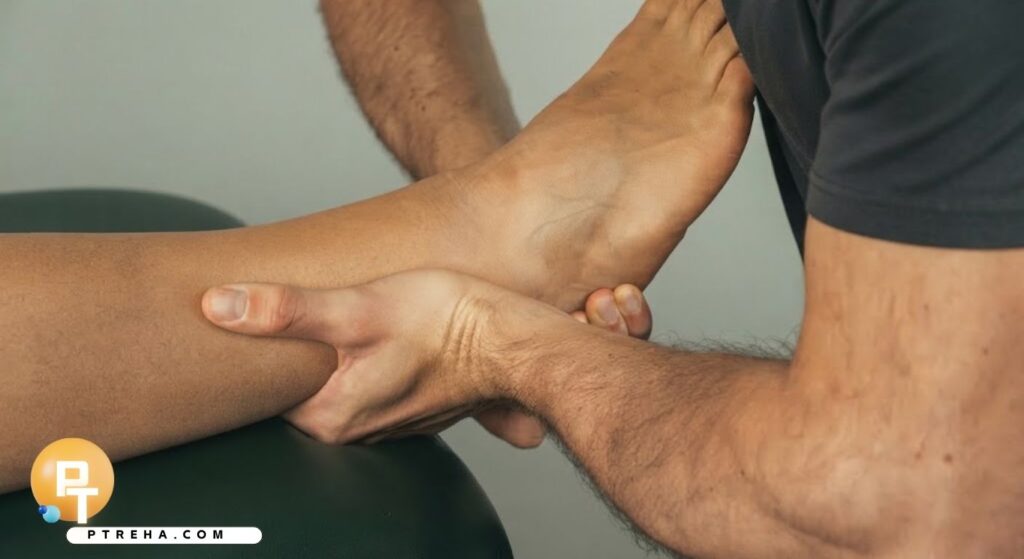
The Cotton Test also known as the hook test or lateral fibular stress test is an orthopedic special test used as part of the clinical assessment of the distal tibiofibular syndesmosis at the ankle.
The bedside version applies side-to-side stress through the talus while the lower leg is stabilized, looking for abnormal mediolateral motion and reproduction of syndesmotic symptoms.
It should be interpreted alongside the history, palpation, other clinical tests, and imaging rather than used as a stand-alone diagnostic test.
What Is the Cotton Test?
The Cotton Test is an orthopedic special test and stress assessment primarily associated with evaluation of the distal tibiofibular syndesmosis.
In the commonly described bedside version, the examiner stabilizes the distal leg and translates the talus and foot medially and laterally within the ankle mortise.
The involved ankle is typically compared with the opposite side.
The test is intended to identify findings that may be associated with syndesmotic injury or instability, particularly increased mediolateral movement and/or reproduction of pain in the distal syndesmotic region.
A comprehensive review of orthopedic special tests for the ankle describes the Cotton Test as a maneuver in which the ankle is stabilized above the joint while the talus is shifted from side to side.
The same review emphasizes that the evidence supporting clinical syndesmotic stress tests is limited and that perceived displacement alone should be interpreted cautiously.
An important distinction is that the term Cotton Test is also used in orthopedic surgery for an intraoperative lateral stress maneuver, commonly performed with a bone hook while fluoroscopy is used to evaluate the syndesmosis.
These procedures share the goal of stressing the ankle mortise but should not be treated as identical diagnostic protocols.
“The Cotton Test contributes one piece of information to a syndesmotic assessment; it does not independently establish the diagnosis.”
Purpose of the Cotton Test
The Cotton Test may be used to:
- Assess the distal tibiofibular syndesmosis clinically.
- Look for abnormal mediolateral movement within the ankle mortise.
- Reproduce symptoms originating around the distal syndesmotic region.
- Compare perceived movement with the contralateral ankle.
- Supplement palpation and other syndesmotic stress tests.
- Contribute to the assessment of a suspected high ankle sprain.
- Help determine whether further imaging or specialist assessment may be appropriate.
- Assess syndesmotic stability intraoperatively when a surgical stress-test protocol is being used.
The Cotton Test does not directly measure the integrity of an individual ligament during routine bedside examination.
It also does not determine the complete extent or severity of a syndesmotic injury by itself.
Cotton Test Indications
The bedside Cotton Test may be considered when the clinical examination raises suspicion of a distal tibiofibular syndesmotic injury.
Situations may include:
- An ankle injury involving an external-rotation mechanism.
- Pain located above the ankle joint rather than only around the lateral ankle ligaments.
- Tenderness over the distal tibiofibular syndesmosis.
- Persistent pain after an ankle sprain.
- Difficulty with weight-bearing activities after an ankle injury.
- Pain during push-off, turning, or pivoting.
- Suspected high ankle sprain.
- Unexplained symptoms around the distal tibiofibular joint.
- Examination of an athlete with a mechanism consistent with syndesmotic loading.
The test should be integrated into the complete ankle examination rather than performed simply because ankle pain is present.
Fractures, lateral ligament injuries, deltoid ligament injuries, osteochondral injuries, tendon disorders, and other causes of ankle pain may produce overlapping symptoms.
Cotton Test Contraindications and Precautions
There are no universally established Cotton-Test-specific contraindication lists supported by strong evidence.
General orthopedic examination precautions are more appropriate.
Clinical precautions include:
- Do not apply unnecessary stress to an ankle with an obvious deformity or suspected unstable injury.
- When fracture is clinically suspected, appropriate fracture assessment and imaging should take priority over aggressive stress testing.
- Avoid forceful manipulation in a severely painful acute ankle.
- Consider the patient’s mechanism of injury before performing the maneuver.
- Use only the amount of force required for clinical assessment.
- Stop if the maneuver produces substantial or unexpected pain.
- Be cautious when comparison with the opposite ankle is unreliable because of previous injury, surgery, deformity, or generalized joint laxity.
- Do not interpret pain alone without considering its anatomical location and the rest of the examination.
The intraoperative Cotton Test is a surgical assessment and is not a procedure for routine physical therapy practice.
Patient Position
Several descriptions of the bedside Cotton Test exist.
A commonly described clinical approach uses the ankle close to neutral.
The patient may be:
- Supine or seated.
- Positioned with the lower leg adequately supported.
- Relaxed as much as possible.
- Positioned so the examiner can stabilize the distal tibia and fibula.
- Positioned with the ankle approximately neutral rather than markedly plantarflexed.
Neutral positioning is clinically useful because foot position can affect ankle mechanics and the examiner’s perception of movement.
The opposite ankle should be available for comparison when appropriate.
Examiner Position
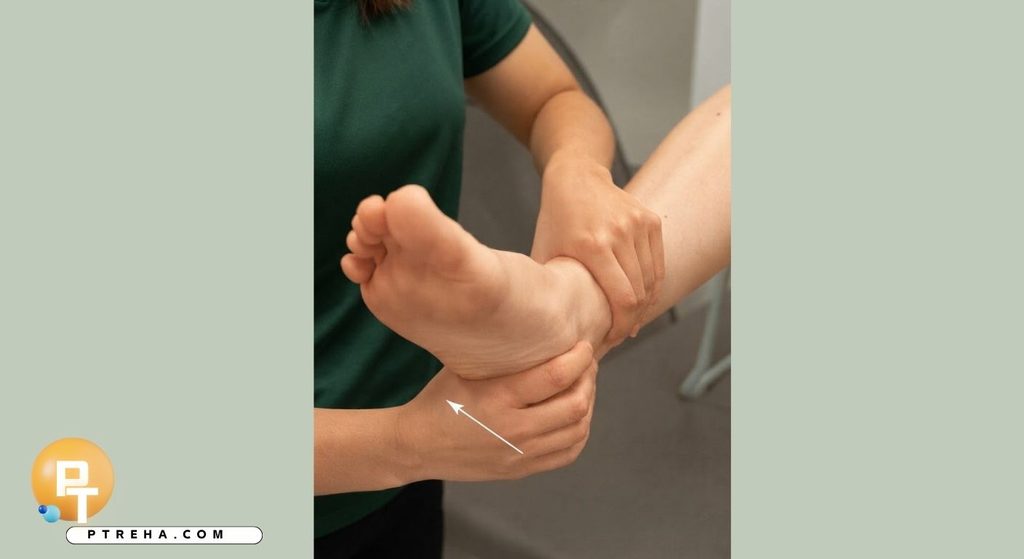
For the bedside version, the examiner typically:
- Positions themselves near the patient’s foot.
- Stabilizes the distal lower leg with one hand.
- Places the stabilizing hand just proximal to the ankle joint.
- Uses the other hand to grasp the hindfoot/foot below the malleoli.
- Maintains control of the ankle position.
- Applies controlled medial and lateral translation.
The goal is not to force the ankle through a large excursion.
The examiner is assessing the quality and relative amount of side-to-side motion together with symptom reproduction.
How to Perform the Cotton Test
A commonly described bedside procedure is:
- Position the patient comfortably with the lower leg supported.
- Place the ankle close to neutral.
- Stabilize the distal tibia and fibula with one hand immediately proximal to the ankle.
- Use the opposite hand to securely grasp the foot and hindfoot below the malleoli.
- Maintain the lower leg in a stable position.
- Translate the talus and foot gently in a medial direction.
- Translate the talus and foot gently in a lateral direction.
- Observe and feel the amount and quality of mediolateral movement.
- Ask whether the maneuver reproduces pain and identify where the pain is felt.
- When clinically appropriate, repeat the maneuver on the opposite ankle for comparison.
The examiner should distinguish syndesmotic-region pain from generalized discomfort caused simply by handling an acutely injured ankle.
Excessive force does not improve the quality of the bedside test and can make interpretation more difficult because pain and guarding may increase.
What Constitutes a Positive Cotton Test?
Positive/negative terminology is commonly used for this orthopedic special test, although the criteria are not supported by a universally accepted quantitative bedside threshold.
A Cotton Test may be considered clinically positive when the maneuver produces findings such as:
- Clearly increased mediolateral movement compared with the opposite ankle.
- Reproduction of pain localized to the distal tibiofibular syndesmosis.
- A combination of abnormal movement and characteristic syndesmotic pain.
The ESSKA-AFAS consensus on acute isolated syndesmotic injuries includes the Cotton Test among recommended clinical tests and describes it as side-to-side translation of the talus with the ankle neutral, with increased translation compared with the opposite side accompanied by pain supporting a positive result.
The consensus can be reviewed in the ESSKA-AFAS guidance on classification and diagnosis of acute syndesmotic injuries.
However, no universally accepted bedside displacement cutoff defines a positive Cotton Test.
The clinician should therefore avoid assigning an arbitrary number to perceived motion.
What Does a Positive Cotton Test Mean?
A positive Cotton Test increases clinical concern for injury involving the distal tibiofibular syndesmosis, particularly when the patient’s mechanism, tenderness pattern, symptoms, and other examination findings point in the same direction.
It does not mean that the clinician has proven:
- Complete syndesmotic ligament rupture.
- Mechanical instability requiring surgery.
- Injury of one specific syndesmotic ligament.
- A particular injury grade.
- The absence or presence of an associated fracture.
- The exact severity of the injury.
Pain reproduction is also not completely specific to syndesmotic injury because other injured structures in the ankle may be stressed during the maneuver.
For this reason, the Cotton Test should be interpreted as part of a clinical pattern, not in isolation.
Negative Cotton Test
A negative Cotton Test occurs when there is no meaningful reproduction of syndesmotic symptoms and no clearly abnormal mediolateral movement compared with the opposite ankle.
A negative result does not reliably exclude syndesmotic injury.
Clinical syndesmotic tests generally have limited sensitivity, particularly for subtle or incomplete injuries.
If the mechanism, tenderness, functional limitations, or other findings continue to raise suspicion, further evaluation may still be necessary despite a negative Cotton Test.
“A negative stress test should not override a convincing injury mechanism and a consistent syndesmotic examination.”
Anatomy Involved in Cotton Test
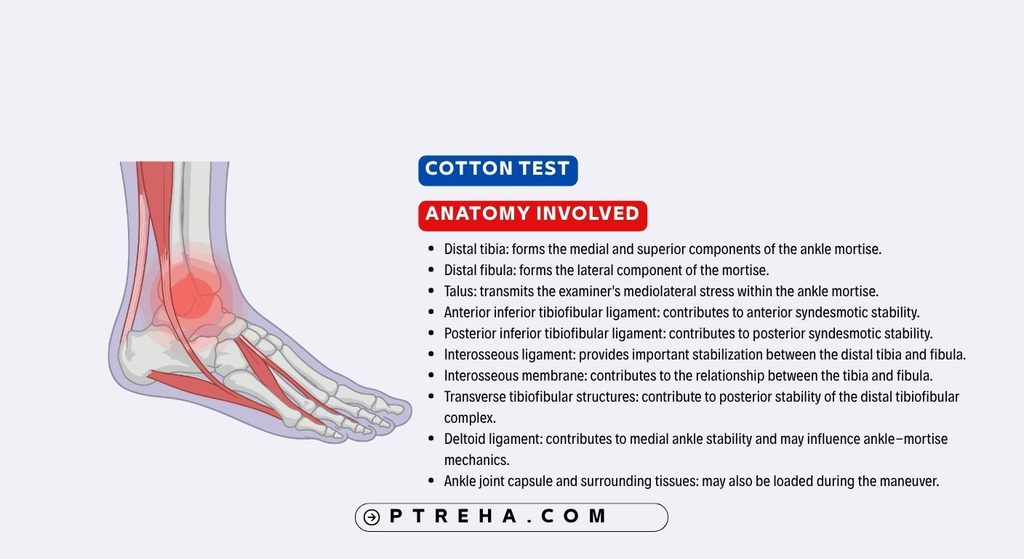
The test stresses the ankle mortise rather than selectively isolating a single ligament.
Relevant structures include:
- Distal tibia: forms the medial and superior components of the ankle mortise.
- Distal fibula: forms the lateral component of the mortise.
- Talus: transmits the examiner’s mediolateral stress within the ankle mortise.
- Anterior inferior tibiofibular ligament: contributes to anterior syndesmotic stability.
- Posterior inferior tibiofibular ligament: contributes to posterior syndesmotic stability.
- Interosseous ligament: provides important stabilization between the distal tibia and fibula.
- Interosseous membrane: contributes to the relationship between the tibia and fibula.
- Transverse tibiofibular structures: contribute to posterior stability of the distal tibiofibular complex.
- Deltoid ligament: contributes to medial ankle stability and may influence ankle-mortise mechanics.
- Ankle joint capsule and surrounding tissues: may also be loaded during the maneuver.
Because several structures contribute to stability, abnormal movement during the Cotton Test should not be interpreted as proof that one particular ligament is torn.
Conditions Associated With the Cotton Test
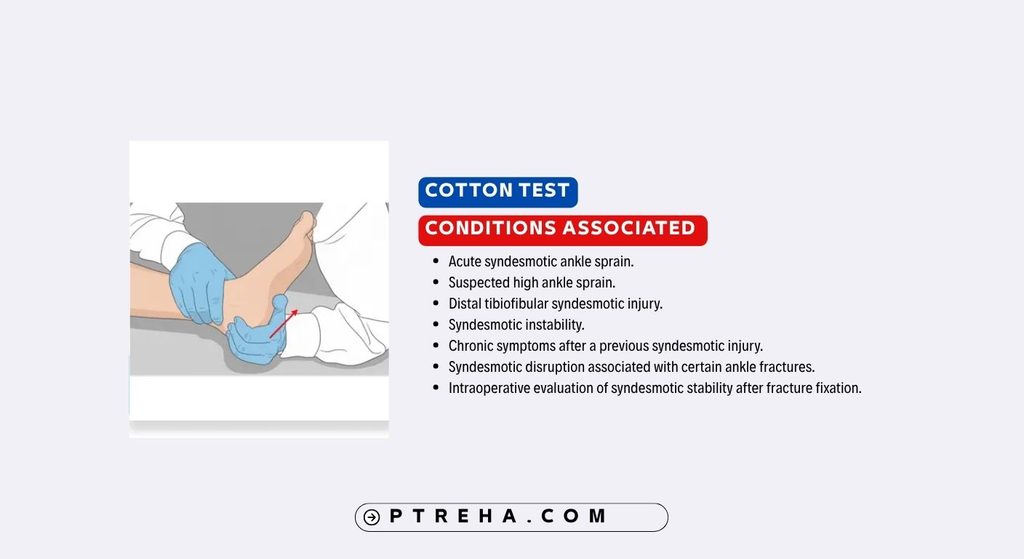
The Cotton Test is mainly associated with assessment of:
- Acute syndesmotic ankle sprain.
- Suspected high ankle sprain.
- Distal tibiofibular syndesmotic injury.
- Syndesmotic instability.
- Chronic symptoms after a previous syndesmotic injury.
- Syndesmotic disruption associated with certain ankle fractures.
- Intraoperative evaluation of syndesmotic stability after fracture fixation.
The test does not independently distinguish all stable from unstable syndesmotic injuries.
Imaging and, in selected surgical cases, intraoperative evaluation may be required when determining mechanical instability.
Clinical Significance
The Cotton Test is most useful when combined with other examination findings.
Clinical interpretation should consider:
- Injury mechanism.
- Location of pain.
- Pattern of tenderness.
- Ability to bear weight.
- Walking characteristics.
- Swelling and bruising.
- Active and passive ankle motion.
- Other syndesmotic stress tests.
- Assessment of the lateral and medial ankle structures.
- Relevant imaging findings.
A concerning Cotton Test may strengthen the clinical rationale for additional investigation when syndesmotic injury is suspected.
Conversely, an isolated positive finding without a supportive history or other examination findings should be interpreted cautiously.
Comparison with the opposite ankle can be useful, but bilateral comparison is not automatically a normal-versus-abnormal test.
Natural anatomical variation, previous injuries, surgery, and generalized laxity may affect the comparison.
Sensitivity and Specificity
The diagnostic evidence for the bedside Cotton Test is limited, and no single sensitivity or specificity value should be treated as universally applicable.
One small prospective investigation summarized in the ankle examination literature involved only a few individuals with confirmed syndesmotic rupture and healthy comparison subjects examined by multiple clinicians.
In that specific setting, the Cotton Test demonstrated low sensitivity.
This limited sample cannot provide a universal diagnostic-performance estimate for patients with acute ankle injuries.
A separate issue is the intraoperative Cotton Test.
A cadaveric study comparing the Cotton Test with a Tap Test investigated coronal-plane syndesmotic instability in 10 specimens.
Using fluoroscopic tibiofibular clear-space measurements and the study’s predefined criterion of a relative increase greater than 2 mm between intact-stressed and injured-stressed conditions, the Cotton Test demonstrated 73.3% sensitivity and 100% specificity within that experimental model.
These values come from a controlled cadaveric protocol and should not be transferred directly to bedside physical examination.
The complete methodology is available in the cadaveric comparison of the Cotton and Tap tests.
Clinical accuracy depends on factors including:
- Test protocol.
- Examiner technique.
- Foot and ankle position.
- Definition of the reference standard.
- Acute versus chronic presentation.
- Extent of ligamentous disruption.
- Whether the test is bedside or intraoperative.
- Whether interpretation relies on pain, motion, or imaging.
For these reasons, sensitivity and specificity should always be attached to the specific protocol and population from which they were derived.
Diagnostic Accuracy
The Cotton Test should not be regarded as a stand-alone diagnostic test for syndesmotic injury.
Clinical research on syndesmotic examination consistently demonstrates the limitations of relying on a single maneuver.
The bedside examiner is primarily evaluating a combination of abnormal movement and symptom reproduction, whereas the intraoperative version may involve controlled lateral stress and fluoroscopic measurements.
These are different assessment environments and should not share diagnostic-accuracy estimates without qualification.
In clinical practice, diagnostic reasoning may incorporate:
- History.
- Injury mechanism.
- Syndesmotic palpation.
- Cotton Test.
- Other syndesmotic stress tests.
- Functional presentation.
- Plain radiographs when indicated.
- MRI or other imaging when clinically appropriate.
- Specialist assessment for suspected mechanical instability.
Therefore, a Cotton Test finding changes the level of clinical suspicion rather than independently proving or excluding a diagnosis.
Common Mistakes in Cotton Test
Several technical and interpretation errors can reduce the usefulness of the test.
Common mistakes include:
- Performing the test without first considering fracture risk.
- Using excessive force.
- Failing to stabilize the distal leg.
- Allowing the entire limb to move instead of stressing the ankle mortise.
- Testing with the ankle in a poorly controlled position.
- Interpreting any pain as syndesmotic pain.
- Ignoring the precise location of symptom reproduction.
- Assuming increased movement isolates one ligament.
- Failing to compare with the opposite side when comparison is appropriate.
- Treating asymmetry as automatically pathological.
- Considering a negative test sufficient to exclude syndesmotic injury.
- Diagnosing syndesmotic instability from the Cotton Test alone.
- Applying diagnostic values from intraoperative cadaveric research to bedside examination.
- Confusing the bedside Cotton Test with the fluoroscopic intraoperative lateral stress test.
One particularly important error is focusing exclusively on how much movement is felt.
Small differences in ankle movement can be difficult to judge manually, and foot position, muscle guarding, anatomy, and examiner technique can influence perceived translation.
Tips for Performing the Cotton Test
To improve clinical usefulness:
- Obtain a clear injury history first.
- Identify the suspected mechanism before stressing the ankle.
- Palpate relevant structures before performing provocative tests.
- Support the leg comfortably.
- Keep the ankle position consistent.
- Stabilize the distal tibia and fibula firmly.
- Apply stress gradually rather than abruptly.
- Ask the patient where symptoms are reproduced.
- Differentiate localized syndesmotic pain from generalized ankle discomfort.
- Compare sides when clinically appropriate.
- Consider previous injury on the contralateral side.
- Record both symptom reproduction and perceived motion.
- Combine the finding with other syndesmotic examination findings.
- Refer for appropriate imaging or medical assessment when the overall clinical presentation warrants it.
Documentation can be more informative than simply writing “Cotton Test positive.”
For example, the clinician might document that controlled mediolateral stress reproduced the patient’s familiar distal syndesmotic pain and that greater translation was perceived compared with the opposite ankle.
This describes what was actually observed rather than implying diagnostic certainty.
Cotton Test in Physical Therapy Practice
For physical therapists, the Cotton Test is principally useful as part of the differential clinical assessment of an ankle injury.
Its purpose is not to decide surgical management or determine ligament fixation requirements.
A physical therapist should consider the test alongside:
- Mechanism of injury.
- Weight-bearing tolerance.
- Gait.
- Location of tenderness.
- Ankle range of motion.
- Swelling.
- Functional limitations.
- Other clinically appropriate stress tests.
- Previously obtained imaging.
- Changes during recovery.
When findings suggest a potentially significant syndesmotic injury, particularly when symptoms or function are disproportionate to an uncomplicated lateral ankle sprain, appropriate medical or orthopedic assessment may be warranted.
During rehabilitation, repeated aggressive Cotton testing is generally unnecessary.
Progress is better evaluated through the patient’s symptoms, functional tolerance, mobility, strength, neuromuscular control, gait, and progressive return to required activities.
Summary
- The Cotton Test is an orthopedic special/stress test used to contribute to assessment of the distal tibiofibular syndesmosis.
- The bedside version involves stabilizing the lower leg and applying controlled medial and lateral translation through the talus and foot, commonly with the ankle near neutral.
- Increased mediolateral movement compared with the opposite ankle and reproduction of distal syndesmotic pain may support suspicion of syndesmotic injury.
- A positive Cotton Test does not independently prove ligament rupture or mechanical instability, while a negative test does not reliably exclude syndesmotic injury.
- Evidence for bedside diagnostic accuracy is limited, and findings from intraoperative or cadaveric Cotton Test protocols should not be generalized to routine physical examination.
The Cotton Test can be clinically useful when its limitations are respected.
The most appropriate interpretation comes from combining the maneuver with the injury mechanism, location of tenderness, other examination findings, functional presentation, and imaging when indicated rather than allowing one special test to determine the diagnosis.