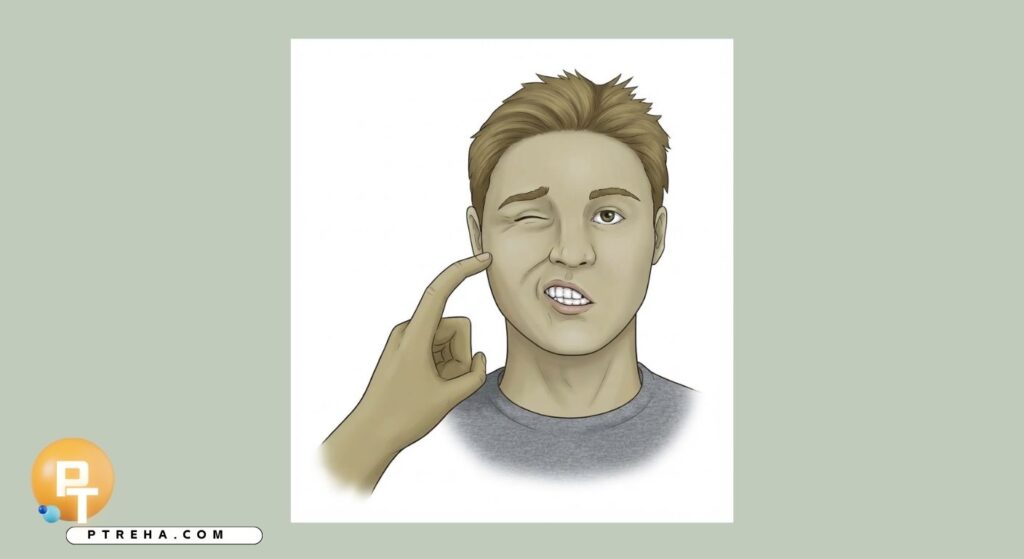
The Chvostek sign is a bedside physical examination finding used to assess increased neuromuscular excitability, classically in the context of suspected hypocalcemia.
It is elicited by mechanically stimulating the facial nerve region and observing for involuntary contraction of the ipsilateral facial muscles.
Although traditionally associated with low calcium levels, the sign has important limitations and should never be used by itself to diagnose hypocalcemia.
What Is the Chvostek Sign?
The Chvostek sign is best classified as a clinical assessment finding or bedside physical examination sign of neuromuscular excitability.
It is not an orthopedic special test, functional performance test, outcome measure, or independent diagnostic test.
The examination involves tapping or percussing an area over the facial nerve or its branches.
An involuntary contraction of facial muscles on the same side is conventionally described as a positive Chvostek sign.
The clinical concept is based on the increased excitability of peripheral nerves and muscles that can occur when ionized calcium is reduced.
However, the relationship between the Chvostek sign and serum calcium is not sufficiently consistent for the sign to confirm or exclude hypocalcemia.
The NCBI StatPearls review of the Chvostek sign emphasizes that although the sign has traditionally been associated with hypocalcemia, available evidence questions the strength and reliability of that relationship.
“The Chvostek sign is a clinical clue to neuromuscular excitability, not a laboratory substitute for measuring calcium.”
Purpose of the Chvostek Sign
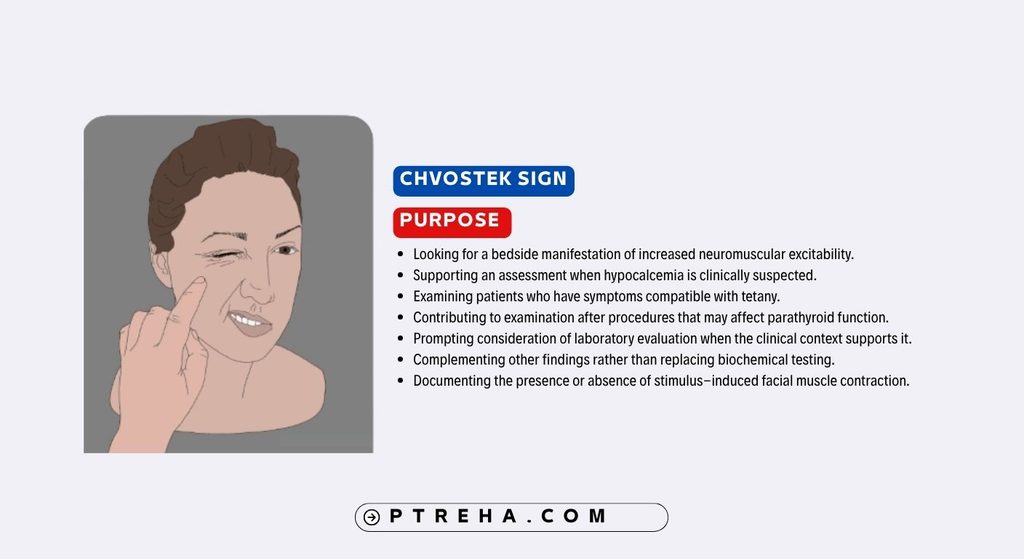
The Chvostek sign may be incorporated into a broader neurological and medical examination when increased neuromuscular excitability is suspected.
Its purposes can include:
- Looking for a bedside manifestation of increased neuromuscular excitability.
- Supporting an assessment when hypocalcemia is clinically suspected.
- Examining patients who have symptoms compatible with tetany.
- Contributing to examination after procedures that may affect parathyroid function.
- Prompting consideration of laboratory evaluation when the clinical context supports it.
- Complementing other findings rather than replacing biochemical testing.
- Documenting the presence or absence of stimulus-induced facial muscle contraction.
The sign should therefore be interpreted alongside symptoms, medical history, medications, laboratory findings, and other examination findings.
Chvostek Sign Indications
A clinician may consider checking the Chvostek sign when the patient’s presentation raises concern about altered neuromuscular excitability.
Examples include:
- Suspected hypocalcemia.
- Perioral tingling or numbness.
- Distal extremity paresthesia.
- Unexplained muscle cramps or spasms.
- Clinical features of tetany.
- Assessment following thyroid or parathyroid surgery when calcium disturbance is a concern.
- Suspected hypoparathyroidism.
- Electrolyte disturbances associated with altered calcium physiology.
- A broader examination of a patient with possible neuromuscular irritability.
A Chvostek sign should not be performed or interpreted as a substitute for appropriate laboratory evaluation when clinically significant hypocalcemia is suspected.
Chvostek Sign Contraindications and Precautions
There are no widely established formal, test-specific contraindications for the routine Chvostek sign described in standard clinical references.
General examination precautions remain appropriate.
These include:
- Avoid forceful percussion.
- Do not repeatedly strike a painful or highly sensitive area.
- Modify or avoid local examination if significant facial trauma is present.
- Use appropriate clinical judgment around fresh surgical wounds or other areas where percussion would be inappropriate.
- Explain the procedure before touching the patient’s face.
- Compare the response with the overall neurological and medical examination rather than interpreting it in isolation.
These are general safety considerations rather than evidence-based contraindications specific to the Chvostek sign.
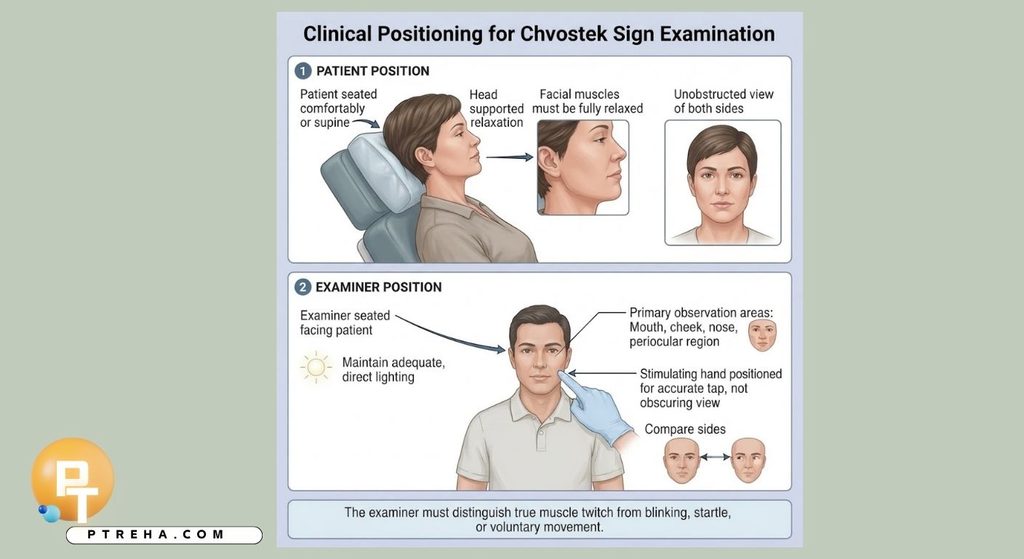
Patient Position
The examination is generally performed with the patient relaxed and the face clearly visible.
Common positioning considerations include:
- The patient may sit comfortably or lie supine.
- The head should be supported or maintained comfortably.
- The facial muscles should be as relaxed as possible.
- The examiner should have an unobstructed view of both sides of the face.
- The patient should not intentionally contract the facial muscles during testing.
There is some variation in the precise percussion site described across clinical sources, which should be considered when comparing examination findings or research protocols.
Examiner Position
The examiner should position themselves where the patient’s facial response can be observed clearly.
Practical points include:
- Stand or sit facing the patient.
- Ensure adequate lighting.
- Observe the mouth, cheek, nose, and periocular region.
- Position the hand so that stimulation can be delivered accurately without obscuring facial movement.
- Compare sides when clinically useful.
The examiner should distinguish a true involuntary muscle contraction from blinking, voluntary facial movement, startle, or withdrawal from an uncomfortable stimulus.
How to Perform the Chvostek Sign
Descriptions of the precise stimulation site vary.
A commonly described bedside method involves tapping over the course of the facial nerve anterior to the ear.
A practical procedure is:
- Ask the patient to sit or lie comfortably with the facial muscles relaxed.
- Observe the face at rest for asymmetry, spontaneous twitching, or pre-existing abnormal movements.
- Identify the region of the facial nerve anterior to the ear.
- Apply a light, brief tapping or percussion stimulus.
- Observe the ipsilateral facial muscles carefully.
- Look particularly for involuntary contraction around the mouth, nose, cheek, or eye.
- Repeat or compare sides only when clinically necessary.
- Document the site of stimulation and observed response.
Another protocol used in research has involved percussion over the malar region.
For example, the population-based study by Hujoel used percussion at the malar process and defined the sign according to visible ipsilateral perioral contraction.
This protocol detail matters because examination technique can influence results.
The procedure should therefore be documented rather than assuming every clinician performs the sign identically.
What Constitutes a Positive Chvostek Sign?
The terminology positive Chvostek sign is conventionally used in clinical medicine.
A positive finding is the appearance of an involuntary contraction of facial muscles on the same side following mechanical stimulation over the facial nerve region.
Depending on the examination method and response, movement may involve facial muscles around the:
- Mouth
- Nose
- Cheek
- Eye
The response should occur in association with the applied stimulus.
Normal blinking, voluntary smiling, facial grimacing, withdrawal from discomfort, and unrelated fasciculation should not automatically be interpreted as a positive Chvostek sign.
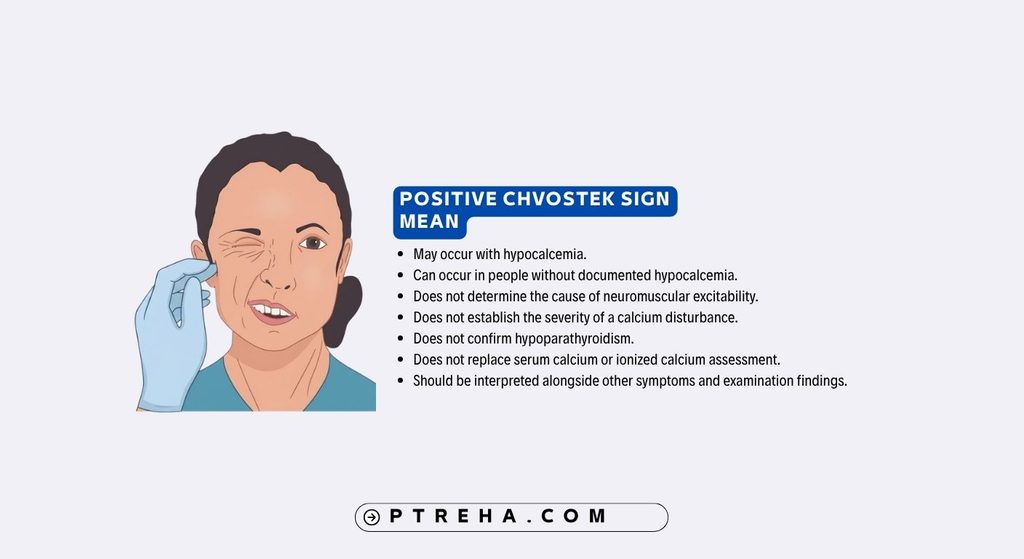
What Does a Positive Chvostek Sign Mean?
A positive Chvostek sign indicates that mechanical stimulation has produced increased facial neuromuscular responsiveness.
Traditionally, this has been interpreted as evidence of increased neuromuscular excitability associated with hypocalcemia.
However, the clinical meaning is more limited than that traditional explanation suggests.
A positive Chvostek sign:
- May occur with hypocalcemia.
- Can occur in people without documented hypocalcemia.
- Does not determine the cause of neuromuscular excitability.
- Does not establish the severity of a calcium disturbance.
- Does not confirm hypoparathyroidism.
- Does not replace serum calcium or ionized calcium assessment.
- Should be interpreted alongside other symptoms and examination findings.
The Merck Manual discussion of hypocalcemia lists the Chvostek sign among bedside findings used to identify latent tetany while also noting that the finding can be present in people without an identifiable calcium disorder.
“A positive Chvostek sign should increase clinical awareness, not end the diagnostic process.”
Negative Chvostek Sign
A negative Chvostek sign means that the examiner does not observe the characteristic involuntary facial contraction after the chosen stimulation technique.
A negative result does not reliably exclude hypocalcemia.
This distinction is clinically important because patients with calcium disturbances may not demonstrate the sign.
The presence or absence of Chvostek sign therefore should not determine whether laboratory testing is performed when the clinical presentation suggests an electrolyte abnormality.
A negative examination finding should be documented in the context of:
- The exact technique used.
- Presenting symptoms.
- Relevant surgical history.
- Other neurological findings.
- Other manifestations of tetany.
- Available biochemical findings.
Anatomy Involved in the Chvostek Sign
The Chvostek sign involves the relationship between peripheral nerve excitability, facial motor pathways, facial muscles, and systemic electrolyte physiology.
Relevant structures and systems include:
- Facial nerve — cranial nerve VII: provides motor innervation to the muscles of facial expression.
- Extracranial facial nerve branches: mechanical stimulation in the region of these branches can trigger facial muscle contraction.
- Muscles of facial expression: produce the visible movement used to identify the sign.
- Neuromuscular membrane excitability: influenced by extracellular electrolyte concentrations.
- Calcium physiology: reduced ionized calcium can increase neuromuscular excitability.
- Parathyroid system: parathyroid hormone plays an important role in calcium homeostasis.
- Magnesium physiology: disturbances in magnesium can alter parathyroid hormone secretion and calcium regulation.
The sign does not selectively test one individual facial muscle or uniquely isolate a single facial nerve branch.
Rather, it represents a visible motor response following mechanical stimulation within a physiological system influenced by multiple factors.
Conditions Associated With the Chvostek Sign
The Chvostek sign is most commonly discussed in relation to hypocalcemia and tetany, but the finding should be described as associated rather than diagnostic.
Relevant clinical contexts can include:
- Hypocalcemia.
- Hypoparathyroidism.
- Postsurgical disturbances in calcium regulation.
- States of increased neuromuscular excitability.
- Electrolyte or metabolic disturbances affecting ionized calcium physiology.
Hypocalcemia itself can arise in several different clinical contexts, including impaired parathyroid function, vitamin D disorders, kidney disease, severe magnesium disturbance, critical illness, and other metabolic conditions.
The Chvostek sign cannot distinguish among these causes.
A clinician who suspects a clinically relevant calcium disorder must evaluate the underlying physiological problem rather than attempting to determine the diagnosis from facial twitching alone.
Clinical Significance
The main value of the Chvostek sign is as a bedside observation that may contribute to a broader assessment of neuromuscular excitability.
Its practical significance includes:
- Drawing attention to possible neuromuscular irritability.
- Supporting further evaluation when symptoms suggest hypocalcemia.
- Providing an additional physical examination finding in patients at risk of disturbed calcium regulation.
- Encouraging correlation with biochemical testing.
- Contributing to assessment after thyroid or parathyroid procedures.
- Helping document changes in the clinical examination.
- Reminding clinicians to consider electrolyte abnormalities in an appropriate clinical context.
For physical therapists, the most important issue is recognizing that unexpected neuromuscular irritability may indicate a problem requiring medical assessment.
A physical therapist should not interpret the Chvostek sign as proof of a specific metabolic diagnosis or independently determine electrolyte treatment from the sign.
Sensitivity and Specificity
Diagnostic-accuracy evidence for the Chvostek sign is limited, and available estimates should not be treated as universal.
A population-based cross-sectional analysis by Hujoel evaluated 3,434 adults aged 25–74 years from historical U.S.
National Health and Nutrition Examination Survey data.
In that particular dataset and protocol, only five analyzed participants met the study’s criterion for hypocalcemia, making estimates particularly imprecise for people with low calcium.
Using the study’s specific percussion technique and definition of a positive sign, the reported sensitivity for hypocalcemia was approximately 26%, with a very wide confidence interval, while specificity was approximately 96%.
These figures require substantial caution because:
- Hypocalcemia was extremely uncommon in the study population.
- Only a few participants had the target condition.
- The population was not representative of many patients in whom clinicians would normally investigate symptomatic hypocalcemia.
- The examination protocol may differ from other bedside techniques.
- Confidence around the sensitivity estimate was very wide.
- The data came from a general population sample rather than a symptomatic clinical cohort.
Accordingly, these values should not be used as universal sensitivity or specificity figures for the Chvostek sign.
Diagnostic Accuracy and Limitations
The Chvostek sign has substantial limitations as an isolated diagnostic test for hypocalcemia.
The Hujoel population-based study found that the relationship between serum calcium concentration and the sign did not behave as would traditionally be expected.
In that dataset, a positive Chvostek sign was not a dependable indicator of low serum calcium.
Important limitations include:
- A positive response may occur without hypocalcemia.
- Hypocalcemia may be present without a Chvostek response.
- Examination technique varies.
- The strength of the response may depend on how and where percussion is applied.
- Observer interpretation may introduce variability.
- The sign cannot determine the etiology of an electrolyte disturbance.
- The sign cannot quantify serum calcium.
- It cannot distinguish acute from chronic calcium abnormalities.
- It should not determine treatment independently.
Laboratory assessment and the overall clinical picture remain essential when a calcium disorder is suspected.
Chvostek Sign and Hypocalcemia
Understanding the physiology helps explain why the sign became associated with calcium disorders.
Calcium contributes to the stabilization of excitable cell membranes.
When ionized calcium becomes sufficiently reduced, the threshold for nerve and muscle activation can change, producing increased neuromuscular excitability.
Clinical manifestations of significant hypocalcemia can include:
- Perioral paresthesia.
- Tingling of the fingers or toes.
- Muscle cramps.
- Muscle spasms.
- Tetany.
- Carpopedal spasm.
- Seizures in severe cases.
- Cardiac electrical abnormalities in clinically significant cases.
The Chvostek sign represents only one possible manifestation within this much broader clinical picture.
Therefore:
Chvostek sign present ≠ confirmed hypocalcemia.
And:
Chvostek sign absent ≠ hypocalcemia excluded.
This distinction is fundamental to safe interpretation.
Chvostek Sign Compared With Trousseau Sign
Chvostek and Trousseau signs are frequently discussed together because both are traditional physical examination findings associated with latent tetany.
They are performed differently.
| Feature | Chvostek Sign | Trousseau Sign |
|---|---|---|
| Type | Bedside clinical sign | Bedside provocative clinical sign |
| Main response | Facial muscle contraction | Carpal spasm |
| Stimulus | Percussion near the facial nerve | Sustained blood-pressure cuff inflation |
| Main clinical association | Neuromuscular excitability, traditionally hypocalcemia | Neuromuscular excitability, traditionally hypocalcemia |
| Diagnostic by itself? | No | No |
| Laboratory confirmation needed when hypocalcemia is suspected? | Yes | Yes |
Neither sign should substitute for biochemical evaluation when clinically relevant hypocalcemia is suspected.
Common Mistakes in Chvostek Sign
Several examination and interpretation errors can reduce the clinical usefulness of the Chvostek sign.
Common mistakes include:
- Calling any facial movement a positive sign.
- Using excessive force when tapping.
- Failing to relax the patient’s facial muscles.
- Mistaking blinking for the intended response.
- Mistaking a startle reaction for a positive finding.
- Failing to document where the face was tapped.
- Assuming all published protocols use exactly the same stimulation site.
- Interpreting a positive sign as proof of hypocalcemia.
- Assuming a negative sign excludes a calcium disturbance.
- Ignoring other symptoms of neuromuscular irritability.
- Failing to consider relevant medical or surgical history.
- Using the sign in isolation to guide clinical decisions.
The largest error is not usually how the sign is elicited—it is overinterpreting what the response means.
Tips for Performing the Chvostek Sign
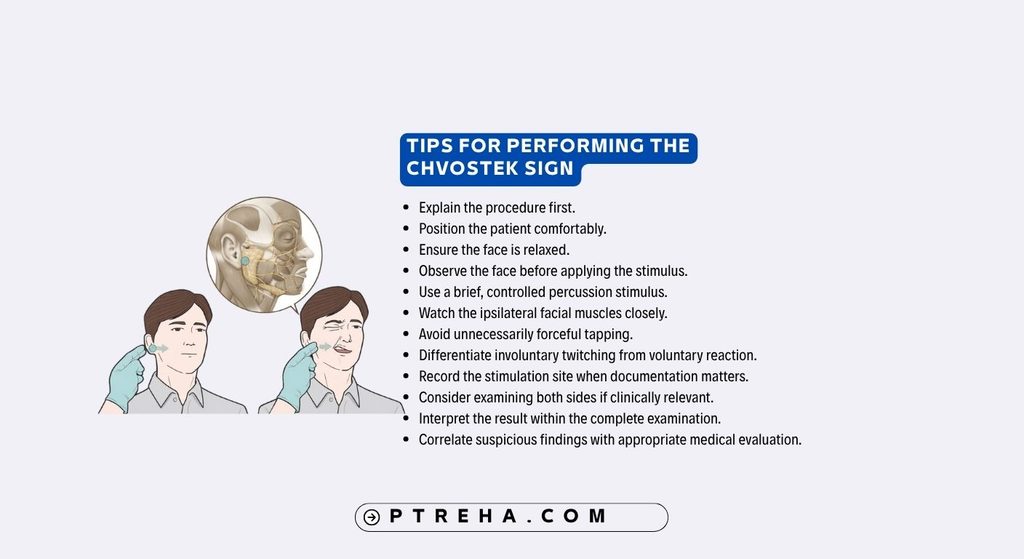
For a more useful and reproducible examination:
- Explain the procedure first.
- Position the patient comfortably.
- Ensure the face is relaxed.
- Observe the face before applying the stimulus.
- Use a brief, controlled percussion stimulus.
- Watch the ipsilateral facial muscles closely.
- Avoid unnecessarily forceful tapping.
- Differentiate involuntary twitching from voluntary reaction.
- Record the stimulation site when documentation matters.
- Consider examining both sides if clinically relevant.
- Interpret the result within the complete examination.
- Correlate suspicious findings with appropriate medical evaluation.
For teaching purposes, students should also understand why the sign is being performed rather than simply memorizing the tapping technique.
A technically correct Chvostek sign examination can still lead to poor clinical reasoning if the finding is treated as diagnostic.
Role of the Physical Therapist
The Chvostek sign is primarily part of a broader medical and neurological examination rather than a routine musculoskeletal special test.
A physical therapist may nevertheless encounter the sign or recognize compatible symptoms during patient assessment.
Clinically appropriate actions include:
- Recognizing symptoms suggesting abnormal neuromuscular excitability.
- Reviewing relevant recent medical or surgical history.
- Identifying unexpected facial or muscular spasms.
- Avoiding assumptions about the underlying electrolyte abnormality.
- Communicating concerning findings to the appropriate medical team.
- Recognizing when the patient’s presentation falls outside routine rehabilitation management.
Symptoms such as significant tetany, seizures, marked neurological changes, or other evidence of a serious systemic disturbance require appropriate medical evaluation rather than continued routine rehabilitation testing.
Summary
- The Chvostek sign is a bedside clinical sign of neuromuscular excitability, traditionally associated with hypocalcemia.
- It is commonly elicited by tapping over the facial nerve region and observing for involuntary ipsilateral facial muscle contraction.
- A positive Chvostek sign may occur with hypocalcemia, but it does not independently diagnose hypocalcemia or its cause.
- A negative Chvostek sign does not reliably exclude a calcium disturbance.
- Evidence concerning its diagnostic accuracy is limited and protocol-dependent, so laboratory findings and the complete clinical presentation should guide interpretation.
The Chvostek sign remains useful as a recognizable physical examination finding, particularly when evaluating neuromuscular irritability.
Its greatest clinical value comes from understanding its limitations: it can contribute to clinical suspicion, but meaningful conclusions about calcium status require correlation with symptoms, history, and appropriate laboratory assessment.