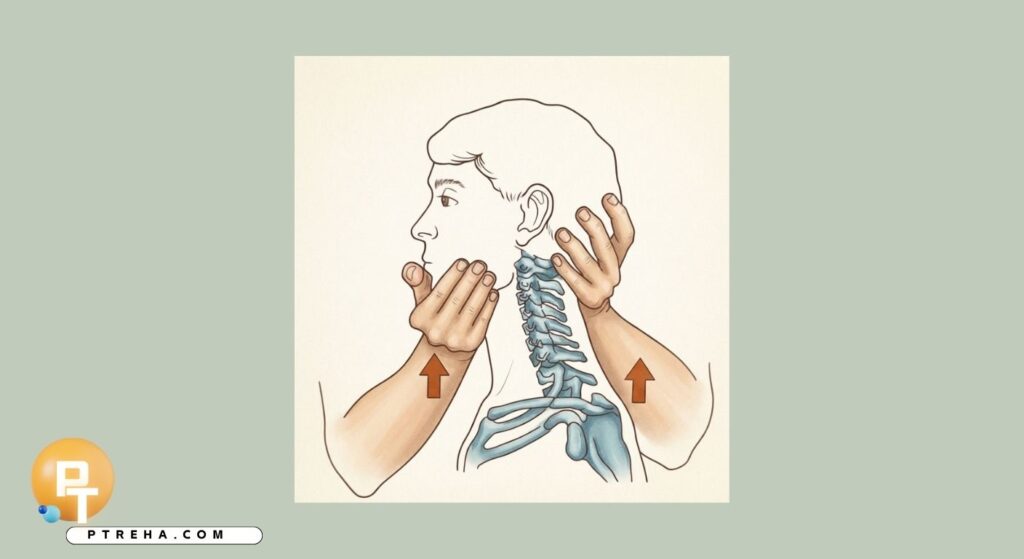
The Cervical Distraction Test is a commonly used orthopedic special test within the physical examination of patients with neck pain and upper-limb symptoms. It involves gently unloading the cervical spine while observing whether the patient’s familiar symptoms change, particularly symptoms that may be compatible with cervical radiculopathy.
What Is the Cervical Distraction Test?
The Cervical Distraction Test, also called the cervical traction or neck distraction test, is a clinical assessment maneuver and orthopedic special test used during cervical spine examination.
The examiner applies a controlled longitudinal distraction force to the patient’s head while supporting the cervical region. The clinician then observes the patient’s response, including changes in familiar neck pain, arm pain, paresthesia, or other symptoms.
The test is most often considered when the clinical presentation raises suspicion of cervical radiculopathy. Importantly, the maneuver does not independently diagnose cervical radiculopathy, identify a specific nerve root, or establish the exact anatomical pain generator.
Its value comes from interpreting the symptom response together with the patient’s history, neurological examination, cervical movement findings, and other relevant physical tests.
“Symptom relief is a clinical finding, not a diagnosis.”
Purpose of the Cervical Distraction Test
The Cervical Distraction Test may be used to:
- Observe whether cervical unloading changes the patient’s familiar symptoms.
- Assess whether radiating upper-limb symptoms are reduced during distraction.
- Add information to an examination when cervical radiculopathy is being considered.
- Compare symptom behavior during cervical loading and unloading.
- Support clinical reasoning when interpreted with other examination findings.
- Explore the patient’s immediate response to a controlled cervical traction maneuver.
The test should be viewed as one component of an examination rather than as an isolated decision-making tool.
Cervical Distraction Test Indications
The maneuver may be appropriate when a patient reports:
- Neck pain associated with arm pain.
- Radiating symptoms into the upper limb.
- Paresthesia or numbness associated with cervical symptoms.
- Symptoms that appear to change with cervical position or mechanical loading.
- A clinical presentation in which cervical radiculopathy is part of the differential diagnosis.
The presence of these symptoms does not automatically mean that the distraction test should be performed. The clinician should first consider the patient’s history, neurological status, irritability, and potential safety concerns.
Cervical Distraction Test Contraindications and Precautions
There is no universally agreed list of test-specific absolute contraindications for the Cervical Distraction Test. Safety should instead be based on the patient’s clinical presentation and the nature of the manual technique being considered.
Relevant precautions include:
- Suspected cervical fracture or major cervical instability.
- Recent cervical surgery when the appropriate postoperative restrictions are unclear.
- Significant unexplained neurological deterioration.
- A clinical presentation containing red flags that requires further medical evaluation before cervical manual loading.
- Severe or highly irritable symptoms in which even gentle movement is poorly tolerated.
- Symptoms such as dizziness, visual disturbance, nausea, or other concerning responses that appear during the maneuver.
The clinician should stop the test when the patient’s response is concerning or substantially outside the expected symptom behavior.
A precaution is not automatically an absolute contraindication. The appropriate decision depends on the patient’s diagnosis, stage of recovery, medical history, and the exact technique being used.
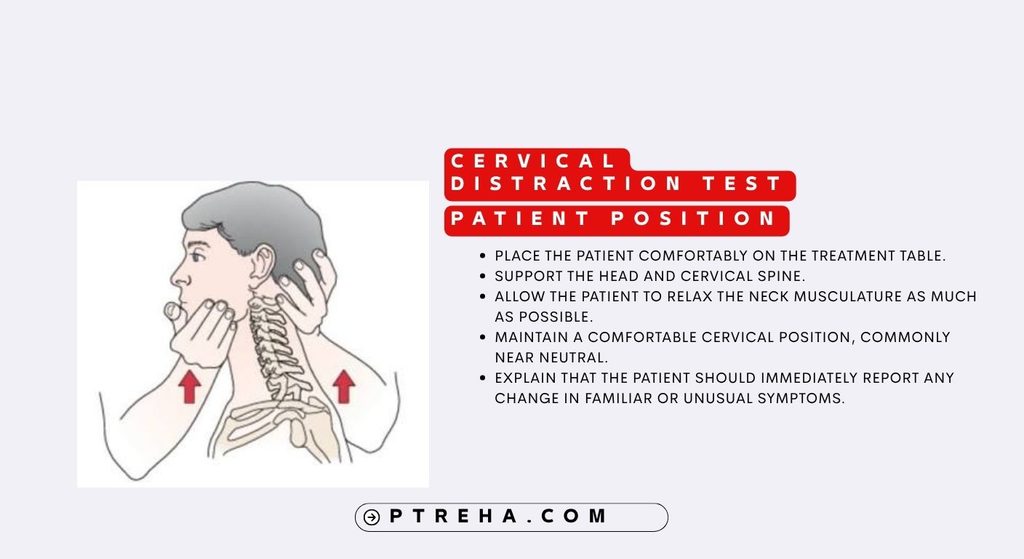
Patient Position
A commonly described position is supine.
- Place the patient comfortably on the treatment table.
- Support the head and cervical spine.
- Allow the patient to relax the neck musculature as much as possible.
- Maintain a comfortable cervical position, commonly near neutral.
- Explain that the patient should immediately report any change in familiar or unusual symptoms.
Different clinical descriptions use slightly different positioning strategies. The position should therefore be interpreted according to the protocol being followed rather than treated as a universal standard.
Examiner Position
For a supine technique:
- Position yourself at the head of the treatment table.
- Establish a stable stance before applying force.
- Support the patient’s head with both hands.
- Place the hands securely around the occipital region.
- Keep the grip comfortable and avoid unnecessary pressure on the jaw or anterior neck.
- Use controlled body mechanics so that the distraction force can be applied gradually.
How to Perform the Cervical Distraction Test
- Establish the baseline.
Ask the patient to identify the familiar symptoms, particularly any arm pain, tingling, numbness, or other radiating complaints. - Position the patient.
Place the patient supine and support the head and cervical spine comfortably. - Position your hands.
Secure the occipital region with both hands while maintaining a relaxed and controlled posture. - Apply gentle distraction.
Introduce a gradual longitudinal traction force along the cervical axis. - Monitor symptoms.
Ask whether the patient’s familiar symptoms change while distraction is maintained. - Observe the response.
Note whether symptoms are reduced, unchanged, reproduced, or otherwise altered. - Release gradually.
Return to the resting position in a controlled manner rather than releasing the force abruptly. - Reassess.
Compare the patient’s symptoms with the pre-test presentation.
The examiner should focus on the quality and location of symptom change, not on generating a large amount of traction force.
Interpretation
The primary clinical observation is the patient’s symptom response to cervical unloading.
Reduction of familiar radiating arm symptoms during distraction may support the clinical impression that cervical mechanical factors are contributing to the patient’s presentation. However, this finding does not prove nerve-root compression and does not establish a specific structural lesion.
A lack of symptom relief does not independently exclude cervical radiculopathy either.
The response should therefore be interpreted in relation to:
- The patient’s history.
- Distribution and behavior of symptoms.
- Neurological findings.
- Cervical range-of-motion findings.
- Other cervical provocation or relief tests.
- The overall pattern of the clinical examination.
What Does a Positive Cervical Distraction Test Mean?
In traditional orthopedic-test terminology, the Cervical Distraction Test is often described as positive when the patient’s familiar radiating symptoms are relieved during cervical distraction.
This terminology should be used cautiously because the test is not a stand-alone diagnostic procedure.
A symptom-relieving response may increase clinical suspicion of cervical radiculopathy when it is consistent with the remainder of the examination. It does not, by itself, confirm:
- Cervical nerve-root compression.
- A disc herniation.
- Foraminal stenosis.
- Cervical spondylosis as the cause of symptoms.
- A particular cervical segment as the source of symptoms.
The correct interpretation is therefore supportive rather than definitive.
Negative Cervical Distraction Test
A non-relieving response may be described as an absence of symptom relief rather than treating the maneuver as a simple pass-or-fail test.
If the patient’s familiar symptoms do not improve during distraction, this does not automatically rule out cervical radiculopathy.
Physical examination tests for cervical radiculopathy have variable diagnostic performance across studies and populations. The evidence supports combining findings rather than relying on a single maneuver to establish or exclude the condition.
Anatomy Involved in Cervical Distraction Test
Relevant anatomy and systems include:
- Cervical vertebrae: These form the bony framework of the cervical spine.
- Intervertebral discs: Cervical loading and unloading can alter mechanical forces across the motion segments.
- Facet joints: Their mechanical environment changes with cervical position and loading.
- Intervertebral foramina: These provide passage for cervical spinal nerve roots and are influenced by cervical position.
- Spinal nerve roots: Symptoms associated with cervical radicular disorders may change when mechanical conditions around the cervical region change.
- Ligaments, muscles, and connective tissues: These contribute to cervical stability and may also respond to unloading.
- Neural tissues: Symptoms cannot be assumed to arise from one isolated structure based only on the distraction response.
The test does not directly visualize or measure any of these structures. A symptom response should therefore not be interpreted as proof that a specific tissue has been mechanically isolated.
Conditions Detected / Associated With the Test
The Cervical Distraction Test is primarily associated with the clinical assessment of suspected cervical radiculopathy.
It may also be used in patients with:
- Neck pain with radiating arm symptoms.
- Upper-limb paresthesia associated with cervical symptoms.
- Cervical presentations in which unloading changes familiar symptoms.
The test should not be considered independently diagnostic for a particular pathology such as disc herniation, foraminal stenosis, degenerative changes, or a specific nerve-root level.
Those conclusions require a broader clinical assessment and, where medically indicated, additional investigations.
Clinical Significance
The Cervical Distraction Test can contribute useful information by showing how a patient’s familiar symptoms behave when cervical loading is reduced.
Its clinical significance is greatest when the finding agrees with other examination results. For example, a relieving response may be more meaningful when the patient also presents with a symptom pattern and neurological findings that are compatible with cervical radiculopathy.
The test can therefore help clinicians:
- Refine a differential diagnosis.
- Identify relevant symptom behavior.
- Compare responses across examination maneuvers.
- Decide whether further neurological or medical assessment is appropriate.
- Integrate mechanical findings into a broader rehabilitation plan.
The test should not be used as the sole basis for imaging, referral, diagnosis, or prognosis.
“Use the distraction response as one piece of the clinical puzzle.”
Sensitivity and Specificity
A universal sensitivity or specificity value for the Cervical Distraction Test should not be presented.
Earlier systematic-review evidence reported that traction or neck distraction showed potentially useful diagnostic characteristics, including relatively high specificity in the small number of studies available. However, the evidence base was limited by methodological problems, heterogeneous study designs, different reference standards, and a small number of primary studies.
More recent systematic-review evidence continues to indicate that the diagnostic evidence for individual physical examination tests in cervical radiculopathy is sparse and that certainty is low or very low for many test outcomes. The updated literature does not provide a strong basis for treating one sensitivity or specificity value as universal across patients and clinical protocols.
For practical clinical use, the important point is that the Cervical Distraction Test should be interpreted in combination with other findings rather than as an isolated diagnostic test.
Diagnostic Accuracy
The Cervical Distraction Test has been studied as part of the physical examination for cervical radiculopathy, but the evidence does not establish it as a sufficiently accurate stand-alone diagnostic test.
Diagnostic accuracy is also influenced by:
- Patient selection.
- The clinical definition of cervical radiculopathy.
- The reference standard used in the study.
- The exact version of the test.
- Examiner technique.
- Whether the test is interpreted alone or as part of a clinical cluster.
Consequently, a relieving response may contribute to diagnostic reasoning without independently establishing the diagnosis.
Common Mistakes in Cervical Distraction Test
- Applying excessive traction in an attempt to produce a stronger response.
- Performing the maneuver too quickly.
- Failing to identify the patient’s baseline symptoms before testing.
- Focusing only on neck pain while ignoring changes in arm symptoms.
- Calling the test positive without defining what symptom change occurred.
- Assuming symptom relief proves a specific structural lesion.
- Using the test in isolation to diagnose cervical radiculopathy.
- Ignoring neurological findings that may be more clinically important.
- Continuing the maneuver despite a concerning or unexpected response.
- Treating the test maneuver as equivalent to a complete cervical traction treatment session.
Tips for Performing the Cervical Distraction Test
- Establish the patient’s familiar symptoms before applying the maneuver.
- Explain exactly what symptom changes the patient should report.
- Use a gradual and controlled force.
- Keep the patient relaxed throughout the procedure.
- Monitor both neck and upper-limb symptoms.
- Ask the patient to describe the location and quality of any change.
- Compare the response with other examination findings.
- Record the actual clinical response rather than relying only on the words “positive” or “negative.”
- Stop the procedure if the response becomes concerning.
- Remember that a symptom-relieving response supports clinical reasoning but does not establish a diagnosis on its own.
Summary
The Cervical Distraction Test is an orthopedic special test and clinical assessment maneuver used primarily when evaluating neck pain with upper-limb symptoms in a presentation where cervical radiculopathy is being considered.
- The test involves controlled longitudinal unloading of the cervical spine while observing changes in familiar symptoms.
- Relief of radiating symptoms may support the clinical hypothesis of cervical radiculopathy when consistent with the rest of the examination.
- The test does not independently identify a specific nerve root, disc lesion, foraminal abnormality, or pain generator.
- There are no universally established diagnostic cutoffs or universal sensitivity and specificity values that should be applied to all patients.
- Proper interpretation requires integration with history, neurological findings, cervical examination, and other relevant clinical tests.
The Cervical Distraction Test is most useful when performed gently, documented precisely, and interpreted as one component of a comprehensive cervical spine assessment.
Resources
Rubinstein SM, Pool JJ, van Tulder MW, Riphagen II, de Vet HCW. A systematic review of the diagnostic accuracy of provocative tests of the neck for diagnosing cervical radiculopathy. European Spine Journal.
PubMed — Rubinstein et al., systematic review
Thoomes EJ, et al. Value of physical tests in diagnosing cervical radiculopathy: a systematic review.
PubMed — Systematic review of physical examination tests
Thoomes EJ, et al. Diagnostic accuracy of physical examination tests for painful cervical radiculopathy: update of a systematic review and meta-analysis. BMC Musculoskeletal Disorders.
PubMed — 2026 updated systematic review and meta-analysis
Romeo A, et al. Cervical Radiculopathy: Effectiveness of Adding Traction to Physical Therapy—A Systematic Review and Meta-Analysis of Randomized Controlled Trials.
PubMed — Systematic review of cervical traction as an intervention
Colombo C, et al. Traction Therapy for Cervical Radicular Syndrome is Statistically Significant but not Clinically Relevant for Pain Relief: A Systematic Literature Review with Meta-Analysis and Trial Sequential Analysis.