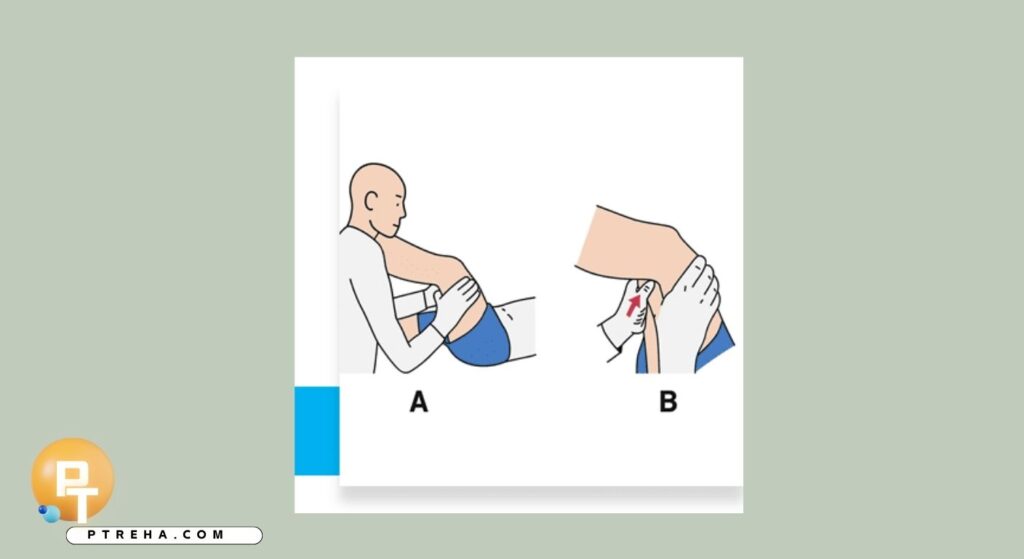
The Bowstring Test is a clinical neurodynamic assessment used primarily when a patient presents with radiating lower-limb symptoms. It is commonly performed as a modification of the straight leg raise and focuses on whether the patient’s familiar symptoms can be reproduced when neural tissues are mechanically loaded in the posterior knee region.
The test can contribute to the assessment of suspected lumbosacral radicular symptoms or sciatic-type pain, but it should not be interpreted as an isolated diagnostic test. Its findings are most useful when combined with the patient’s history, neurological examination, symptom behavior, and other appropriate clinical tests.
What Is the Bowstring Test?
The Bowstring Test, also referred to in some clinical literature as the Bowstring Sign or Cram Test, is a neurodynamic clinical assessment maneuver.
A commonly described technique begins with a straight leg raise. When the patient’s familiar symptoms are reproduced, the examiner slightly flexes the knee while maintaining the hip position. Pressure is then applied in the popliteal region to determine whether the patient’s familiar symptoms can be reproduced.
The test is intended to provide information about symptom behavior during mechanical loading of neural tissues. It does not independently identify the exact anatomical source of pain or establish the presence of a specific nerve-root lesion.
The Bowstring Test should therefore be considered part of a broader clinical assessment rather than a stand-alone diagnostic procedure.
Purpose of the Bowstring Test
The Bowstring Test may be used to:
- Assess symptom behavior during a neurodynamic examination.
- Investigate radiating posterior lower-limb symptoms.
- Complement the straight leg raise examination.
- Assess whether familiar symptoms can be reproduced after modifying the SLR position.
- Contribute to the clinical assessment of suspected lumbosacral radicular symptoms.
- Help determine whether neural mechanosensitivity may be relevant to the patient’s presentation.
The test should be interpreted in relation to the patient’s complete clinical presentation rather than according to the maneuver alone.
Bowstring Test Indications
The maneuver may be considered when a patient presents with:
- Low-back pain associated with radiating leg symptoms.
- Posterior thigh or lower-leg symptoms that may have a neural component.
- Symptoms suggestive of lumbosacral nerve-root involvement.
- Symptoms reproduced during a straight leg raise.
- Posterior leg pain in which a neurodynamic examination may provide additional information.
The presence of low-back pain alone does not necessarily justify performing the test. The clinical history and examination should determine whether a neurodynamic assessment is appropriate.
Bowstring Test Contraindications and Precautions
There is no universally established list of Bowstring-Test-specific contraindications. Safety should therefore be determined according to the patient’s overall clinical presentation.
Relevant precautions include:
- Explain the procedure before beginning.
- Establish how the patient will communicate discomfort or worsening symptoms.
- Perform the maneuver gradually rather than forcing the limb into a painful position.
- Avoid repeatedly provoking severe or escalating neurological symptoms.
- Stop the examination if the patient develops concerning symptoms or cannot tolerate the maneuver.
- Consider symptom irritability when determining the amount of neural loading to apply.
- If the history or examination raises concern for serious spinal or neurological pathology, appropriate medical evaluation should take priority over provocative testing.
The purpose of the maneuver is to assess symptom behavior, not to produce maximal pain.
Patient Position
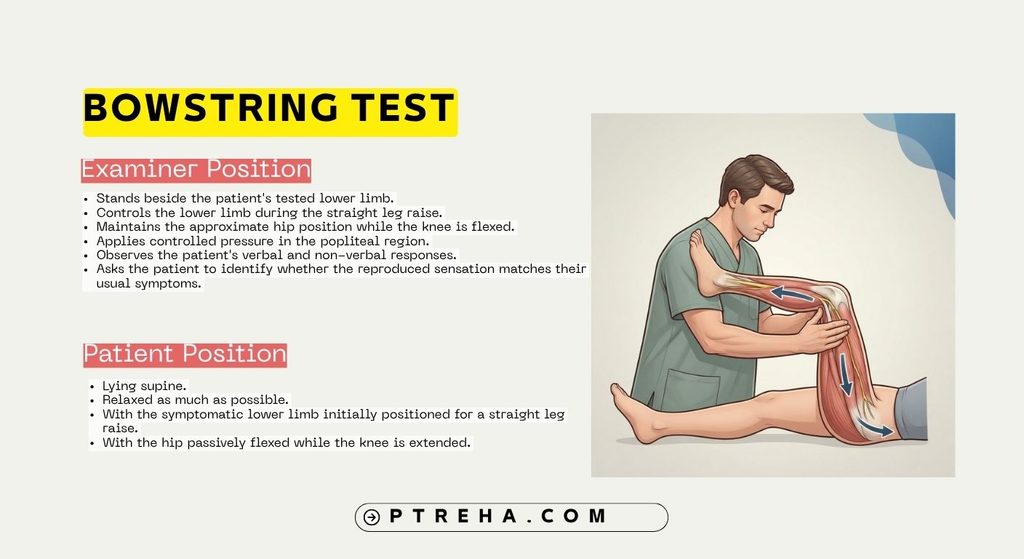
A commonly described Bowstring Test is performed with the patient:
- Lying supine.
- Relaxed as much as possible.
- With the symptomatic lower limb initially positioned for a straight leg raise.
- With the hip passively flexed while the knee is extended.
When the patient’s familiar symptoms are reproduced, the knee is slightly flexed while the hip position is maintained as consistently as practical.
Different descriptions of the Bowstring Test exist, so clinicians should be clear about the protocol they are using.
Examiner Position
The examiner generally:
- Stands beside the patient’s tested lower limb.
- Controls the lower limb during the straight leg raise.
- Maintains the approximate hip position while the knee is flexed.
- Applies controlled pressure in the popliteal region.
- Observes the patient’s verbal and non-verbal responses.
- Asks the patient to identify whether the reproduced sensation matches their usual symptoms.
The examiner should avoid unnecessary force and should monitor the patient’s response throughout the maneuver.
How to Perform the Bowstring Test
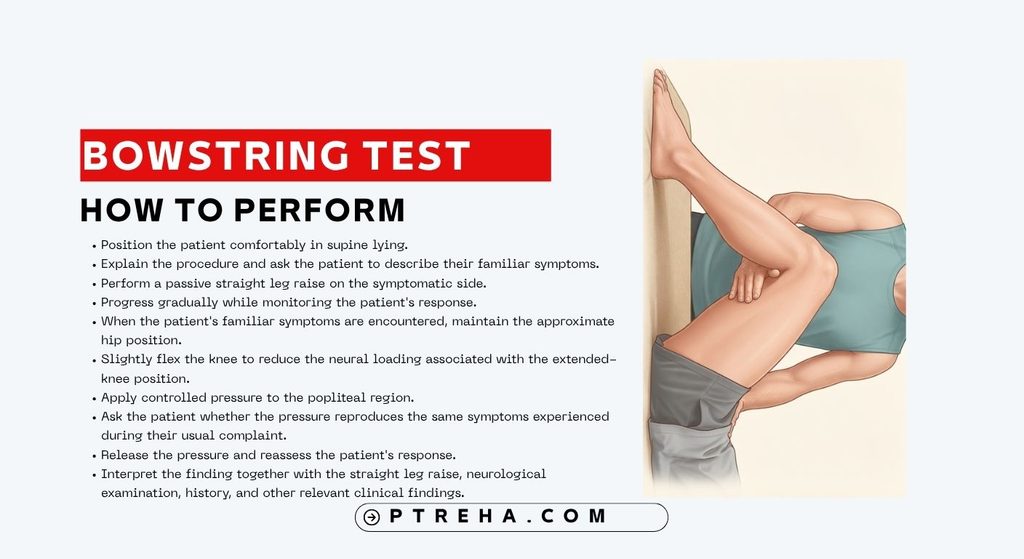
- Position the patient comfortably in supine lying.
- Explain the procedure and ask the patient to describe their familiar symptoms.
- Perform a passive straight leg raise on the symptomatic side.
- Progress gradually while monitoring the patient’s response.
- When the patient’s familiar symptoms are encountered, maintain the approximate hip position.
- Slightly flex the knee to reduce the neural loading associated with the extended-knee position.
- Apply controlled pressure to the popliteal region.
- Ask the patient whether the pressure reproduces the same symptoms experienced during their usual complaint.
- Release the pressure and reassess the patient’s response.
- Interpret the finding together with the straight leg raise, neurological examination, history, and other relevant clinical findings.
The important clinical observation is not simply whether pressure produces discomfort. The examiner should determine whether the maneuver reproduces the patient’s familiar symptom pattern.
Interpretation
The Bowstring Test does not require a universal numerical cutoff or pass/fail threshold.
A clinically meaningful response may involve reproduction of the patient’s familiar radiating or neural-type symptoms during the maneuver. This may support a clinical hypothesis involving neural mechanosensitivity.
However, symptom reproduction does not establish the exact cause of the symptoms. It does not independently confirm lumbar disc herniation, nerve-root compression, or another specific spinal pathology.
Local tenderness in the popliteal region should also not automatically be interpreted as evidence of neural pathology.
What Does a Positive Bowstring Test Mean?
When the patient’s familiar radiating symptoms are reproduced during the maneuver, the finding may be consistent with neural mechanosensitivity in the context of the examination.
The finding should be considered alongside:
- The patient’s symptom distribution.
- The straight leg raise response.
- Neurological findings.
- Motor function.
- Sensory findings.
- Reflexes.
- Other relevant neurodynamic tests.
- The overall clinical history.
A positive-appearing response therefore contributes to clinical reasoning but should not be treated as a diagnosis by itself.
Negative Bowstring Test
Failure to reproduce the patient’s familiar symptoms during the maneuver does not independently exclude neural involvement.
The response may be influenced by:
- The testing technique.
- The patient’s symptom irritability.
- The position reached during the straight leg raise.
- The patient’s ability to recognize and describe familiar symptoms.
- The underlying condition.
- Differences between clinical populations and testing protocols.
For this reason, a non-provocative response should be interpreted as one finding within the overall examination rather than definitive evidence that neural involvement is absent.
Anatomy Involved in the Bowstring Test
Relevant anatomical and physiological structures include:
- Sciatic nerve: A major neural structure of the posterior lower limb that is mechanically influenced during neurodynamic testing.
- Tibial nerve: A major terminal component of the sciatic nerve that passes through the popliteal region.
- Common fibular nerve: The other major terminal component of the sciatic nerve.
- Lumbosacral nerve roots: Neural structures contributing to the pathway assessed during straight leg raise and related neurodynamic procedures.
- Popliteal fossa: The anatomical region in which pressure is applied during the Bowstring maneuver.
- Posterior lower-limb tissues: Muscles, connective tissues, and other structures can also contribute to the mechanical response during the test.
The Bowstring Test does not isolate one nerve or one nerve root. Neurodynamic responses reflect interaction between multiple anatomical structures and mechanical and physiological factors.
Conditions Detected / Associated With the Test
The Bowstring Test has been discussed in association with:
- Sciatic-type leg pain.
- Lumbosacral radicular symptoms.
- Clinical presentations involving suspected nerve-root irritation.
- Lumbar disc disorders associated with radiating symptoms.
The test should not be described as independently detecting or confirming lumbar disc herniation.
A clinical finding can contribute to a diagnostic hypothesis without being sufficient to establish the underlying pathology.
Clinical Significance
The Bowstring Test can provide additional information during the assessment of patients with radiating lower-limb symptoms.
Its interpretation is particularly useful when the examiner considers whether the reproduced sensation is the same as the patient’s familiar complaint.
Clinical interpretation should incorporate:
- Symptom location and behavior.
- History of onset and aggravating factors.
- Straight leg raise findings.
- Neurological examination.
- Muscle strength.
- Sensory examination.
- Reflexes.
- Other appropriate neurodynamic assessments.
- Functional limitations.
The test may help refine a clinical hypothesis, but it should not replace a complete examination.
Sensitivity and Specificity
A universally applicable sensitivity and specificity for the Bowstring Test has not been established.
Research has examined Bowstring and other sciatic tension signs in specific patient populations, including patients with documented lumbar disc herniation. Findings from such studies should not be transferred directly to every patient with low-back pain or leg symptoms.
Diagnostic performance depends on factors such as the population studied, reference standard, test protocol, and definition of the clinical finding.
For this reason, a single sensitivity or specificity value should not be presented as a universal characteristic of the Bowstring Test.
Diagnostic Accuracy
The Bowstring Test should not be used as a stand-alone diagnostic test for lumbar radiculopathy or lumbar disc herniation.
The available literature includes studies examining sciatic tension signs and neurodynamic maneuvers, but diagnostic accuracy can vary according to the population and methodology used.
The most clinically appropriate approach is to treat the Bowstring Test as one component of a broader assessment of radiating lower-limb symptoms and possible neural mechanosensitivity.
Common Mistakes in Bowstring Test
- Treating the test as a definitive test for lumbar disc herniation.
- Assuming a painful response automatically represents nerve-root pathology.
- Applying excessive pressure to the popliteal region.
- Failing to establish the patient’s familiar symptoms before testing.
- Focusing on local tenderness rather than symptom reproduction.
- Changing the hip position substantially while modifying the knee position.
- Repeatedly provoking severe symptoms.
- Ignoring the neurological examination.
- Treating a non-provocative response as proof that neural involvement is absent.
- Using an arbitrary straight-leg-raise angle as a universal diagnostic cutoff.
- Performing the maneuver without considering symptom irritability.
Tips for Performing the Bowstring Test
- Begin with a clear understanding of the patient’s familiar symptoms.
- Perform the straight leg raise slowly and progressively.
- Ask the patient to distinguish familiar radiating symptoms from ordinary posterior-leg stretching.
- Maintain the hip position as consistently as practical when flexing the knee.
- Apply pressure gradually and in a controlled manner.
- Avoid using excessive force.
- Stop if symptoms become severe or concerning.
- Document the location and character of the reproduced symptoms.
- Compare the response with the patient’s usual symptoms rather than simply recording pain.
- Interpret the maneuver alongside the neurological and musculoskeletal examination.
- Use a consistent protocol when monitoring changes over time.
“The clinical question is not simply whether the maneuver hurts; it is whether it reproduces the patient’s familiar symptoms.”
“A neurodynamic finding contributes to clinical reasoning, but it does not automatically identify the underlying pathology.”
Summary
- The Bowstring Test is a neurodynamic clinical assessment maneuver, commonly described as a modification of the straight leg raise.
- The maneuver involves positioning the lower limb during SLR, slightly flexing the knee, and applying controlled pressure in the popliteal region.
- Reproduction of the patient’s familiar radiating symptoms may support a hypothesis of neural mechanosensitivity.
- The test does not independently diagnose lumbar disc herniation, radiculopathy, or a specific nerve-root lesion.
- There are no universally applicable sensitivity, specificity, or diagnostic cutoff values that should be presented as standard for all patients.
- Proper interpretation requires integration with the patient’s history, neurological examination, symptom behavior, and other relevant clinical findings.
The Bowstring Test is most useful when it answers a specific clinical question about symptom behavior during neural loading. Used carefully, it can add information to the examination of patients with radiating lower-limb symptoms while avoiding overinterpretation of a single clinical maneuver.
Resources
- PubMed – Sciatic tension signs and lumbar disc herniation: Supik LF, Broom MJ. Spine. 1994;19(9):1066–1069. This study evaluated sciatic tension maneuvers, including the Bowstring sign, in patients with documented lumbar disc herniation.
PubMed article - NCBI Bookshelf – Straight Leg Raise Test (Lasègue sign): Provides clinical background on SLR and describes the Bowstring sign as a related maneuver involving knee flexion and popliteal pressure.
NCBI Bookshelf resource - PubMed – Inadequacies of the Lasègue test, and how the Slump and Bowstring tests are useful for the diagnosis of sciatica: Review discussing the role and limitations of the Bowstring Test within the broader examination of sciatica.
PubMed review