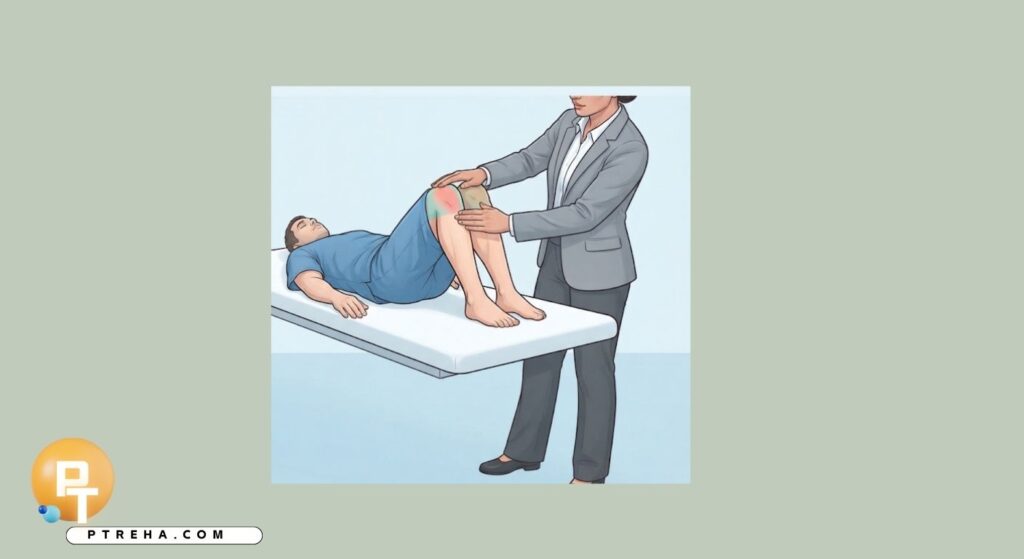
The Allis Test is a clinical orthopedic assessment in which the examiner compares the relative height or position of the knees while the patient lies supine with the hips and knees flexed. It is also widely referred to as the Galeazzi test or Galeazzi sign.
What Is the Allis Test?
Its classic clinical use is in the assessment of infants and young children when there is concern about developmental dysplasia of the hip (DDH), unilateral hip dislocation, or an apparent difference in lower-limb length.
The important point is that the Allis Test is a clinical sign, not an isolated measurement of femoral or tibial length. Unequal knee height can reflect several factors, including the relative position of the hip and the length of the thigh segment. It does not, by itself, establish the cause of the asymmetry.
The terminology is not completely standardized. Some clinical sources use “Allis” and “Galeazzi” interchangeably, while other descriptions of the Allis Test have attempted to use knee position to identify the segment responsible for an apparent leg-length difference. Those extended applications are less clearly supported and should not be treated as universally valid.
“Knee-height asymmetry is a clinical finding, not a diagnosis.”
Purpose of the Allis Test
The Allis Test may be used to:
- Identify asymmetry in apparent thigh length or knee height.
- Contribute to the clinical examination of a child when hip displacement or DDH is suspected.
- Detect an asymmetrical lower-limb presentation that warrants further orthopedic assessment.
- Provide one component of a broader examination of hip position, movement, and limb symmetry.
- Support clinical reasoning about possible unilateral limb-length inequality.
The American Academy of Pediatrics includes assessment for limb-length discrepancy, including the Galeazzi sign, within ongoing hip surveillance in infants and young children.
Allis Test Indications
The Allis Test can be considered when clinical examination raises concern about:
- Possible unilateral developmental dysplasia of the hip.
- Suspected unilateral hip dislocation.
- Apparent lower-limb length asymmetry.
- Unequal knee height observed during pediatric hip examination.
- A child with other findings suggesting hip asymmetry or altered hip movement.
It should be interpreted alongside the rest of the examination rather than used as a stand-alone screening decision.
Allis Test Contraindications and Precautions
There is no universally established Allis-Test-specific contraindication in the major pediatric hip guidance reviewed.
Relevant precautions include:
- Position the child gently and avoid forceful hip movement.
- Do not force the hips into a position that causes pain, guarding, or distress.
- Respect postoperative, traumatic, or other medically imposed movement restrictions.
- If the child cannot be positioned symmetrically, document the limitation rather than interpreting asymmetry as a definite abnormal finding.
- In an infant or child with suspected hip instability, the Allis Test should not replace an appropriately performed pediatric hip examination.
The quality of the observation depends greatly on keeping the pelvis as level and symmetrical as possible. This is particularly important in infants, where positioning can make interpretation difficult.
Patient Position
A commonly described position is:
- Patient lying supine on a firm examination surface.
- Pelvis positioned as symmetrically as practical.
- Both hips flexed.
- Both knees flexed so that the examiner can compare their height and position.
- Feet or lower legs positioned symmetrically without unnecessary rotation.
Descriptions differ somewhat regarding the exact degree of hip and knee flexion. For that reason, the precise angle should be documented when a specific institutional or teaching protocol is being followed rather than presented as a universal requirement.
Examiner Position
The examiner should:
- Stand where both knees can be viewed simultaneously.
- Ensure that the pelvis remains level and is not artificially rotated.
- Observe the knees from a consistent viewpoint.
- Compare the apparent knee height and forward-backward position.
- Repeat the observation if positioning is uncertain before interpreting the finding.
The examiner should avoid using visual estimates to assign an exact limb-length difference. A clinical sign of asymmetry is different from a validated quantitative measurement of limb length.
How to Perform the Allis Test
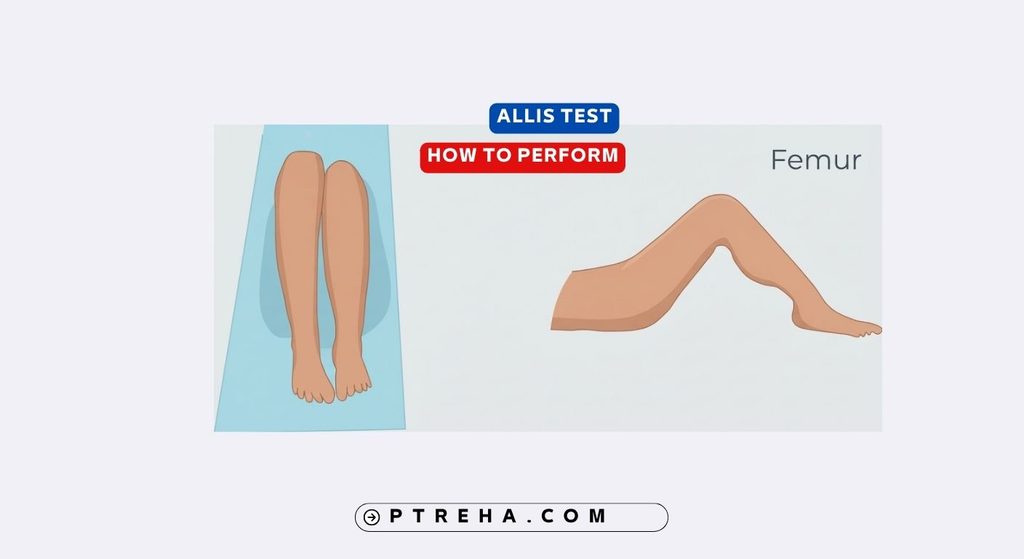
A commonly used pediatric technique is:
- Place the child supine with the pelvis as level as possible.
- Flex both hips and knees in a symmetrical manner.
- Keep the lower limbs relaxed and avoid unnecessary rotation.
- Compare the height of the two knees from the same viewing position.
- Observe whether one knee appears lower or closer to the child’s trunk than the other.
- Reposition the child if pelvic rotation or unequal limb placement could account for the asymmetry.
- Record the finding and integrate it with hip abduction, stability assessment, limb symmetry, gait when age-appropriate, and relevant history.
The classical observation is an unequal knee position rather than a numerical score.
What Constitutes a Positive Test?
The term “positive Allis Test” is commonly used when there is a noticeable difference in knee height or position with the hips and knees flexed.
However, terminology should be used carefully. An unequal knee height is best documented as a clinical finding rather than automatically labeled as evidence of a particular disease.
A difference in knee position may reflect unilateral hip displacement, an apparent limb-length difference, femoral asymmetry, positioning effects, or other anatomical factors.
What Does a Positive Allis Test Mean?
An asymmetric Allis finding can increase clinical suspicion of an underlying asymmetry involving the hip or lower limb.
In pediatric hip assessment, an unequal knee height is particularly relevant because unilateral hip displacement can make the affected thigh appear shorter, producing a difference in knee position. The finding is therefore associated with conditions such as unilateral hip dislocation or DDH, but it does not independently confirm them.
A careful clinician should ask:
- Is the pelvis level?
- Is the child positioned symmetrically?
- Is the asymmetry reproducible?
- Are there accompanying findings such as limited hip abduction or other signs of hip instability?
- Does the child’s history increase concern for hip pathology?
These questions help distinguish an important clinical finding from a positioning artifact.
Negative Allis Test
A symmetrical knee position means that an obvious asymmetry was not identified during this particular observation.
It should not be interpreted as proof that the hips are normal.
This limitation is especially important in bilateral hip involvement, where both sides may be affected similarly and therefore appear symmetrical. Clinical surveillance literature emphasizes that no single examination maneuver completely excludes developmental hip pathology.
Anatomy Involved in Allis Test
Relevant structures and anatomical relationships include:
- Hip joint, including the femoral head and acetabulum.
- Femur, particularly the proximal femur and overall thigh segment.
- Pelvis, whose position can substantially affect the apparent relationship between the knees.
- Knee joints, which serve as the visible reference points being compared.
- Tibia and fibula, which influence lower-limb length but are not directly measured by knee-height comparison.
The test should not be described as isolating a single ligament, muscle, nerve, or bone. Knee position is the result of the combined geometry and positioning of several anatomical segments.
Conditions Detected / Associated With the Test
The Allis Test may be associated with:
- Unilateral developmental dysplasia of the hip.
- Unilateral hip dislocation.
- Apparent lower-limb length asymmetry.
- Structural differences involving the proximal femur or hip.
- Other causes of asymmetric knee height.
The finding is most clinically useful when interpreted alongside the rest of the pediatric orthopedic examination. Contemporary guidance emphasizes assessment of limb-length discrepancy, hip abduction, and hip stability rather than reliance on a single maneuver.
Clinical Significance
The Allis Test can contribute to clinical decision-making by:
- Identifying an asymmetry that deserves further investigation.
- Supporting a broader assessment for pediatric hip pathology.
- Helping the clinician decide whether additional orthopedic evaluation or imaging is appropriate.
- Providing a simple observation that can be compared across examinations.
An abnormal finding should be interpreted in context rather than converted directly into a diagnosis.
In suspected DDH, physical examination and imaging have complementary roles. The AAP and orthopedic guidance support clinical surveillance and appropriate imaging when clinical findings or other circumstances raise sufficient concern.
Sensitivity and Specificity
Reliable universal sensitivity and specificity values for the Allis/Galeazzi finding itself are not well established across pediatric populations and examination protocols.
Available systematic reviews of DDH clinical examination have primarily evaluated other maneuvers, such as the Ortolani and Barlow tests and limited hip abduction, rather than providing a universal diagnostic-performance estimate for the Allis Test. The evidence also varies according to patient age, examiner experience, reference standard, and clinical protocol.
For this reason, a single sensitivity or specificity value should not be presented as a universal characteristic of the Allis Test.
Diagnostic Accuracy
The Allis Test should not be regarded as a standalone diagnostic test for developmental dysplasia of the hip.
Its main role is as a clinical observation within a wider assessment. When the finding is abnormal, the clinician should consider the complete history and examination and, when indicated, appropriate diagnostic imaging or specialist assessment.
Its limitations are particularly important because an apparent difference in knee height can arise from more than one anatomical explanation.
Allis Test and Leg-Length Assessment
A common misconception is that the Allis Test can precisely determine whether a limb is short because of the femur or the tibia.
The literature questioning the extended adult application of the Allis Test demonstrates why this interpretation should be made cautiously. Mathematical modeling showed that knee height can be affected by changes in either femoral or tibial length, the femur-to-tibia relationship, and the position of the hip. Therefore, knee position should not automatically be treated as a direct measurement of which bone is short.
For patients in whom actual anatomical leg-length discrepancy needs to be quantified, dedicated measurement methods are more appropriate. A systematic review concluded that clinical methods vary considerably in validity and reliability and that full-length standing radiography can provide a more valid reference for anatomical discrepancy when imaging is clinically justified.
“Use the Allis finding to identify asymmetry—not to manufacture a precise diagnosis.”
Common Mistakes in Allis Test
- Allowing the pelvis to rotate during positioning.
- Comparing the knees from different viewing angles.
- Failing to reproduce the position when the initial observation is uncertain.
- Assuming unequal knee height automatically means DDH.
- Treating the test as a precise measurement of femoral or tibial length.
- Ignoring bilateral pathology because both knees appear similarly positioned.
- Using the Allis Test as a substitute for the complete pediatric hip examination.
- Applying adult leg-length interpretations without considering the limitations of the technique.
Tips for Performing the Allis Test
- Keep the pelvis as level and symmetrical as possible.
- Use a consistent examiner viewpoint.
- Compare both limbs simultaneously rather than inspecting one side in isolation.
- Reposition the child if movement or rotation may have affected the finding.
- Document the actual observation rather than overstating its meaning.
- Look for accompanying findings such as asymmetric hip abduction or other evidence of hip asymmetry.
- Treat an abnormal finding as a reason for clinical correlation, not automatic diagnostic confirmation.
- When quantitative leg-length assessment is required, use an appropriate validated measurement method rather than relying on visual knee-height comparison alone.
Summary
- The Allis Test, commonly called the Galeazzi sign, is a clinical assessment of knee-height asymmetry with the hips and knees flexed.
- It is particularly relevant in the examination of infants and children for possible hip asymmetry and unilateral hip displacement.
- An unequal knee position may be associated with unilateral hip dislocation or limb-length asymmetry, but it does not establish a diagnosis by itself.
- Correct positioning and a level pelvis are essential because pelvic rotation and other factors can alter the observation.
- The test should not be treated as a precise method for determining femoral versus tibial shortening or as a substitute for appropriate diagnostic assessment.
The Allis Test remains useful as a simple component of pediatric orthopedic examination, especially when interpreted alongside hip stability, abduction, limb symmetry, history, and—when indicated—imaging. Its greatest clinical value comes from recognizing asymmetry without overinterpreting what that asymmetry means.
Resources and External Links
American Academy of Pediatrics — Evaluation and Referral for Developmental Dysplasia of the Hip in Infants
AAP Clinical Report on DDH evaluation and referral
American Academy of Orthopaedic Surgeons — Pediatric Developmental Dysplasia of the Hip
AAOS Pediatric Developmental Dysplasia of the Hip resources
International Hip Dysplasia Institute — Infant Diagnosis and Allis/Galeazzi Assessment
International Hip Dysplasia Institute clinical diagnosis resources
Allis Test and its limitations — Mathematical Modeling Study
Mathematical modeling of the Allis Test
Leg Length Discrepancy — Systematic Review of Clinical and Imaging Assessments
Systematic review of leg-length discrepancy assessment methods
Diagnostic Performance of Clinical Examination for Developmental Dysplasia of the Hip — Systematic Review and Meta-analysis
Systematic review and meta-analysis of DDH clinical examination