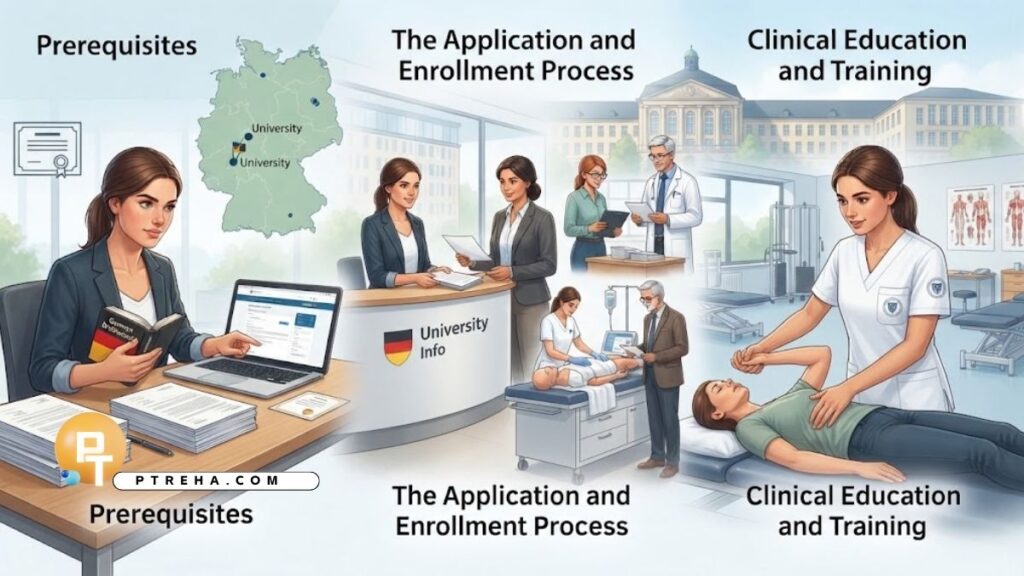
To study Physiotherapy in Germany, first choose between a three-year vocational programme and a university degree that includes professional qualification.
The right choice depends on whether you are entering the profession, already qualified, or seeking an academic degree alongside clinical training.
Understand the Routes into Physiotherapy in Germany
In Germany, Physiotherapeut/in is a regulated healthcare profession.
Completing a course about rehabilitation or earning a related degree does not, by itself, give someone permission to practise under that professional title.
The standard vocational route is a three-year programme at a recognised physiotherapy school, with practical placements and a state examination.
University routes also exist, but their structure and professional outcome differ by programme.
Germany’s Federal Employment Agency description of physiotherapy training is a useful starting point for comparing these routes.
Before applying, identify which description fits your goal:
- New entrant: You need a route leading to the German professional qualification.
- Prospective university student: You want to combine clinical preparation with academic study.
- Qualified physiotherapist from abroad: You need to examine professional recognition.
- Qualified German physiotherapist: You may want a degree to deepen your academic skills.
The distinction matters.
A programme called “physiotherapy” may lead to professional qualification, require an existing qualification, or focus on research and advanced study.
Read its stated admission requirements and awarded qualifications before comparing tuition or location.
Compare Vocational and University Programmes
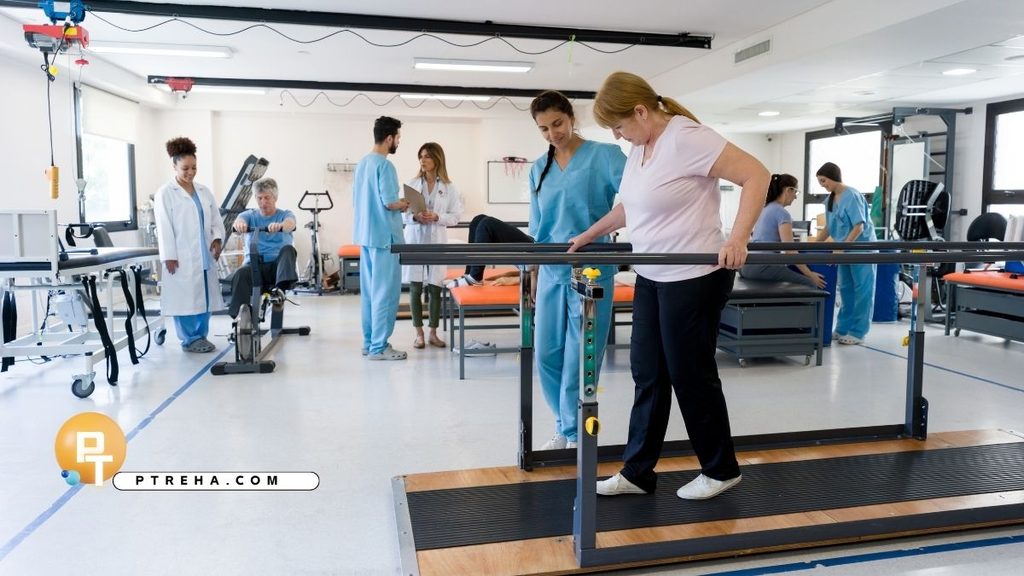
The vocational route centres on structured teaching, supervised practical experience, and preparation for the state examination.
A university programme adds academic work, such as reading research, evaluating evidence, and completing a degree project.
Some university programmes prepare students for initial professional qualification.
Others are designed for people who already hold it, and some combine study with a separate school-based training arrangement.
The university’s programme description should make the sequence clear.
| Route | Typical applicant | What to verify before applying |
|---|---|---|
| Vocational physiotherapy training | Someone entering the profession | State recognition, placements, fees, and examination arrangements |
| University programme leading to initial qualification | Someone seeking a degree and a route into practice | Whether and how the programme leads to permission to use the professional title |
| Degree combined with vocational training | Someone pursuing both qualifications | Partner school, timetable, separate applications, and total cost |
| Degree for qualified physiotherapists | Someone already entitled to practise | Required prior qualification and whether the degree changes professional status |
| Recognition of a foreign qualification | Someone trained outside Germany | Responsible authority, required documents, and any compensation measure |
For example, a student with no previous clinical qualification should not assume that admission to a physiotherapy bachelor’s degree guarantees eligibility to practise.
The decisive question is: What professional qualification will I hold when I finish, and what steps are required to obtain it?
Compare programmes using a short checklist:
- The exact name of each final qualification.
- Whether the route leads to the German professional title.
- The language used in teaching and placements.
- The location and duration of clinical placements.
- Tuition, other fees, and possible remuneration.
- The institution that organises the state examination.
Check Your Entry Qualifications
Vocational schools and universities assess applicants under different admission rules.
A university applicant normally needs a recognised higher education entrance qualification, while a vocational school assesses eligibility under the rules for its training route and location.
If you completed school abroad, do not assume that your certificate has the same effect for every German institution.
The DAAD’s overview of study requirements explains how prospective students can examine university entrance eligibility and programme-specific language requirements.
Start by collecting the documents that show your education clearly:
- School-leaving certificate and grade transcript.
- Any university transcript or completed degree.
- Official translations when the institution requires them.
- Proof of language skills in the accepted format.
- Identification documents requested by the programme.
- Evidence of relevant experience if the programme asks for it.
A school or university may request additional items, such as an interview, a placement agreement, or documents relevant to clinical training.
Treat its published application instructions as the requirements for that particular programme.
If your school certificate does not provide direct access to a German university, ask the admissions office which recognised pathway applies to your educational background.
Do this before paying for translations, a preparatory course, or an application service.
Plan for German in Class and Clinic
German is central to most physiotherapy training in Germany because students must communicate with patients, supervisors, and other healthcare staff.
A language certificate is one part of readiness; safe clinical communication is another.
A student may need to understand a patient’s description of symptoms, explain an exercise, confirm consent, and document what happened in a session.
Everyday conversational German alone may not cover these tasks.
Build your preparation around the work you will actually do:
- Practise taking a clear history without leading the patient.
- Learn common terms for movement, function, and symptoms.
- Explain an exercise in short, understandable sentences.
- Practise asking whether instructions were understood.
- Read sample clinical notes and write concise summaries.
- Learn how to report concerns to a supervisor promptly.
Language requirements vary between institutions and programmes.
Check which certificate is accepted, the required level, and the deadline for submitting it; avoid relying on a general claim that every physiotherapy programme uses the same threshold.
An English-taught academic module also does not establish that patient-facing placements can be completed in English.
Confirm the placement language with the programme before applying.
Examine the Clinical Curriculum
A strong programme should help students connect scientific knowledge with supervised patient care.
Anatomy and movement science matter, but they are useful only when students can apply them thoughtfully to a person’s goals and circumstances.
Look for teaching that develops assessment, clinical reasoning, treatment planning, communication, and review of outcomes.
Ask how students receive feedback during placements and how classroom learning is integrated with practice.
Useful curriculum questions include:
- Which patient groups are covered in teaching and placements?
- How are assessment and clinical reasoning taught?
- Who supervises students during practical work?
- How is patient safety addressed before placements begin?
- How are exercises selected, progressed, and reviewed?
- How do students learn to use research in clinical decisions?
For instance, a student working with someone after a period of reduced mobility should learn more than a set of exercises.
They should learn to establish the person’s current function, agree on a meaningful goal, choose an appropriate starting task, and review the response with their supervisor.
Physical therapists work within their professional scope and alongside other healthcare professionals.
Good training teaches students to recognise when a concern needs discussion or referral, without treating physiotherapy education as medical or surgical training.
Calculate the Full Cost of Training

The advertised tuition figure is only one part of the budget.
Costs can differ substantially between vocational schools, universities, locations, and arrangements with clinical employers.
Ask for a written breakdown before accepting an offer.
A programme with low tuition can still be difficult to afford if placements require travel or prevent substantial paid work.
Include these items in your estimate:
- Tuition or school fees, where applicable.
- University semester contributions.
- Rent, food, and everyday transport.
- Travel to placements at different sites.
- Health insurance and required supplies.
- Translation and application expenses.
- Any examination or administrative charges.
Do not assume that every vocational student receives an Ausbildungsvergütung, or training salary.
The Federal Employment Agency notes that school-based training often does not include remuneration; the actual arrangement depends on the provider and any employment contract.
Likewise, “public university” does not mean that every applicant will pay the same amount.
Check the institution’s current fee schedule, including rules that may apply specifically to international students, and budget for living expenses separately.
Apply in the Right Order
A clear application sequence saves time, especially when language preparation, recognition of school qualifications, and immigration steps are involved.
Begin with programmes whose professional outcome matches your goal.
Keep a simple record for every institution.
Requirements and deadlines may differ even when programmes have similar names.
Work through the application in this order:
- Choose the vocational or university route that fits your starting point.
- Confirm that each programme leads to your intended qualification.
- Check academic and language eligibility.
- Review placement arrangements and total costs.
- Prepare the exact documents requested.
- Submit through the institution’s stated application channel.
- Respond promptly to document or interview requests.
- Complete enrolment and entry formalities after admission.
If you are applying from outside Germany, allow time for any visa process that applies to your citizenship and purpose of stay.
University admission, professional qualification, and permission to enter Germany are separate matters; receiving one does not automatically resolve the others.
For example, an applicant comparing two bachelor’s programmes should record whether each awards a degree alone or also provides a route to the professional title.
That single difference may be more consequential than a modest difference in fees.
Follow the Recognition Route if You Qualified Abroad
A physiotherapist who already qualified outside Germany usually needs to investigate recognition of that existing qualification before deciding to repeat an entire training programme.
Recognition compares the foreign qualification with the German reference profession; the outcome depends on the applicant’s individual documents.
The federal Recognition in Germany portal explains why recognition is needed for regulated professions and directs applicants toward the appropriate procedure.
The responsible authority depends in part on where the applicant intends to work.
Prepare a complete account of your training:
- Qualification certificate and academic transcript.
- Course content and training duration.
- Records of supervised clinical education.
- Evidence of relevant professional experience.
- Identity documents and required translations.
- Language evidence requested by the authority.
Recognition is an individual assessment, not an automatic conversion of a foreign degree.
If the authority identifies substantial differences, its decision will explain the available next steps; these can include a measure to address those differences.
A master’s degree in Germany is not a substitute for this process.
If your main goal is to practise as a physiotherapist, establish the professional recognition route before choosing further academic study.
Choose a Programme That Fits Your Practice Goals
Location and reputation matter, but they should not obscure the daily training experience.
The best fit is a programme that gives you an attainable route to qualification, suitable placements, and enough support to develop sound clinical habits.
Consider what you want to learn from different practice environments.
A programme with exposure to several patient groups may help you explore interests; a particular placement partnership may matter more if you have a clear professional direction.
Ask these questions when comparing offers:
- Where will most placements take place?
- How far might students travel between sites?
- What feedback do clinical supervisors provide?
- How are students prepared before patient contact?
- Can students access learning support when they struggle?
- What happens if a placement must be rescheduled?
Do not choose solely on a promised specialty.
Early professional education should build broad assessment, communication, and treatment skills; focused interests can develop through experience and later education.
Before accepting, request the programme regulations or training plan.
Read the rules on attendance, placement completion, examinations, and progression so that the commitment is clear.
Prepare for the Work of Being a Student Clinician
Success in physiotherapy education requires steady study and the ability to learn from supervised practice.
Memorising anatomy is useful, but it cannot replace listening, explaining, observing movement, and reflecting on decisions.
Use a repeatable study routine rather than waiting until examinations approach.
Keep patient information confidential and follow the documentation and supervision rules of each placement.
A practical weekly routine could include:
- Review anatomy alongside a relevant movement task.
- Revisit one clinical concept from class.
- Practise explaining an exercise in plain German.
- Record feedback from a supervisor without patient identifiers.
- Identify one question to investigate with reliable teaching material.
- Rehearse how to present a concise clinical summary.
Suppose a supervisor asks why you selected a walking exercise.
A useful answer links the patient’s functional goal, current ability, safety considerations, and planned progression.
Naming an exercise alone does not show the reasoning behind it.
Expect to revise your approach as you learn.
Asking for feedback early, recognising the limits of your competence, and discussing uncertainty with supervisors are essential parts of safe clinical education.
Conclusion

To study physical therapy in Germany, establish the professional outcome first, then compare entry rules, language demands, clinical placements, and total cost.
If you are already qualified abroad, investigate recognition before committing to a new course; if you are entering the profession, choose a programme with a clear route to the German physiotherapy qualification.
Frequently Asked Questions
Is physical therapy a university degree in Germany?
It can be, but the established vocational route is also available.
University programmes differ in whether they lead to initial professional qualification, combine with separate vocational training, or require applicants to be qualified physiotherapists already.
How long does the vocational route take?
The standard physiotherapy training route lasts three years and includes a state examination.
Check the individual school’s timetable and practical placement arrangements when planning your finances and accommodation.
Can I practise with a physiotherapy bachelor’s degree alone?
Do not assume so from the degree title.
Confirm whether the specific programme leads to the required professional qualification and what formal steps follow graduation.
Do I need to speak German?
German is generally important for teaching, clinical placements, and communication with patients.
The accepted certificate and required level are set by the relevant institution or authority, so use its published requirements for your application.
Are physiotherapy students paid during training?
Payment is not guaranteed across school-based routes.
Ask the school or employer whether there is an employment contract or training remuneration, and calculate your budget using the written offer.
Is training free at every public institution?
No single fee rule covers every programme and applicant.
Check tuition, semester contributions, placement travel, and living costs with the institution before deciding that a route is affordable.
Can an international student apply directly?
International applicants can apply when they meet the programme’s academic, language, and other admission requirements.
Entry and residence requirements depend on the applicant’s circumstances and should be handled separately from admission.
Does a foreign physiotherapy degree automatically qualify me to work in Germany?
No.
Physiotherapy is regulated, and a foreign qualification must be assessed through the relevant recognition route before professional practice under the protected title.
Should I complete a master’s degree to obtain recognition?
A master’s degree does not replace professional recognition.
If you already trained abroad and want to practise, identify the competent recognition authority and follow its assessment process.
What should I ask a school before accepting a place?
Ask which qualifications you will receive, whether the route permits entry into professional practice, where placements take place, what language is required, and what the full cost will be.
Request the answers in the programme documents or in writing.