I can prepare the article as a fully formatted, publication-ready piece here, including image placements, captions, and authoritative resources. I don’t have a Canvas editing surface available in this chat, so I can’t directly place it into Canvas; the content below is formatted for straightforward Gutenberg/WordPress use.
Patient-centered communication is a core clinical skill in physical therapy, not simply a matter of being friendly or polite. For PT students, effective communication means listening carefully, understanding what matters to the patient, explaining clinical information clearly, involving the patient in decisions, and adapting the treatment conversation to the person’s needs, goals, concerns, and circumstances.
Why Communication Matters in Physical Therapy
Physical therapy is highly interactive. A patient may need to describe symptoms, perform movements, discuss personal goals, understand a diagnosis or assessment, learn exercises, and make decisions about treatment during the same appointment.
Communication affects how effectively these tasks happen. Poor communication can lead to misunderstandings about exercise instructions, unrealistic expectations, missed concerns, or a treatment plan that does not fit the patient’s circumstances.
Patient-centered communication does not mean agreeing with everything a patient says. It means taking the patient’s perspective seriously while using clinical knowledge to explain findings, discuss options, identify risks, and develop an appropriate plan together.
A PT student should therefore learn to communicate in a way that is both clinically accurate and understandable to the patient.
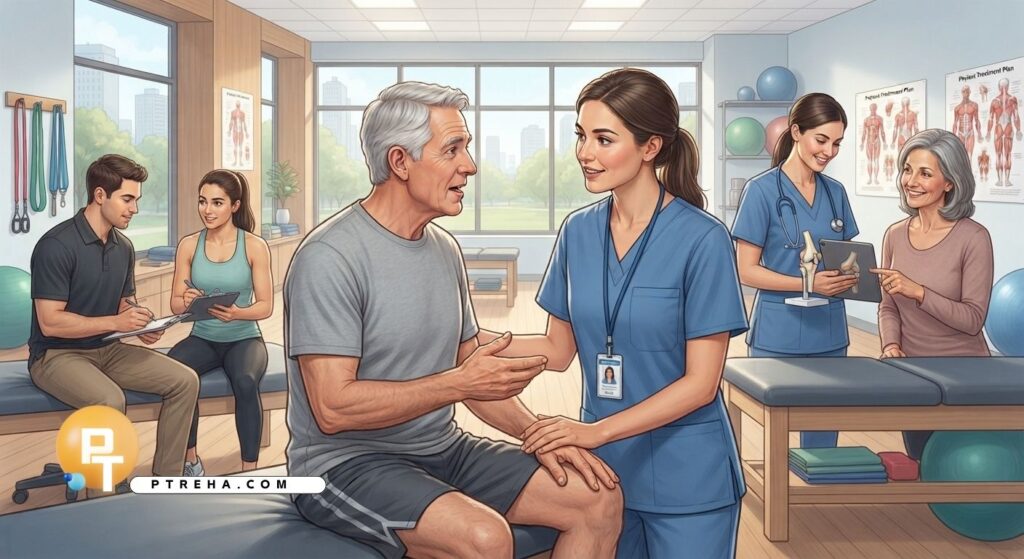
Image suggestion: A physical therapist having an attentive conversation with a patient before an assessment. The image should emphasize eye contact, active listening, and patient participation rather than treatment equipment.
1. Start With Active Listening

One of the most important communication skills for a PT student is learning to listen without immediately trying to solve the problem.
During the subjective assessment, the patient’s description can provide important information about symptoms, functional limitations, concerns, expectations, and goals.
Useful active-listening behaviors include:
- Give the patient your attention rather than constantly looking at the computer.
- Allow the patient to finish important thoughts before responding.
- Use brief verbal acknowledgments such as “I see” or “Go on.”
- Maintain appropriate eye contact.
- Use an open and attentive posture.
- Notice changes in tone or facial expression.
- Reflect important information back to the patient.
- Ask follow-up questions when something is unclear.
- Avoid unnecessarily interrupting.
- Summarize the patient’s main concerns before moving forward.
For example, instead of immediately asking several detailed questions about knee pain, a student might first ask:
“Can you tell me what has been bothering you and how it is affecting your daily activities?”
After listening, the student could summarize:
“So the main problem is that your knee hurts when going downstairs, and you’re concerned because you have started avoiding activities you normally enjoy. Is that correct?”
This gives the patient an opportunity to correct misunderstandings before the assessment continues.
2. Ask Better Questions

The quality of the questions you ask strongly influences the quality of information you receive.
Open-ended questions are useful at the beginning of an interview because they allow patients to describe their experience in their own words.
Examples include:
- “What brings you in today?”
- “What concerns you most about this problem?”
- “How has this affected your normal activities?”
- “What were you hoping we could work on?”
- “What would you like to be able to do again?”
- “What makes your symptoms better?”
- “What makes them worse?”
- “How has this changed your daily routine?”
- “What have you already tried?”
- “What questions do you have about the plan?”
Closed questions still have an important role when you need specific information. However, relying exclusively on yes/no questions can restrict the patient’s opportunity to explain what is important to them.
A useful sequence is to start broadly, then become more specific.
For example:
Broad: “Tell me about your shoulder problem.”
Specific: “When does the pain usually appear?”
Functional: “What activities does it prevent you from doing?”
Goal-oriented: “What activity would you most like to return to?”
3. Show Empathy Without Making Assumptions

Empathy involves recognizing and responding appropriately to the patient’s experience.
You do not need to have experienced the same condition to communicate empathy. You can acknowledge what the patient is telling you without assuming exactly how they feel.
Useful statements include:
- “That sounds frustrating.”
- “I can understand why that would concern you.”
- “It sounds like this has affected your routine quite a bit.”
- “Thank you for explaining that.”
- “I can see why getting back to that activity is important to you.”
Avoid statements that minimize the patient’s experience, such as:
- “It’s nothing serious.”
- “You shouldn’t worry about it.”
- “Everyone has pain.”
- “You’ll be fine.”
- “That’s normal.”
Even when the clinical situation appears reassuring, the patient’s concern remains relevant.
A better approach is to provide reassurance while acknowledging uncertainty where appropriate:
“The findings today are reassuring, but I understand why the symptoms are concerning. Let’s go through what we found and what we can do next.”
4. Explain Clinical Information in Plain Language

PT students often know the terminology but forget that patients may not.
Terms such as proprioception, tendinopathy, radicular symptoms, joint hypomobility, motor control, or load tolerance may be appropriate in professional documentation but may require explanation during a patient conversation.
Plain language does not mean oversimplifying clinical information. It means communicating the same concept in language the patient can understand and use.
For example:
| Clinical terminology | Patient-friendly explanation |
|---|---|
| Cervical radiculopathy | Irritation of a nerve in the neck that can cause symptoms into the arm |
| Joint hypomobility | A joint that is not moving as freely as expected |
| Tendinopathy | A problem involving a tendon that can be associated with pain and reduced load tolerance |
| Proprioception | The body’s ability to sense where a joint or limb is positioned |
| Muscle weakness | Reduced ability of a muscle to produce force |
| Exercise adherence | How consistently someone follows the agreed exercise plan |
The goal is not to eliminate every medical term. Instead, explain unfamiliar terminology when it matters to the patient’s understanding.
The CDC’s health-literacy guidance recommends using familiar words, organizing information around the audience’s needs, and putting important information first.
Image suggestion: A PT explaining a movement or anatomical concept using a simple demonstration or model.
5. Check Understanding With Teach-Back

One of the most practical communication techniques for PT students is teach-back.
Instead of asking, “Do you understand?”, ask the patient to explain the plan in their own words. A simple “yes” does not necessarily demonstrate understanding.
AHRQ recommends teach-back as a way to confirm that information has been communicated clearly. It emphasizes that the technique checks the clinician’s explanation rather than testing the patient’s intelligence or memory
Examples for physical therapy include:
“Just so I know I explained the exercise clearly, can you show me how you will perform it at home?”
“We’ve covered several things today. Can you tell me what the main parts of your home plan are?”
“When you get home, what will you do if this exercise causes more symptoms than expected?”
Teach-back can also be used in smaller sections rather than only at the end of an appointment. AHRQ describes this as “chunk and check”—provide a manageable amount of information, check understanding, then continue.
Make Teach-Back Non-Threatening
The wording matters.
Instead of:
“Do you understand what I told you?”
Try:
“I want to make sure I explained that clearly. Can you show me how you would do it at home?”
If the patient cannot explain or demonstrate the plan correctly, do not blame the patient. Re-explain it using a different approach and check again.
6. Communicate During the Physical Examination

Communication should continue throughout the physical examination, not stop after the subjective interview.
Before touching the patient or beginning a test, explain what you are going to do and why it is relevant.
For example:
“I’m going to move your shoulder in a few different directions. I’ll ask you to tell me if you feel pain, stretching, or anything unusual.”
During the examination, continue checking the patient’s response.
Useful communication habits include:
- Explain unfamiliar procedures before performing them.
- Ask permission when appropriate.
- Tell the patient what you are asking them to do.
- Explain where you need to place your hands when relevant.
- Ask about discomfort.
- Monitor symptoms during testing.
- Stop or modify an assessment when clinically appropriate.
- Avoid unnecessary technical language.
- Maintain professional boundaries.
- Explain what the finding means before drawing conclusions.
Physical examination communication is particularly important when an assessment involves close physical contact, sensitive areas, pain, fear, or uncertainty.
7. Discuss Goals That Matter to the Patient

A treatment goal should not be based exclusively on what the therapist thinks is important.
Patients may value activities that are not obvious from their diagnosis. A person with knee pain may care less about a particular strength measurement and more about returning to work, walking with a child, climbing stairs, exercising, or sleeping comfortably.
Useful questions include:
- “What activity are you most hoping to get back to?”
- “What would successful rehabilitation look like for you?”
- “Which daily activity is currently the biggest problem?”
- “Is there something you have stopped doing because of this problem?”
- “What would you like to be able to do more confidently?”
Goals should still be clinically appropriate and realistic. Patient-centered care means incorporating the patient’s priorities into clinical reasoning rather than abandoning professional judgment.
8. Use Shared Decision-Making

Physical therapy frequently involves choices.
Depending on the clinical situation, options may include different exercise approaches, education, activity modification, monitoring, referral, or other interventions within the PT’s scope of practice.
A patient-centered conversation can include:
- Explain the relevant findings.
- Discuss reasonable options.
- Explain potential benefits and limitations.
- Ask what matters most to the patient.
- Consider practical barriers.
- Agree on an appropriate plan.
- Confirm that the patient understands the plan.
For example:
“We have several ways we can approach this. One option is to focus initially on graded strengthening, while another is to emphasize activity modification and symptom management before progressing loading. Let’s discuss what each would involve and what fits best with your current routine.”
Shared decision-making does not mean allowing the patient to choose an intervention without adequate clinical information. It means creating a decision process in which relevant clinical information and the patient’s preferences are both considered.
9. Adapt Communication to the Patient

The same explanation will not work equally well for every patient.
Communication may need to change according to language, health literacy, hearing or vision limitations, cognitive needs, cultural context, age, emotional state, previous healthcare experiences, and the complexity of the information.
Important strategies include:
- Ask how the patient prefers to receive information.
- Use an appropriate qualified interpreter when needed.
- Face the patient when speaking.
- Reduce unnecessary background noise.
- Use written instructions when useful.
- Demonstrate exercises rather than relying only on verbal explanations.
- Use pictures or models when appropriate.
- Break complicated information into smaller parts.
- Allow time for questions.
- Confirm understanding.
For patients with limited proficiency in the language used for care, qualified interpreters can support communication and patient safety. AHRQ specifically describes interpreter involvement throughout the encounter and recommends checking understanding through techniques such as teach-back.
Family members may provide valuable support, but they should not automatically replace a qualified medical interpreter when professional interpretation is needed.
10. Communicate About Pain and Fear Carefully

Pain is not simply a number on a scale. Patients may also be worried about damage, worsening symptoms, movement, work, sport, or whether their condition will improve.
Avoid language that unnecessarily increases fear.
For example, telling a patient:
“Your spine is extremely unstable.”
may communicate a stronger conclusion than the available clinical findings support.
A more appropriate explanation might be:
“Your symptoms are affected by certain movements, but the assessment does not mean that your spine is being damaged every time you move. We’ll work within a level of activity that is appropriate for you and monitor your response.”
The exact wording should depend on the patient’s presentation and the available clinical evidence.
Communication should provide reassurance without making unsupported promises.
11. Handle Difficult Conversations Professionally

PT students will eventually encounter patients who are angry, frustrated, anxious, disappointed, or skeptical.
The first step is not necessarily to defend yourself. Listen and identify the underlying concern.
A useful approach is:
- Remain calm.
- Allow the patient to explain the problem.
- Avoid interrupting unnecessarily.
- Acknowledge the concern.
- Clarify what happened.
- Explain what you can do.
- Identify when another professional should be involved.
- Document clinically relevant information according to local requirements.
For example:
“I understand that you’re frustrated because you expected your pain to improve more quickly. Let’s look at what has changed since the last visit and discuss whether we need to modify the plan.”
This response does not promise a particular outcome. It acknowledges the concern and moves the conversation toward clinical reassessment.
Communication Mistakes PT Students Should Avoid
Even knowledgeable students can unintentionally create communication problems.
Common mistakes include:
- Using too much medical terminology.
- Interrupting too quickly.
- Talking more than listening.
- Asking only closed questions.
- Focusing on the impairment while ignoring the patient’s goals.
- Giving too many instructions at once.
- Asking “Do you understand?” instead of checking understanding.
- Making promises about recovery.
- Dismissing pain or fear.
- Assuming that every patient wants the same treatment approach.
- Speaking to a family member instead of the patient when the patient can participate.
- Ignoring nonverbal signs of discomfort or confusion.
- Failing to explain why an assessment is being performed.
AHRQ’s communication guidance similarly emphasizes active listening, open-ended questions, respectful communication, limiting information to key points, and confirming understanding.
A Simple Communication Framework for PT Students
A practical framework can help students organize communication during clinical placements.
Think of the encounter as:
Listen → Clarify → Explain → Collaborate → Check
Listen
Allow the patient to describe the problem and identify what matters to them.
Clarify
Ask focused questions to understand symptoms, functional limitations, concerns, expectations, and goals.
Explain
Describe your findings and recommendations in language the patient can understand.
Collaborate
Discuss appropriate options and incorporate the patient’s goals and circumstances into the plan.
Check
Use teach-back, demonstration, or open-ended questions to confirm understanding.
This framework is simple enough to remember during a busy clinical placement while still supporting patient-centered care.
Image suggestion: PT and patient reviewing a rehabilitation plan together. The visual should communicate collaboration rather than one-way instruction.
Conclusion
Patient-centered communication is a clinical skill that PT students develop through deliberate practice. Listening carefully, asking effective questions, explaining findings clearly, checking understanding, discussing goals, and involving patients in appropriate decisions can make clinical encounters more understandable and collaborative.
The most effective communication does not require complicated language. It requires the PT student to understand the patient’s perspective, communicate clinical information accurately, recognize when understanding is uncertain, and adapt the conversation to the person in front of them.
Frequently Asked Questions
What is patient-centered communication in physical therapy?
Patient-centered communication is an approach in which the therapist considers the patient’s concerns, goals, preferences, circumstances, and understanding alongside clinical findings. It involves listening, explaining information clearly, involving the patient appropriately in decisions, and checking that the agreed plan is understood.
Why is communication important for PT students?
PT students communicate with patients throughout assessment, treatment, education, exercise instruction, and discharge planning. Effective communication can help identify relevant concerns, reduce misunderstandings, improve patient participation, and support a collaborative therapeutic relationship.
What is the most important communication skill for a PT student?
There is no single communication behavior that replaces all others, but active listening is foundational. Students need to understand the patient’s story before deciding what information to provide or which questions to ask next.
How can a PT student improve active listening?
Start by allowing the patient to speak without unnecessary interruption. Use brief acknowledgments, reflect important information back to the patient, summarize what you heard, and ask clarifying questions when something is unclear.
Should physical therapy students avoid medical terminology?
Not necessarily. Medical terminology is useful when communicating with healthcare professionals, but patients may need familiar explanations. When a technical term is clinically useful, explain it in plain language rather than assuming the patient understands it.
What is teach-back in physical therapy?
Teach-back is a communication method in which the patient explains information or demonstrates a task in their own words or actions. In physical therapy, it can be used to check whether a patient understands an exercise, home program, activity modification strategy, or other important instruction.
Is asking “Do you understand?” enough?
No. A patient may answer “yes” even when information is unclear. AHRQ recommends open-ended teach-back questions that allow the clinician to hear how the patient understands the information.
How should a PT student communicate with a patient who is afraid of movement?
First, listen to the patient’s concern rather than immediately dismissing it. Explain relevant findings accurately, avoid unnecessarily threatening language, discuss appropriate movement or activity within the clinical context, and monitor the patient’s response as rehabilitation progresses.
How can PT students communicate better with patients who speak another language?
Use appropriate qualified interpretation when needed and communicate directly with the patient rather than speaking only to the interpreter. Keep explanations clear and check understanding using methods such as teach-back.
How can PT students practice communication skills?
Role-play is a practical method. Students can practice patient interviews, exercise explanations, teach-back, difficult conversations, and shared decision-making with classmates and then review whether they listened effectively, used understandable language, invited questions, and confirmed understanding. AHRQ also provides role-playing resources for practicing communication techniques.
Article Resources
- Agency for Healthcare Research and Quality — Use the Teach-Back Method
AHRQ Teach-Back Method - Agency for Healthcare Research and Quality — Key Strategies for Clear Communication
AHRQ Clear Communication Strategies - Agency for Healthcare Research and Quality — Team Communication for Patients With Limited English Proficiency
AHRQ Team Communication and Interpreters - Agency for Healthcare Research and Quality — Role Playing Ideas
AHRQ Communication Role-Playing Resources - CDC — Plain Language Materials and Resources
CDC Plain Language Resources
The image placements above are intended as editorial image positions, with captions describing the appropriate clinical visual. For a WordPress/Gutenberg version, each can be implemented as an Image block followed by a Caption block and the corresponding resource link.