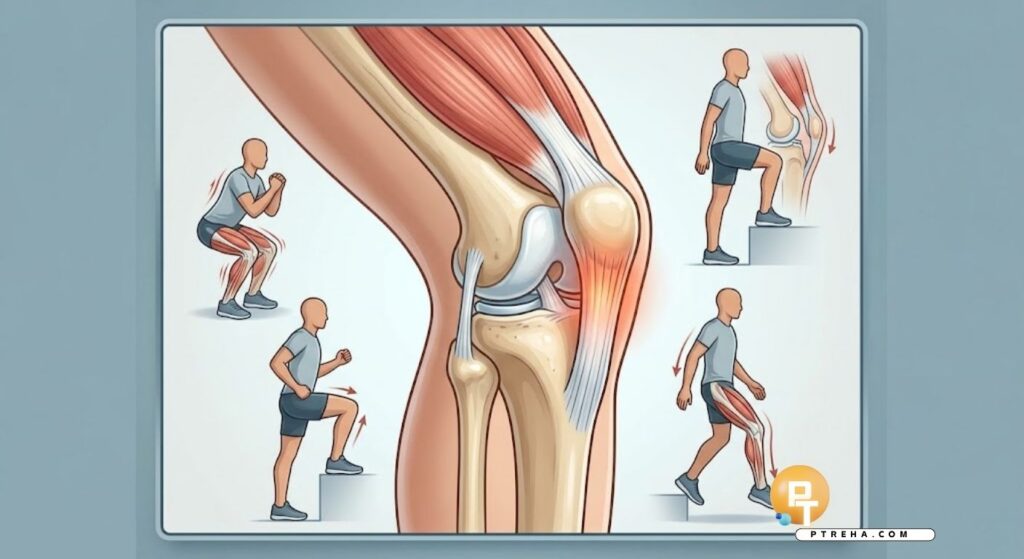
Patellar tendinopathy, often called jumper’s knee, is primarily a load-related tendon problem rather than an injury that simply needs rest.
Effective rehabilitation usually requires controlling aggravating loads, progressively rebuilding quadriceps and patellar tendon capacity, and eventually restoring the ability to tolerate running, jumping, landing, acceleration, and sport-specific demands.
Understanding Patellar Tendinopathy Before Starting a Loading Protocol
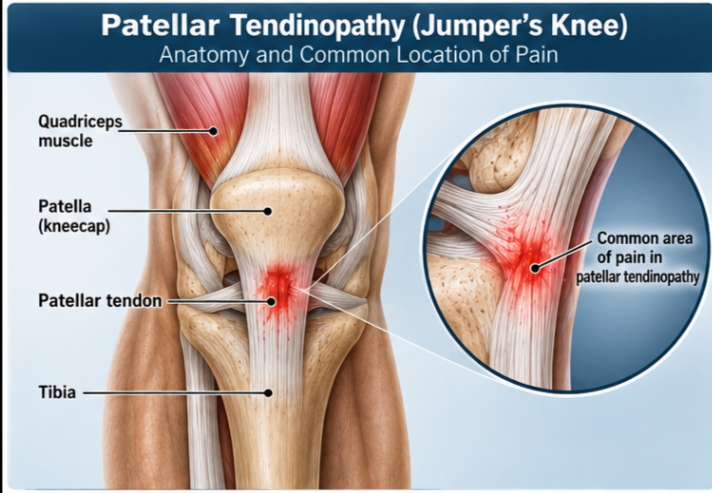
Patellar tendinopathy commonly causes localized pain at or near the lower pole of the patella where the patellar tendon begins.
Pain is typically related to activities that place high demand on the knee extensor mechanism.
A clinically useful feature is the relationship between symptoms and load.
A person may feel relatively comfortable during ordinary walking but develop pain with jumping, deep squatting, sprinting, stairs, or repeated changes of direction.
Typical features include:
- Pain localized around the proximal patellar tendon.
- Pain during jumping or landing.
- Symptoms during repeated squatting.
- Pain with rapid knee-extensor loading.
- Morning or post-exercise tendon stiffness.
- Reduced tolerance for training volume.
- Symptoms that may warm up temporarily during activity.
- Pain that returns after heavy training.
- Reduced quadriceps strength or confidence.
- Difficulty tolerating repeated explosive movements.
The clinical presentation matters because anterior knee pain is not automatically patellar tendinopathy.
Patellofemoral pain, fat-pad irritation, referred pain, and other knee conditions can produce overlapping symptoms.
The clinical review on patellar tendinopathy diagnosis and load management emphasizes localized tendon pain, load-related symptoms, appropriate differential assessment, and progressive restoration of load tolerance rather than diagnosis based on imaging alone.
Why Loading Is Central to Patellar Tendinopathy Rehabilitation
Complete rest may temporarily reduce symptoms, but it does not prepare the patellar tendon for the forces that caused difficulty in the first place.
The rehabilitation goal is therefore not simply to make the tendon painless.
The goal is to increase the capacity of the tendon, quadriceps, and wider lower-limb system so that normal activity or sport becomes tolerable again.
A good loading program progressively develops:
- Tendon tolerance to force.
- Quadriceps strength.
- Knee-extension capacity.
- Hip and calf strength where appropriate.
- Movement confidence.
- Rate of force development.
- Jumping tolerance.
- Landing tolerance.
- Repeated-effort capacity.
- Sport-specific load tolerance.
One randomized clinical trial comparing progressive tendon-loading exercise with an eccentric-only program found greater improvement in the progressive loading group.
The progressive tendon-loading clinical trial supports a staged approach rather than treating eccentric exercise as the only acceptable tendon exercise.
A recent systematic review similarly concluded that structured tendon-loading exercise remains central to patellar tendinopathy rehabilitation, while also noting that current evidence does not establish one loading method as universally superior for every patient.
Review of patellar tendon loading strategies
Load Management Comes Before Exercise Progression
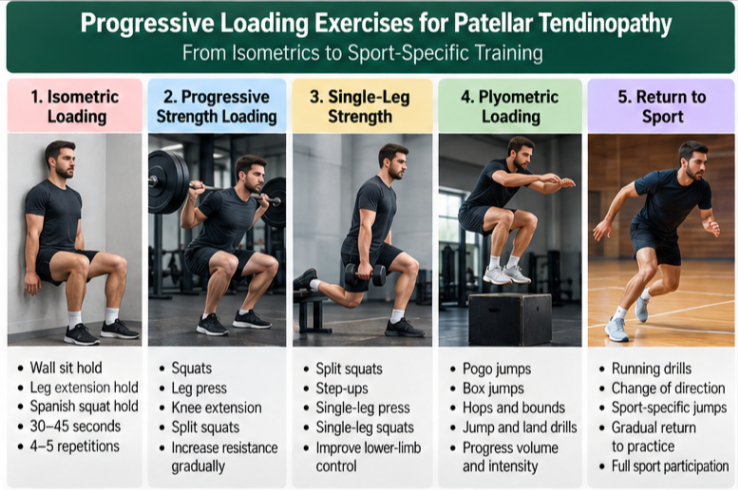
One of the most common clinical mistakes is adding rehabilitation exercises without adjusting the other loads already reaching the tendon.
For example, a basketball player may perform an appropriate strengthening program three times per week but continue five high-volume jumping sessions.
The total tendon load may still exceed current capacity.
Review the entire week rather than looking only at rehabilitation exercises.
Potential high-load activities include:
- Volleyball jumping.
- Basketball practice.
- Sprint training.
- Hill running.
- Plyometric workouts.
- Repeated stair climbing.
- Deep weighted squats.
- Olympic lifting.
- High-volume lunges.
- Frequent competitions.
The objective is usually load modification, not automatic elimination of all activity.
A recreational athlete may temporarily reduce repeated jumping while continuing upper-body training, controlled cycling, selected strength exercises, and other activities that do not meaningfully aggravate symptoms.
In physiotherapy practice, symptom behavior over the following day can be particularly useful.
If pain or stiffness is consistently worse after a loading session, the total dose may be greater than the tendon currently tolerates.
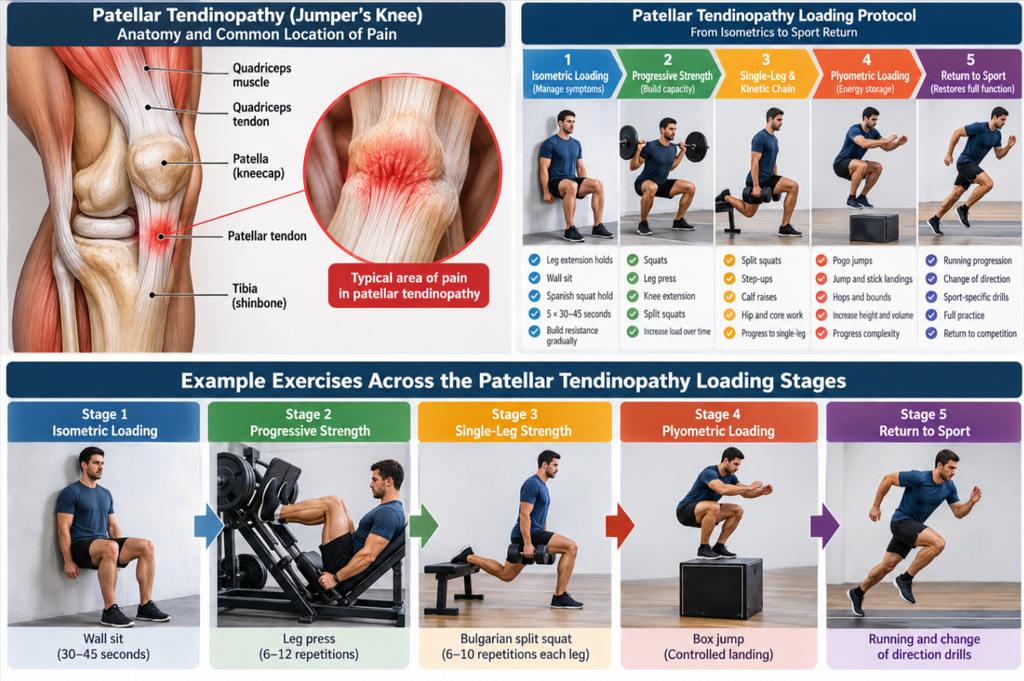
Stage 1: Isometric Loading for an Irritable Tendon
Isometric exercises involve generating muscular force without significant joint movement.
They can be useful early in rehabilitation when dynamic knee-extension exercises are uncomfortable or when the athlete needs a practical exercise that loads the quadriceps without repeated movement.
Options include:
- Isometric knee extension.
- Leg-extension machine holds.
- Leg-press holds.
- Spanish squat holds.
- Wall-supported squat holds.
- Single-leg isometric variations when appropriate.
A commonly used clinical approach is several sustained contractions performed at a challenging but tolerable intensity.
For example:
- Select a knee angle that is comfortable.
- Build tension gradually.
- Hold the contraction.
- Rest sufficiently between repetitions.
- Repeat several contractions.
- Increase resistance as tolerance improves.
Five repetitions of approximately 30–45 seconds are frequently used in tendon rehabilitation programs, but this should not be treated as a mandatory prescription for every patient.
Isometrics can sometimes provide short-term pain reduction, but analgesia is not guaranteed.
Their main role should not be presented as “switching off” tendon pain.
Important clinical considerations include:
- Keep symptoms tolerable.
- Avoid maximal effort immediately if highly irritable.
- Use sufficient resistance to challenge the quadriceps.
- Adjust the knee angle if compression or pain increases.
- Progress beyond isometrics when tolerated.
- Do not remain indefinitely in this stage.
A patient capable of comfortable dynamic strengthening usually does not need to spend weeks performing only isometric exercises.
Stage 2: Progressive Isotonic and Heavy Strength Loading
Dynamic resistance exercise is a major component of patellar tendinopathy rehabilitation.
The quadriceps must regain sufficient force-producing capacity because it contributes directly to the loads transmitted through the patellar tendon.
Appropriate exercises may include:
- Leg press.
- Knee extension.
- Squat variations.
- Split squats.
- Reverse lunges.
- Step-ups.
- Hack squats.
- Single-leg press.
- Supported single-leg squats.
- Other tolerated knee-dominant strength exercises.
Early loading may use relatively higher repetitions and moderate resistance.
As tolerance improves, resistance can gradually increase while repetitions decrease.
An example progression could look like this:
| Rehabilitation phase | Example loading | Primary objective |
|---|---|---|
| Irritable phase | Isometric holds | Introduce tolerable tendon and quadriceps load |
| Early strength | Moderate resistance, higher repetitions | Restore controlled dynamic loading |
| Heavy strength | Heavier resistance, lower repetitions | Improve quadriceps and tendon capacity |
| Energy storage | Jumps, hops and landing drills | Prepare for faster loading |
| Sport preparation | Running, jumping and sport drills | Restore competition-specific capacity |
The exact sets, repetitions, resistance, and frequency should respond to the individual rather than a calendar.
Useful progression principles include:
- Start with a manageable range of motion.
- Increase resistance gradually.
- Use controlled repetitions.
- Train both concentric and eccentric phases.
- Increase range when tolerated.
- Progress from bilateral to unilateral work when appropriate.
- Monitor symptoms during the session.
- Check the response later that day.
- Reassess the following morning.
- Allow adequate recovery between demanding sessions.
Heavy-slow resistance does not mean every repetition must be extremely slow.
Controlled tempo can help make the exercise predictable and allows adequate resistance to be used without turning the movement into an explosive task too early.
How Much Pain Is Acceptable During Loading?
Pain monitoring is useful, but it should not become an arbitrary rule that every patient must follow identically.
Some people can rehabilitate successfully with mild discomfort during exercise.
Others with highly reactive symptoms need a more conservative starting point.
A practical approach is to ask four questions:
- Is the pain mild and tolerable?
- Does pain escalate from set to set?
- Does movement quality deteriorate?
- Are symptoms noticeably worse afterward or the next morning?
Mild stable discomfort is different from rapidly increasing pain.
Signs that loading may be excessive include:
- Progressively increasing pain during sets.
- Significant limping after exercise.
- Noticeably worse morning symptoms.
- Reduced tolerance at the next session.
- Increasing pain with routine daily activities.
- Loss of previously tolerated training capacity.
A pain number alone should therefore not control the entire program.
For example, two athletes may both report pain of 3/10 during squats.
One returns to baseline soon afterward, while the other develops significant stiffness and pain the next morning.
Those are different load responses and should be managed differently.
Stage 3: Building Single-Leg Strength and Kinetic-Chain Capacity
Patellar tendinopathy rehabilitation should not become a collection of isolated tendon exercises.
Jumping, landing, running, and changing direction involve the hip, knee, ankle, and trunk working together.
Weakness or reduced capacity elsewhere can influence how an athlete distributes load.
Useful supplementary exercises may include:
- Calf raises.
- Soleus raises.
- Romanian deadlifts.
- Hip thrusts.
- Split squats.
- Step-downs.
- Single-leg deadlifts.
- Hamstring strengthening.
- Hip-abductor strengthening.
- Trunk-control exercises.
These exercises do not need to be prescribed because the patient supposedly has a specific biomechanical “fault.” Instead, they are used when assessment identifies a relevant capacity deficit or when greater general lower-limb strength would support the athlete’s goals.
Clinical progression may include:
- Bilateral squat → split squat.
- Double-leg press → single-leg press.
- Low step-up → higher step-up.
- Double-leg calf raise → single-leg calf raise.
- Controlled squat → heavier squat.
- Stable exercise → more sport-specific movement.
The rehabilitation program should increasingly resemble the physical requirements the person needs to return to.
Stage 4: Energy-Storage Loading and Plyometric Progression
Heavy strengthening alone does not fully prepare a jumping athlete for sport.
During jumping and landing, the patellar tendon must manage high forces over very short periods.
This is fundamentally different from a controlled resistance exercise performed over several seconds.
Energy-storage loading bridges the gap.
Early options may include:
- Small double-leg pogo jumps.
- Low-amplitude skipping.
- Submaximal vertical jumps.
- Controlled jump-and-stick landings.
- Low box jumps.
- Double-leg forward hops.
Later progression may include:
- Higher vertical jumps.
- Repeated hops.
- Single-leg hops.
- Broad jumps.
- Drop landings.
- Bounding.
- Lateral hops.
- Approach jumps.
- Repeated maximal-effort jumps.
Plyometric progression should consider more than exercise difficulty.
Variables include:
- Jump height.
- Number of contacts.
- Speed.
- Landing intensity.
- Single- versus double-leg loading.
- Direction.
- External load.
- Rest intervals.
- Training surface.
- Total weekly exposure.
A volleyball athlete doing ten controlled submaximal jumps is exposed to a very different tendon load from an athlete performing repeated maximal approach jumps during a long training session.
That difference matters.
Stage 5: Return to Running, Jumping and Sport
Return to sport should be a progression rather than a single clearance event.
The tendon may tolerate gym exercises before it tolerates repeated competition-level jumping.
A basketball player might progress through:
- Jogging.
- Faster running.
- Acceleration drills.
- Deceleration drills.
- Submaximal jumping.
- Controlled layups.
- Repeated jumping.
- Change-of-direction drills.
- Partial team practice.
- Full practice.
- Competition.
A volleyball player may instead progress through:
- Low pogo jumps.
- Block jumps.
- Submaximal approach jumps.
- Controlled hitting drills.
- Repeated approach jumps.
- Modified practice.
- Full practice.
- Match exposure.
Useful return-to-sport considerations include:
- Symptoms are stable.
- Heavy strength work is well tolerated.
- Jumping does not produce a significant delayed flare.
- Required training volume can be completed.
- Strength is appropriate for the activity.
- Repeated jumping capacity has been restored.
- Sport-specific drills are tolerated.
- Confidence has returned.
- Recovery between sessions is adequate.
- Weekly load is sustainable.
Pain-free strength testing alone is not enough for an athlete whose sport requires hundreds of rapid tendon-loading cycles.
Example Weekly Patellar Tendinopathy Loading Protocol
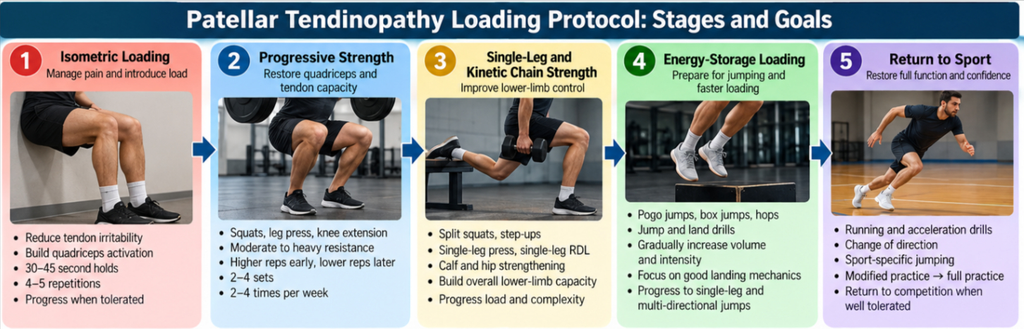
A weekly plan should reflect sport exposure, irritability, training history, and available recovery time.
An illustrative strength-focused week might include:
Day 1
- Heavy leg press.
- Knee-extension exercise.
- Split squat.
- Calf strengthening.
- Hip strengthening.
Day 2
- Recovery or low-load conditioning.
- Optional tolerable isometrics.
- Upper-body training.
Day 3
- Heavy knee-dominant strengthening.
- Single-leg strength.
- Posterior-chain training.
Day 4
- Recovery.
- Controlled cardiovascular training.
Day 5
- Strength work.
- Introductory jumping or hopping.
- Landing practice.
Day 6
- Sport-specific exposure if tolerated.
Day 7
- Lower-load recovery day.
This is an example rather than a universal prescription.
An athlete already participating in sport may need fewer additional plyometric exercises because sport practice itself provides considerable energy-storage loading.
Common Loading Mistakes That Delay Progress
Patellar tendinopathy often becomes frustrating when rehabilitation alternates between doing too much and doing almost nothing.
Common errors include:
- Complete rest until pain disappears.
- Returning immediately to full jumping volume.
- Performing only stretching.
- Staying with isometrics for too long.
- Performing eccentric decline squats indefinitely.
- Ignoring quadriceps weakness.
- Increasing volume and intensity simultaneously.
- Adding plyometrics before adequate strength work.
- Ignoring delayed symptom responses.
- Testing the tendon maximally every day.
- Changing the rehabilitation plan after every painful session.
- Using passive treatment instead of progressive loading.
Another common mistake is assuming that a painful tendon needs constant stretching.
Patellar tendon symptoms are not generally caused by a “tight tendon.” Stretching may be included when a relevant mobility restriction exists, but it should not replace resistance training.
When the Presentation Needs Further Assessment
A loading program is appropriate only when the clinical presentation fits patellar tendinopathy and exercise is safe for the individual.
Further assessment is appropriate when there is:
- Significant trauma.
- Sudden loss of knee-extension function.
- Marked swelling.
- Knee locking.
- Repeated giving way.
- Severe pain unrelated to loading.
- Persistent night pain.
- Fever or systemic illness.
- Progressive neurological symptoms.
- Symptoms that do not behave like typical tendon pain.
Imaging is not automatically required for every case.
Patellar tendon changes can exist in people without pain, so imaging findings should be interpreted alongside history and physical examination rather than treated as the diagnosis by themselves.
A physical therapist should remain within rehabilitation scope and refer appropriately when the presentation suggests a condition requiring additional medical assessment.
Conclusion
Patellar tendinopathy responds best to a structured loading strategy rather than prolonged rest or a single “jumper’s knee exercise.” Rehabilitation typically begins with a tolerable level of tendon and quadriceps loading, progresses toward heavier dynamic strength work, and then adds faster energy-storage exercises before sport-specific exposure.
The most useful protocol is not necessarily the one with the most exercises.
It is the one that applies enough load to stimulate adaptation while remaining within the person’s current capacity, then systematically progresses that capacity toward the real demands of work, recreation, or sport.
Frequently Asked Questions
Can patellar tendinopathy heal with exercise alone?
Exercise-based loading is a central conservative treatment for patellar tendinopathy and many people improve substantially with an appropriately progressed program.
However, the program needs to match the diagnosis, tendon irritability, strength level, sport exposure, and individual response.
Persistent or atypical symptoms should be reassessed rather than repeatedly increasing exercises.
Are eccentric decline squats still recommended?
Eccentric decline squats can be useful, but they are no longer the only loading option used in patellar tendinopathy rehabilitation.
Progressive programs can include isometric, isotonic, heavy resistance, eccentric-concentric, plyometric, and sport-specific loading depending on the rehabilitation stage.
Is heavy-slow resistance better than eccentric exercise?
Both approaches can load the patellar tendon and quadriceps effectively.
Current evidence supports progressive resistance loading but does not justify saying that one exact loading method is universally best for every person.
Exercise selection should be individualized according to tolerance and goals.
Should patellar tendon exercises hurt?
Some people can exercise successfully with mild, tolerable discomfort.
Completely pain-free exercise is not always necessary.
The more important question is whether symptoms remain controlled during loading and return toward baseline afterward rather than progressively worsening over subsequent sessions.
How often should I perform patellar tendon exercises?
Frequency depends on the exercise type and loading intensity.
Isometric exercises may sometimes be performed relatively frequently, while demanding heavy strength sessions and plyometric sessions usually require more recovery.
The person’s sport schedule must also be counted as part of total tendon loading.
Should I stop jumping completely?
Not necessarily.
Highly provocative jumping may need temporary reduction, particularly when symptoms are irritable, but permanent avoidance does not prepare a jumping athlete for sport.
Jumping should usually be reintroduced progressively as tendon capacity improves.
Can I continue playing sport with jumper’s knee?
Some athletes can continue modified participation while rehabilitating, while others require a temporary reduction in training or competition volume.
The decision depends on symptom severity, response to loading, total weekly exposure, performance demands, and whether participation prevents rehabilitation progress.
Are leg extensions bad for patellar tendinopathy?
No exercise is automatically harmful simply because it loads the knee extensors.
Leg-extension exercises can provide a useful and measurable method of strengthening the quadriceps.
Resistance, range of motion, symptoms, and overall training load should be adjusted to the individual.
How do I know when I am ready for plyometrics?
A person should generally demonstrate good tolerance to progressive strength loading before high-demand jumping is emphasized.
The transition should also consider current pain behavior, quadriceps capacity, single-leg control, previous jumping exposure, sport demands, and recovery after lower-level jumping drills.
How do I know when I am ready to return to sport?
Return to sport should be based on capacity rather than simply waiting for a certain amount of time.
The athlete should tolerate required strength work, progressive jumping or running, repeated sport-specific loading, and increasingly realistic training without a meaningful delayed symptom flare.
Full practice tolerance is usually an important step before unrestricted competition.