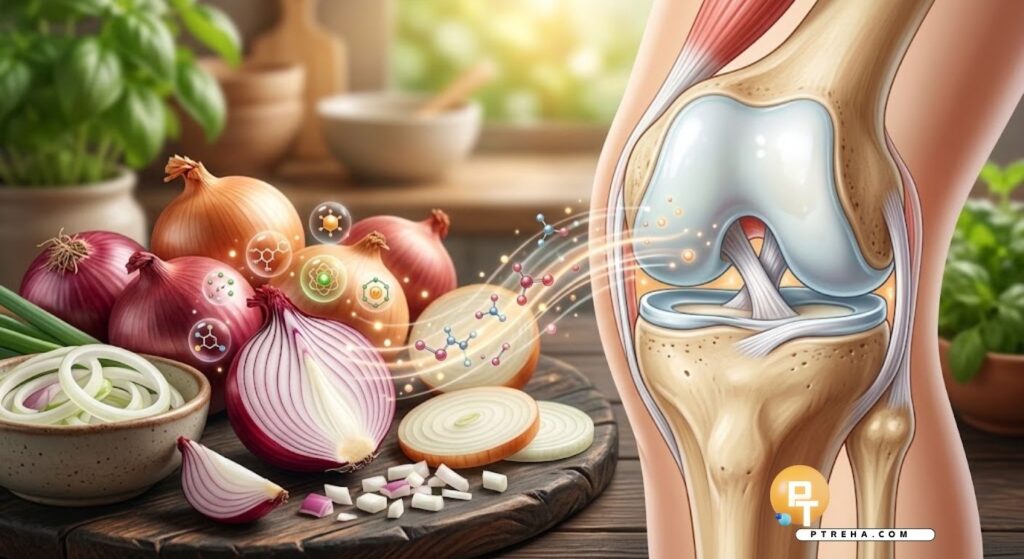
Onions are a nutrient-dense vegetable that can fit naturally into a joint-supportive diet.
Their vitamin C, flavonoids such as quercetin, sulfur-containing compounds, and other plant chemicals may support antioxidant defenses and connective-tissue nutrition, but onions should be viewed as part of an overall dietary pattern rather than as a treatment for arthritis or joint pain.
Onions and Joint Health: What Matters Clinically?
When patients ask me whether a specific food can “help the joints,” the most useful clinical answer is rarely a simple yes or no.
Joint health depends on many interacting factors, including physical activity, muscle strength, body composition, sleep, injury history, metabolic health, and overall nutrition.
Onions can contribute positively to that picture.
Their potential relevance to joint health comes mainly from:
- Quercetin and other flavonoids
- Vitamin C
- Sulfur-containing compounds
- Antioxidant phytochemicals
- Small amounts of several minerals
- Prebiotic carbohydrates
- Their usefulness in vegetable-rich eating patterns
However, eating onions cannot rebuild worn cartilage, correct joint mechanics, or replace appropriate rehabilitation.
For someone with knee osteoarthritis, for example, strengthening the quadriceps, improving activity tolerance, managing body weight when appropriate, and gradually increasing physical activity have much more direct clinical relevance than increasing onion intake alone.
Onions are therefore best considered a supportive food, not a therapeutic intervention.
Nutritional Profile of Onions
Raw onions contain mostly water and carbohydrate, with relatively few calories.
They also provide fiber and modest amounts of vitamin C, vitamin B6, folate, potassium, and several other micronutrients.
A typical onion is not an exceptionally concentrated source of any single joint-related vitamin.
Its value comes partly from the combination of nutrients and phytochemicals it contributes to the diet.
Important components include:
- Vitamin C: needed for normal collagen production.
- Quercetin: a flavonoid investigated for antioxidant and inflammatory effects.
- Fiber: supports digestive and metabolic health.
- Fructans: prebiotic carbohydrates that can support intestinal bacteria but may cause digestive symptoms in susceptible people.
- Potassium: contributes to normal neuromuscular function.
- Vitamin B6: participates in normal protein and energy metabolism.
- Sulfur compounds: responsible for many characteristic onion aromas and biological properties.
- Polyphenols: plant compounds involved in antioxidant activity.
Onions are also naturally:
- Very low in fat
- Low in sodium
- Cholesterol-free
- Easy to combine with protein foods
- Suitable for many plant-based meals
- Available raw or cooked
The precise nutritional composition varies with the onion variety, growing conditions, storage, and cooking method.
How Onions Could Support Joint Health
There is no established clinical dose of onion for preventing or treating joint disease.
The possible benefits are better understood by looking at the biological roles of the nutrients and phytochemicals onions contain.
| Onion component | Potential relevance to joint health | Clinical perspective |
|---|---|---|
| Quercetin | Antioxidant and inflammation-related pathways | Human joint evidence remains limited |
| Vitamin C | Required for normal collagen synthesis | Important as part of adequate overall nutrition |
| Polyphenols | Help support antioxidant defenses | Best obtained through a varied plant-rich diet |
| Fiber | Supports gut and metabolic health | May indirectly support healthy body-weight management |
| Fructans | Can act as prebiotics | May cause bloating in people sensitive to FODMAPs |
| Sulfur compounds | Have biological antioxidant activity | Clinical joint effects remain uncertain |
| Potassium | Supports normal muscle and nerve function | Onion is only a modest dietary source |
The key point is that these mechanisms should not be confused with proven clinical treatment effects.
Laboratory evidence demonstrating that a plant compound influences inflammatory pathways does not automatically mean that eating the food will reduce a person’s joint pain.
Quercetin: The Main Compound Linking Onions With Joint Research
Quercetin receives much of the scientific attention surrounding onions and joint health.
It belongs to a group of plant compounds called flavonoids and occurs naturally in foods including:
- Onions
- Apples
- Berries
- Grapes
- Kale
- Broccoli
- Tea
- Certain herbs
Onions, particularly some red and yellow varieties, can be useful dietary sources.
Quercetin has demonstrated antioxidant and inflammation-modulating effects in laboratory research.
This has led researchers to investigate whether it could influence diseases involving chronic inflammatory processes.
For osteoarthritis specifically, a systematic review of preclinical research on quercetin and osteoarthritis found encouraging effects on cartilage-related outcomes in animal models.
Importantly, the authors concluded that randomized human clinical trials are still needed before quercetin can be considered effective for treating osteoarthritis.
That distinction is extremely important.
Current research does not justify claims such as:
- Onions regenerate cartilage.
- Onions cure osteoarthritis.
- Quercetin reverses joint degeneration.
- Onion extract replaces arthritis medication.
- Eating onions eliminates joint inflammation.
Preclinical findings can help researchers identify promising mechanisms, but they cannot establish a clinical treatment recommendation.
What about inflammatory arthritis?
One small randomized controlled trial studied quercetin supplementation in women with rheumatoid arthritis.
Some improvements in clinical and inflammatory measures were reported, but the trial investigated 500 mg of supplemental quercetin, not ordinary dietary onion consumption.
The results therefore should not be interpreted as evidence that eating onions treats rheumatoid arthritis.
For patients with inflammatory arthritis, nutrition can complement care, but disease-specific medical management remains essential.
Vitamin C, Collagen, and Connective Tissue
One of the more straightforward nutritional connections between onions and musculoskeletal health is vitamin C.
Vitamin C is required for normal collagen synthesis.
Collagen is a major structural protein found in tissues including:
- Tendons
- Ligaments
- Skin
- Bone
- Joint-related connective tissues
- Blood vessels
The NIH Office of Dietary Supplements’ vitamin C guidance confirms that vitamin C is required for collagen biosynthesis and also functions as an antioxidant.
Onions contain vitamin C, although they are not among the richest dietary sources.
People wanting to increase vitamin C intake should also regularly consume foods such as:
- Bell peppers
- Citrus fruits
- Kiwi
- Strawberries
- Broccoli
- Tomatoes
- Brussels sprouts
- Potatoes
This illustrates an important principle in musculoskeletal nutrition: one food rarely supplies everything a tissue requires.
Normal connective-tissue maintenance depends on adequate energy, protein, vitamins, minerals, physical loading, recovery, and many other factors.
Can more vitamin C repair damaged cartilage?
Not in the way this claim is sometimes presented online.
Vitamin C is physiologically necessary for collagen formation, but taking extra vitamin C or eating more onions does not mean the body will automatically rebuild cartilage damaged by established osteoarthritis.
Nutrient adequacy supports normal physiology.
It should not be equated with disease reversal.
Inflammation, Oxidative Stress, and Joint Symptoms

Inflammation is relevant to several musculoskeletal disorders, although its role differs substantially between conditions.
For example:
- Rheumatoid arthritis is an inflammatory autoimmune disease.
- Osteoarthritis can involve local inflammatory processes alongside structural and biomechanical changes.
- Acute injuries involve normal inflammatory responses during healing.
- Tendon pain cannot simply be explained as “inflammation.”
- Mechanical joint pain may occur without systemic inflammation.
This is why describing onions simply as an “anti-inflammatory treatment” is misleading.
Plant foods containing flavonoids and antioxidants may contribute to a dietary pattern associated with better metabolic health.
However, individual foods typically have much smaller effects than social media claims suggest.
A practical joint-supportive eating pattern is more likely to emphasize:
- Vegetables
- Fruit
- Whole grains
- Legumes
- Nuts and seeds
- Fish or other quality protein sources
- Unsaturated fats
- Adequate hydration
- Appropriate total energy intake
Onions fit easily into this pattern.
Rather than asking whether one onion reduces inflammation, it is more useful to ask whether onions help someone consistently eat more vegetables and prepare balanced meals.
Can Onions Reduce Joint Pain?
At present, there is not enough high-quality evidence to recommend onions specifically as an intervention for reducing joint pain.
Some people may feel better when improving their overall diet, but changes in pain cannot automatically be attributed to onions.
Joint pain is influenced by factors such as:
- Tissue sensitivity
- Physical load
- Muscle capacity
- Previous injury
- Sleep
- Stress
- Physical activity
- Body weight
- General health
- Pain-processing mechanisms
For example, a patient with painful knee osteoarthritis may improve after beginning regular walking, progressive strengthening, improving sleep, and changing dietary habits.
If onions become part of that dietary improvement, they can contribute nutritionally.
It would still be incorrect to say that onions themselves treated the knee.
From a physical therapy perspective, functional progress is generally better assessed through changes such as:
- Walking tolerance
- Stair performance
- Strength
- Range of movement
- Confidence with activity
- Ability to perform daily tasks
- Exercise tolerance
- Symptom response to loading
Diet can support rehabilitation, but it does not replace appropriately dosed movement and exercise.
Raw, Cooked, Red, Yellow, or White Onions?
Different onion varieties contain somewhat different concentrations of phytochemicals.
Red and yellow onions are often particularly interesting from a polyphenol perspective.
Red onions also contain anthocyanins, the pigments responsible for their reddish-purple color.
However, there is no convincing clinical evidence showing that one onion variety produces superior joint outcomes.
All of the following can fit into a healthy diet:
- Red onions
- Yellow onions
- White onions
- Sweet onions
- Shallots
- Spring onions
Cooking affects some nutrients and phytochemicals, but cooked onions remain nutritious.
Useful preparation methods include:
- Light sautéing
- Roasting
- Baking
- Adding to soups
- Adding to stews
- Grilling
- Eating raw in salads
- Mixing into bean dishes
There is no need to consume large quantities of raw onion solely to obtain a theoretical joint benefit.
Practical meal example
A rehabilitation patient trying to improve overall dietary quality could prepare a meal containing:
- Salmon or lentils for protein
- Roasted onions
- Broccoli
- Sweet potato
- Olive oil
- A serving of fruit
The nutritional value comes from the combination of foods rather than from treating any single ingredient as medicine.
Onions, Body Weight, and Joint Loading
Onions may also be useful indirectly because they add flavor and volume to meals without contributing many calories.
This can matter for people for whom body-weight management is clinically appropriate.
Higher body mass can increase mechanical loading across weight-bearing joints, particularly during activities such as:
- Walking
- Stair climbing
- Squatting
- Rising from a chair
- Running
- Prolonged standing
Adipose tissue also has metabolic functions, which means the relationship between body composition and osteoarthritis is more complicated than mechanical load alone.
Onions can help make vegetable-rich meals satisfying through:
- Flavor
- Texture
- Aroma
- Meal volume
- Culinary versatility
However, weight management should never be reduced to simply eating one specific food.
Sustainable strategies generally involve dietary quality, appropriate energy intake, exercise, resistance training, sleep, and behavioral factors.
How to Include Onions in a Joint-Supportive Diet
There is no medically established number of onions that someone needs to eat for joint health.
Instead, use onions as one component of varied meals.
Practical options include:
- Add chopped onion to scrambled eggs.
- Mix red onion into salads.
- Roast onions beside vegetables.
- Add onion to lentil soup.
- Use onions in bean dishes.
- Combine onions with fish and vegetables.
- Add them to whole-grain wraps.
- Mix cooked onion into rice dishes.
- Add onions to tomato-based sauces.
- Use caramelized onions in moderation as a flavoring.
- Add spring onions to bowls and soups.
- Combine onions with other colorful vegetables.
For someone completing a strengthening program, the larger nutritional priorities usually include sufficient overall energy and adequate protein rather than maximizing onion intake.
A useful post-exercise meal could therefore include chicken, fish, tofu, lentils, eggs, yogurt, or another protein source alongside vegetables that include onion.
When Onions May Not Be Comfortable or Appropriate
Onions are safe for most people when eaten as ordinary food, but they are not equally well tolerated by everyone.
Onions contain fructans, which belong to the group of fermentable carbohydrates commonly referred to as FODMAPs.
People with certain gastrointestinal disorders may experience:
- Bloating
- Abdominal discomfort
- Excess gas
- Changes in bowel habits
- Cramping
Some people with reflux also find onions aggravate their symptoms.
A person should not force themselves to eat onions because of claims that they are essential for joint health.
Similar nutrients and plant compounds can be obtained from many other foods.
Alternatives may include:
- Bell peppers
- Broccoli
- Leafy vegetables
- Berries
- Citrus fruit
- Apples
- Herbs
- Other tolerated vegetables
Food allergy to onion is uncommon but possible.
Anyone experiencing facial swelling, breathing difficulty, widespread hives, or another severe allergic reaction requires appropriate urgent medical care.
Concentrated quercetin supplements should also be distinguished from food.
Supplement doses can greatly exceed what someone would normally obtain from onions, and supplements may carry different medication-interaction and safety considerations.
A Physical Therapist’s Perspective on Onions and Joint Health
In clinical practice, nutrition is most useful when it supports the patient’s broader rehabilitation goals rather than becoming another isolated treatment.
When someone has knee, hip, shoulder, or other joint pain, I would not expect meaningful functional recovery simply from adding onions to the diet.
I would look more closely at:
- What activities provoke symptoms
- Current physical capacity
- Muscle strength
- Joint mobility
- Load tolerance
- Exercise history
- Work demands
- Sleep and recovery
- General physical activity
- Relevant health conditions
- Overall dietary quality
For someone with knee osteoarthritis, for example, progressive lower-limb strengthening may include appropriate variations of:
- Sit-to-stand exercises
- Knee extension exercises
- Step exercises
- Hip strengthening
- Calf strengthening
- Walking
- Cycling
The program should be individualized according to the person’s symptoms and functional capacity.
Onions can complement this process nutritionally, particularly when they form part of balanced meals containing adequate protein, vegetables, fruit, whole grains, and healthy fats.
The strongest message is therefore simple: eat onions because they are a nutritious vegetable you enjoy, not because you expect them to cure a joint disorder.
Conclusion
Onions can be a useful part of a joint-supportive diet because they provide vitamin C, quercetin, sulfur-containing compounds, fiber, and other plant phytochemicals.
Research into quercetin is biologically interesting, but evidence is not strong enough to claim that onions prevent cartilage loss, cure arthritis, or directly relieve joint pain.
From a physical therapy perspective, joint health is better supported through a combination of appropriate exercise, progressive strengthening, regular physical activity, adequate recovery, healthy body composition where relevant, and a varied nutrient-rich diet.
Onions fit well within that strategy, but they should remain one food among many rather than becoming the focus of treatment.
Frequently Asked Questions About Onions and Joint Health
1. Are onions good for joint health?
Onions are a nutritious vegetable that can contribute vitamin C, flavonoids, fiber, and other phytochemicals to the diet.
These nutrients can support normal physiological processes relevant to connective tissue and general health.
There is not enough clinical evidence, however, to describe onions as a treatment for joint disease.
2. Can onions reduce arthritis pain?
There is currently insufficient evidence to conclude that eating onions directly reduces arthritis pain.
People with arthritis should place greater emphasis on evidence-based management such as appropriate physical activity, strengthening, weight management when indicated, and condition-specific healthcare.
3. Does quercetin in onions help osteoarthritis?
Quercetin has shown potentially beneficial effects in laboratory and animal osteoarthritis studies, particularly involving inflammatory and cartilage-related pathways.
Human clinical evidence remains insufficient to establish quercetin or onions as an osteoarthritis treatment.
4. Can onions rebuild cartilage?
No convincing human evidence demonstrates that eating onions rebuilds damaged articular cartilage.
Although nutrients such as vitamin C contribute to normal collagen synthesis, this should not be interpreted as proof that consuming more of a nutrient reverses established cartilage degeneration.
5. Are red onions better for joints than white onions?
Red onions contain distinctive pigments called anthocyanins and can provide substantial amounts of flavonoids, but no strong clinical evidence shows that red onions produce better joint outcomes than white or yellow onions.
Choosing several types of vegetables is more important than focusing on one onion variety.
6. Are raw onions healthier than cooked onions for joints?
Raw and cooked onions can both fit into a healthy diet.
Cooking can modify the concentrations or availability of some nutrients and phytochemicals, but it does not make cooked onions nutritionally useless.
Choose the preparation method that makes onions enjoyable and well tolerated.
7. How much onion should I eat for joint health?
There is no evidence-based therapeutic dose of onion for joint health.
Onions can simply be included regularly as one of many vegetables in meals rather than consumed according to a specific arthritis dosage.
8. Are onions anti-inflammatory?
Onions contain compounds such as quercetin that have demonstrated effects on inflammatory pathways in experimental research.
Calling onions an anti-inflammatory treatment is nevertheless too strong because clinical outcomes in humans depend on dosage, health condition, overall diet, and many other factors.
9. Can I eat onions while doing physical therapy for joint pain?
For most people, yes.
Onions can be part of balanced meals that support general nutrition during rehabilitation.
More important nutritional priorities during strengthening and recovery include adequate energy, sufficient protein, overall micronutrient adequacy, and hydration.
10. Should I take quercetin supplements instead of eating onions?
Not automatically.
Quercetin supplements contain concentrated doses that are very different from the amounts obtained through normal food intake.
For general nutrition, obtaining phytochemicals through a varied diet is usually the more practical approach.
People taking medications or considering high-dose supplements should discuss their individual situation with an appropriately qualified healthcare professional.