
Gentle stretches for the hamstrings and thigh muscles can help some runners feel less stiff, but stretching alone is not a proven cure for IT band syndrome. Useful stretches should feel comfortable and support a plan that also manages running load and rebuilds strength. Here are practical options, their limits and how to judge whether they belong in your recovery.
What stretching can realistically do for IT band syndrome
The iliotibial band is a thick strip of connective tissue along the outside of the thigh. IT band syndrome commonly causes activity-related pain near the outside of the knee, although other conditions can cause pain in the same area.
The AAOS explanation of IT band syndrome describes its anatomy, symptoms and assessment. The familiar description of a “tight IT band” does not by itself tell you what needs treatment.
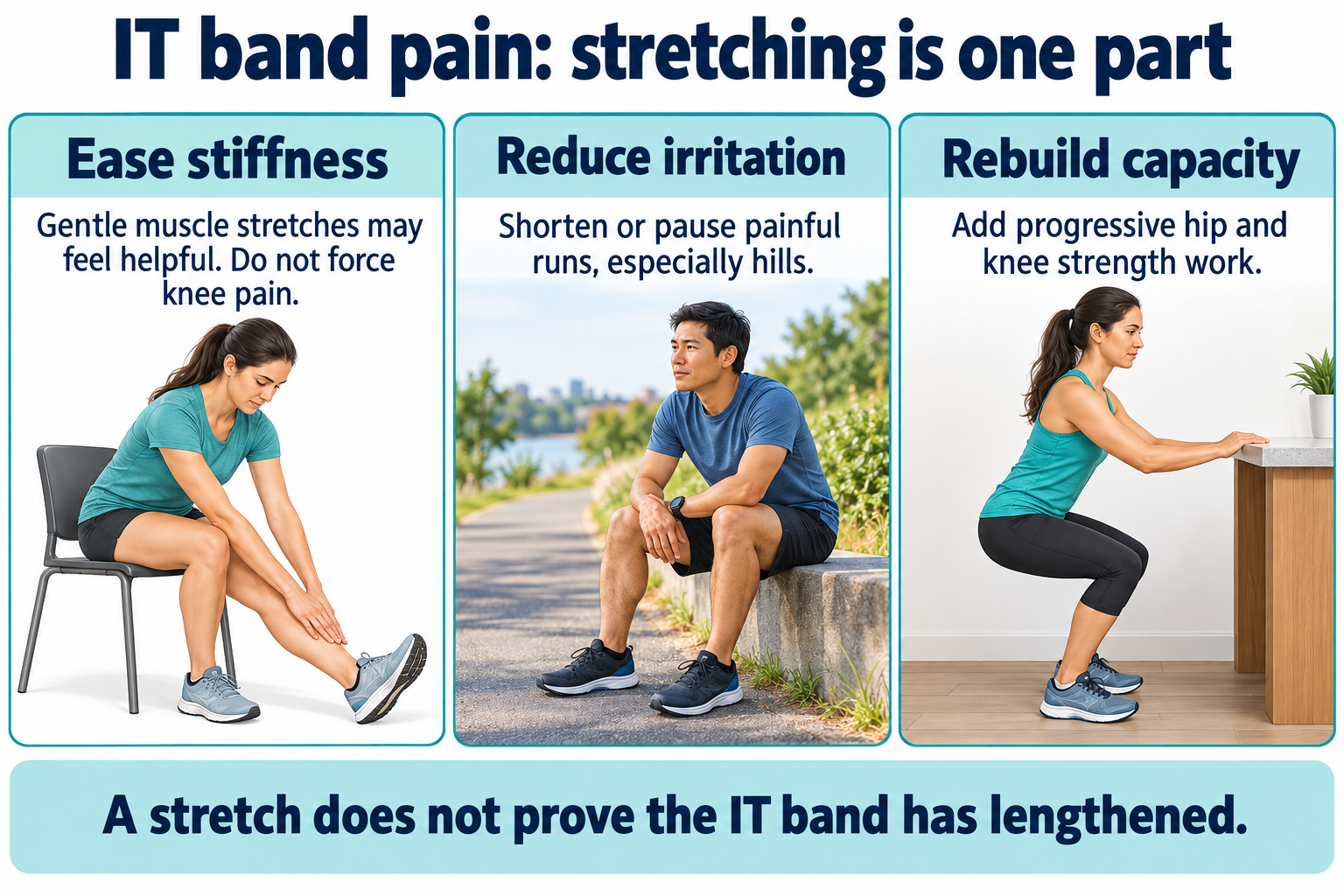
- A stretch may change comfort or how easily you move.
- That feeling does not prove the IT band has become longer.
- More force is not evidence of a better treatment.
A randomised trial of stretching and foam rolling found no short-term change in IT band stiffness after a single session in healthy participants. This does not settle every question about treating symptomatic runners, but it does argue against promising a quick mechanical “release.”
Check that outer-knee pain is suitable for self-care
Arrange an assessment if the diagnosis is uncertain, symptoms keep returning or normal walking and stairs are becoming difficult. IT band syndrome needs to be distinguished from problems such as a meniscal injury or arthritis.
- Seek urgent advice if you cannot bear weight or move the knee.
- A badly swollen, deformed, locking or giving-way knee needs assessment.
- A hot or red knee with fever, chills or feeling unwell needs urgent medical care.
These warning signs are listed in the NHS knee pain guidance. Do not use stretching to test a knee after a significant injury or force it past a block to movement.
Prepare for a comfortable stretch
Start with easy movement, such as a short comfortable walk. If walking already causes a limp, focus on assessment and reducing irritation rather than adding stronger stretches.
- Use a stable chair, wall or comfortable mat.
- Aim for a mild muscle pull, not sharp pain at the outside of the knee.
- Breathe normally and avoid bouncing.
- Release the position if symptoms spread, tingle or become painful.
For a starting trial, hold a comfortable position for about 15–20 seconds and repeat once if it feels helpful. This is an example, not a required dose; skip any stretch that leaves symptoms worse afterward.
| Option | Intended use | Reason to modify or stop |
|---|---|---|
| Seated hamstring stretch | Comfortable movement at the back of the thigh | Outer-knee pain, tingling or back pain |
| Side-lying thigh stretch | A mild stretch at the front of the thigh | Knee compression, twisting or pain |
| Supported side lean | An optional gentle sensation around the outer hip/thigh | Outer-hip or outer-knee pain |
| Progressive strengthening | Build capacity for daily tasks and running | Increasing symptoms or loss of movement control |
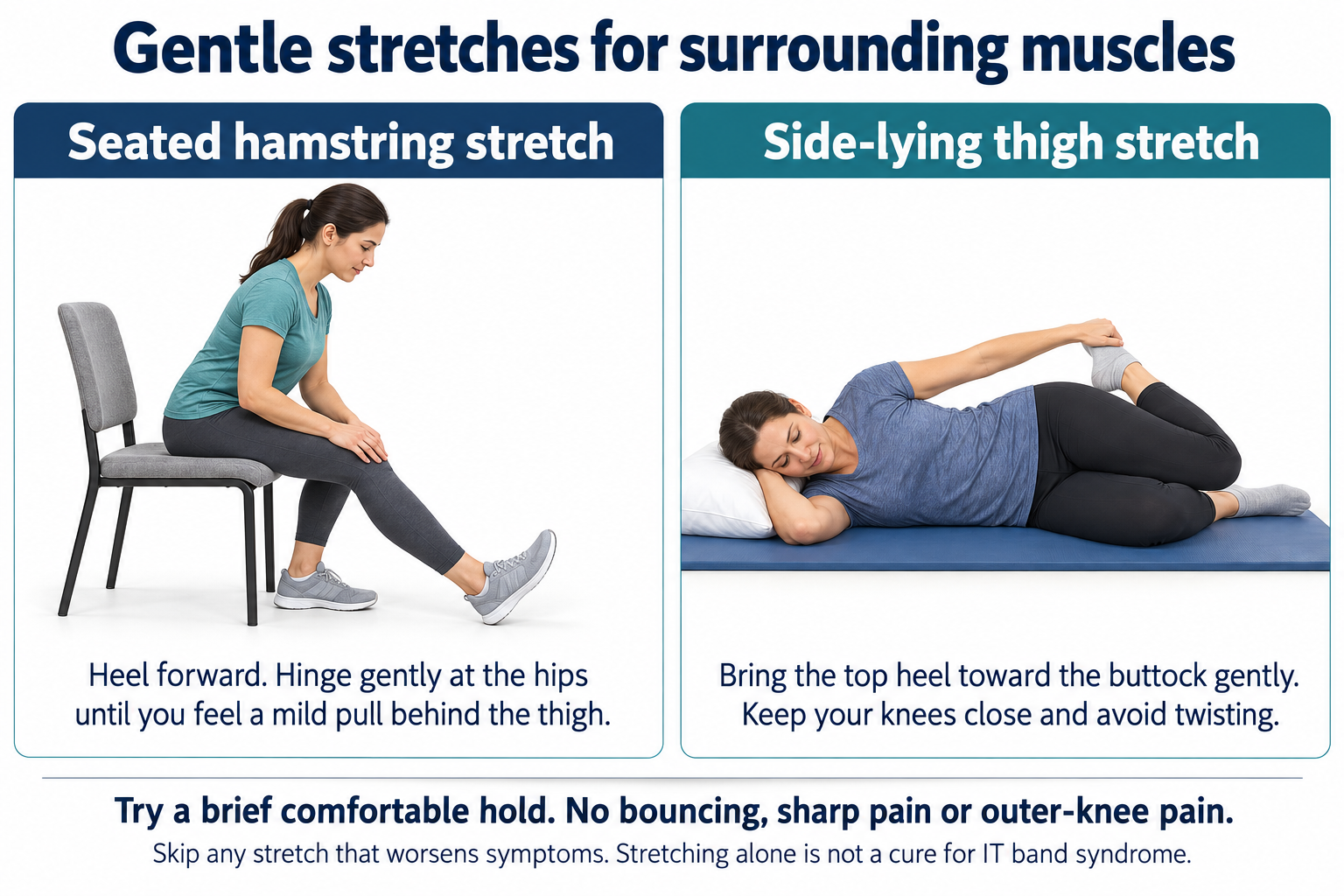
Try a seated hamstring stretch
Sit near the front of a stable chair. Keep one foot under a bent knee and place the other heel farther forward with that knee comfortably straight.
- Lengthen through your back and hinge forward slightly from the hips.
- Rest your hands on your thigh without pushing the knee down.
- Stop when you feel a mild pull behind the thigh.
- Release slowly and compare how the leg feels afterward.
This position appears in the NHS knee exercises for runners. You do not need to touch your toes or fully lock the knee to make it useful.
If you feel tingling or an electric sensation rather than a local muscle pull, stop. That response should not be treated as a sign that you need to stretch harder.
Use a side-lying thigh stretch without twisting the knee
Lie on your side on a comfortable surface, supporting your head. Bend the top knee and gently bring that heel toward the buttock, holding the foot only if you can reach it comfortably.
- Keep your hips stacked rather than rolling backward.
- Let the knees stay close together without forcing them.
- Keep your lower back comfortable and avoid arching.
- Release if the stretch produces knee pain instead of a gentle front-thigh pull.
The NHS stretching guide includes a side-lying thigh stretch and advises adapting stretches when you have an injury. If reaching your foot is difficult, ask a physiotherapist for a different version rather than pulling awkwardly.
Treat the standing “IT band stretch” as optional
A supported side lean is often called an IT band stretch. It may feel useful around the outer hip or thigh, but should not be presented as a way to lengthen the band itself.
- Stand next to a wall and keep a hand supported.
- Cross the leg on the side being stretched behind the other leg.
- Shift that hip gently toward the wall while leaning the trunk away.
- Use only a small range and stop for hip or knee pain.
NHS lateral knee pain advice describes this option alongside strengthening and a gradual return to activity. It is not essential: leave it out if it is uncomfortable, difficult to balance or less helpful than the simpler stretches.
If your main pain is over the outside of the hip, especially with side-lying, seek assessment before using strong crossed-leg stretches. Outer-hip pain may require a different approach from knee-focused IT band rehabilitation.
Add strength work rather than stretching indefinitely
Once symptoms are settling, build the ability to tolerate activity. Kent Community Health’s IT band advice recommends working with a physiotherapist on hip and knee flexibility and strength.
- Chair rise: From a stable seat, stand smoothly and sit slowly, using hand support if needed.
- Supported mini-squat: Hold a stable surface, bend your hips and knees slightly, then return to standing.
- Progression: Start with a few comfortable repetitions and build gradually when the current version is manageable.
Keep the knees moving comfortably in line with the feet and reduce the depth if symptoms appear. More demanding work, such as step-downs, single-leg tasks or band exercises, can be selected after checking your strength and control.
These exercises build function; they do not prove that weak hips caused your injury. There is no single strengthening routine that every runner must complete before improving.
Change the run that keeps provoking symptoms
Stretching after a painful run will not reliably compensate for repeating the same aggravating session. Temporarily shorten or pause running that reproduces pain, particularly downhill routes or uneven surfaces if these are triggers.
- Choose a shorter, level route when returning.
- Use comfortable alternative activity, but remember cycling can also provoke IT band symptoms.
- Allow recovery between early runs.
- Increase one training demand at a time rather than adding distance, speed and hills together.
Johns Hopkins Medicine’s IT band guidance supports temporarily avoiding aggravating activity and returning gradually. A clinician can help review training history, knee function and running mechanics if symptoms persist.
Daily walking and stairs should be comfortable before you progress running. Begin with an easy, short session or walk-run intervals suited to your recovery, and stop if pain builds or changes your stride.
Avoid painful rolling and judge progress by function
There is no need to grind a foam roller directly over the tender outside of the knee. Short-lived relief from rolling or stretching does not establish that the underlying problem has been corrected.
- Do not force a stretch through lateral knee pain.
- Do not use temporary relief as permission to complete an aggravating run.
- Do not chase a stronger stretch every day.
- Do not keep changing shoes or technique without reviewing the total training load.
Check symptoms later that day and the following morning. If a particular stretch consistently worsens pain, remove it and review the plan rather than increasing its duration.
Useful signs to track include:
- More comfortable walking and stairs.
- Better tolerance of the chosen strength exercises.
- A short run without pain building or lingering afterward.
- Less need to interrupt daily activity because of symptoms.
Ask for assessment if improvement stalls, pain starts earlier in each run or you develop swelling, locking or instability. Recovery should be judged by these changes in function rather than a promised number of days.
Conclusion
For IT band syndrome in runners, useful stretches are gentle options that ease surrounding stiffness without reproducing knee pain. Try a comfortable hamstring or thigh stretch, leave out positions that irritate symptoms, and combine any benefit with sensible training changes and progressive strength work. Persistent or unusual knee symptoms deserve an assessment.
Frequently asked questions
Can I actually stretch my IT band longer?
A stretching sensation does not demonstrate lasting IT band lengthening. Short-term research in healthy participants found no change in stiffness after stretching or foam rolling, so avoid treating a “release” as a proven cure.
Which stretch should I try first?
A gentle seated hamstring stretch is straightforward to adjust. Keep the heel supported and hinge slightly from the hips, stopping if the position causes outer-knee pain or tingling.
How long should I hold a stretch?
A brief comfortable hold, such as 15–20 seconds, can be a starting trial. You do not need to reach a fixed duration if symptoms increase, and longer holds are not automatically better.
Should stretching hurt at the outside of the knee?
No. Aim for a mild muscle pull, not the same lateral knee pain that troubles you when running. Release the position and choose another option if it reproduces that pain.
Is foam rolling necessary?
No. It is an optional comfort measure for some people, not a requirement for recovery. Avoid painful pressure over the outer knee and do not assume rolling physically lengthens the band.
Can I keep running while doing the stretches?
Only within a plan that does not keep provoking symptoms. Reduce or pause painful running and return gradually as daily activities and rehabilitation improve.
Why include strengthening in a stretching article?
Stretching may address comfort, while progressive strengthening builds capacity for running and daily tasks. A useful rehabilitation plan considers both rather than relying on flexibility alone.
Is every case caused by weak glutes?
No. Training changes, individual movement patterns and other factors may contribute. An assessment helps identify relevant issues without assuming every runner has the same cause.
What if the pain is mainly over my outer hip?
Seek an assessment because outer-hip pain can have a different source and may not tolerate crossed-leg stretches. Do not automatically apply a knee-focused IT band routine to hip pain.
When should I get urgent help?
Get urgent advice for a very painful or badly swollen knee, inability to bear weight, locking or giving way. A hot or red knee with fever or feeling unwell also needs urgent medical care.