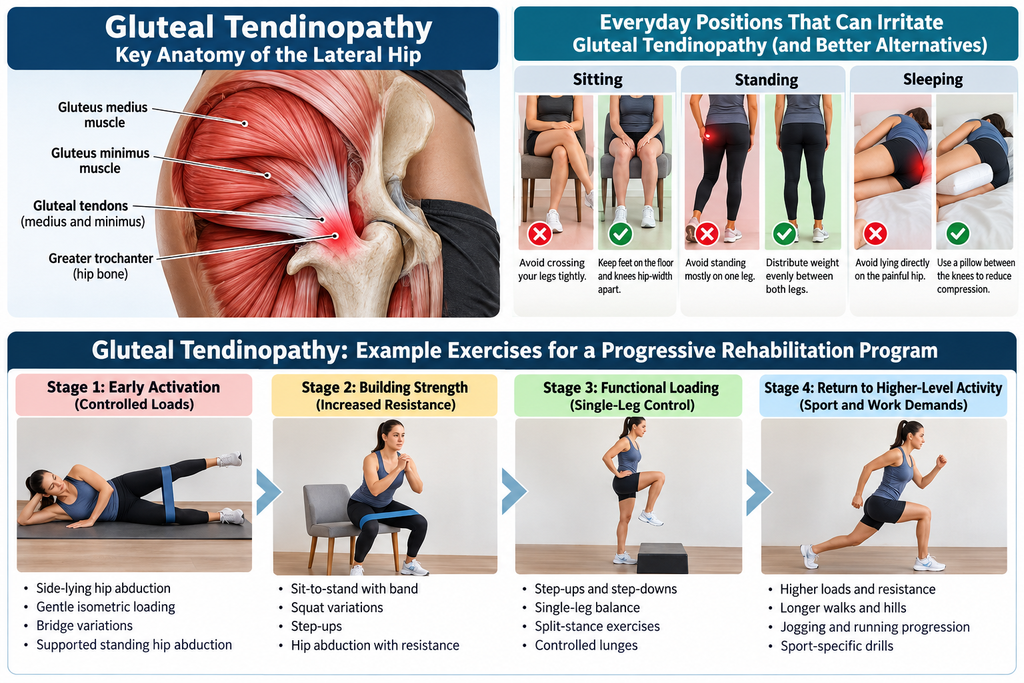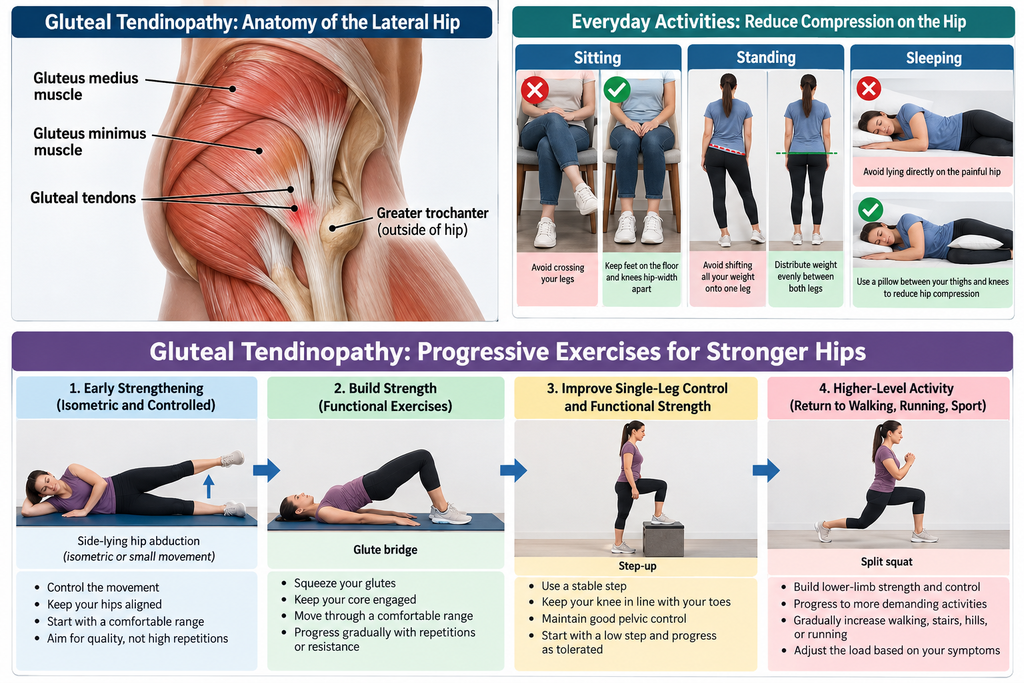
Gluteal tendinopathy is a common cause of persistent pain on the outside of the hip, especially when walking, climbing stairs, standing on one leg, or lying on the painful side.
Effective relief usually depends less on completely resting the hip and more on reducing irritating compression, adjusting daily loads, and progressively strengthening the gluteal muscles so the tendons can tolerate normal activity again.
What Is Gluteal Tendinopathy?
Gluteal tendinopathy affects the tendons of the gluteal muscles where they attach near the greater trochanter, the prominent bone on the outside of the upper thigh.
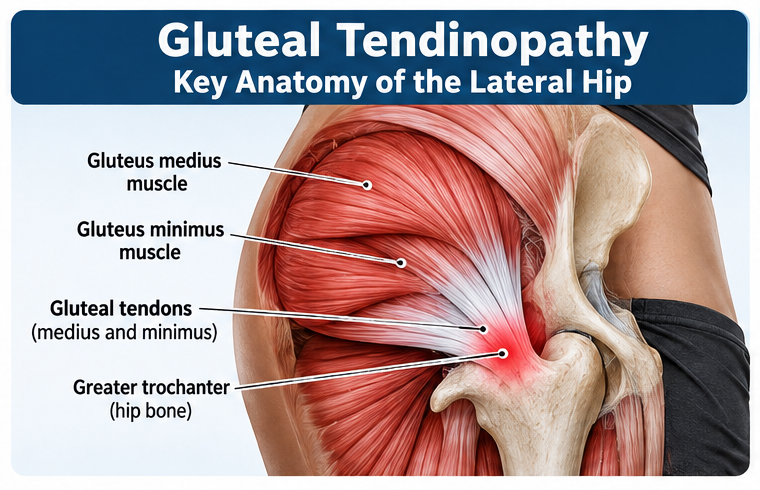
The gluteus medius and gluteus minimus tendons are particularly relevant.
These muscles help control the pelvis when walking, climbing stairs, running, and standing on one leg.
From a physical-therapy perspective, gluteal tendinopathy should not simply be treated as an inflamed structure that needs prolonged rest.
Tendons respond to mechanical loading, and both excessive loading and insufficient loading can become problematic.
Typical features include:
- Pain over the outside of the hip.
- Tenderness around the greater trochanter.
- Pain when lying on the affected side.
- Discomfort during longer walks.
- Pain when climbing stairs or hills.
- Symptoms when standing on one leg.
- Pain when getting out of a low chair.
- Increased discomfort after sudden increases in activity.
- Pain when the legs are crossed.
- Symptoms after prolonged standing with weight shifted onto one hip.
Gluteal tendinopathy is frequently included within the broader term greater trochanteric pain syndrome, or GTPS.
GTPS can involve the gluteal tendons and surrounding structures, so not every person with lateral hip pain has exactly the same problem.
A clinical examination is therefore important before assuming that every painful outer hip represents gluteal tendinopathy.
Why Gluteal Tendinopathy Causes Side Hip Pain
Tendons are designed to transmit force between muscles and bones.
The gluteal tendons experience substantial forces during everyday activities because they help stabilize the pelvis whenever body weight passes through one leg.
Problems may develop when the tendon is repeatedly exposed to more load than it currently has the capacity to tolerate.
This can occur after:
- Suddenly increasing walking distance.
- Starting a new running program.
- Adding repeated hills or stairs.
- Returning to exercise after inactivity.
- Increasing gym resistance too quickly.
- Spending long periods standing on one leg.
- Performing repeated hip-loading activities without adequate recovery.
- Continuing high workloads despite increasing lateral hip pain.
Compression is another important consideration.
When the hip moves into excessive adduction, meaning the thigh moves across the body’s midline, the gluteal tendons can experience greater compression around the greater trochanter.
Research examining gluteal tendinopathy has therefore emphasized both tendon load management and reduction of excessive compressive positions.
Common examples include crossing the legs tightly, allowing one knee to fall inward while standing, or sleeping on one side with the upper knee dropping across the body.
The goal is not to permanently avoid hip adduction.
Instead, temporarily reducing repeated or sustained provocative positions may give an irritable tendon a better environment for recovery while its load capacity is rebuilt.
How Physical Therapists Assess Lateral Hip Pain
Side hip pain should not be diagnosed from the location of pain alone.
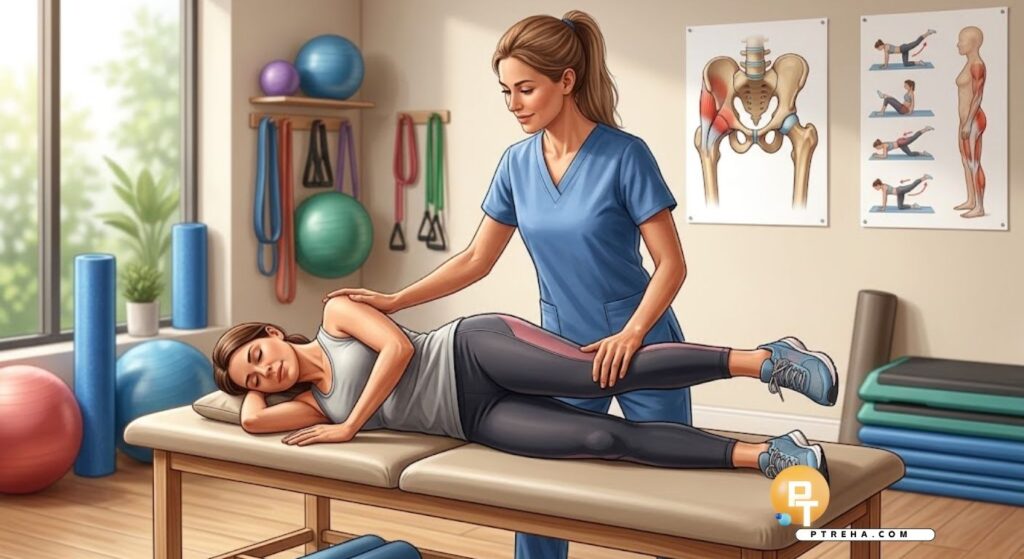
A physical therapist considers the history, aggravating activities, tenderness, strength, functional movements, and whether symptoms could originate from another region.
The assessment may include:
- Location and behavior of the pain.
- Tenderness around the greater trochanter.
- Resisted hip abduction.
- Single-leg standing.
- Walking mechanics.
- Stair climbing.
- Hip muscle strength.
- Pelvic control during single-leg tasks.
- Hip range of motion.
- Lumbar spine screening when appropriate.
- Functional activities that reproduce the person’s symptoms.
A systematic review of diagnostic testing found that combining greater trochanter palpation with resisted hip abduction can substantially improve clinical confidence when assessing people with lateral hip pain.
No single test should automatically be treated as a definitive diagnosis.
Imaging is also not automatically required for every person with side hip pain.
Ultrasound or MRI may sometimes be considered when the presentation is unclear, symptoms persist despite appropriate rehabilitation, or another condition needs investigation.
Conditions That Can Resemble Gluteal Tendinopathy
Several conditions may produce pain around the hip, buttock, thigh, or groin.
A physical therapist may therefore screen for features associated with:
- Hip osteoarthritis.
- Lumbar referred pain.
- Lumbar radicular symptoms.
- Intra-articular hip disorders.
- Significant gluteal tendon tears.
- Traumatic injuries.
- Stress-related bone injuries.
- Other causes of greater trochanteric pain.
Pain accompanied by significant trauma, inability to bear weight, progressive neurological changes, systemic illness, or other concerning symptoms requires appropriate medical assessment rather than self-directed rehabilitation alone.
Reduce Tendon Compression During Everyday Activities
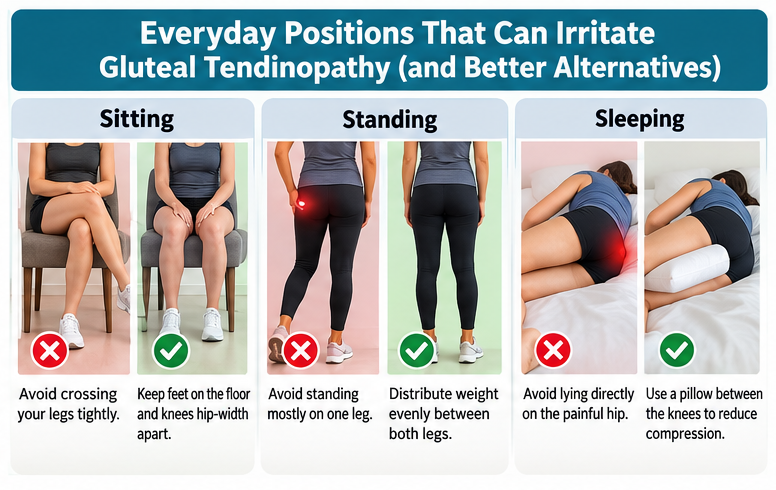
One of the most useful early strategies for gluteal tendinopathy is changing positions that repeatedly compress an irritated tendon.
This does not mean trying to move perfectly throughout the entire day.
Small modifications to frequent aggravating positions are usually more realistic.
Standing
People with lateral hip pain often unconsciously shift most of their body weight onto one leg.
Instead:
- Stand with weight distributed between both feet.
- Avoid letting the pelvis hang excessively toward one side.
- Change position regularly.
- Use a footrest temporarily if prolonged standing is unavoidable.
- Avoid repeatedly resting the opposite foot against the painful leg.
Imagine someone preparing food at a kitchen counter.
If they habitually stand with the painful hip pushed outward and almost all their weight on that leg, simply distributing weight more evenly may reduce cumulative compression.
Sitting
Avoid spending long periods with the thighs crossed tightly.
Useful alternatives include:
- Keep both feet supported.
- Sit with the knees approximately hip-width apart.
- Avoid repeatedly crossing one knee over the other.
- Change sitting position periodically.
- Stand and move after prolonged sitting.
The objective is comfort and load management rather than rigid posture correction.
Sleeping With Gluteal Tendinopathy
Night pain is particularly frustrating because direct pressure and prolonged hip positions can repeatedly aggravate the lateral hip.
Sleeping directly on the symptomatic hip places pressure over the greater trochanter.
Sleeping on the opposite side can also become uncomfortable if the upper leg falls across the body into substantial hip adduction.
Practical options include:
- Avoid lying directly on the painful hip during an irritable period.
- Place a pillow between the thighs and knees when lying on the opposite side.
- Support the entire upper leg rather than only the knee.
- Consider sleeping on the back if comfortable.
- Place pillows under the knees when lying on the back if this feels better.
- Use a semi-prone position when appropriate.
- Experiment with positioning rather than forcing one sleeping posture.
The Royal National Orthopaedic Hospital also advises using pillows to support the upper leg and reduce excessive hip compression when sleeping with gluteal tendinopathy.
A pillow should ideally prevent the upper thigh from dropping markedly across the midline.
Exercise Is a Core Part of Gluteal Tendinopathy Rehabilitation
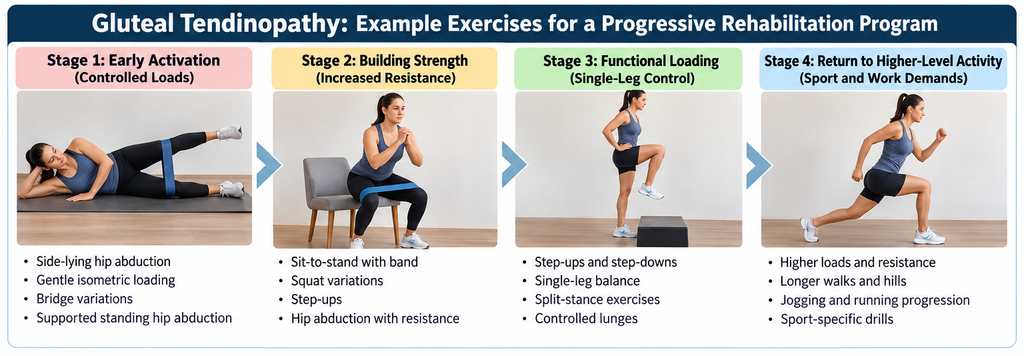
Rest may temporarily reduce symptoms, but prolonged avoidance of loading does little to restore the tendon and muscle capacity required for walking, stairs, work, sport, and daily activity.
Progressive exercise is therefore central to conservative rehabilitation.
A major clinical trial compared education plus targeted exercise with corticosteroid injection and a wait-and-see approach.
Education and exercise produced better global improvement than the other approaches, supporting a rehabilitation strategy based on load management and progressive strengthening.
A more recent systematic review similarly concluded that exercise and education can be cautiously recommended as the core approach for improving pain and function in gluteal tendinopathy.
Rehabilitation commonly progresses through several objectives:
- Reduce highly provocative loading.
- Maintain tolerable daily activity.
- Restore comfortable muscle loading.
- Improve hip abductor strength.
- Improve pelvic control.
- Increase tolerance to single-leg loading.
- Restore walking capacity.
- Progress toward stairs and hills.
- Add faster or heavier tasks when appropriate.
- Return gradually to recreational or sporting activity.
The exact exercise prescription should reflect the person’s symptoms, strength, activity requirements, and response to loading.
Examples of Early Strengthening
Early exercises may involve relatively controlled positions.
Examples can include:
- Gentle isometric hip abduction.
- Supported standing hip abduction.
- Bridge variations when comfortable.
- Controlled sit-to-stand exercises.
- Light resistance exercises prescribed according to tolerance.
Exercises should not automatically be selected simply because they activate the gluteal muscles.
For example, an exercise that places the painful hip in substantial adduction and compression may be poorly tolerated during an irritable stage even though it is traditionally considered a “glute exercise.”
Progressing Toward Functional Strength
As symptoms become more manageable, loading should gradually become more demanding.
Later exercises may include:
- Heavier hip abduction resistance.
- Step-ups.
- Controlled step-downs.
- Squat variations.
- Split-stance exercises.
- Single-leg balance tasks.
- Loaded sit-to-stand exercises.
- Functional carrying tasks.
- Gradual hill walking.
- Sport-specific loading when required.
The progression should be based on the person’s response rather than an arbitrary exercise calendar.
How Much Pain Is Acceptable During Exercise?
People with tendinopathy are often told either to exercise through pain or to stop whenever any discomfort occurs.
Neither rule is universally appropriate.
A more useful approach considers several factors together.
Monitor:
- Pain during exercise.
- Whether symptoms settle afterward.
- Night pain.
- Walking tolerance.
- Symptoms the following morning.
- Ability to perform normal daily activities.
- Whether each progression creates a sustained flare.
Mild, tolerable discomfort during a prescribed exercise does not necessarily mean that tendon damage is occurring.
However, exercise that repeatedly produces substantial pain, causes progressively worse night symptoms, or leaves the hip significantly more irritable afterward may indicate that the current load is excessive.
Consider a person who can perform a step-up comfortably but develops pronounced lateral hip pain after increasing both step height and repetitions simultaneously.
Rather than abandoning step-ups completely, the therapist may reduce one variable and rebuild gradually.
This principle is important: adjust the load before automatically eliminating the activity.
Practical Load-Management Example
| Situation | Possible Problem | Practical Adjustment |
|---|---|---|
| Long walk causes increasing hip pain | Walking volume exceeds current capacity | Reduce distance temporarily and rebuild gradually |
| Pain after repeated hills | Increased hip abductor demand | Use flatter routes before progressing hills |
| Side sleeping worsens pain | Direct tendon compression | Change side or use pillow support |
| Standing on one hip is painful | Sustained compression and loading | Distribute weight between both legs |
| Exercise causes next-day flare | Load may be progressing too quickly | Reduce resistance, repetitions, or exercise volume |
| Stairs repeatedly provoke pain | Single-leg demand exceeds tolerance | Use rail support temporarily and build strength |
The table is not a universal prescription.
It illustrates how rehabilitation can modify an aggravating load without necessarily removing movement completely.
Walking, Running, Stairs, and Hills
Walking is usually worth maintaining when it can be performed at a manageable level.
The mistake is often continuing exactly the same walking volume despite increasing symptoms, or stopping all activity for an extended period.
Instead:
- Find a tolerable baseline distance.
- Prefer flatter terrain during an irritable phase.
- Avoid suddenly doubling walking volume.
- Use shorter walks when necessary.
- Increase duration gradually.
- Monitor symptoms later that day and the next morning.
- Reintroduce hills progressively.
- Build stair tolerance with strengthening exercises.
- Increase speed only after basic walking is comfortable.
- Progress running separately from walking volume.
For runners, rehabilitation should consider more than hip strengthening alone.
Weekly running volume, hills, speed sessions, recent training changes, recovery, and overall lower-limb capacity may all influence tendon load.
Returning immediately to the previous running distance because pain has improved for several days can produce another flare.
Stair Strategy
Stairs require substantial single-leg control.
During a painful stage, a patient may benefit from:
- Using a handrail for temporary assistance.
- Reducing unnecessary repeated stair trips.
- Moving at a controlled pace.
- Avoiding exaggerated pelvic drop.
- Building step-up capacity during rehabilitation.
These modifications should generally be temporary tools rather than permanent avoidance strategies.
Common Mistakes That Can Delay Improvement
Gluteal tendinopathy often improves gradually, but several habits can repeatedly irritate the tendon.
Complete Rest
Removing every meaningful load can reduce pain temporarily, but the tendon and surrounding muscles still need sufficient capacity for normal daily life.
The aim is usually relative load modification, not indefinite rest.
Aggressive Stretching Into Hip Adduction
People often assume that painful tissue must be stretched.
For an irritable gluteal tendon, repeatedly pulling the thigh strongly across the body can increase compression around the lateral hip.
Stretching should therefore not automatically be prescribed simply because the area feels tight.
Doing Only Clamshell Exercises
Clamshells can be useful in some rehabilitation programs, but gluteal tendinopathy cannot be reduced to one exercise.
Recovery may require progressively developing:
- Hip abductor capacity.
- Functional single-leg control.
- Walking tolerance.
- Stair tolerance.
- Pelvic control.
- Sport-specific strength.
- Overall lower-limb capacity.
Progressing Too Many Variables at Once
Suppose a patient simultaneously increases walking distance, resistance exercises, stair use, and weekend hiking.
If symptoms flare, it becomes difficult to identify which load exceeded current capacity.
Progress one or two variables at a time when possible.
Repeatedly Testing the Pain
Constantly pressing the greater trochanter, repeatedly standing on one leg to “check it,” or performing provocative movements several times a day can unnecessarily irritate a sensitive area.
Monitor function instead of repeatedly provoking symptoms.
A Practical Physical Therapy Progression
There is no single exercise protocol that fits everyone with gluteal tendinopathy.
A useful rehabilitation framework is based on tolerance and function.
Phase 1: Reduce Irritability
Priorities may include:
- Reduce sustained hip compression.
- Modify painful sleeping positions.
- Adjust walking volume.
- Temporarily reduce steep hills.
- Maintain comfortable movement.
- Begin tolerable strengthening.
Phase 2: Develop Strength
As irritability decreases:
- Increase resistance gradually.
- Strengthen the hip abductors.
- Add functional lower-limb exercises.
- Improve controlled single-leg loading.
- Increase walking capacity.
Phase 3: Restore Functional Capacity
Progress toward:
- Higher step-ups.
- Controlled step-downs.
- Heavier lower-limb strengthening.
- Longer walks.
- Hills.
- Repeated stair climbing.
- Work-specific tasks.
Phase 4: Return to Higher-Level Activity
For active individuals, progression may include:
- Jogging.
- Faster running.
- Longer running.
- Hill running.
- Direction changes.
- Jumping tasks.
- Sport-specific drills.
A flare does not necessarily mean rehabilitation has failed.
It may simply indicate that the tendon was exposed to more load than it was prepared for at that stage.
The appropriate response is often to identify the provoking change, temporarily reduce it, and then progress again more gradually.
When to Seek a Physical Therapy Assessment
Persistent side hip pain deserves individualized assessment when it limits sleep, walking, work, exercise, or normal daily activities.
Consider a physical-therapy evaluation when:
- Pain continues despite basic activity modification.
- Walking distance keeps decreasing.
- Night pain remains troublesome.
- Stairs are becoming increasingly difficult.
- You are uncertain which exercises are appropriate.
- Symptoms repeatedly flare after exercise.
- The diagnosis is unclear.
- Strength appears noticeably reduced.
- You cannot return to your usual activities.
- You need a structured return-to-running or sport program.
A physical therapist can assess how much load the hip currently tolerates, identify provocative positions and activities, select suitable exercises, and adjust progression according to the response.
The goal is not merely to make the hip temporarily less painful.
Effective rehabilitation aims to restore enough capacity for the activities the person needs and values.
Conclusion
Gluteal tendinopathy is a load-related source of lateral hip pain that often responds well to a combination of education, sensible activity modification, reduction of excessive tendon compression, and progressive strengthening.
Avoiding every painful activity is rarely the long-term solution; rehabilitation should gradually increase the gluteal tendons’ ability to tolerate walking, stairs, exercise, work, and sport while monitoring how symptoms respond.
Frequently Asked Questions About Gluteal Tendinopathy
1. Where is gluteal tendinopathy pain usually felt?
Pain is usually felt around the outside of the hip near the greater trochanter.
It may sometimes spread slightly down the outer thigh, but the exact pain pattern varies between individuals.
2. Is gluteal tendinopathy the same as trochanteric bursitis?
Not exactly.
Gluteal tendinopathy involves the gluteal tendons, while bursitis refers to irritation involving a bursa.
Both may occur within the broader clinical presentation commonly called greater trochanteric pain syndrome, which is why a proper clinical assessment is useful.
3. Should I stop walking if I have gluteal tendinopathy?
Usually not completely.
Walking volume may need temporary modification if symptoms steadily worsen during or after longer walks.
Finding a tolerable baseline and gradually increasing from it is generally more useful than prolonged complete inactivity.
4. Can I exercise with gluteal tendinopathy?
Exercise is an important component of conservative management.
The key is choosing an appropriate starting load and progressing according to symptom response.
Exercises that repeatedly cause substantial or sustained aggravation may need modification.
5. Is stretching helpful for gluteal tendinopathy?
Not every stretch is appropriate.
Aggressive stretches that move the painful hip into strong adduction can increase compression of the gluteal tendons around the greater trochanter.
Stretching should therefore be selected according to the person’s presentation rather than used automatically.
6. What is the best sleeping position for gluteal tendinopathy?
Avoiding direct pressure on the painful hip can help when symptoms are irritable.
When lying on the opposite side, placing a pillow between the thighs and knees can support the upper leg and reduce excessive hip adduction.
Sleeping on the back is another option for some people.
7. Are stairs bad for gluteal tendinopathy?
Stairs are not inherently harmful, but they place meaningful demand on the hip abductors.
If repeated stair climbing aggravates symptoms, temporarily reducing stair volume or using a rail while building strength may help.
8. How long does gluteal tendinopathy take to improve?
Recovery time varies considerably depending on symptom duration, tendon capacity, daily loading, general health, activity demands, and consistency with rehabilitation.
Tendon rehabilitation is usually better approached as a progressive process rather than expecting symptoms to disappear after a few exercise sessions.
9. Do I need an MRI for gluteal tendinopathy?
Not necessarily.
Many cases can be assessed clinically using the history and physical examination.
Imaging may become useful when symptoms are atypical, the diagnosis remains uncertain, significant tendon injury is suspected, or progress is not occurring as expected.
10. Can gluteal tendinopathy return after it gets better?
Symptoms can recur if activity increases faster than the hip’s current capacity, particularly after a period of reduced activity.
Maintaining adequate hip and lower-limb strength, managing sudden workload changes, and progressively preparing for demanding activities can reduce the likelihood of repeated flare-ups.