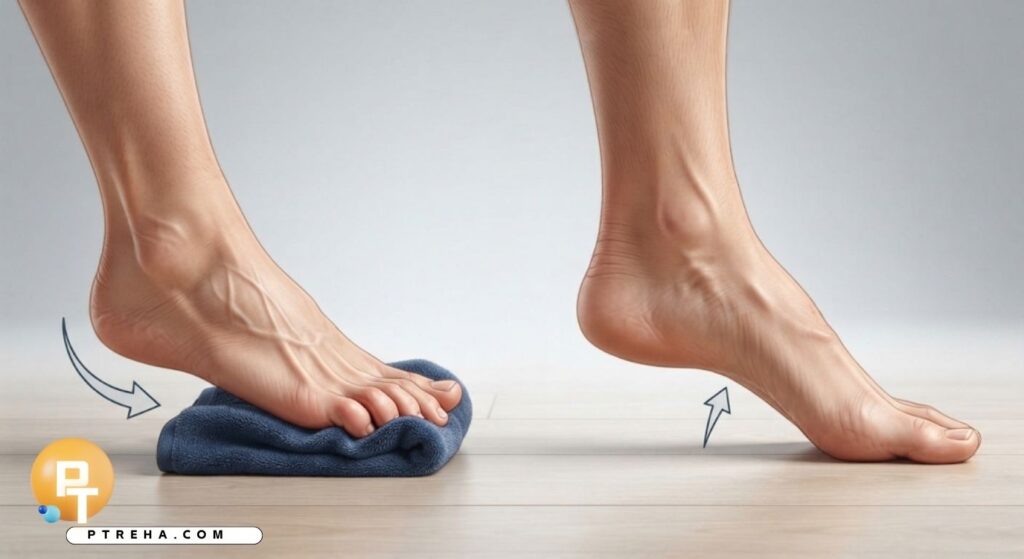
Flat-Foot do not always require treatment, but when reduced arch support is associated with pain, fatigue, balance problems, or difficulty with walking and exercise, targeted strengthening can be useful.
Foot arch strengthening exercises for flat feet commonly focus on the intrinsic foot muscles, calf muscles, tibialis posterior, and the ability to maintain controlled foot alignment during weight-bearing activities.
What Happens to the Foot Arch in Flat Feet?
The medial longitudinal arch is formed by the bones, joints, ligaments, plantar fascia, and muscles of the foot and ankle.
Its appearance can change between non-weight-bearing and weight-bearing positions, particularly in flexible flat feet.
A lower arch does not automatically mean that the foot is weak or pathological.
Some people have flat feet without pain or functional limitations and may not need corrective treatment.
Exercise becomes more relevant when reduced foot control is accompanied by symptoms or functional problems.
Important factors to consider include:
- Whether the flat foot is flexible or relatively rigid.
- Whether symptoms are present.
- Whether symptoms occur on one or both sides.
- Foot and ankle muscle strength.
- Calf flexibility and strength.
- Tibialis posterior function.
- Great-toe and lesser-toe control.
- Balance and single-leg control.
- Walking and running demands.
- Recent changes in activity level.
Strengthening the intrinsic muscles of the foot may improve aspects of foot control, strength, balance, and function.
However, exercise should not be presented as a guaranteed method for permanently increasing the visible height of every flat foot.
Short Foot Exercise: The Main Arch-Strengthening Exercise
The short foot exercise is commonly used to train the intrinsic muscles of the foot.
The basic idea is to gently shorten the foot by drawing the forefoot toward the heel while maintaining contact with the ground.
The important detail is that the exercise should not be performed by aggressively curling the toes.
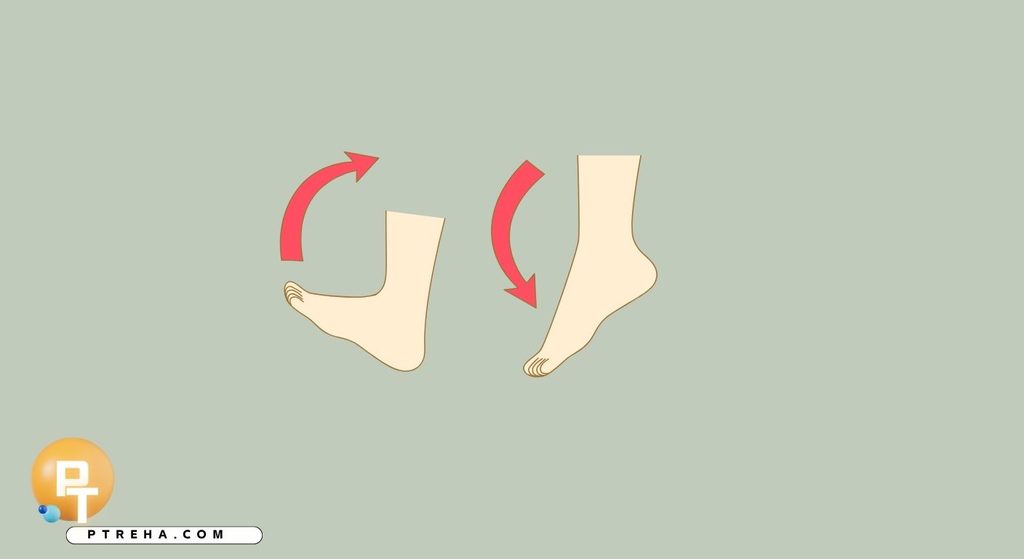
The goal is controlled activation of the arch rather than excessive toe gripping.
How to Perform the Short Foot Exercise
Start seated with the foot flat on the floor.
Keep the heel, base of the big toe, and base of the little toe in contact with the ground.
Gently attempt to shorten the foot by drawing the forefoot toward the heel.
The medial arch should rise slightly without clawing or aggressively flexing the toes.
Useful technique points include:
- Sit in a comfortable position.
- Keep the heel grounded.
- Keep the forefoot in contact with the floor.
- Keep the toes relatively relaxed.
- Gently contract the arch.
- Hold the contraction briefly.
- Release slowly.
- Avoid rolling the ankle outward.
- Avoid excessive toe gripping.
- Repeat with controlled movement.
The exercise should feel like a subtle muscular contraction rather than a large movement of the foot.
If the movement is difficult, practicing in sitting can help develop awareness before progressing to standing.
Toe Control and Intrinsic Foot Muscle Exercises
The small muscles within the foot contribute to active control of the arch and toes.
Training these muscles can be useful because arch control is not simply a matter of passive support.
Great-Toe and Lesser-Toe Control
Sit with the foot comfortably supported and practice moving the great toe independently from the lesser toes.
For example, lift the great toe while keeping the lesser toes down, then reverse the pattern if you can do so without excessive foot movement.
Useful practice points include:
- Keep the heel grounded.
- Avoid rolling the ankle.
- Move slowly.
- Use visual feedback initially.
- Practice one foot at a time.
- Avoid excessive force.
- Relax between repetitions.
- Keep the rest of the leg relatively still.
- Focus on accuracy.
- Stop if persistent pain develops.
These exercises can be particularly useful when someone has difficulty separating toe movements or maintaining controlled forefoot contact.
Toe Spreading
Toe spreading is another low-load exercise for developing awareness and control of the forefoot.
Place the foot comfortably on the floor and attempt to separate the toes without forcefully pressing them downward.
Hold briefly and then relax.
The objective is controlled movement rather than trying to spread the toes as widely as possible.
Heel Raises for Flat Feet
Heel raises provide a useful progression because the foot and ankle must control the arch while the body moves through plantarflexion.
The calf muscles generate the heel-raise movement, while other structures of the foot and ankle contribute to maintaining alignment and controlling the load.
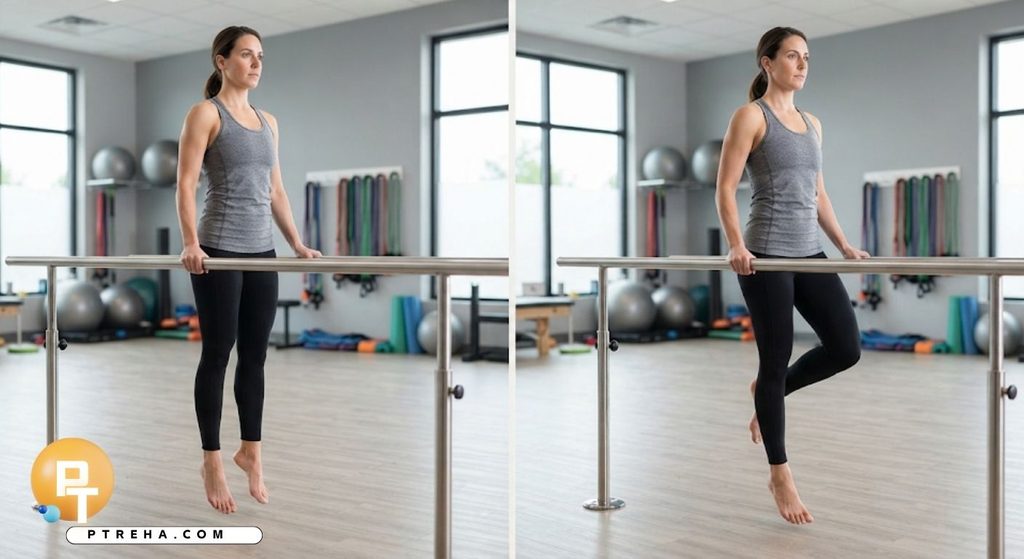
The emphasis should be on controlled foot and ankle movement rather than simply lifting the heels as high as possible.
Basic Heel Raise
Stand near a wall or stable support.
Rise onto the balls of both feet and then lower slowly.
Pay attention to:
- Maintaining comfortable toe contact.
- Avoiding excessive rolling of the ankles.
- Keeping the movement controlled.
- Avoiding rapid bouncing.
- Maintaining comfortable weight distribution.
- Using support when balance is limited.
- Monitoring symptoms.
- Controlling the lowering phase.
- Avoiding unnecessary foot gripping.
- Progressing gradually.
When bilateral heel raises are well controlled, a person may progress to a single-leg version if clinically appropriate.
A single-leg heel raise places greater demand on the calf-foot complex and should not automatically be used as the starting exercise for someone with painful or weak feet.
Tibialis Posterior and Lower-Limb Strengthening
The tibialis posterior contributes to foot and ankle function and participates in controlling the medial side of the foot during weight-bearing activities.
For some people with symptomatic flexible flat feet, strengthening this muscle as part of a broader rehabilitation program may be appropriate.
However, flat feet have different causes and presentations, so exercise should not assume that tibialis posterior weakness is present in every person with a low arch.
A broader strengthening program may include:
- Intrinsic foot strengthening.
- Calf strengthening.
- Tibialis posterior strengthening.
- Great-toe control.
- Balance exercises.
- Hip strengthening.
- Functional single-leg exercises.
- Calf mobility exercises when indicated.
- Walking retraining when appropriate.
- Gradual return to higher-load activities.
The goal is not simply to strengthen one muscle.
Foot function depends on the interaction between the foot, ankle, knee, hip, and the demands of the activity being performed.
Progressing Foot Arch Exercises From Sitting to Standing
One of the most important principles in foot rehabilitation is progression.
A person may be able to create an arch while sitting but lose control when standing.
This does not necessarily mean the exercise has failed; the weight-bearing task is simply more demanding.
A practical progression can look like this:
| Stage | Exercise position | Main objective | Progression consideration |
|---|---|---|---|
| 1 | Seated | Learn arch contraction | Controlled movement without toe clawing |
| 2 | Seated repetitions | Improve muscular control | Consistent technique |
| 3 | Double-leg standing | Control arch under load | Stable foot position |
| 4 | Standing weight shifts | Integrate movement | Maintain foot control |
| 5 | Single-leg standing | Challenge balance | Control without excessive compensation |
| 6 | Heel raises | Combine strength and loading | Controlled upward and downward phases |
| 7 | Functional movements | Transfer control to activity | Symptoms remain manageable |
Progression should be individualized rather than based on a fixed timetable.
Standing Short Foot
Once the seated exercise is controlled, perform the same arch contraction while standing.
Keep the heel and forefoot connected to the floor.
Avoid deliberately rolling the foot onto its outside border.
The arch should rise through muscular control rather than through a large movement of the entire foot.
Single-Leg Arch Control
Single-leg standing adds balance and weight-bearing demand.
Use a wall or stable surface for support when necessary.
The objective is not to hold a perfect-looking arch at all costs, but to maintain controlled foot and lower-limb alignment during the task.
A Practical Foot Arch Exercise Routine
A simple home program can combine intrinsic muscle work with progressively loaded exercises.
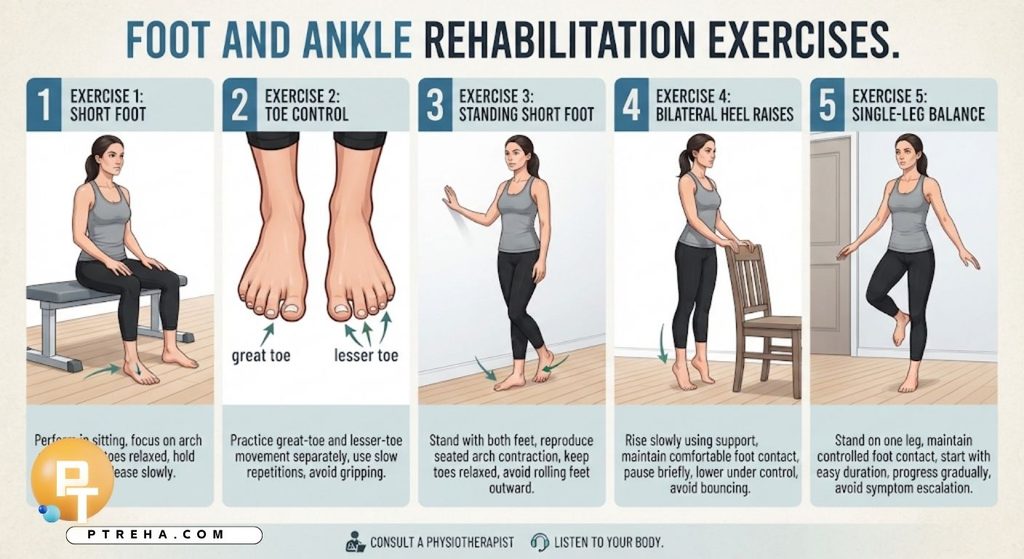
Exercise 1: Short Foot
- Perform in sitting initially.
- Focus on a gentle arch contraction.
- Keep the toes relaxed.
- Hold briefly.
- Release slowly.
- Repeat with controlled technique.
Exercise 2: Toe Control
- Practice great-toe movement.
- Practice lesser-toe movement.
- Use slow repetitions.
- Avoid excessive gripping.
- Practice each foot separately.
Exercise 3: Standing Short Foot
- Stand with both feet supported.
- Reproduce the seated arch contraction.
- Use a wall for balance if needed.
- Keep the toes relaxed.
- Avoid rolling the feet outward.
Exercise 4: Bilateral Heel Raises
- Stand with appropriate support.
- Rise slowly.
- Maintain comfortable foot contact.
- Pause briefly if comfortable.
- Lower under control.
- Avoid bouncing.
Exercise 5: Single-Leg Balance
- Stand on one leg near a stable support.
- Maintain controlled foot contact.
- Start with an easy duration.
- Progress gradually.
- Avoid allowing symptoms to escalate.
The purpose of the routine is not to force the arch into a particular shape.
It is to improve the person’s ability to control and tolerate load through the foot.
Common Mistakes When Strengthening Flat Feet
Foot exercises can become less useful when technique changes substantially during the movement.
Common errors include:
- Curling the toes during short-foot exercises.
- Gripping the floor excessively.
- Rolling onto the outside border of the foot.
- Trying to create an exaggerated arch.
- Holding the breath.
- Performing repetitions too quickly.
- Using excessive resistance too early.
- Ignoring increasing pain.
- Progressing to single-leg exercises too soon.
- Assuming that every flat foot requires the same exercise program.
One particularly important issue during short-foot training is substitution.
When the intrinsic muscles are difficult to activate, a person may compensate by gripping with the toes or changing the position of the ankle and entire foot.
Good technique is therefore more important than simply completing a large number of repetitions.
When Foot Exercises May Not Be Enough
Exercise is only one component of assessment and management.
Professional assessment may be appropriate when there is persistent pain, significant asymmetry, progressive change in foot shape, swelling, weakness, or difficulty with normal activities.
Pay particular attention to:
- Persistent or worsening pain.
- A noticeable change in one foot.
- Recent loss of the arch.
- Swelling around the inner ankle.
- Difficulty pushing off during walking.
- Declining walking tolerance.
- Significant weakness.
- Numbness or altered sensation.
- Unexpected deterioration in balance.
- Symptoms following an injury.
Rigid flat feet also require different consideration from flexible flat feet.
The ability of the arch to change between non-weight-bearing and weight-bearing positions can provide useful clinical information.
Depending on the individual presentation, management may include strengthening, mobility exercises, activity modification, footwear considerations, orthoses, balance training, or other rehabilitation strategies.
How Long Does It Take to Improve Arch Control?
Strength and motor control require repeated practice rather than isolated exercise sessions.
Research involving intrinsic foot muscle training has reported changes in measures of foot posture and function, but exercise programs differ considerably in their dosage, duration, participant characteristics, and outcome measures.
There is therefore no single timeframe that guarantees improvement for every person.
Useful progress indicators include:
- Less foot fatigue.
- Better standing tolerance.
- Improved single-leg balance.
- Better heel-raise control.
- Improved walking tolerance.
- Greater confidence during exercise.
- Reduced symptom aggravation.
- Better foot control during functional activities.
- Improved exercise tolerance.
- Ability to progress to more demanding tasks.
A visible increase in arch height should not be the only measure of success.
Conclusion
Foot arch strengthening exercises for flat feet are best viewed as progressive rehabilitation rather than a quick method for permanently changing foot shape.
Short-foot exercises, toe-control drills, heel raises, balance exercises, and broader lower-limb strengthening can improve active foot control and functional capacity in appropriate individuals.
The most important principle is quality of movement.
A controlled and comfortable contraction that can eventually be integrated into standing, walking, and functional activities is more useful than forcing the arch upward or performing large numbers of poorly controlled repetitions.
Frequently Asked Questions
Can foot arch strengthening exercises correct flat feet?
Exercises may improve muscular control, strength, balance, and some measures of foot posture, particularly in people with flexible flat feet.
They should not be presented as a guaranteed method for permanently changing the structural shape of every flat foot.
What is the best exercise for strengthening the arch?
The short-foot exercise is one of the commonly used exercises for training the intrinsic muscles of the foot.
However, the most appropriate exercise depends on symptoms, strength, foot mobility, movement control, and functional goals.
Should I curl my toes during the short-foot exercise?
No.
The short-foot exercise is intended to create a shortening or doming action of the foot without relying on excessive toe curling.
Excessive toe gripping can change the exercise technique and make the movement less specific.
Can I perform these exercises if my flat feet do not hurt?
People without symptoms may perform appropriate foot-strengthening exercises as part of general conditioning.
However, an asymptomatic flat foot does not automatically require treatment simply because the arch appears low.
How often should I perform arch exercises?
There is no single frequency that is appropriate for everyone.
A practical program should use a manageable workload that allows good technique and can be progressed according to strength, symptoms, recovery, and functional performance.
Are heel raises useful for flat feet?
Heel raises can strengthen the calf-foot complex and provide progressively loaded exercise for the foot and ankle.
They can be particularly useful when introduced at an appropriate level and performed with controlled alignment.
Can strengthening exercises reduce flat-foot pain?
They may help some people, particularly when reduced strength or poor foot control contributes to their functional limitations.
However, pain reduction is not guaranteed, and persistent symptoms should be assessed in the context of the person’s complete clinical presentation.
Should I use orthotics while doing foot exercises?
Orthoses and exercise address different aspects of foot management and may sometimes be used together.
Whether an orthosis is appropriate depends on symptoms, examination findings, activity demands, and the individual’s response to treatment.
Are these exercises suitable for children with flat feet?
Children require age-appropriate assessment because foot development changes over time and not every pediatric flat foot requires intervention.
Persistent pain, functional limitation, marked asymmetry, or other concerning findings should be assessed by an appropriately qualified healthcare professional.
When should I see a physical therapist about flat feet?
A physical therapist may be helpful when flat feet are associated with pain, weakness, balance problems, reduced activity tolerance, recurrent symptoms, or difficulty progressing exercises.
Clinical assessment can help determine whether the main limitation involves the foot muscles, ankle, calf, proximal lower limb, movement control, or another contributing factor.
Article Resources
- PubMed — Effects of Strengthening the Intrinsic Muscles of the Foot in Adults with Flatfoot: View the research review
- PubMed — Effects of Intrinsic Foot Muscle Strengthening on the Medial Longitudinal Arch: View the systematic review
- PubMed — Evidence for Intrinsic Foot Muscle Training in Improving Foot Function: View the systematic review and meta-analysis
- PubMed — Effects of Short Foot Exercises to Treat Flat Foot Deformity: View the systematic review
- NHS Wales — Foot Exercises: View the patient exercise resource