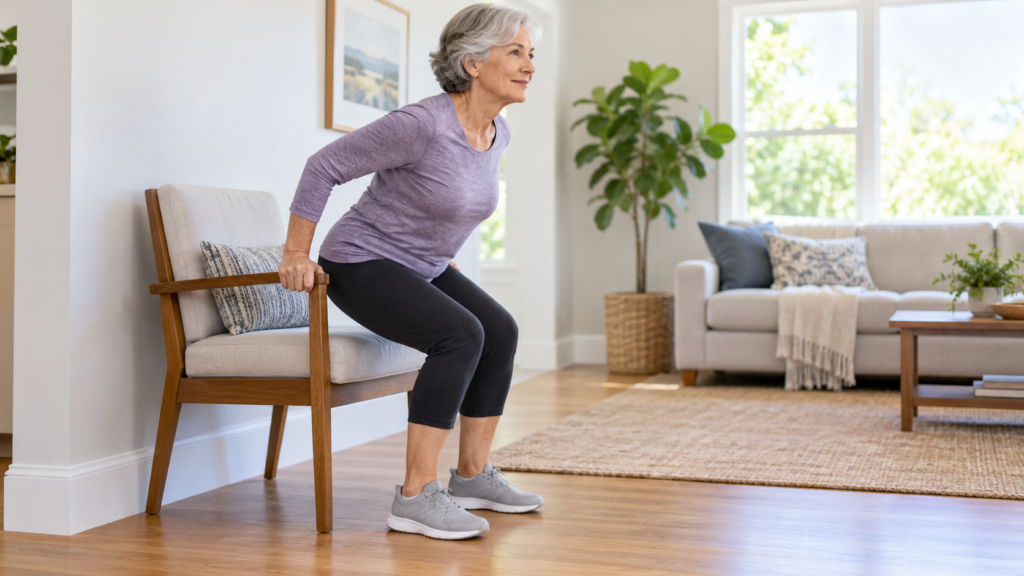
Targeted leg strengthening can help manage knee osteoarthritis by improving strength and making everyday movement easier. It does not rebuild worn cartilage, and the right exercise level depends on your symptoms and ability. Here is how to choose useful exercises, build them gradually and recognise when knee pain needs assessment.
What strengthening can realistically achieve
Knee osteoarthritis affects the joint as a whole, not just the cartilage. Pain, stiffness and weakness can make stairs, walking and getting out of a chair harder.
Training the legs builds capacity for these tasks. The NICE osteoarthritis recommendations support tailored strengthening and general fitness, with supervision when helpful.
- Choose a practical goal, such as rising from your dining chair more easily.
- Track function as well as pain.
- Avoid judging success by whether the knee becomes completely silent or symptom-free.
You do not need one supposedly perfect exercise. The American College of Rheumatology and Arthritis Foundation guideline supports several exercise approaches and does not identify one universal prescription.
Check that home strengthening is appropriate
These options are for established knee osteoarthritis, not a new unexplained injury. If you are unsure of the diagnosis, arrange an assessment rather than treating every painful knee as arthritis.
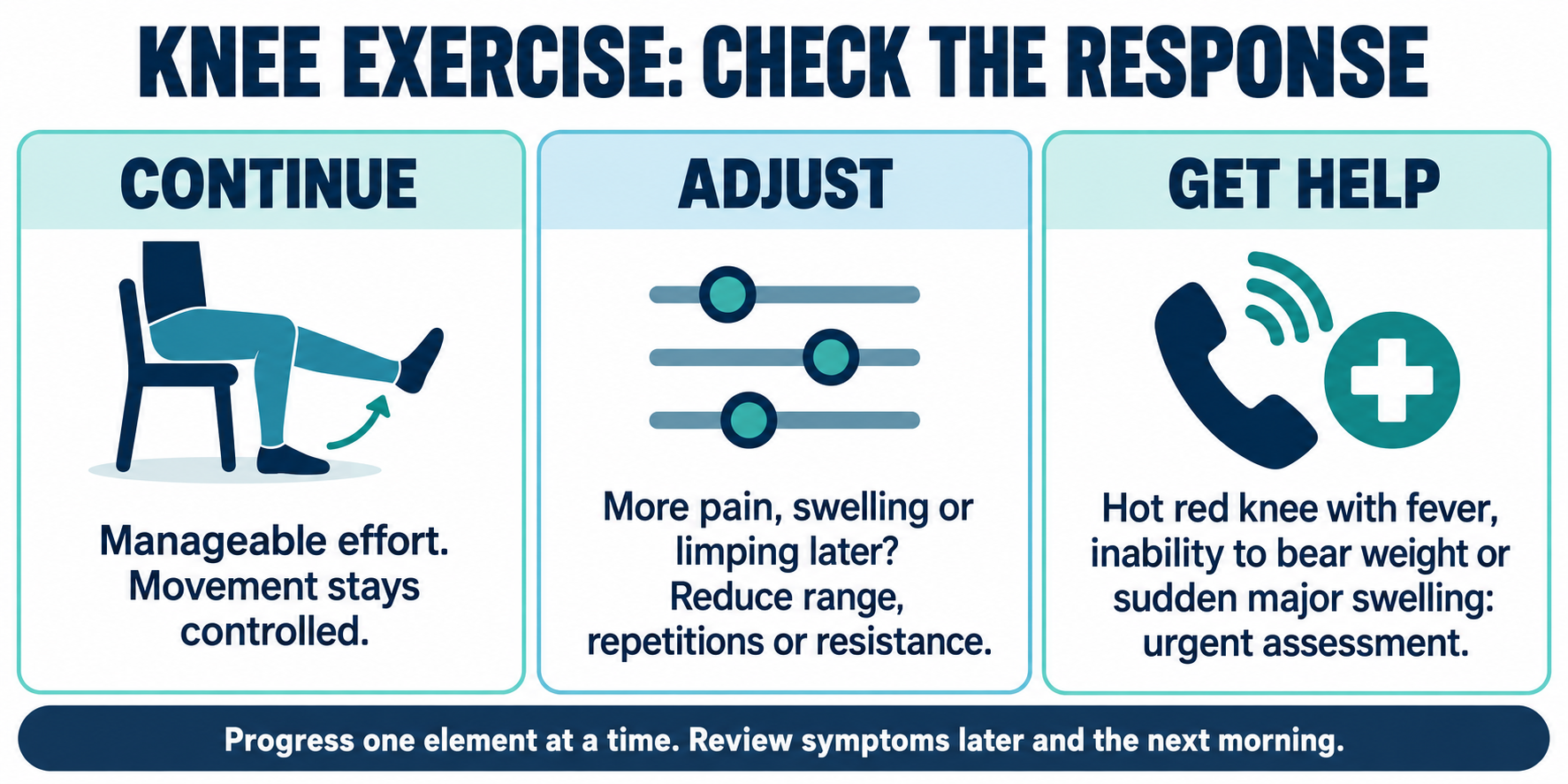
- Seek urgent help for a hot, red knee with fever or feeling unwell.
- Get urgent advice if you cannot bear weight, the knee becomes badly swollen or changes shape.
- A newly locked knee or repeated giving way also needs assessment.
The NHS knee pain guidance explains these warning signs. Follow individual restrictions after surgery, a recent injury or another medical condition; a general osteoarthritis routine does not replace them.
Choose a manageable starting dose
Begin below your maximum rather than testing how much discomfort you can tolerate. Try one or two exercises first so you can identify their effect.
- Use a stable chair, supportive footwear and a clear space.
- Start with one small set, for example three or four controlled repetitions.
- Rest when needed and finish before technique deteriorates.
- Leave recovery time between harder strengthening sessions.
The NHS knee exercise guidance includes low starting repetitions for beginners, with gradual increases. That is an example starting point, not a required dose for everyone.
A useful session is one you can repeat consistently. If three repetitions are too much, simplify the movement or seek help choosing an alternative.
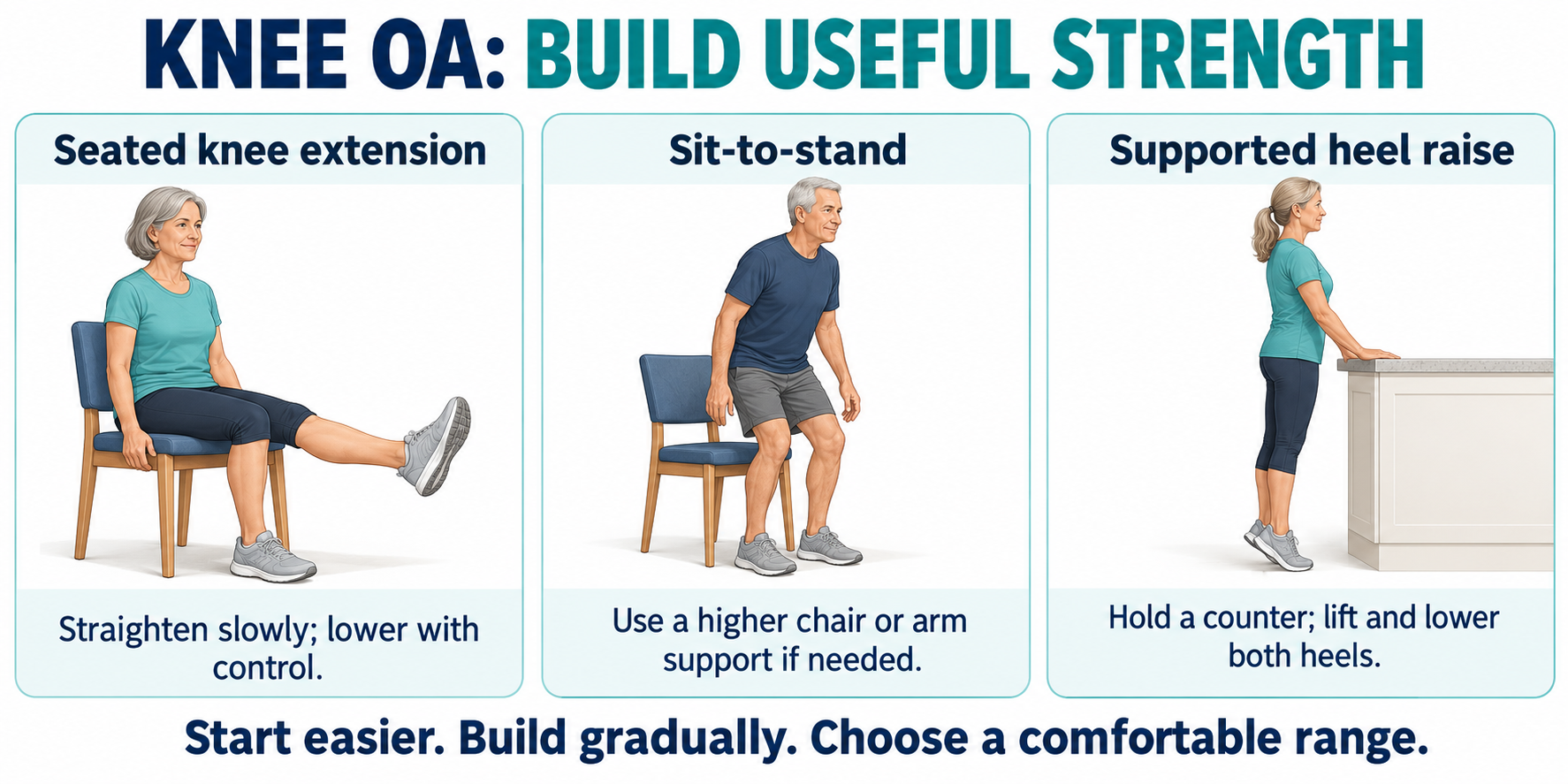
Use seated knee extension for direct thigh work
Sit upright on a firm chair with your thigh supported. Slowly straighten one knee through a comfortable range, then lower the foot without letting it drop.
- Keep your trunk steady rather than leaning back to swing the leg.
- Use a smaller movement if the final part is uncomfortable.
- Begin without an ankle weight.
This targets the quadriceps at the front of the thigh. Bexley’s knee osteoarthritis exercise guidance includes seated knee extension and other graded options.
If moving the knee is difficult, a clinician may start with a static thigh contraction: tighten the front thigh gently while the leg is supported, then relax. Do not force a stiff knee straight.
Practise sit-to-stand for everyday function
Place a sturdy chair against a wall. Sit with feet flat and comfortably apart, lean forward from the hips and stand, then lower yourself back with control.
- Use a higher, firm chair if a low seat is too demanding.
- Use armrests for assistance if needed.
- Keep the knees moving comfortably in the direction of the feet.
- Avoid dropping into the seat at the end.
The orthopaedic hospital’s knee osteoarthritis advice includes this practical strengthening movement. An assisted rise still counts as exercise; removing hand support is a progression, not a starting requirement.
For example, practise from the same chair you use at meals. That makes it easier to notice whether the task becomes smoother over time.
Include hip and calf exercises when useful
A knee programme can include the rest of the leg. Supported heel raises train the calves, while a bridge provides another way to work the hips and back of the thighs.
- For heel raises, hold a stable counter and lift both heels, then lower slowly.
- For a bridge, lie on your back with knees bent and feet planted, lift the hips gently and lower.
- Keep bridge height comfortable without arching the lower back.
- Choose a standing alternative with a therapist if getting down to the floor is unsafe.
Berkshire Healthcare’s physiotherapy exercise advice includes heel raises and bridges alongside knee strengthening. You do not need to perform every option in one session.
| Exercise | Easier option | Possible later progression |
|---|---|---|
| Seated knee extension | Smaller comfortable range, no added weight | More controlled repetitions, then suitable resistance |
| Sit-to-stand | Higher chair and arm support | Less hand assistance or a lower stable seat |
| Supported heel raise | Small lift with both legs and counter support | More repetitions while maintaining control |
| Bridge | Small hip lift on a safe surface | More repetitions before added difficulty |
These are choices, not a compulsory ladder. Progress only when the current version and its recovery response are manageable.
Build the challenge without chasing soreness
When an exercise becomes easy, increase one element at a time. Adding repetitions, resistance and depth together makes it harder to know which change caused a flare.
- First repeat the movement with consistent control.
- Add a small number of repetitions if recovery remains acceptable.
- Consider suitable resistance or a harder variation later.
- Ask for supervision if balance, confidence or technique limits you.
A physiotherapist can help choose the challenge that fits your goal. Climbing stairs may eventually need step practice, but repeated deep squats are not a requirement for everyone with knee osteoarthritis.
Use symptoms to adjust—not abandon—the plan
Some discomfort can occur when starting exercise. Sharp or escalating pain, a worsening limp or increasing swelling is a reason to change the session, not a target to push through.
- Check the knee during exercise and later that day.
- Notice whether sleep or the next morning’s usual activity is worse.
- Reduce range, repetitions or resistance when the response is excessive.
- Seek review if symptoms repeatedly worsen despite these adjustments.
During a familiar flare, temporarily choose gentler movement and less demanding activity. Resume the previous manageable level as symptoms settle rather than immediately making up missed sessions.
A suddenly hot, markedly swollen or unusable knee needs medical assessment even if you already have osteoarthritis.
Keep walking and general fitness in the picture
Strength work is one part of knee osteoarthritis management. The NIAMS osteoarthritis treatment guidance also includes low-impact activity, mobility and balance work.
- Choose short walks, comfortable cycling or water-based exercise according to access and tolerance.
- Break longer tasks into smaller bouts.
- Increase activity gradually rather than only exercising on unusually good days.
If weight management is appropriate, request supportive advice rather than delaying all exercise until weight changes. Strengthening can be adapted to current ability.
Review progress and ask for additional support
Look for trends over weeks, not a guaranteed result after one session. Examples include needing less help from your arms, walking farther comfortably or having more confidence on stairs.
- Record the exercise version and repetitions you used.
- Note what happens later and the next morning.
- Keep a simple functional goal to review.
- Arrange a review if pain prevents participation or daily life remains substantially limited.
The NHS osteoarthritis treatment overview explains additional support, including physiotherapy, walking aids and medicines. A pharmacist or clinician can check whether pain relief is suitable for you.
Persistent disability despite appropriate non-surgical treatment deserves a discussion about further options. Strengthening is useful care, not a reason to withhold reassessment or insist someone tolerate severe symptoms indefinitely.
Conclusion
Targeted leg strengthening is most useful when it matches your ability and daily goals. Start with manageable movements, build one demand at a time and review the knee’s response. Combine strength with regular activity, and seek assessment for warning signs or progress that remains limited.
Frequently asked questions
Can strengthening cure knee osteoarthritis?
No. Exercise can improve symptoms and function, but it does not promise to reverse joint changes or regrow cartilage.
Which exercise should I start with?
Choose a movement you can control, such as an unloaded seated knee extension or an assisted sit-to-stand. Your symptoms, balance and goals determine the best starting option.
How many repetitions do I need?
A few controlled repetitions may be enough initially. Build gradually rather than treating any example repetition count as a universal prescription.
Should I exercise every day?
Gentle movement may fit into daily life, while harder strengthening needs recovery. Agree a schedule that accounts for the exercise difficulty and your response.
Is all pain during exercise harmful?
Not necessarily; manageable discomfort can occur. Sharp or worsening pain, swelling, disturbed sleep or reduced next-day function calls for adjustment or assessment.
Are squats forbidden with knee arthritis?
No blanket ban applies. A high-chair sit-to-stand can offer a manageable alternative to a deep squat, with depth and assistance adapted to you.
Do I need weights or a resistance band?
Not to begin. Body-weight and unloaded exercises can provide a starting challenge, with resistance added when appropriate.
Can I keep walking?
Usually, walking can remain part of an adapted plan. Shorter bouts or another activity may be easier when symptoms increase.
What should I do during a flare?
Reduce the demanding parts and use gentler movement temporarily. Seek medical advice for new, severe or unusual symptoms instead of assuming every change is an ordinary flare.
When should I see a physiotherapist?
Seek help if you cannot find a tolerable starting exercise, feel unstable or struggle to progress. An individual assessment can address technique, support needs and other causes of pain.