
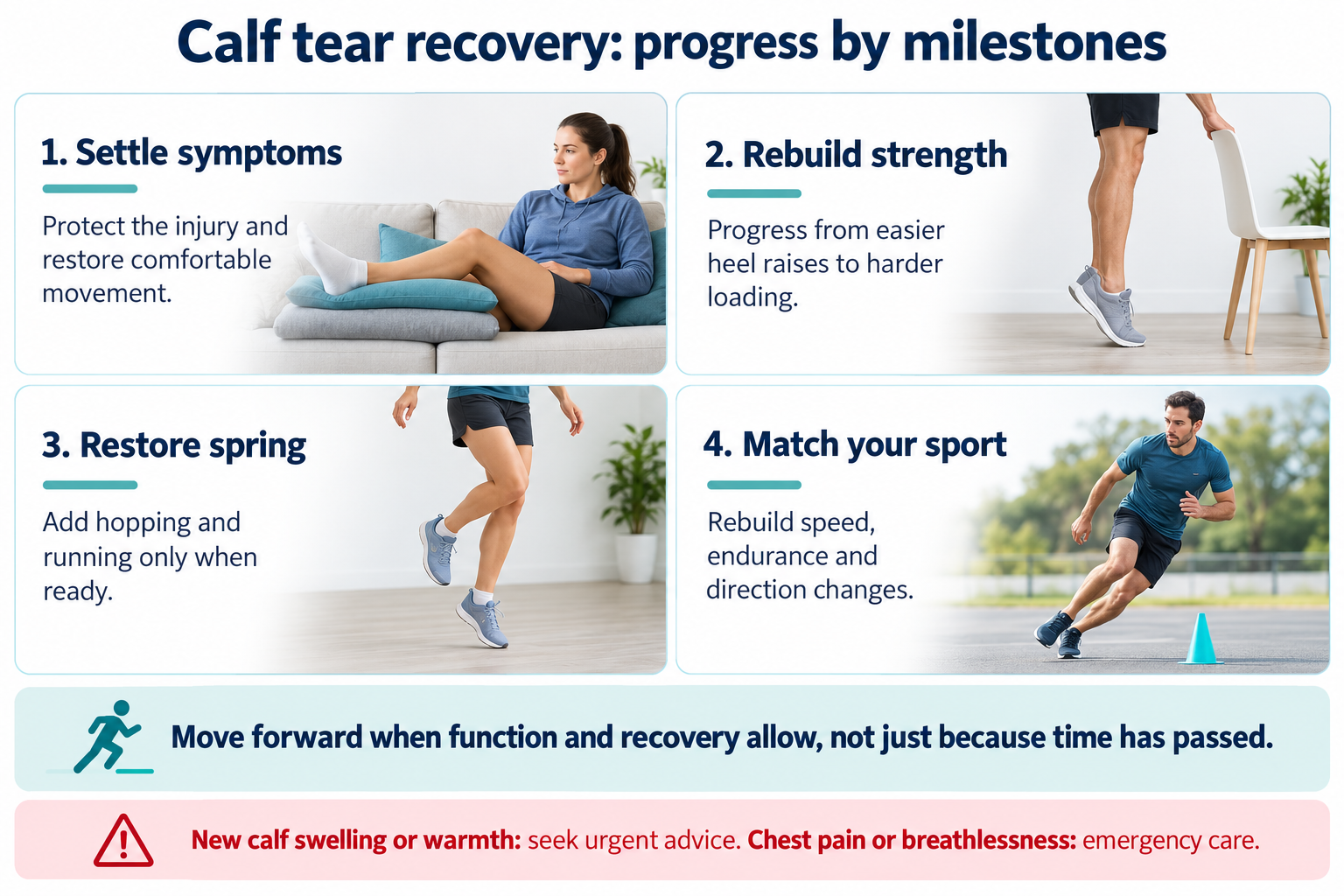
Calf tear recovery usually involves protecting the injured muscle briefly, restoring comfortable movement and gradually rebuilding strength before running or sport. Progressive loading means increasing what the calf does as its function and recovery allow. This guide explains practical exercise stages, how to adjust them and when calf pain needs urgent assessment.
Understand the injury before choosing exercises
A calf strain or tear affects muscle fibres at the back of the lower leg. The gastrocnemius is the larger superficial muscle, while the soleus lies deeper; both contribute to pushing the foot downward and join into the Achilles tendon.
Hospital guidance on calf muscle tears and strains describes sudden pain, swelling, bruising and difficulty walking. Severity varies, and a small strain and a major tear should not follow an identical exercise schedule.
- Clarify the diagnosis if pain began with a pop or major loss of push-off.
- Follow prescribed boot, heel-wedge and weight-bearing instructions.
- Ask for review if walking remains very difficult or recovery is worsening.
The exercises below are options for an assessed calf muscle injury. They are not an Achilles rupture programme or a substitute for evaluating unexplained calf pain.
Recognise blood clot and Achilles warning signs
New or increasing one-sided calf swelling, warmth, discolouration or throbbing pain needs urgent assessment for a possible deep vein thrombosis, or DVT. A muscle injury and reduced mobility do not exclude a blood clot.
- Seek urgent medical advice if symptoms suggest DVT.
- Do not massage or exercise a newly swollen, unexplained painful calf to test it.
- Chest pain or breathlessness with calf pain or swelling requires emergency care.
The NHS DVT guidance explains these symptoms and when to seek emergency help. Sudden severe pain, rapidly worsening swelling, numbness or a cold or discoloured foot also needs immediate assessment.
A pop near the heel or lower calf with difficulty pushing off may indicate an Achilles injury. Get urgent assessment rather than assuming it is a muscle strain.
- Do not repeatedly try heel raises after a suspected tendon rupture.
- Avoid calf stretching until an Achilles injury has been assessed.
- Keep any prescribed boot in the position advised by the treating team.
Royal Free London’s suspected Achilles injury advice specifically warns against stretching or ankle exercises during its protective treatment pathway.
Settle the early injury without prolonged inactivity
Initially, reduce painful walking, running and jumping. Use a walking aid if supplied, and aim to avoid repeatedly limping through long distances.
- Elevate the supported leg when resting if swelling is troublesome.
- Use a cold pack wrapped in a towel for short-term comfort, avoiding direct skin contact.
- Avoid forceful stretching, deep massage and heat over a fresh injury.
- Ask a pharmacist or clinician about appropriate pain relief if needed.
Gentle movement can usually be introduced as symptoms permit once the injury has been assessed. The NHS calf strain self-care guidance supports activity modification and movement within pain limits.
If you have a boot or crutches, use the individual plan rather than removing support because a generic exercise looks easy. Pain relief should help everyday function, not hide symptoms so you can return to sport early.
Restore comfortable ankle movement and walking
When permitted, sit with the leg supported and gently point the foot away, then bring it back toward you. Work within an easy range rather than pulling hard on the injured calf.
- Begin with a few slow ankle movements at a time.
- Stop if the movement causes sharp pain.
- Use shorter walks while working toward a comfortable, even stride.
- Reduce the distance if limping or swelling increases.
Worcestershire’s calf muscle tear advice includes early exercises and individual guidance about support. The goal is useful movement and improving walking, not reaching the maximum possible ankle range immediately.
Start calf loading with a seated heel raise
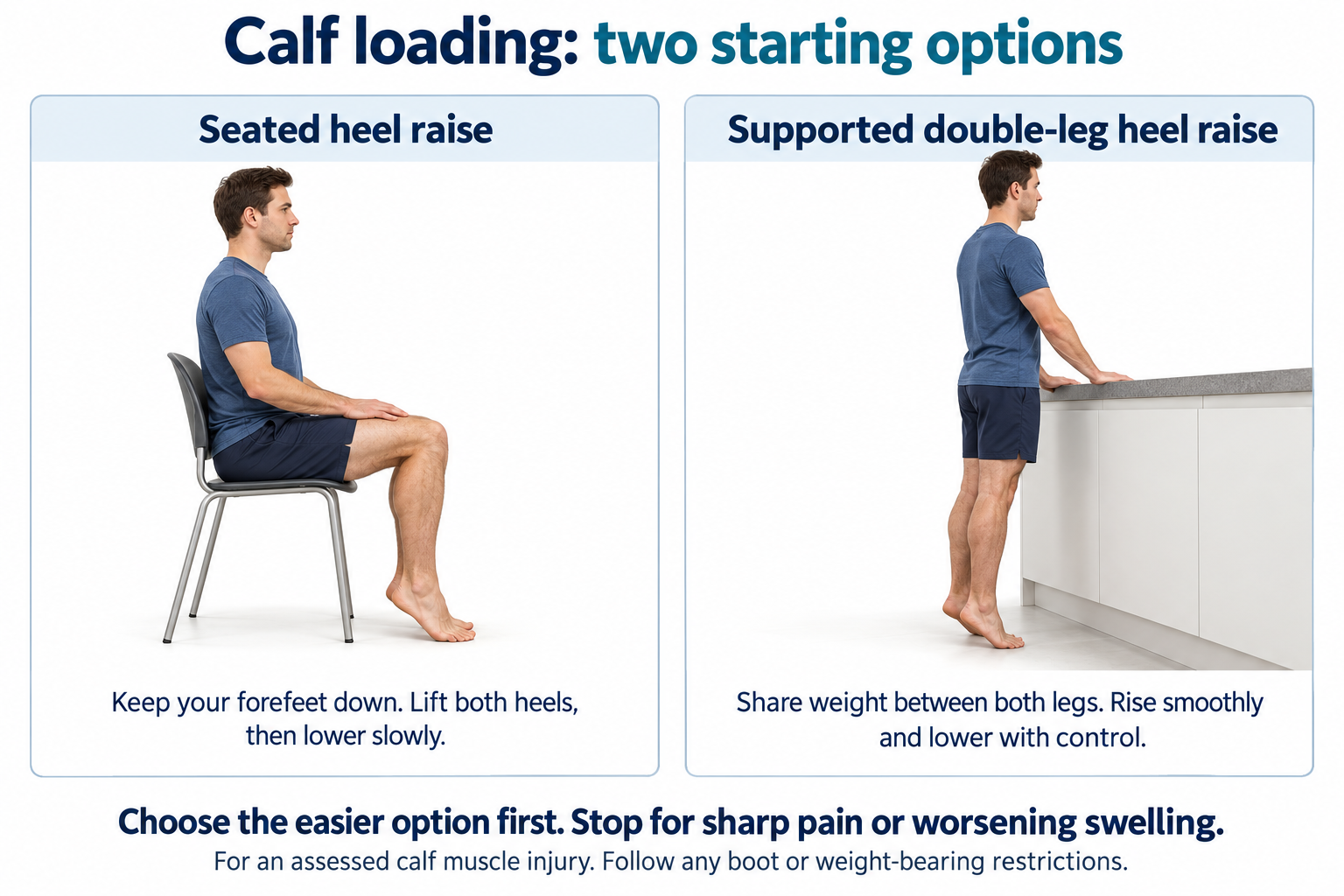
Once comfortable movement is possible and your treatment plan allows loading, sit on a stable chair with both feet supported. Keep the forefeet on the floor, lift the heels slightly and lower them slowly.
- Start without added weight.
- Use a small range if that is more comfortable.
- Begin with a few controlled repetitions rather than working to exhaustion.
- Stop if you get sharp pain or symptoms build from repetition to repetition.
The Leicester Hospitals calf strain exercise leaflet includes seated and standing heel raises. A seated version may be a useful first step, but is not automatically suitable immediately after every tear.
Progress to supported standing heel raises
When walking and the easier exercise are comfortable, try a double-leg heel raise while holding a stable counter. Keep both forefeet on level ground, share your weight between the legs and lift and lower the heels smoothly.
- Use your hands for balance rather than pulling yourself upward.
- Keep the knees comfortably straight without locking them.
- Avoid bouncing or rolling onto the outer edges of the feet.
- Return to the easier option if the injured side cannot contribute comfortably.
For an example starting trial, perform only a few good-quality repetitions, then check the response later. Add repetitions gradually before making the exercise substantially harder.
| Stage | Example | What to check |
|---|---|---|
| Comfortable movement | Gentle ankle movements and short walks | Less limping and no worsening swelling |
| Easier strength | Seated heel raise | Controlled movement with acceptable recovery |
| Body-weight strength | Supported double-leg heel raise | The injured side contributes without sharp pain |
| Higher strength demands | Single-leg or added-resistance work | Good movement quality, endurance and next-day response |
| Elastic and sport demands | Hopping, running and direction changes | Readiness assessed for the intended activity |
The table describes a broad progression, not a checklist that clears you for sport without assessment.
Build single-leg and bent-knee capacity
Later rehabilitation should prepare the calf for more than a few easy repetitions. A physiotherapist may progress from double-leg to supported single-leg heel raises and add resistance when body-weight work is manageable.
- Introduce one harder element at a time.
- Include bent-knee calf work when appropriate, not only straight-knee raises.
- Compare movement height and control between sides as well as repetitions.
- Allow recovery after demanding strength sessions.
Changing knee position changes the demands on the calf muscles; it does not completely isolate one muscle. Research describing expert clinicians’ calf rehabilitation practices emphasises monitoring capacity, loading response and sport demands. It is expert-practice research rather than proof of one best exercise programme.
Do not jump straight to heel drops off a step or heavy single-leg work because they appear in a general calf routine. Range, resistance and speed should be chosen for your stage of recovery.
Restore hopping and running before full sport
Pain-free walking is a useful milestone, but running, jumping and sprinting place different demands on the calf. Later rehabilitation needs to rebuild those demands before unrestricted sport.
- Introduce small controlled springing or hopping only when your clinician considers you ready.
- Begin running at an easy level suited to your previous ability and recovery.
- Rebuild speed, longer efforts and direction changes separately.
- Complete the relevant training demands before returning to competition.
A runner needs repeated calf loading over distance; a court-sport player also needs acceleration, braking and changes of direction. A single successful heel raise does not test all of these requirements.
If pain changes your stride, you feel a fresh pull or the calf becomes more swollen, stop the session and reassess. Do not use repeated hopping as an early self-test immediately after injury.
Adjust exercise according to recovery
Check symptoms during the session, afterward and the following morning. A calf that becomes progressively more painful, swollen or difficult to walk on has not tolerated the current dose.
- Reduce repetitions, range or resistance if symptoms increase.
- Return to the last manageable exercise level rather than abandoning all movement.
- Seek review for a new pop, loss of function or repeated setbacks.
- Arrange urgent assessment for new DVT-type symptoms rather than calling them normal soreness.
Mild muscular effort can occur with strengthening, but sharp pain at the tear is not a target. Progress should leave you able to manage your normal daily activity without a worsening limp.
Support recovery and reduce repeat injuries
Continue calf strength work after you resume sport and avoid sudden jumps in training. Build toward the actual demands you expect to meet, especially after time away.
- Warm up progressively before faster running or jumping.
- Balance demanding sessions with recovery.
- Keep enough food, fluids and sleep in your routine.
- Ask for advice if calf weakness or recurrent strains limit participation.
Recovery commonly takes weeks and can take longer with a more substantial injury. The size and location of the tear, previous injuries and activity goals all matter, so a fixed deadline is less useful than improving function and a clear review plan.
Conclusion
Calf tear recovery works toward comfortable movement, progressively stronger heel raises and the running or sport demands you need. Start with manageable loading, review the response and advance by milestones rather than dates. New swelling, possible Achilles symptoms or chest pain and breathlessness require medical assessment rather than another exercise session.
Frequently asked questions
Is a calf strain the same as a calf tear?
A strain involves injury to muscle fibres and is often described as a tear. Severity ranges from a small injury to a major tear, which is why symptoms and examination guide the plan.
How long does a calf tear take to recover?
Recovery varies from weeks to longer periods for more severe injuries. Comfortable walking, calf strength and tolerance of your intended activity are more useful milestones than one promised return date.
Should I stretch the calf straight away?
Do not force a fresh tear into a stretch. Gentle movement may be appropriate after assessment, but suspected Achilles injury and specific boot protocols require different restrictions.
Which loading exercise is easiest to start with?
A seated heel raise without added weight may be an easier option when permitted. Begin with a small comfortable movement and progress only if the calf tolerates it.
When can I try standing heel raises?
Try a supported double-leg version when walking and easier loading are comfortable and any treatment restrictions allow it. Step back if you cannot share weight without sharp pain.
Do I need bent-knee exercises too?
They may be useful later because different knee positions change calf loading demands. A physiotherapist can select suitable straight- and bent-knee exercises for your injury and goals.
Can I walk if it hurts?
Keep walking within the limits advised by your clinician and avoid pushing through a worsening limp. Use prescribed support and seek review if ordinary walking remains difficult or symptoms increase.
When can I run again?
Running follows restoration of walking, strength and readiness for repeated impact. Start gradually with a plan matched to your activity; being able to walk without pain is not the only requirement.
How could a blood clot differ from the tear?
New or worsening one-sided swelling, warmth, discolouration or throbbing pain can suggest DVT, but symptoms overlap. Seek urgent assessment rather than trying to distinguish them with home exercises or massage.
Which symptoms need emergency care?
Chest pain or breathlessness with calf pain or swelling needs emergency care. Sudden severe pain, rapidly worsening swelling, numbness or a cold or discoloured foot also needs immediate assessment.