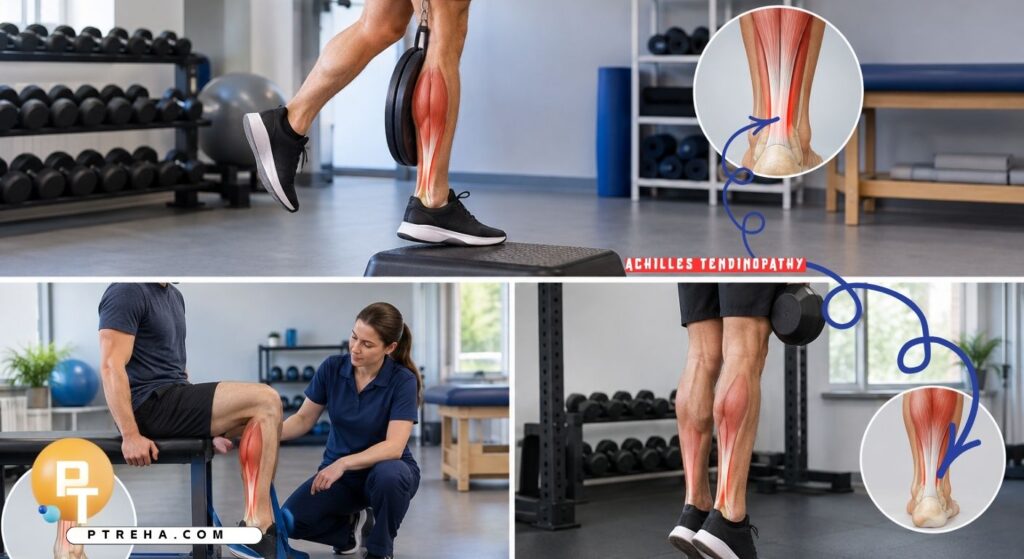
Achilles tendinopathy is commonly managed with progressive tendon loading rather than prolonged rest, and heavy slow resistance (HSR) is one practical way to progressively strengthen the calf–Achilles complex.
This guide explains how to apply HSR safely, how to progress resistance and repetitions, how to monitor symptoms, and how to adapt the program to the individual patient.
What Is Heavy Slow Resistance Training?
Heavy slow resistance training uses progressively heavier resistance while each repetition is performed at a deliberately controlled speed.
For Achilles rehabilitation, the goal is not simply to make the calf muscles tired but to progressively expose the tendon and plantar-flexor muscles to higher mechanical demands.
The evidence supports tendon-loading exercise as a first-line treatment for midportion Achilles tendinopathy.
Current clinical guidance recommends loads as high as tolerated, provided there is no concern about substantial tendon structural frailty.
HSR is not synonymous with eccentric exercise.
It normally includes both concentric and eccentric phases, allowing the gastrocnemius, soleus, and Achilles tendon to experience substantial loading throughout the movement.
Key principles include:
- Progressive rather than sudden loading.
- Slow, controlled repetitions.
- Gradual increases in resistance.
- Adequate recovery between sessions.
- Monitoring symptoms over time.
- Maintaining good movement quality.
- Progressing toward the patient’s functional goals.
Who Can Benefit From Achilles HSR?
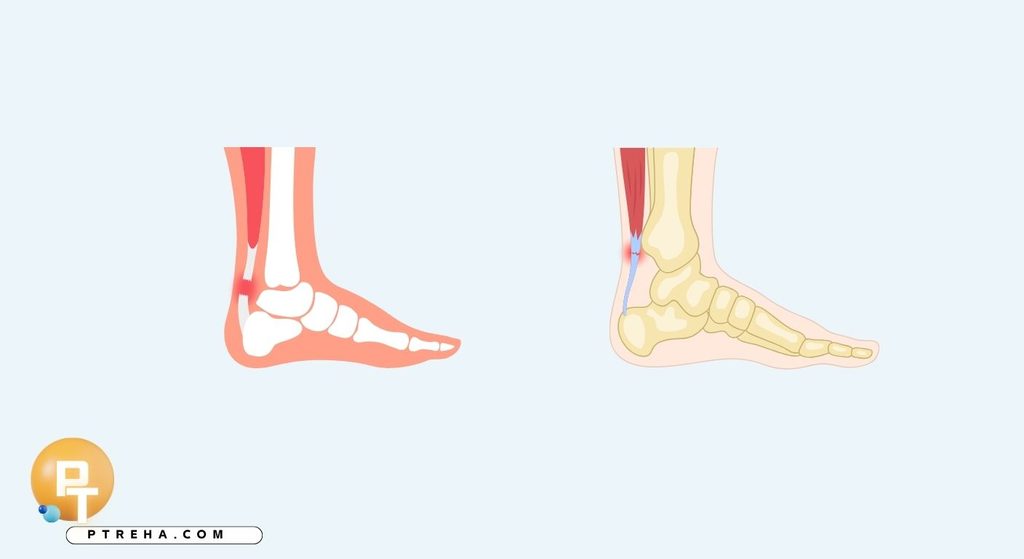
The strongest direct evidence for the classic HSR protocol comes from adults with chronic midportion Achilles tendinopathy.
In a randomized controlled trial, HSR and eccentric training both produced meaningful improvements in symptoms and function, with benefits maintained at follow-up.
This does not mean that every patient should immediately begin with heavy resistance.
The appropriate starting point depends on irritability, strength, training history, functional capacity, and the clinician’s examination.
HSR may be particularly useful when a patient:
- Has sufficient baseline loading tolerance.
- Can perform controlled heel raises.
- Has access to resistance equipment.
- Wants a structured gym-based program.
- Needs progressive calf strengthening.
- Is returning to running or jumping.
- Has persistent symptoms despite lower-load exercise.
- Can tolerate loading without unacceptable symptom escalation.
A patient with very irritable symptoms may initially require a lower-load version of calf strengthening before progressing toward traditional HSR.
Midportion vs Insertional Achilles Tendinopathy
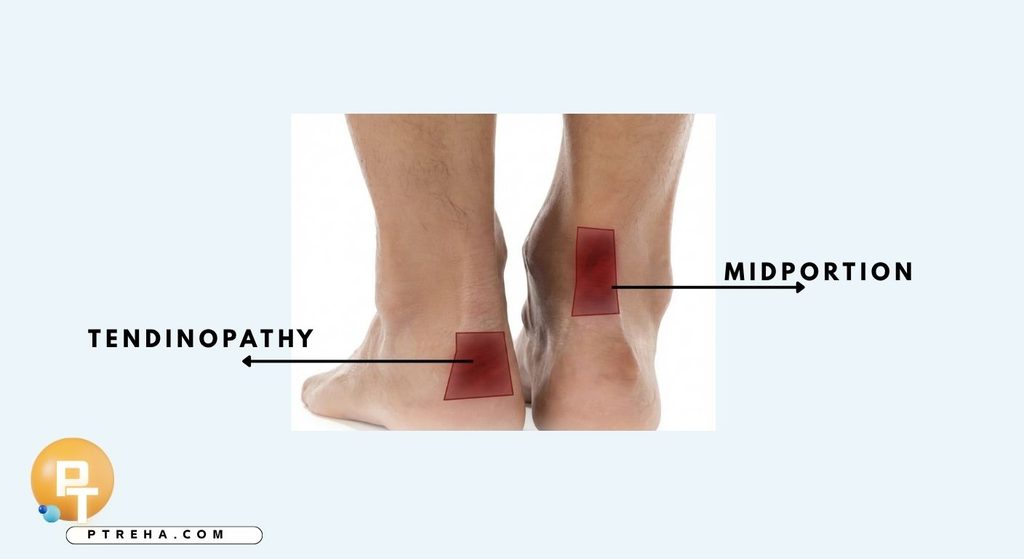
Before prescribing the program, identify where the symptoms are located.
Midportion Achilles tendinopathy typically produces symptoms in the tendon above its calcaneal attachment.
Insertional Achilles tendinopathy is centered near the tendon attachment to the calcaneus.
The current midportion clinical practice guideline specifically states that its recommendations should not automatically be generalized to insertional disease.
This distinction matters because deep ankle dorsiflexion can increase compression at the tendon insertion.
For insertional symptoms, early exercises may therefore be performed on a flat surface rather than from a step, with the exercise range modified according to symptoms.
Practical clinical checks include:
- Locate the patient’s maximal pain area.
- Determine whether pain is midportion or insertional.
- Assess single-leg heel-raise ability.
- Examine plantar-flexor strength.
- Assess functional loading tolerance.
- Consider running and jumping demands.
- Review recent changes in activity.
- Establish a baseline outcome measure such as VISA-A when appropriate.
Clinical point: The exercise name alone does not determine whether an Achilles program is appropriate. The patient’s tendon location, loading tolerance, function, and response to progression all matter.
The Classic HSR Exercise Selection
The commonly studied HSR program for midportion Achilles tendinopathy used three bilateral calf exercises performed in a gym environment:
- Seated calf raise with the knee flexed.
- Calf raise in a leg-press machine with the knee relatively extended.
- Standing calf raise with the knee relatively extended.
The program was performed three times per week, with resistance progressively increased while repetitions decreased.
The original research used a 15-repetition maximum early in the program and progressed toward a 6-repetition maximum later.
Seated Calf Raise
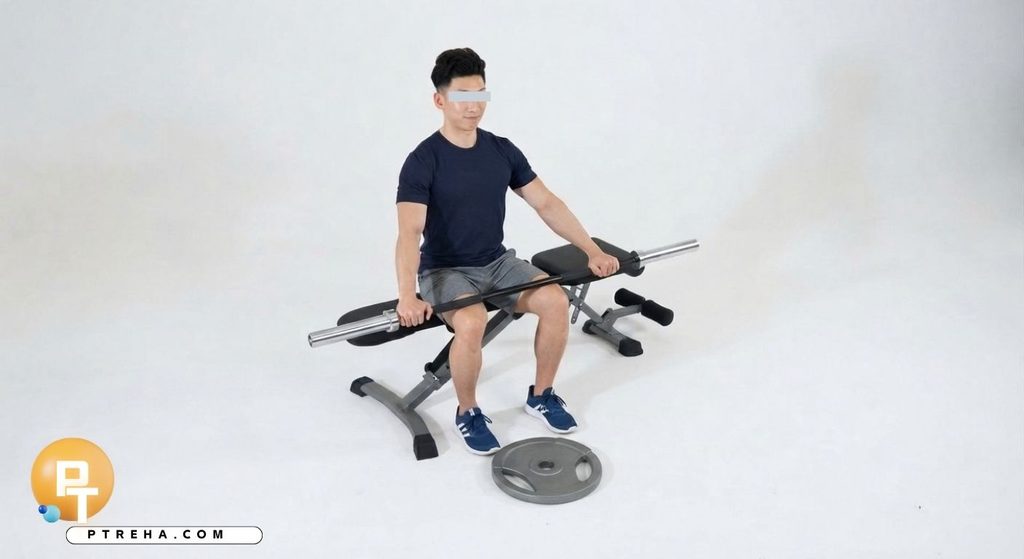
The seated variation emphasizes plantar-flexor work with the knee flexed, increasing the contribution of the soleus relative to a straight-knee position.
The patient should maintain controlled ankle movement and avoid bouncing through the bottom of the repetition.
Useful coaching cues include:
- Keep the forefoot securely supported.
- Move through a controlled ankle range.
- Avoid sudden bouncing.
- Maintain consistent tempo.
- Use a load that permits technically sound repetitions.
- Avoid compensatory knee or hip movement.
Leg-Press Calf Raise
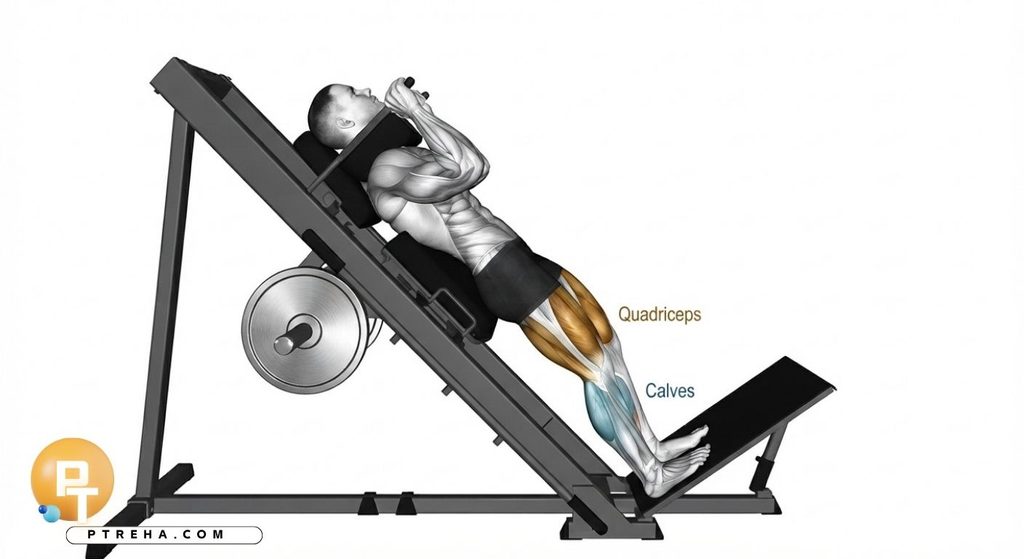
The leg-press variation provides external support while allowing substantial resistance to be applied to the plantar-flexors.
The patient performs a controlled heel-raise movement against the resistance of the machine, maintaining a stable foot position.
Important points include:
- Keep the forefoot supported.
- Control both directions.
- Avoid abrupt end-range movement.
- Keep the ankle and foot aligned.
- Progress resistance gradually.
- Reassess symptoms after the session.
Standing Calf Raise
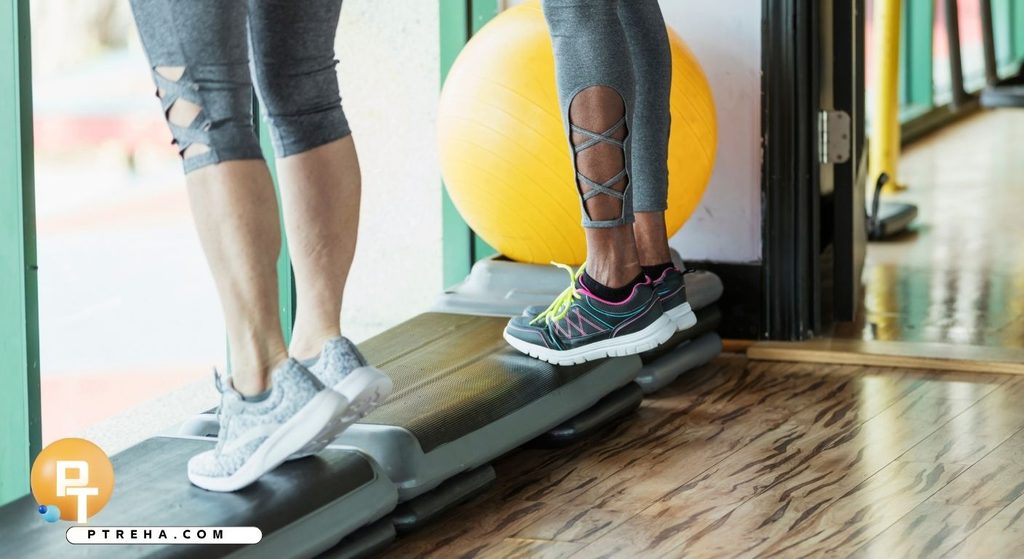
The standing variation provides a more functional straight-knee plantar-flexor exercise and can be performed using a Smith machine, barbell setup, or another appropriate resistance system.
The movement should remain controlled rather than being performed as a rapid bouncing heel raise.
Useful cues include:
- Maintain stable foot contact.
- Raise the heel smoothly.
- Pause only if clinically useful.
- Lower under control.
- Avoid excessive trunk movement.
- Keep repetitions consistent.
HSR Repetition and Load Progression
The original Achilles HSR trial used a structured progression from higher repetitions and lower external resistance toward lower repetitions and heavier resistance.
The published protocol progressed through 15RM, 12RM, 10RM, 8RM, and 6RM stages.
The original program was organized as follows:
| Training period | Target repetition range | Sets per exercise | Main progression |
|---|---|---|---|
| Week 1 | 15RM | 3 | Establish technique and starting load |
| Weeks 2–3 | 12RM | 3 | Increase resistance |
| Weeks 4–5 | 10RM | 4 | Increase resistance and volume |
| Weeks 6–8 | 8RM | 4 | Continue progressive loading |
| Weeks 9–12 | 6RM | 4 | Highest planned resistance |
The original protocol used approximately three seconds for the concentric phase and three seconds for the eccentric phase, producing a deliberately slow repetition.
It also used rest periods between sets and exercises.
However, clinicians should not treat these exact numbers as mandatory for every patient.
Contemporary guidance emphasizes loading at an intensity as high as tolerated rather than requiring one universal exercise recipe.
Progression should consider:
- Current strength.
- Exercise tolerance.
- Pain response.
- Recovery between sessions.
- Movement quality.
- Functional goals.
- Training experience.
- Other lower-limb training.
- Running or jumping exposure.
- Overall weekly tendon load.
How to Monitor Pain During HSR
Pain during tendon rehabilitation does not automatically mean that the exercise is damaging the tendon.
At the same time, excessive or progressively worsening symptoms should not simply be ignored.
A practical approach is to monitor the patient’s symptoms during the exercise and again during the following day.
Look for:
- Exercise-related pain.
- Change in walking comfort.
- Morning stiffness.
- Post-exercise soreness.
- Symptoms during stairs.
- Symptoms during running.
- Symptoms during jumping.
- Recovery before the next session.
- Progressive change in function.
The patient’s response over several sessions is generally more useful than reacting to one isolated pain score.
If symptoms repeatedly become substantially worse and remain elevated into subsequent activity, the clinician may need to reduce resistance, range, volume, or other concurrent tendon-loading activities.
The Dutch multidisciplinary guideline similarly recommends pain monitoring and gradual adjustment of sporting activities while progressively strengthening the calf for at least several weeks.
Important: Symptom monitoring should guide load modification, not become a reason to avoid all tendon loading.
Practical HSR Program Example
A patient with established midportion Achilles tendinopathy who can tolerate calf strengthening may begin with a controlled bilateral program.
A practical session could include:
- Seated calf raise.
- Leg-press calf raise.
- Standing calf raise.
- Three controlled sets initially.
- Slow concentric and eccentric phases.
- Adequate rest between sets.
- Three sessions per week.
- Gradual resistance progression.
- Symptom monitoring after training.
- Functional reassessment at regular intervals.
The load should be challenging without compromising technique.
For a patient who cannot tolerate the planned resistance, the clinician can temporarily reduce the load and rebuild capacity.
Conversely, if the prescribed load becomes clearly easy while symptoms remain stable, progressive resistance can be considered.
The objective is not to reach an arbitrary weight.
The objective is to progressively improve the patient’s capacity to tolerate plantar-flexor and Achilles loading.
Common HSR Mistakes
A well-designed program can become ineffective when the exercise is performed too quickly, progressed too aggressively, or separated from the patient’s overall activity load.
Common errors include:
- Increasing resistance too rapidly.
- Treating pain as the only outcome.
- Ignoring next-day symptoms.
- Using poor ankle mechanics.
- Bouncing through repetitions.
- Training to complete muscular failure unnecessarily.
- Changing several variables simultaneously.
- Ignoring running volume.
- Progressing strength without progressing function.
- Assuming every Achilles problem should use the same program.
Another common mistake is treating the original research protocol as a rigid prescription.
The study provides useful evidence that HSR can work; it does not establish that every patient must use exactly the same equipment, repetition schedule, tempo, or range of motion.
How to Progress From Strength to Running and Sport
Strength rehabilitation is only one part of Achilles rehabilitation for a runner or jumping athlete.
A patient may regain good calf strength but still have inadequate tolerance for repeated running, acceleration, deceleration, hopping, or jumping.
Return-to-sport planning should therefore gradually expose the tendon to the specific demands of the target activity.
Exercise-based rehabilitation is supported as a core component of Achilles management, while sport-specific progression should reflect the patient’s symptoms, impairments, and activity demands.
Useful progression targets include:
- Walking without meaningful symptom limitation.
- Repeated single-leg heel raises.
- Faster plantar-flexion movements.
- Low-level hopping.
- Repeated hopping.
- Running at controlled intensity.
- Increasing running volume.
- Acceleration and deceleration.
- Sport-specific jumping.
- Full training exposure.
The sequence should be individualized rather than dictated solely by a calendar.
What Does the Evidence Say About HSR?

HSR has direct clinical evidence in midportion Achilles tendinopathy.
In the randomized trial comparing HSR with eccentric training, both approaches produced significant improvements in symptoms and function, and neither showed a clinically important overall advantage in the longer follow-up.
The same trial found high adherence to the HSR program, suggesting that a structured gym-based approach can be practical for appropriately selected patients.
More recent clinical guidance supports tendon-loading exercise broadly rather than restricting clinicians to eccentric-only exercise.
The guideline recommends loading at an intensity as high as tolerated and exercising at least three times per week for midportion Achilles tendinopathy when there is no presumed tendon structural frailty.
Evidence reviews also indicate that high-load slow-velocity resistance exercise is a reasonable treatment option for Achilles tendinopathy, although the evidence does not establish HSR as universally superior to every other loading strategy.
This is clinically important: HSR is an evidence-supported option, not a requirement.
When Should HSR Be Modified or Delayed?
Heavy loading is not automatically appropriate simply because HSR has supporting evidence.
A clinician should first determine whether the patient can safely tolerate the planned exercise and whether the clinical presentation fits the population for which the evidence is most applicable.
Modification may be appropriate when:
- Symptoms are highly irritable.
- The patient cannot perform the movement with adequate control.
- The tendon response remains elevated between sessions.
- There is substantial functional limitation.
- The diagnosis is uncertain.
- The presentation is not consistent with typical tendinopathy.
- There is concern about significant tendon structural compromise.
- The patient has recently experienced an acute traumatic event.
Sudden posterior ankle pain accompanied by a popping sensation, substantial weakness, or difficulty performing a plantar-flexion task warrants appropriate clinical assessment rather than simply increasing resistance.
Likewise, persistent swelling, unusual neurological symptoms, marked night pain, systemic symptoms, or other atypical findings should prompt reconsideration of the working diagnosis and referral when appropriate.
Conclusion
Heavy slow resistance training provides a structured method for progressively loading the calf–Achilles complex in people with appropriate loading tolerance, particularly those with midportion Achilles tendinopathy.
Evidence indicates that HSR can produce meaningful improvements in pain and function, while contemporary guidelines support progressive tendon loading rather than restricting rehabilitation to eccentric exercise.
The most important clinical principle is individualization.
Start with an appropriate load, use controlled movement, progress resistance as tolerated, monitor the patient’s response, and eventually connect strength gains to the functional demands of walking, running, jumping, or sport.
Frequently Asked Questions
Is heavy slow resistance effective for Achilles tendinopathy?
Yes.
HSR has been studied directly in people with midportion Achilles tendinopathy and produced significant improvements in pain and function.
Research comparing HSR with eccentric training found similar overall clinical outcomes between the approaches.
How many times per week should Achilles HSR be performed?
The classic HSR protocol was performed three times per week.
Current clinical guidance also recommends tendon-loading exercise at least three times per week for midportion Achilles tendinopathy, at an intensity as high as tolerated when appropriate.
How heavy should the resistance be?
The resistance should be sufficiently challenging to provide progressive overload while maintaining appropriate technique and an acceptable symptom response.
The original HSR study progressively moved from approximately 15RM toward 6RM loads, but those exact targets should not be applied rigidly to every patient.
Should Achilles exercises be slow?
HSR specifically uses deliberately slow repetitions.
The original protocol used approximately three seconds for the concentric phase and three seconds for the eccentric phase.
However, slow movement is only one part of the rehabilitation strategy.
The patient’s total loading capacity and eventual need for faster functional movements also need to be considered.
Is HSR better than eccentric exercises?
The available direct trial evidence does not establish HSR as universally superior to eccentric training.
Both approaches produced meaningful clinical improvements, so exercise selection can be based on patient characteristics, access to equipment, preferences, and clinical goals.
Can I do HSR with only body weight?
Yes, body-weight calf raises can be used when external resistance is not yet appropriate or equipment is unavailable.
However, traditional HSR usually requires progressive external resistance once body-weight loading becomes insufficient to provide an appropriate training challenge.
Should Achilles HSR hurt?
Some symptoms during rehabilitation can occur, and pain alone does not necessarily indicate tissue damage.
The more important issue is whether symptoms remain acceptable and recover appropriately between sessions; repeated substantial worsening should lead to reassessment of the training dose.
Can HSR be used for insertional Achilles tendinopathy?
HSR principles can be adapted to insertional presentations, but the evidence and exercise recommendations for midportion Achilles tendinopathy should not simply be transferred unchanged.
In particular, early insertional rehabilitation may use a flatter exercise surface and avoid unnecessary deep dorsiflexion.
When can I return to running after Achilles tendinopathy?
Return to running should be based on functional capacity and symptom response rather than a fixed timetable.
A progressive sequence can move from strengthening to hopping and running, followed by gradual increases in running intensity and volume according to the individual’s goals and tolerance.
Do I need a gym for Achilles rehabilitation?
No.
A gym provides convenient options for progressive external resistance, but Achilles rehabilitation can also begin with simpler calf-strengthening exercises.
The essential principle is progressive loading that is appropriate for the patient’s current capacity and gradually advances toward the demands of daily life or sport.
Resources
- PubMed — Heavy Slow Resistance Versus Eccentric Training for Achilles Tendinopathy
- APTA Orthopaedic Physical Therapy — Midportion Achilles Tendinopathy Clinical Practice Guideline
- JOSPT — Midportion Achilles Tendinopathy Clinical Practice Guideline
- PubMed — Effects of High-Load Slow-Velocity Resistance Exercise in Athletes With Tendinopathy
- PubMed — Dutch Multidisciplinary Guideline on Achilles Tendinopathy