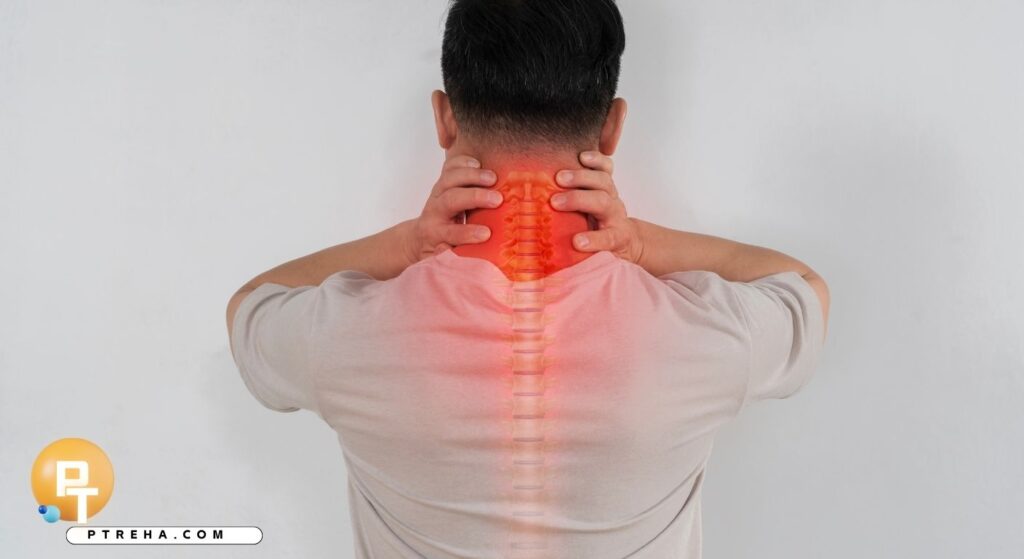
People with cervical radiculopathy may experience neck pain together with arm pain, tingling, numbness, or weakness. The best exercise program is not simply a list of neck stretches; it should progressively restore comfortable movement, upper-quarter strength, and tolerance to activity while monitoring neurological symptoms.
Important: These exercises are general examples, not a substitute for an individual assessment. New or worsening weakness, increasing numbness, problems with balance or walking, or other neurological changes require medical reassessment.
1. Gentle Cervical Retraction

Cervical retraction is a controlled movement in which the head moves backward without looking upward. It can help a patient practice controlled cervical movement while maintaining an upright position.
How to perform it
- Sit upright with your shoulders relaxed.
- Look straight ahead.
- Slowly draw your head backward, as though making a gentle “double chin.”
- Keep your eyes level rather than looking down.
- Hold the position briefly.
- Return slowly to the starting position.
Recommended approach
Begin with a small, comfortable movement rather than forcing the neck into its end range.
A practical starting point is:
- 8–10 repetitions
- Slow, controlled movement
- 1–2 sets
- Rest as needed between sets
- Perform within a comfortable range
What should you feel?
You may feel mild muscular effort around the front or back of the neck, but the exercise should not produce a strong increase in arm pain, numbness, or tingling.
Some patients find that certain cervical movements reduce or centralize their symptoms, while others are aggravated by the same movement. The response of the individual patient should therefore determine whether this exercise is appropriate.
Common mistakes
Avoid:
- Tilting the head downward
- Lifting the chin
- Moving the entire trunk backward
- Performing the exercise aggressively
- Repeatedly provoking distal arm symptoms
2. Gentle Cervical Rotation

Maintaining comfortable neck rotation can help prevent unnecessary movement avoidance and improve the patient’s ability to look around during everyday activities.
How to perform it
- Sit or stand upright.
- Keep your shoulders relaxed.
- Slowly turn your head toward one side.
- Move only as far as comfortable.
- Return to the center.
- Repeat toward the opposite side.
The movement should be smooth rather than forced.
Recommended approach
Try:
- 5–10 repetitions each direction
- Slow movement
- 1–2 sets
- Comfortable range of motion
- Regular breaks when symptoms are irritable
Symptom monitoring
The important point is not simply whether the neck feels stiff. Pay attention to what happens in the arm.
For example, if turning the head produces a mild local stretch in the neck but does not worsen the arm symptoms, that may be acceptable. If the movement consistently increases shooting arm pain or numbness, the exercise should be modified or temporarily avoided.
Progression
As tolerance improves, the patient can gradually increase the comfortable range. The objective is not to force maximum rotation but to restore useful, confident movement.
3. Resistance Band Row
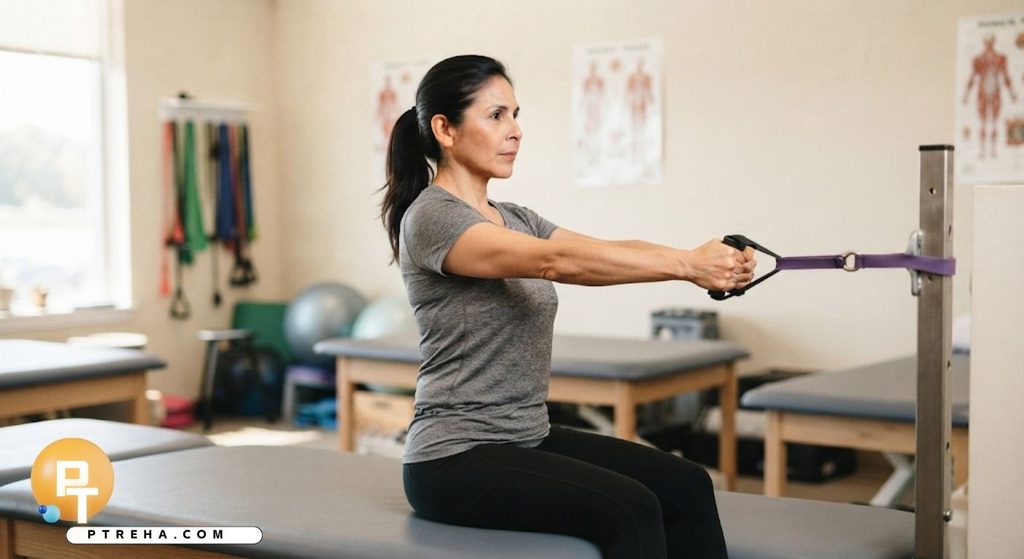
Upper-quarter strengthening can be useful as part of a broader rehabilitation program. A resistance-band row trains the muscles responsible for pulling the shoulder blades backward and can be incorporated once the patient can tolerate the starting load.
How to perform it
- Attach a resistance band securely at approximately chest height.
- Hold one end in each hand.
- Stand or sit with the spine in a comfortable neutral position.
- Begin with the arms extended forward.
- Pull the band toward your body.
- Move the elbows backward without aggressively shrugging the shoulders.
- Gently bring the shoulder blades toward each other.
- Slowly return to the starting position.
Recommended approach
A useful starting point may be:
- 8–12 repetitions
- 1–3 sets
- Controlled movement
- Light-to-moderate resistance
- Gradual progression as tolerated
The exact resistance should depend on the patient’s current strength and symptoms rather than a fixed weight.
Why include it?
The purpose is not to “put the vertebrae back in place.” Instead, strengthening helps improve the patient’s ability to tolerate upper-limb and postural demands during daily activities.
For example, a patient returning to desk work, lifting, or household tasks may gradually need more upper-quarter strength and endurance.
Common mistakes
Avoid:
- Excessive shoulder shrugging
- Jerking the band
- Excessive spinal extension
- Starting with too much resistance
- Holding the breath during the exercise
4. Neural Sliding Exercise

Neural mobilization can be incorporated into rehabilitation for selected patients with cervical radicular symptoms. Research suggests that neural mobilization may contribute to improvements in pain and disability, particularly when combined with other rehabilitation approaches, although the evidence is not strong enough to justify using one specific neural exercise for everyone.
A slider is generally performed with alternating movements so that the nerve is moved without deliberately holding a strong sustained stretch.
Example: Gentle Median-Nerve Slider
This exercise should be used only when the clinical presentation supports it and the technique has been appropriately assessed.
- Sit or stand comfortably.
- Bring the affected arm gently out to the side.
- Slowly straighten the elbow while allowing the wrist to move into a comfortable position.
- At the same time, gently move the head in the direction that reduces neural tension.
- Then return the arm while moving the head in the opposite direction.
- Continue with a smooth alternating rhythm.
The movement should be gentle and dynamic.
Recommended approach
A starting program may include:
- 5–10 gentle repetitions
- Slow, smooth movement
- 1–2 sets
- No prolonged end-range hold
- Frequent reassessment of symptoms
What should you feel?
You should not deliberately chase a strong stretch, burning sensation, or intense tingling.
A mild, brief neural sensation may occur in some people, but symptoms should settle quickly and should not progressively increase during the exercise.
Clinical principle: Neural mobilization is not simply “stretching the nerve harder.” Excessive tension is not automatically better.
When to stop
Stop the exercise and seek professional guidance when it produces:
- Increasing numbness
- Increasing weakness
- Persistent arm pain after the exercise
- Strong electric or burning symptoms
- Worsening neurological symptoms
5. Cervical Isometric Exercise

Once acute irritability has reduced and the patient can perform basic movements comfortably, gentle cervical isometrics can introduce controlled resistance without requiring large neck movements.
How to perform cervical flexion isometric
- Sit upright.
- Place your palm against your forehead.
- Gently press your forehead into your hand.
- Do not allow your head to move forward.
- Keep the effort comfortable and controlled.
- Relax completely.
Other directions
The same general concept can be used for:
- Extension
- Rotation
- Side bending
However, the appropriate direction depends on the person’s symptoms and clinical findings.
Recommended approach
Start with:
- 5-second gentle contractions
- 5–8 repetitions
- Low effort
- Rest between repetitions
- Gradual progression in resistance or duration
There is no need to push maximally.
Why use an isometric exercise?
Isometrics allow the patient to practice producing force while limiting visible cervical movement. This can be useful when the patient is beginning to rebuild confidence and muscular capacity.
The exercise should complement, rather than replace, functional movement and progressive strengthening.
How to choose the right five exercises
Not every person with cervical radiculopathy should perform all five exercises. The best selection depends on symptom behavior and the findings from the clinical examination.
A physiotherapist may consider:
- Severity of arm pain
- Presence of numbness
- Presence of weakness
- Neurological findings
- Cervical movement tolerance
- Neural mechanosensitivity
- Functional limitations
- Irritability of symptoms
- Response to previous exercise
For example, a patient with highly irritable arm symptoms may initially need very gentle movement and education rather than several strengthening exercises. Another patient whose symptoms are improving may be ready for progressive resistance training.
Exercise programs for cervical radiculopathy should therefore be progressed according to response rather than by automatically increasing repetitions every few days. Evidence supports exercise as part of conservative management, but studies vary considerably in the exercises and programs used.
How to monitor symptoms during exercise
A useful rule is to pay particular attention to changes in the arm, not just the neck.
Monitor:
- Arm pain
- Tingling
- Numbness
- Muscle weakness
- Grip ability
- Hand coordination
- Symptoms after exercise
- Symptoms later the same day
- Symptoms the following day
A mild local muscular response can be acceptable, but a clear and persistent worsening of neurological symptoms should prompt modification or reassessment.
When to stop exercising and seek medical advice
Exercise should not be used to push through progressive neurological deterioration.
Seek prompt medical assessment if there is:
- New or rapidly increasing weakness
- Increasing loss of sensation
- New hand clumsiness
- Difficulty walking or maintaining balance
- Symptoms developing in several limbs
- New bowel or bladder dysfunction
- Significant neurological deterioration
Practical progression
A rehabilitation program can gradually move from mobility and symptom control toward strength and functional loading.
One example of progression is:
Stage 1: Comfortable cervical movement
Stage 2: Gentle motor-control exercises
Stage 3: Scapular and upper-quarter strengthening
Stage 4: Neural mobilization when clinically indicated
Stage 5: Progressive resistance and functional activities
The stages are not rigid. A patient may move between them according to symptom irritability, neurological status, and functional goals.
The overall goal is not simply to make the neck feel better for a few minutes. The goal is to help the patient regain comfortable movement, strength, confidence, and tolerance for normal activities.
Final advice
These five exercises can provide useful components of a cervical radiculopathy rehabilitation program, but there is no universal exercise sequence that is appropriate for every patient. Current evidence supports exercise and multimodal rehabilitation, while neural mobilization and selected traction or manual techniques may be useful additions for appropriately selected patients.
A good program should therefore be individualized, progressive, symptom-guided, and regularly reassessed, particularly when numbness or weakness is present.